

Journal of System Simulation ›› 2026, Vol. 38 ›› Issue (2): 294-306.doi: 10.16182/j.issn1004731x.joss.25-0590
• Learning and Integration Frameworks • Previous Articles Next Articles
Wu Shuxia1,2,3, Zhang Junjie1,2,3, Chen Delong1,2,3, Chen Zheyi1,2,3
Received:2025-06-24
Revised:2025-09-11
Online:2026-02-18
Published:2026-02-11
Contact:
Chen Zheyi
CLC Number:
Wu Shuxia, Zhang Junjie, Chen Delong, Chen Zheyi. Resource-efficient Continuous Learning Framework for Edge Real-time Video Analytics[J]. Journal of System Simulation, 2026, 38(2): 294-306.
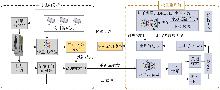
Fig. 1
Overview of proposed CL4VA
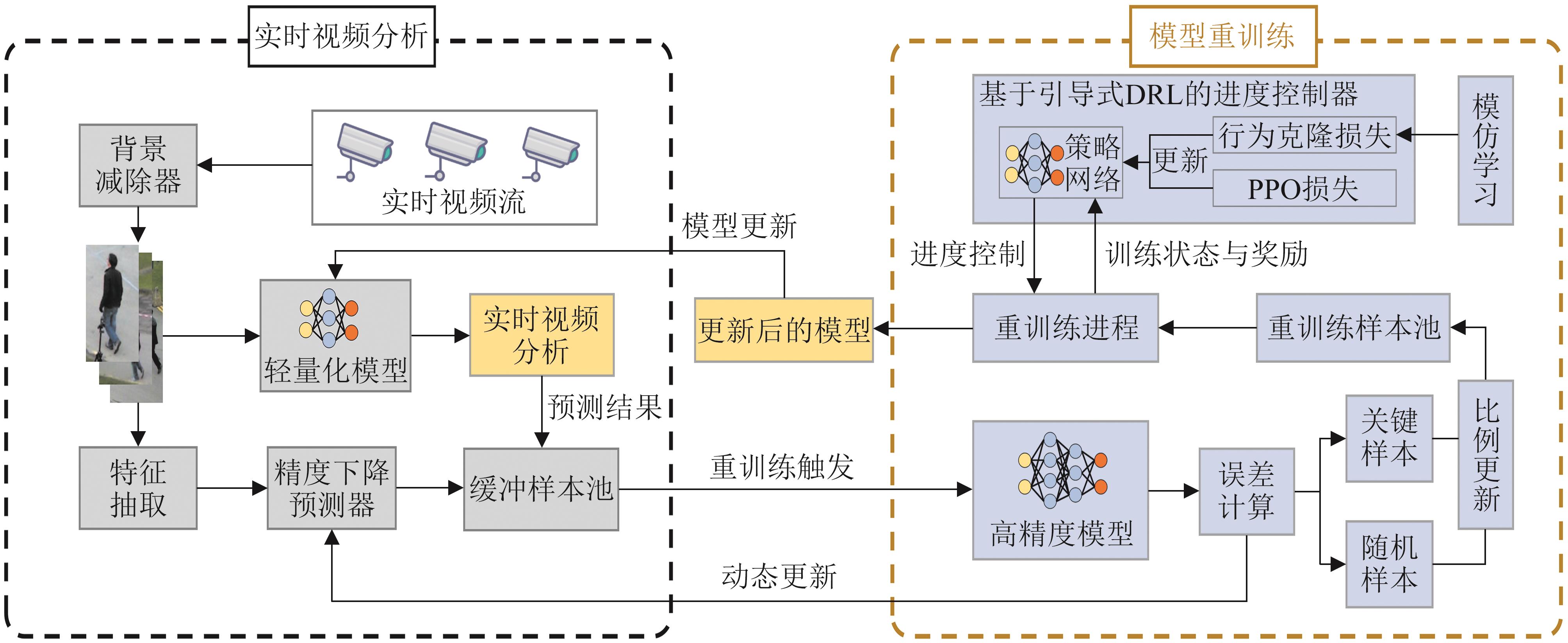
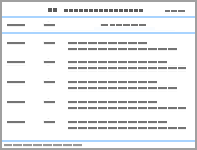
Table 1
Description of RoI features
| 特征 | 含义 | 作用 |
|---|---|---|
| area | 候选RoI面积与整帧图像面积之比 | 刻画了RoI在图像中的占比,当RoI较小或被部分遮挡时,其在低分辨率场景下容易丢失 |
| ratio | 候选RoI的外接矩形宽高比 | 描述了RoI的形态特征,反映了遮挡场景带来的比例异常 |
| circularity | RoI中所有前景轮廓平均圆形度的反值 | 反映了RoI轮廓的几何规则,在光照不均或遮挡导致轮廓断裂时,该值将升高 |
| convexity | RoI中所有前景轮廓的平均凸度 | 反映了RoI轮廓的凹陷特征,在遮挡场景下RoI轮廓会出现凹陷,导致该值下降 |
| position | 候选RoI中心点相对整帧图像中心的归一化位置 | 表示RoI在图像中的分布情况,位于边缘位置的 RoI 更容易受到拍摄角度、光照不均或遮挡的影响而难以被检测到 |
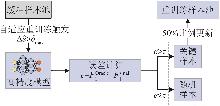
Fig. 2
Workflow of hybrid sample pool
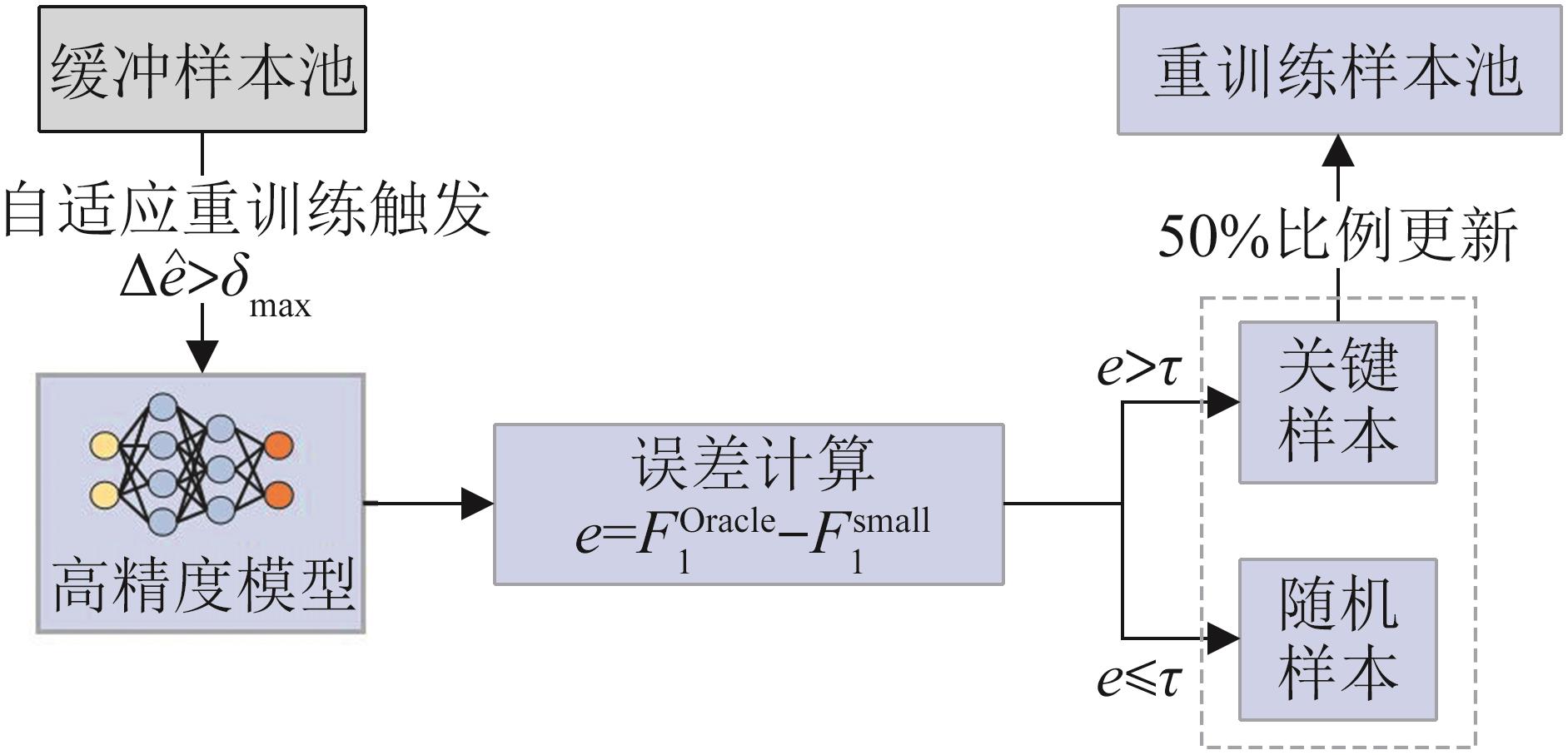
Table 2
Overall performance comparison of different methods on various datasets
| 数据集 | 指标 | Vanilla | Ekya | AdaInf | CL4VA | Oracle |
|---|---|---|---|---|---|---|
| UA-DETRAC | 延迟/ms | 19.98 | 34.48 | 35.65 | 41.42 | |
| mAp/% | 20.20 | 58.32 | 58.44 | 70.15 | ||
| BDD100K | 延迟/ms | 21.78 | 38.07 | 42.18 | 46.45 | |
| mAp/% | 28.68 | 32.46 | 33.48 | 36.50 | ||
| MOT | 延迟/ms | 16.45 | 31.24 | 29.42 | 39.20 | |
| mAp/% | 73.69 | 78.23 | 80.64 | 78.93 | ||
| Real-Camera | 延迟/ms | 17.12 | 30.74 | 30.61 | 39.89 | |
| mAp/% | 59.14 | 94.66 | 97.25 | 100 |
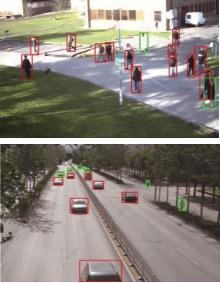
Fig. 3
Detection comparison before and after retraining lightweight model
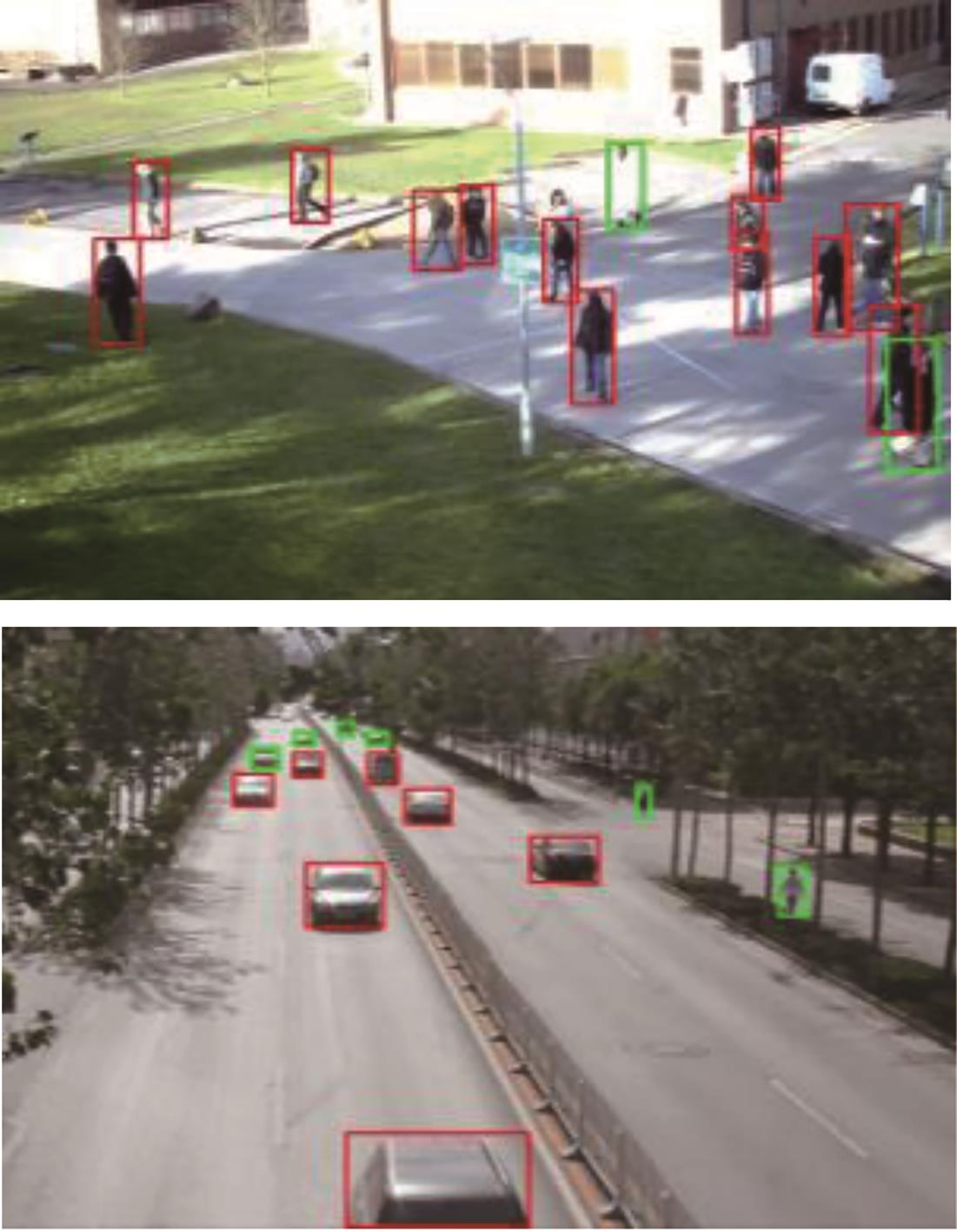
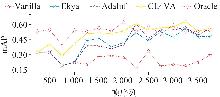
Fig. 4
Accuracy changes of different methods on video frames
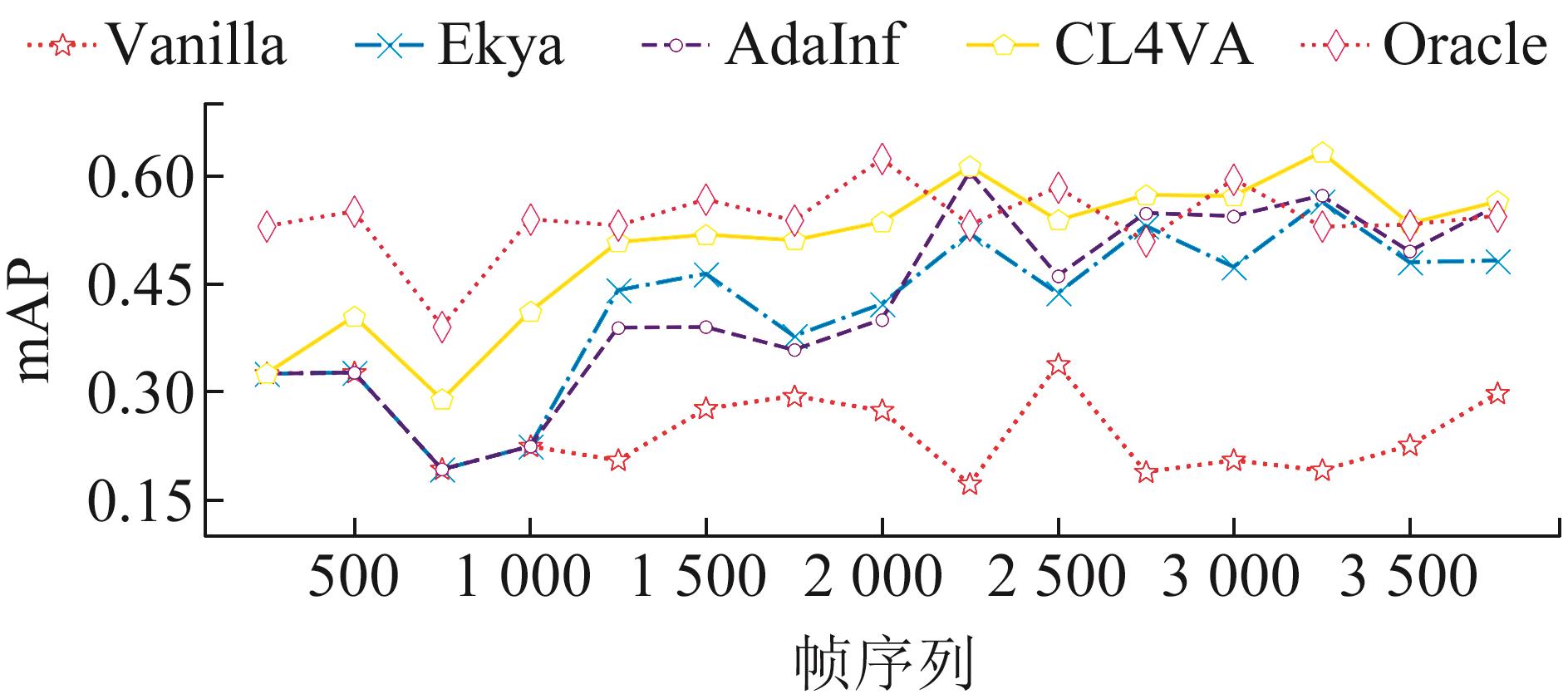
Fig. 5
Ablation experiment for core components in CL4VA
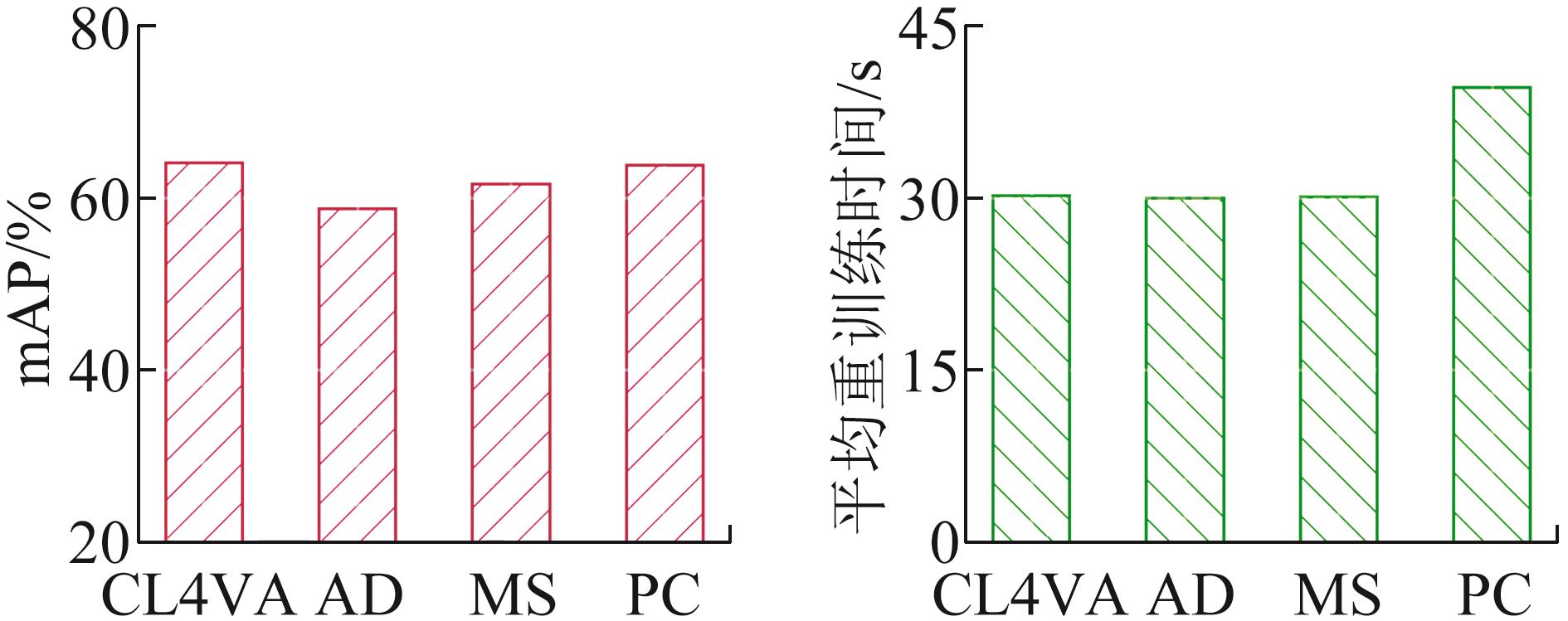
Table 3
Time overheads of core components in CL4VA ms
| RoI抽取 | RoI特征计算 | 精度下降预测 | DRL重训练 进度控制 |
|---|---|---|---|
| 8.84 | 0.42 | 0.20 | 1.50 |
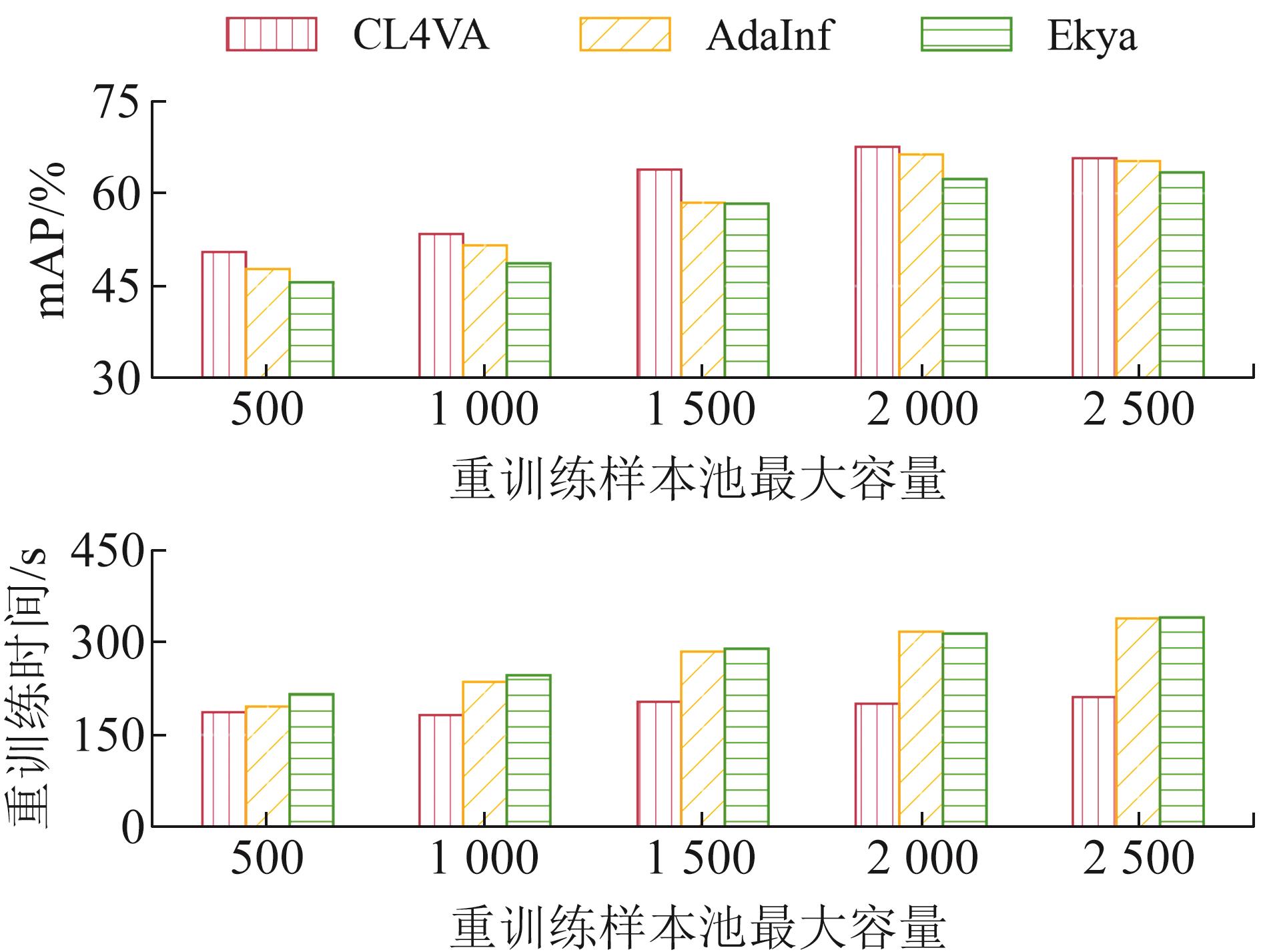
Fig. 6
Impact of maximum capacity of retraining sample pool on accuracy and retraining time
| [1] | Xu Renjie, Razavi Saiedeh, Zheng Rong. Edge Video Analytics: A Survey on Applications, Systems and Enabling Techniques[J]. IEEE Communications Surveys & Tutorials, 2023, 25(4): 2951-2982. |
| [2] | 袁牧, 张兰, 姚云昊, 等. 面向智能物联网的资源高效模型推理综述[J]. 计算机学报, 2024, 47(10): 2247-2273. |
| Yuan Mu, Zhang Lan, Yao Yunhao, et al. Resource-efficient Model Inference for AIoT: A Survey[J]. Chinese Journal of Computers, 2024, 47(10): 2247-2273. | |
| [3] | 李超, 李贾宝, 丁才昌, 等. 基于DRL的边缘监控任务卸载与资源分配算法[J]. 系统仿真学报, 2024, 36(9): 2113-2126. |
| Li Chao, Li Jiabao, Ding Caichang, et al. Edge Surveillance Task Offloading and Resource Allocation Algorithm Based on DRL[J]. Journal of System Simulation, 2024, 36(9): 2113-2126. | |
| [4] | Gao Xitong, Zhao Yiren, Dudziak Łukasz, et al. Dynamic Channel Pruning: Feature Boosting and Suppression[EB/OL]. (2019-01-28) [2025-06-12]. . |
| [5] | Banitalebi-Dehkordi Amin, Vedula Naveen, Pei Jian, et al. Auto-split: A General Framework of Collaborative Edge-cloud AI[C]//Proceedings of the 27th ACM SIGKDD Conference on Knowledge Discovery & Data Mining. New York: Association for Computing Machinery, 2021: 2543-2553. |
| [6] | Huang Kai, Gao Wei. Real-time Neural Network Inference on Extremely Weak Devices: Agile Offloading with Explainable AI[C]//Proceedings of the 28th Annual International Conference on Mobile Computing and Networking. New York: Association for Computing Machinery, 2022: 200-213. |
| [7] | Chen Gang, He Shengyu, Meng Haitao, et al. PhoneBit: Efficient GPU-accelerated Binary Neural Network Inference Engine for Mobile Phones[C]//2020 Design, Automation & Test in Europe Conference & Exhibition (DATE). Piscataway: IEEE, 2020: 786-791. |
| [8] | Chen Yuhan, Ravindranath L, Deng Shuo, et al. Glimpse: Continuous, Real-time Object Recognition on Mobile Devices[C]//Proceedings of the 13th ACM Conference on Embedded Networked Sensor Systems. New York: Association for Computing Machinery, 2015: 155-168. |
| [9] | Yuan Mu, Zhang Lan, He Fengxiang, et al. InFi: End-to-end Learnable Input Filter for Resource-efficient Mobile-centric Inference[C]//Proceedings of the 28th Annual International Conference on Mobile Computing And Networking. New York: Association for Computing Machinery, 2022: 228-241. |
| [10] | Li Yuanqi, Padmanabhan A, Zhao Pengzhan, et al. Reducto: On-camera Filtering for Resource-efficient Real-time Video Analytics[C]//Proceedings of the Annual conference of the ACM Special Interest Group on Data Communication on the applications, technologies, architectures, and protocols for computer communication. New York: Association for Computing Machinery, 2020: 359-376. |
| [11] | Ling Neiwen, Wang Kai, He Yuze, et al. RT-mDL: Supporting Real-time Mixed Deep Learning Tasks on Edge Platforms[C]//Proceedings of the 19th ACM Conference on Embedded Networked Sensor Systems. New York: Association for Computing Machinery, 2021: 1-14. |
| [12] | Jiang Shiqi, Lin Zhiqi, Li Yuanchun, et al. Flexible High-resolution Object Detection on Edge Devices with Tunable Latency[C]//Proceedings of the 27th Annual International Conference on Mobile Computing and Networking. New York: Association for Computing Machinery, 2021: 559-572. |
| [13] | Yang Zheng, Wang Xu, Wu Jiahang, et al. EdgeDuet: Tiling Small Object Detection for Edge Assisted Autonomous Mobile Vision[J]. IEEE/ACM Transactions on Networking, 2023, 31(4): 1765-1778. |
| [14] | Mullapudi R T, Chen S, Zhang Keyi, et al. Online Model Distillation for Efficient Video Inference[C]//2019 IEEE/CVF International Conference on Computer Vision (ICCV). Piscataway: IEEE, 2019: 3572-3581. |
| [15] | Khani M, Ananthanarayanan G, Hsieh K, et al. RECL: Responsive Resource-efficient Continuous Learning for Video Analytics[C]//20th USENIX Symposium on Networked Systems Design and Implementation (NSDI 23). Boston: USENIX Association, 2023: 917-932. |
| [16] | Zhang Jingwei, Cheng Long, Liu Cong, et al. Cost-aware Scheduling Systems for Real-time Workflows in Cloud: An Approach Based on Genetic Algorithm and Deep Reinforcement Learning[J]. Expert Systems with Applications, 2023, 234: 120972. |
| [17] | Cai Huaiguang, Zhou Zhi, Huang Qianyi. Online Resource Allocation for Edge Intelligence with Colocated Model Retraining and Inference[C]//IEEE INFOCOM 2024 - IEEE Conference on Computer Communications. Piscataway: IEEE, 2024: 1900-1909. |
| [18] | Kong Yuxin, Yang Peng, Cheng Yan. Edge-assisted On-device Model Update for Video Analytics in Adverse Environments[C]//Proceedings of the 31st ACM International Conference on Multimedia. New York: Association for Computing Machinery, 2023: 9051-9060. |
| [19] | Shubha S S, Shen Haiying. AdaInf: Data Drift Adaptive Scheduling for Accurate and SLO-guaranteed Multiple-model Inference Serving at Edge Servers[C]//Proceedings of the ACM SIGCOMM 2023 Conference. New York: Association for Computing Machinery, 2023: 473-485. |
| [20] | Zhang Ziyang, Zhao Yang, Chang Mingching, et al . E 4: Energy-efficient DNN Inference for Edge Video Analytics Via Early Exiting and DVFS[C]//Proceedings of the Thirty-ninth AAAI Conference on Artificial Intelligence and Thirty-seventh Conference on Innovative Applications of Artificial Intelligence and Fifteenth Symposium on Educational Advances in Artificial Intelligence. Palo Alto: AAAI Press, 2025: 1165-1173. |
| [21] | Wang Liang, Qu Xiaoyang, Wang Jianzong, et al. Gecko: Resource-efficient and Accurate Queries in Real-time Video Streams at the Edge[C]//IEEE INFOCOM 2024 - IEEE Conference on Computer Communications. Piscataway: IEEE, 2024: 481-490. |
| [22] | Bhardwaj R, Xia Zhengxu, Ananthanarayanan G, et al. Ekya: Continuous Learning of Video Analytics Models on Edge Compute Servers[C]//19th USENIX Symposium on Networked Systems Design and Implementation (NSDI 22). Renton: USENIX Association, 2022: 119-135. |
| [23] | Schulman J, Wolski F, Dhariwal P, et al. Proximal Policy Optimization Algorithms[EB/OL]. (2017-08-28) [2025-06-12]. . |
| [24] | Zeng Xiao, Fang Biyi, Shen Haichen, et al. Distream: Scaling Live Video Analytics with Workload-adaptive Distributed Edge Intelligence[C]//Proceedings of the 18th Conference on Embedded Networked Sensor Systems. New York: Association for Computing Machinery, 2020: 409-421. |
| [25] | Huang Wenhui, Zhou Yanxin, He Xiangkun, et al. Goal-guided Transformer-enabled Reinforcement Learning for Efficient Autonomous Navigation[J]. IEEE Transactions on Intelligent Transportation Systems, 2024, 25(2): 1832-1845. |
| [26] | Leal-Taixé Laura, Milan A, Reid I, et al. MOTChallenge 2015: Towards a Benchmark for Multi-Target Tracking[EB/OL]. (2015-04-08) [2025-06-12]. . |
| [27] | Yu F, Chen Haofeng, Wang Xin, et al. BDD100K: A Diverse Driving Dataset for Heterogeneous Multitask Learning[C]//2020 IEEE/CVF Conference on Computer Vision and Pattern Recognition (CVPR). Piscataway: IEEE, 2020: 2633-2642. |
| [28] | Wen Longyin, Du Dawei, Cai Zhaowei, et al. UA-DETRAC: A New Benchmark and Protocol for Multi-object Detection and Tracking[J]. Computer Vision and Image Understanding, 2020, 193: 102907. |
| [1] | Wang Bingkun, Wang Yue, Yang Mei, Zhang Pengnian, Fan Bohao, Tang Jie. Strike Strategy Planning Method of Unmanned Ground Vehicles Based on Improved PPO Algorithm [J]. Journal of System Simulation, 2026, 38(2): 372-386. |
| [2] | Liu Quan, Wang Yu, Liu Linyue, Chen Hao, Huang Jian. Knowledge Closed-loop Driving-based Intelligent Game Confrontation Simulation [J]. Journal of System Simulation, 2026, 38(2): 416-432. |
| [3] | Wang Ziyi, Zhang Kai, Qian Dianwei, Liu Yuzhen. A DRL⁃based Approach for Distributed Equipment Nodes Selection [J]. Journal of System Simulation, 2025, 37(6): 1565-1573. |
| [4] | Zhang Sen, Dai Qiangqiang. UAV Path Planning Based on Improved Deep Deterministic Policy Gradients [J]. Journal of System Simulation, 2025, 37(4): 875-881. |
| [5] | Li Min, Zhang Sen, Zeng Xiangguang, Wang Gang, Zhang Tongwei, Xie Dijie, Ren Wenzhe, Zhang Tao. Trajectory Planning of Quadruped Robot Over Obstacle with Single Leg Based on Deep Reinforcement Learning [J]. Journal of System Simulation, 2025, 37(4): 895-909. |
| [6] | Wang He, Xu Jianing, Yan Guangyu. Research on Pedestrian Avoidance Strategy for AGV Based on Deep Reinforcement Learning [J]. Journal of System Simulation, 2025, 37(3): 595-606. |
| [7] | Zhang Bin, Lei Yonglin, Li Qun, Gao Yuan, Chen Yong, Zhu Jiajun, Bao Chenlong. Reinforcement Learning Modeling of Missile Penetration Decision Based on Combat Simulation [J]. Journal of System Simulation, 2025, 37(3): 763-774. |
| [8] | Huang Sijin, Wen Jia, Chen Zheyi. Intelligent Service Migration towards MEC-based IoV Systems [J]. Journal of System Simulation, 2025, 37(2): 379-391. |
| [9] | Fei Shuaidi, Cai Changlong, Liu Fei, Chen Minghui, Liu Xiaoming. Research on the Target Allocation Method for Air Defense and Anti-missile Defense of Naval Ships [J]. Journal of System Simulation, 2025, 37(2): 508-516. |
| [10] | Zheng Jiayu, Mai Zhuxue, Chen Zheyi. Optimization of Service Caching and Computation Offloading in Digital Twin Cloud-edge Networks [J]. Journal of System Simulation, 2025, 37(11): 2741-2753. |
| [11] | Huang Zhiqin, Lu Tianying, Chen Zheyi. Multi-UAV Deployment and Collaborative Offloading for Large-scale IoT Systems [J]. Journal of System Simulation, 2025, 37(1): 25-39. |
| [12] | Li Chao, Li Jiabao, Ding Caichang, Ye Zhiwei, Zuo Fangwei. Edge Surveillance Task Offloading and Resource Allocation Algorithm Based on DRL [J]. Journal of System Simulation, 2024, 36(9): 2113-2126. |
| [13] | Zhu Zilu, Liu Yongkui, Zhang Lin, Wang Lihui, Lin Tingyu. Simulation of Robotic Peg-in-hole Assembly Strategy Based on DRL [J]. Journal of System Simulation, 2024, 36(6): 1414-1424. |
| [14] | Wang Hongjun, Lin Junqiang, Zou Xiangjun, Zhang Po, Zhou Mingxuan, Zou Weirui, Tang Yunchao, Luo Lufeng. Construction of a Virtual Interactive System for Orchards Based on Digital Twin [J]. Journal of System Simulation, 2024, 36(6): 1493-1508. |
| [15] | Wang Yuan, Xu Lin, Gong Xiaoze, Zhang Yongliang, Wang Yongli. Gradient-based Deep Reinforcement Learning Interpretation Methods [J]. Journal of System Simulation, 2024, 36(5): 1130-1140. |
| Viewed | ||||||
|
Full text |
|
|||||
|
Abstract |
|
|||||
 http://www.china-simulation.com

