

Journal of System Simulation ›› 2026, Vol. 38 ›› Issue (9): 2486-2501.doi: 10.16182/j.issn1004731x.joss.26-0013
• Special Column : System Simulation for Autonomous Driving and Intelligent Transportation • Previous Articles
Cheng Guozhu1, Wang Changyuan1, Wang Wenzhi1, Zhang Yifan1, Feng Tianjun2
Received:2026-01-06
Revised:2026-04-04
Online:2026-09-30
Published:2026-10-02
CLC Number:
Cheng Guozhu, Wang Changyuan, Wang Wenzhi, Zhang Yifan, Feng Tianjun. Vehicle Cross-modal Trajectory Prediction Model Based on Driving Style Hypergraphs[J]. Journal of System Simulation, 2026, 38(9): 2486-2501.
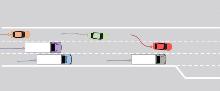
Fig. 1
Schematic diagram of the scene
Fig. 2
SDHT-SCMI vehicle trajectory prediction model
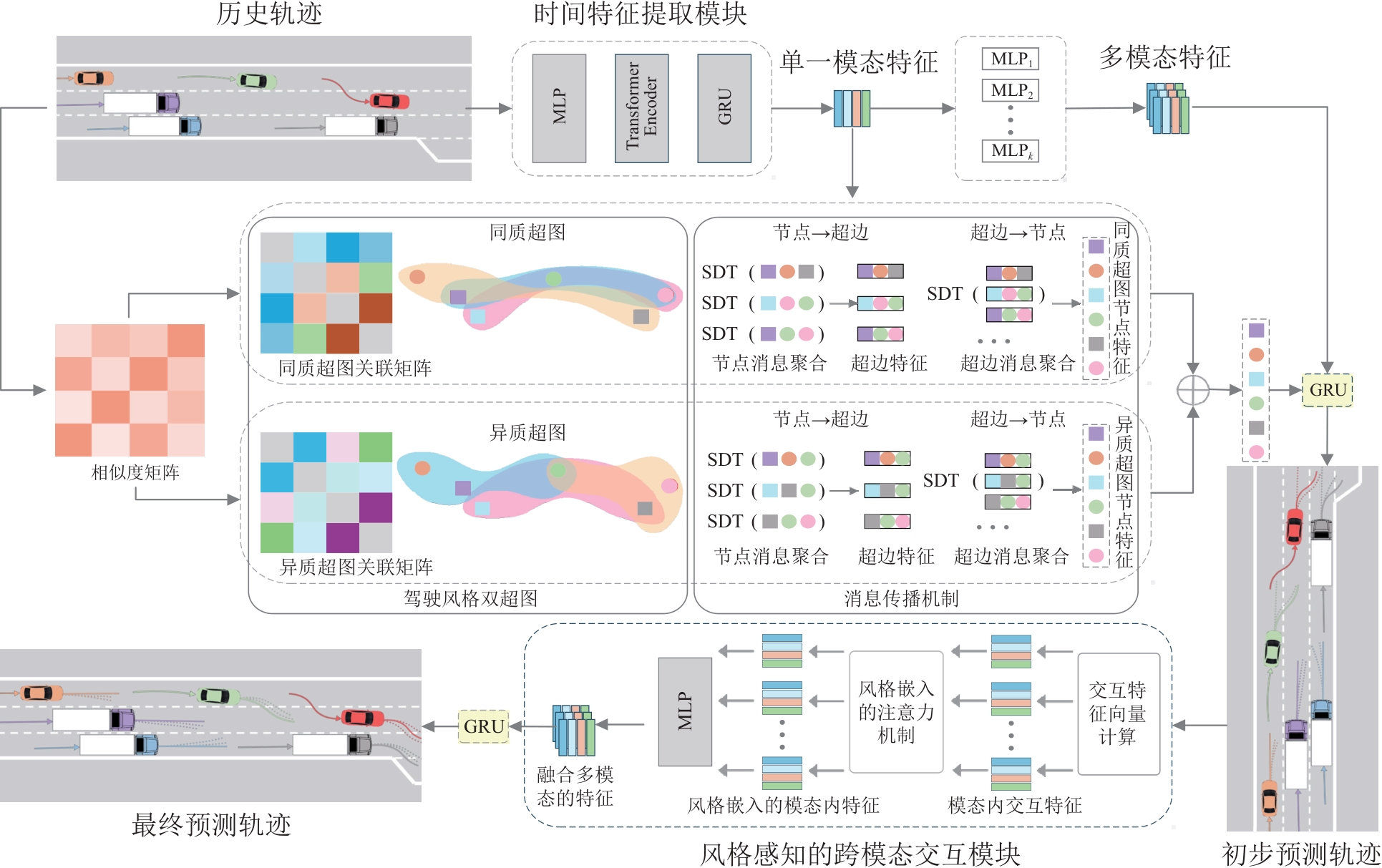
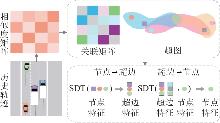
Fig. 3
Driving style bipartite hypergraph Transformer framework diagram
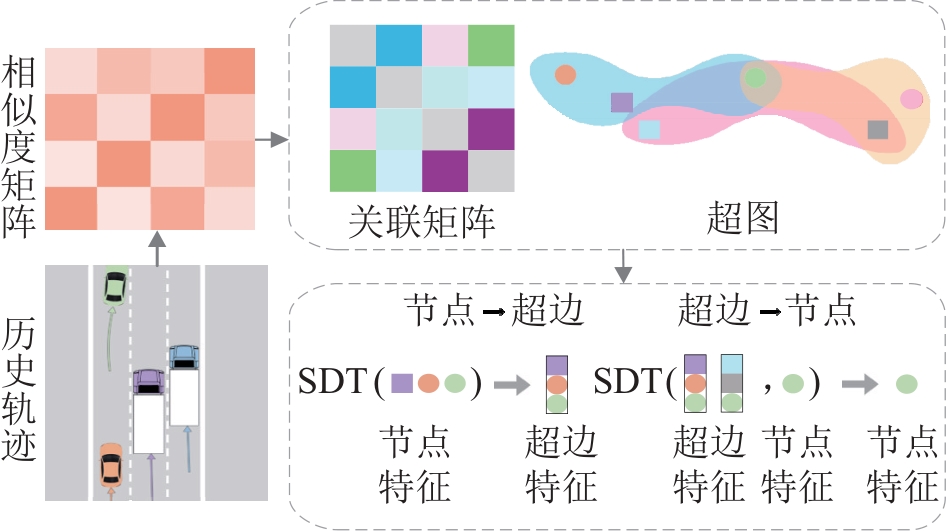
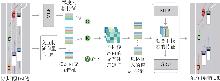
Fig. 4
Cross-modal interaction module for style perception
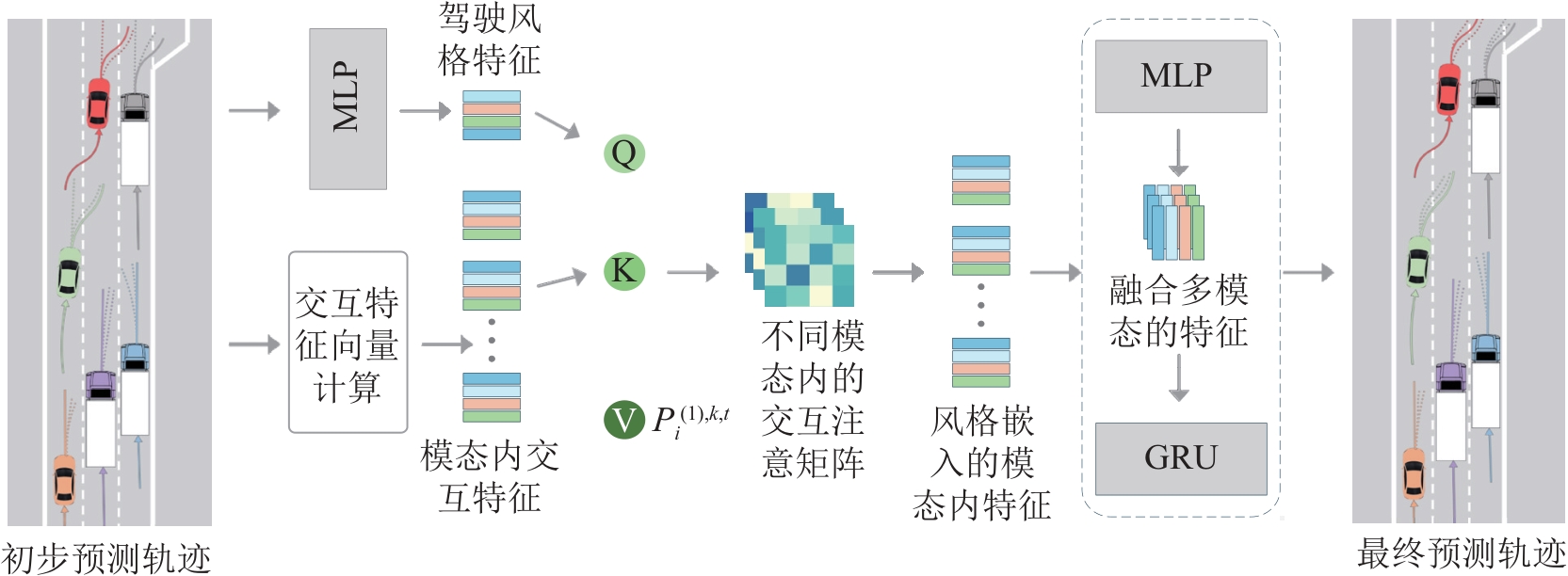
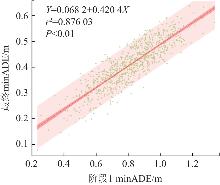
Fig. 5
Analysis of error propagation in a two-stage prediction architecture
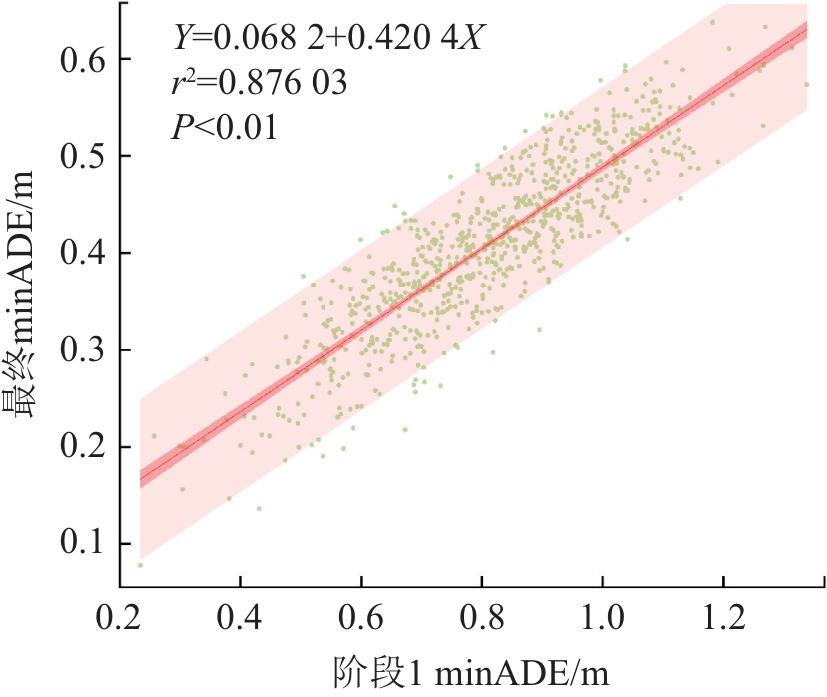

Table 1
Ablation results on HighD dataset
| 实验 | SDHT | SCMI | 指标 | ||||
|---|---|---|---|---|---|---|---|
| 同质超图 | 异质超图 | 跨模态交互 | 风格调制 | RMSE/m | ADE/m | FDE/m | |
| Exp-0 | × | × | × | × | 2.31 | 0.85 | 1.56 |
| Exp-1 | √ | × | × | × | 1.98 | 0.76 | 1.39 |
| Exp-2 | × | √ | × | × | 1.96 | 0.77 | 1.38 |
| Exp-3 | √ | √ | × | × | 1.92 | 0.73 | 1.29 |
| Exp-4 | × | × | √ | √ | 1.91 | 0.74 | 1.25 |
| Exp-5 | √ | × | √ | √ | 1.77 | 0.68 | 1.16 |
| Exp-6 | √ | √ | × | √ | 1.78 | 0.67 | 1.17 |
| Exp-7 | √ | √ | √ | × | 1.75 | 0.67 | 1.14 |
| Exp-8 | √ | √ | √ | √ | 1.69 | 0.64 | 1.09 |
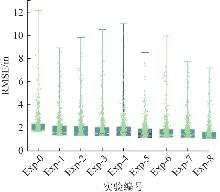
Fig. 6
Distribution of errors in the ablation experiment
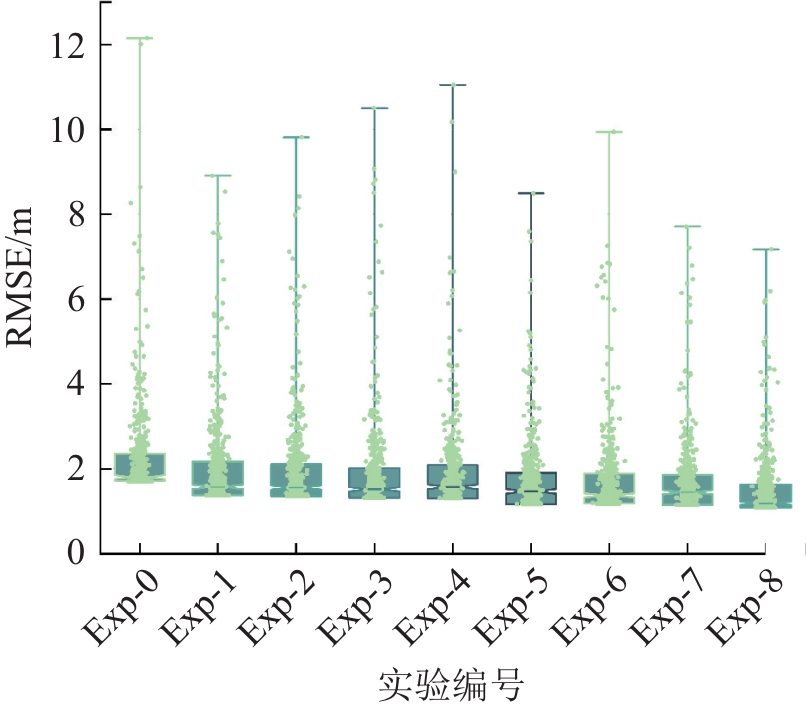
Table 2
Effect of different maximum hyperedge sizes on model performance
| RMSE/m | ADE/m | FDE/m | 推理时间/ms | ||
|---|---|---|---|---|---|
| 4 | 3.2 | 1.74 | 0.66 | 1.13 | 21 |
| 6 | 4.7 | 1.66 | 0.63 | 1.05 | 25 |
| 8 | 5.8 | 1.70 | 0.65 | 1.11 | 30 |
| 10 | 6.5 | 1.72 | 0.66 | 1.14 | 36 |
Table 3
Comparison of 1~5 s trajectory prediction performance on HighD dataset
| 预测时长 | 指标 | NLS-LSTM | GRIP | TS-GAN | DRBP | HTPF | IPF-GCN | SDHT-SCMI |
|---|---|---|---|---|---|---|---|---|
| 1 s | RMSE | 0.23 | 0.29 | 0.24 | 0.41 | 0.17 | 0.26 | 0.22 |
| ADE | 0.10 | 0.13 | 0.11 | 0.06 | 0.05 | |||
| FDE | 0.18 | 0.22 | 0.19 | 0.11 | 0.09 | |||
| 2 s | RMSE | 0.60 | 0.68 | 0.62 | 0.79 | 0.43 | 0.51 | 0.49 |
| ADE | 0.22 | 0.25 | 0.23 | 0.14 | 0.13 | |||
| FDE | 0.45 | 0.50 | 0.47 | 0.29 | 0.27 | |||
| 3 s | RMSE | 1.13 | 1.23 | 1.17 | 1.11 | 0.87 | 0.77 | 0.75 |
| ADE | 0.3 | 0.41 | 0.39 | 0.23 | 0.21 | |||
| FDE | 0.83 | 0.89 | 0.87 | 0.46 | 0.44 | |||
| 4 s | RMSE | 1.84 | 1.95 | 1.88 | 1.40 | 1.53 | 1.09 | 1.08 |
| ADE | 0.56 | 0.61 | 0.58 | 0.35 | 0.35 | |||
| FDE | 1.33 | 1.40 | 1.38 | 0.79 | 0.78 | |||
| 5 s | RMSE | 2.72 | 2.87 | 2.76 | 2.36 | 1.68 | 1.69 | |
| ADE | 0.78 | 0.84 | 0.81 | 0.64 | 0.64 | |||
| FDE | 1.93 | 2.03 | 1.99 | 1.07 | 1.09 | |||
| 平均RMSE | 1.30 | 1.40 | 1.33 | 0.93 | 1.07 | 0.86 | 0.85 | |
Table 4
Comparison of RMSE for 1~5 s trajectory prediction on ExiD dataset
| 预测时长 | 模型 | |||
|---|---|---|---|---|
| MMnTP | POVL | IPF-GCN | SDHT-SCMI | |
| 平均RMSE | 1.08 | 0.86 | 0.77 | 0.75 |
| 1 s | 0.26 | 0.17 | 0.17 | 0.15 |
| 2 s | 0.57 | 0.41 | 0.32 | 0.29 |
| 3 s | 0.98 | 0.76 | 0.59 | 0.57 |
| 4 s | 1.50 | 1.21 | 1.10 | 1.07 |
| 5 s | 2.11 | 1.75 | 1.66 | 1.66 |
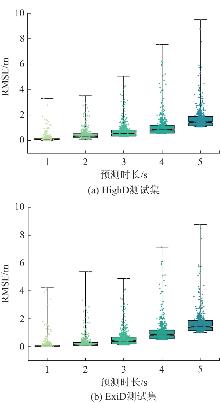
Fig. 7
Distribution of trajectory prediction errors of the model on the test set
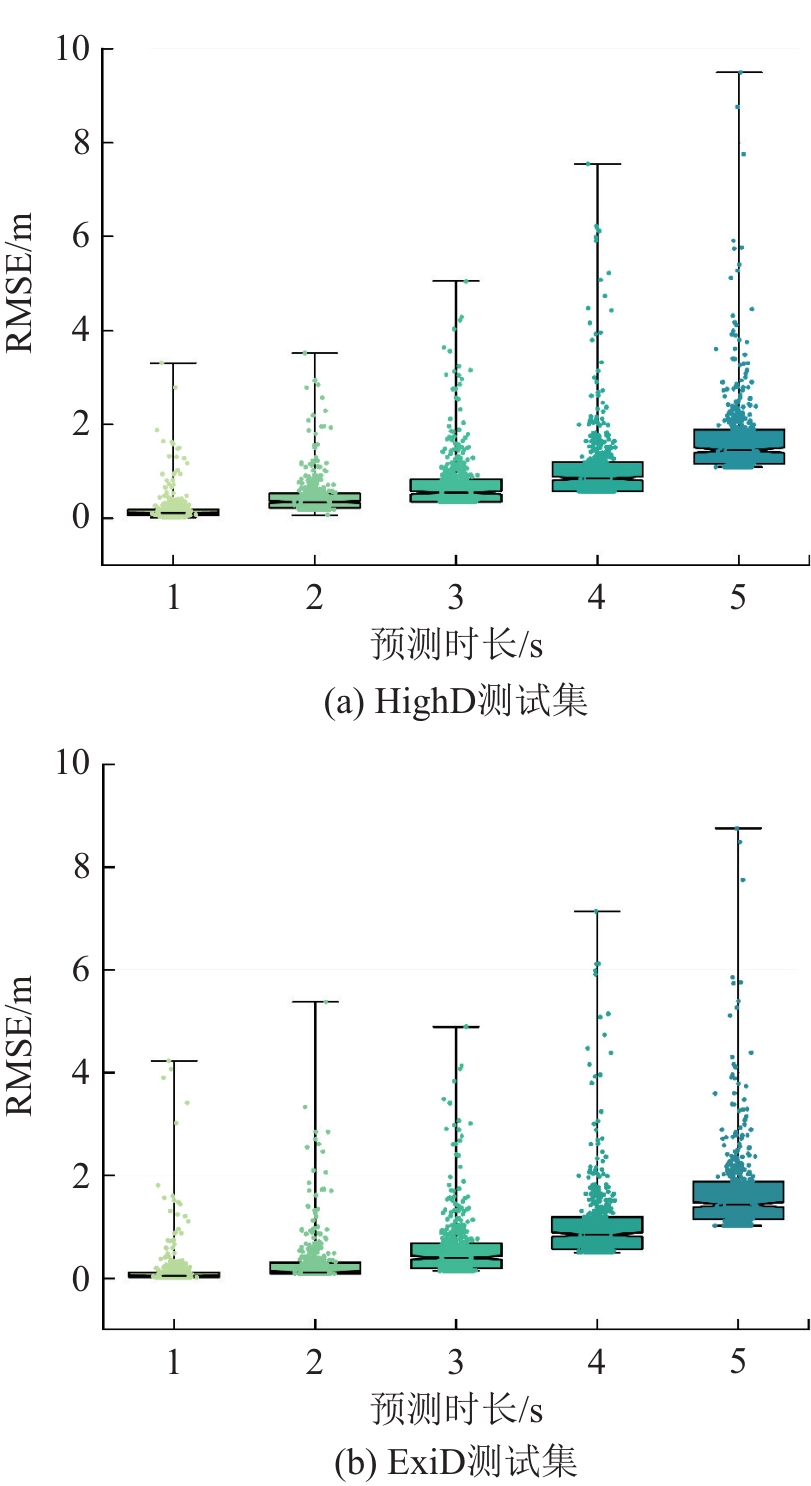
Fig. 8
Visualization results under three operating conditions
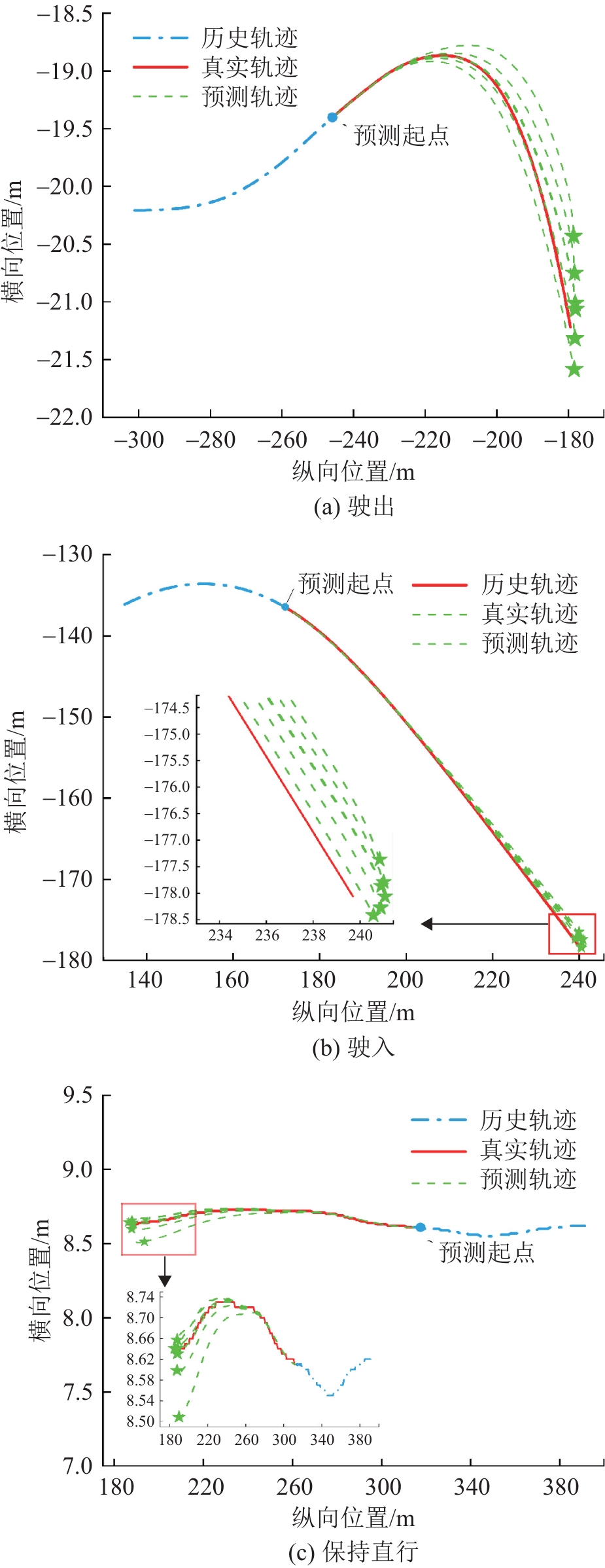
Fig. 9
Distribution of attention weights and inter-vehicle distances across different driving style clusters
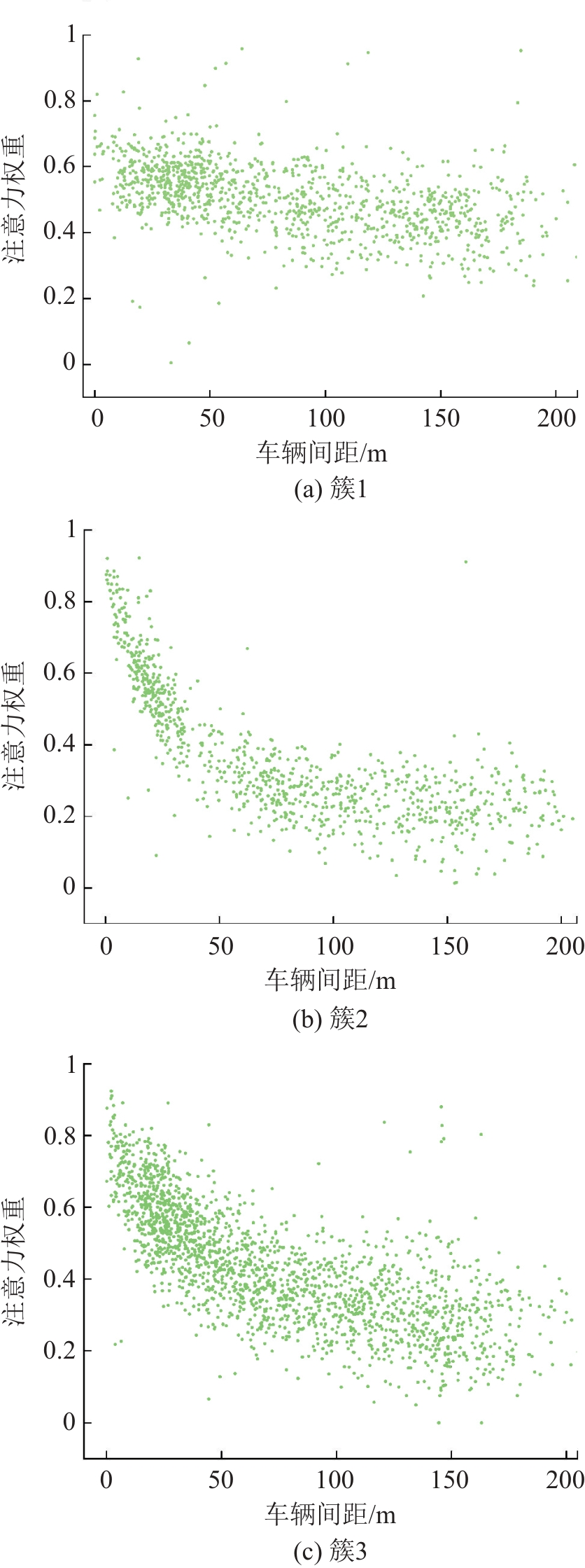
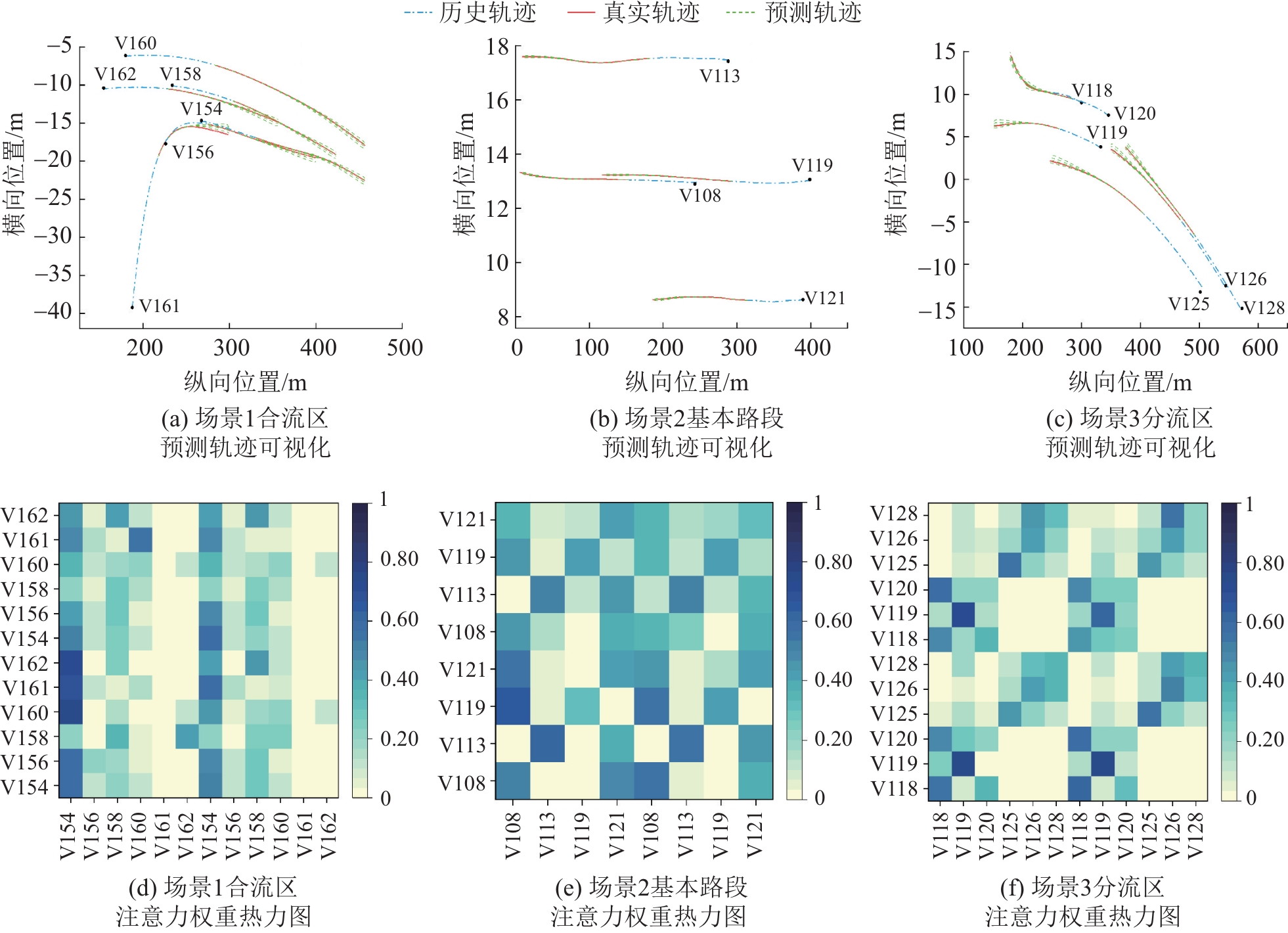
Fig. 10
Visualization results on ExiD and HighD test sets
| [1] | Yurtsever Ekim, Lambert Jacob, Carballo Alexander, et al. A Survey of Autonomous Driving: Common Practices and Emerging Technologies[J]. IEEE Access, 2020, 8: 58443-58469. |
| [2] | Zyner Alex, Worrall Stewart, Nebot Eduardo. Naturalistic Driver Intention and Path Prediction Using Recurrent Neural Networks[J]. IEEE Transactions on Intelligent Transportation Systems, 2020, 21(4): 1584-1594. |
| [3] | 方华珍, 刘立, 肖小凤, 等. 混合示教长短时记忆网络的车辆轨迹预测研究[J]. 交通运输系统工程与信息, 2023, 23(4): 80-87. |
| Fang Huazhen, Liu Li, Xiao Xiaofeng, et al. Vehicle Trajectory Prediction Based on Mixed Teaching Force Long Short-term Memory[J]. Journal of Transportation Systems Engineering and Information Technology, 2023, 23(4): 80-87. | |
| [4] | Lian Jing, Li Shuoxian, Yang Dongfang, et al. Encoding the Intrinsic Interaction Information for Vehicle Trajectory Prediction[J]. IEEE Transactions on Intelligent Vehicles, 2024, 9(1): 2600-2611. |
| [5] | Djamel Eddine Benrachou, Glaser Sebastien, Elhenawy Mohammed, et al. Graph-based Spatial-temporal Attentive Network for Vehicle Trajectory Prediction in Automated Driving[J]. IEEE Transactions on Intelligent Transportation Systems, 2025, 26(9): 13109-13130. |
| [6] | Jia Xiaosong, Wu Penghao, Chen Li, et al. HDGT: Heterogeneous Driving Graph Transformer for Multi-agent Trajectory Prediction via Scene Encoding[J]. IEEE Transactions on Pattern Analysis and Machine Intelligence, 2023, 45(11): 13860-13875. |
| [7] | 温惠英, 张昕怡, 黄俊达, 等. 考虑动态交互作用的智能车辆轨迹预测[J]. 交通运输系统工程与信息, 2024, 24(4): 60-68. |
| Wen Huiying, Zhang Xinyi, Huang Junda, et al. Intelligent Vehicle Trajectory Prediction Considering Dynamic Interactions[J]. Journal of Transportation Systems Engineering and Information Technology, 2024, 24(4): 60-68. | |
| [8] | 陈峥, 张景, 陈博闻, 等. 基于异构多图时空融合的长时域车辆轨迹预测[J]. 交通运输系统工程与信息, 2025, 25(4): 126-136. |
| Chen Zheng, Zhang Jing, Chen Bowen, et al. Heterogeneous Multi-graph Spatiotemporal Fusion for Long-term Vehicle Trajectory Forecasting[J]. Journal of Transportation Systems Engineering and Information Technology, 2025, 25(4): 126-136. | |
| [9] | Mo Xiaoyu, Liu Haochen, Huang Zhiyu, et al. Map-adaptive Multimodal Trajectory Prediction via Intention-aware Unimodal Trajectory Predictors[J]. IEEE Transactions on Intelligent Transportation Systems, 2024, 25(6): 5651-5663. |
| [10] | Xu Da, Nengchao Lü, Yang Liu. A Proactive Risk Prediction Framework for Cut-in Maneuvers Incorporating Inherent Driving Styles[J]. IEEE Transactions on Intelligent Transportation Systems, 2025, 26(12): 23084-23099. |
| [11] | Yang Jiayu, Jaeyoung Jay Lee, Antoniou Constantinos. Trajectory Prediction for Multiple Agents in Dynamic Environments: Factoring in Traffic States and Driving Styles[J]. IEEE Transactions on Intelligent Transportation Systems, 2025, 26(11): 19281-19295. |
| [12] | Li Xiang, Yang Bo, Zeng Xianming, et al. StyleFormer: Multi-agent Joint Trajectory Prediction and Planning in Urban Environments with Driving Style Awareness[J]. IEEE Transactions on Intelligent Transportation Systems, 2025, 26(11): 20317-20333. |
| [13] | Wang Yifan. Personalized Trajectory Inference Framework Integrating Driving Behavior Recognition and Temporal Dependency Learning[C]//2025 5th International Conference on Artificial Intelligence and Industrial Technology Applications (AIITA). Piscataway: IEEE, 2025: 1991-1997. |
| [14] | Zhang Qixiang, Xing Yang, Wang Jinxiang, et al. Interaction-aware and Driving Style-aware Trajectory Prediction for Heterogeneous Vehicles in Mixed Traffic Environment[J]. IEEE Transactions on Intelligent Transportation Systems, 2025, 26(7): 10710-10724. |
| [15] | Zhou Xiangzheng, Chen Xiaobo, Yang Jian. Heterogeneous Hypergraph Transformer Network with Cross-modal Future Interaction for Multi-agent Trajectory Prediction[J]. Engineering Applications of Artificial Intelligence, 2025, 144: 110125. |
| [16] | Qiu Mingming, Yu Wei, Wang Lei, et al. A Regenerative Braking Control Strategy for ICVs Considering the Coupling Effect of Driving Conditions and Driving Styles[J]. IEEE Transactions on Vehicular Technology, 2023, 72(6): 7195-7210. |
| [17] | Makansi Osama, Ilg Eddy, Çiçek Özgün, et al. Overcoming Limitations of Mixture Density Networks: A Sampling and Fitting Framework for Multimodal Future Prediction[C]//2019 IEEE/CVF Conference on Computer Vision and Pattern Recognition (CVPR). Piscataway: IEEE, 2019: 7137-7146. |
| [18] | Krajewski Robert, Bock Julian, Kloeker Laurent, et al. The HighD Dataset: A Drone Dataset of Naturalistic Vehicle Trajectories on German Highways for Validation of Highly Automated Driving Systems[C]//2018 21st International Conference on Intelligent Transportation Systems (ITSC). Piscataway: IEEE, 2018: 2118-2125. |
| [19] | Moers Tobias, Vater Lennart, Krajewski Robert, et al. The ExiD Dataset: A Real-world Trajectory Dataset of Highly Interactive Highway Scenarios in Germany[C]//2022 IEEE Intelligent Vehicles Symposium (IV). Piscataway: IEEE, 2022: 958-964. |
| [20] | Wang Jiaqin, Liu Kai, Li Hantao. LSTM-based Graph Attention Network for Vehicle Trajectory Prediction[J]. Computer Networks, 2024, 248: 110477. |
| [21] | Messaoud Kaouther, Yahiaoui Itheri, Verroust-Blondet Anne, et al. Non-local Social Pooling for Vehicle Trajectory Prediction[C]//2019 IEEE Intelligent Vehicles Symposium (IV). Piscataway: IEEE, 2019: 975-980. |
| [22] | Li Xin, Ying Xiaowen, Mooi Choo Chuah. GRIP: Graph-based Interaction-aware Trajectory Prediction[C]//2019 IEEE Intelligent Transportation Systems Conference (ITSC). Piscataway: IEEE, 2019: 3960-3966. |
| [23] | Wang Yu, Zhao Shengjie, Zhang Rongqing, et al. Multi-vehicle Collaborative Learning for Trajectory Prediction with Spatio-temporal Tensor Fusion[J]. IEEE Transactions on Intelligent Transportation Systems, 2022, 23(1): 236-248. |
| [24] | Gao Kai, Li Xunhao, Chen Bin, et al. Dual Transformer Based Prediction for Lane Change Intentions and Trajectories in Mixed Traffic Environment[J]. IEEE Transactions on Intelligent Transportation Systems, 2023, 24(6): 6203-6216. |
| [25] | Wang Mingqiang, Zhang Lei, Chen Jun, et al. A Hybrid Trajectory Prediction Framework for Automated Vehicles with Attention Mechanisms[J]. IEEE Transactions on Transportation Electrification, 2024, 10(3): 6178-6194. |
| [26] | Li Yajin, Wang Shu, Zhao Xuan, et al. IPF-GCN: A Graph Convolutional Network Based on the Interaction Potential Field for Multi-vehicle Trajectory Prediction[J]. Physica a: Statistical Mechanics and Its Applications, 2025, 667: 130583. |
| [27] | Mozaffari S, Sormoli M A, Koufos K, et al. Multimodal Manoeuvre and Trajectory Prediction for Automated Driving on Highways Using Transformer Networks[J]. IEEE Robotics and Automation Letters, 2023, 8(10): 6123-6130. |
| [28] | Mozaffari S, Sormoli M A, Koufos K, et al. Trajectory Prediction with Observations of Variable-length for Motion Planning in Highway Merging Scenarios[C]//2023 IEEE 26th International Conference on Intelligent Transportation Systems (ITSC). Piscataway: IEEE, 2023: 5633-5640. |
| [1] | Xu Haoran, Huang Zhiqin, Hu Youwu, Chen Zheyi. Trajectory-aware Dynamic Offloading for High-mobility Vehicular Edge Systems [J]. Journal of System Simulation, 2026, 38(7): 1935-1949. |
| [2] | Yang Yongqi, Wang Cong, Zhang Hongli, Ma Ping, Meng Yue, Zhou Tianhao. Adaptive Spatiotemporal Graph Neural Network-based Net Load Forecasting for Residential Areas [J]. Journal of System Simulation, 2026, 38(7): 2007-2019. |
| [3] | Zhang Kun, Qian Jiajie, Ma Shuhong, Zhao Zengxu, Pan Yuchen, Tang Yaoqi. Research on Optimization Modeling Method for Eye Tracking in Solfeggio Cognitive Simulation [J]. Journal of System Simulation, 2026, 38(6): 1749-1760. |
| [4] | Mei Huawei, Yang Penghui, Yu Yang. Ultra-short-term Photovoltaic Power Prediction Based on Improved PatchTST Considering Data Drift [J]. Journal of System Simulation, 2026, 38(5): 1239-1254. |
| [5] | Tao Ye, Tang Jinhui, Zhou Chen, Wang Chong. Research on Completion Method for Trajectory Based on Image Representation and Collaborative Feature Perception [J]. Journal of System Simulation, 2026, 38(5): 1333-1349. |
| [6] | Zhang Ziyao, Ji Yunfeng. Simulation of Robotic Arm Ball-catching Strategy Based on Curriculum RL of Transformer [J]. Journal of System Simulation, 2026, 38(2): 321-331. |
| [7] | Zou Jing, Tan Xu, Mao Junji, Gao Haidong, Tan Jianrong. Defect Detection Method Based on Hierarchical Microscopic Feature Modeling and Simulation [J]. Journal of System Simulation, 2026, 38(1): 1-13. |
| [8] | Zou Changjun, Ge Zhiyu, Zhong Chenxi. Spatio-temporal Swin Transformer-based Flow-solid Coupling Interaction Sequence Image Prediction Network [J]. Journal of System Simulation, 2026, 38(1): 112-124. |
| [9] | Zhang Shuozhe, Song Wenfeng, Hou Xia, Li Shuai. Full-body Co-speech Gesture Generation Based on Spatial-temporal Enhanced Generation Model [J]. Journal of System Simulation, 2026, 38(1): 211-224. |
| [10] | Yang Xiujian, Huang Jingjing, Wang Xi. Modeling and Simulation of Hybrid Traffic Flow Considering the Inherent Dynamics of CACC Vehicular Platoons [J]. Journal of System Simulation, 2025, 37(6): 1388-1399. |
| [11] | Xu Ming, Li Jinye, Zuo Dongyu, Zhang Jing. Signal Timing Optimization via Reinforcement Learning with Traffic Flow Prediction [J]. Journal of System Simulation, 2025, 37(4): 1051-1062. |
| [12] | Jiang Lun, Wang Dajiang, Sun Wenlei, Bao Shenghui, Liu Han, Chang Saike. Research on Transformer Fault Diagnosis Method Based on Digital Twin [J]. Journal of System Simulation, 2025, 37(3): 775-790. |
| [13] | Gu Hao, Wang Jiayu, Xiong Weili. Soft Sensor Modeling Based on Improved Transformer in Dual-stream Framework [J]. Journal of System Simulation, 2025, 37(10): 2594-2604. |
| [14] | Li Dongxue, Liu Yan, Shen Boyao, Jing Yongteng, Ma Qiang, Liu Ran. Carbon Footprint Analysis and Low-carbon Optimization Method Simulation Study of Power Transformer Based on Digital Twin Technology [J]. Journal of System Simulation, 2024, 36(9): 2075-2085. |
| [15] | Liu Peijin, Fu Xuefeng, Sun Haofeng, He Lin, Liu Shujie. A Highly Robust Target Tracking Algorithm Merging CNN and Transformer [J]. Journal of System Simulation, 2024, 36(8): 1854-1868. |
| Viewed | ||||||
|
Full text |
|
|||||
|
Abstract |
|
|||||
 http://www.china-simulation.com

