

Journal of System Simulation ›› 2026, Vol. 38 ›› Issue (7): 1935-1949.doi: 10.16182/j.issn1004731x.joss.25-0844
• Papers • Previous Articles Next Articles
Xu Haoran1,2,3, Huang Zhiqin1,2,3, Hu Youwu1,2,3, Chen Zheyi1,2,3
Received:2025-09-03
Revised:2026-01-10
Online:2026-07-28
Published:2026-07-31
Contact:
Chen Zheyi
CLC Number:
Xu Haoran, Huang Zhiqin, Hu Youwu, Chen Zheyi. Trajectory-aware Dynamic Offloading for High-mobility Vehicular Edge Systems[J]. Journal of System Simulation, 2026, 38(7): 1935-1949.
Fig. 1
Trajectory-aware offloading system for VEC
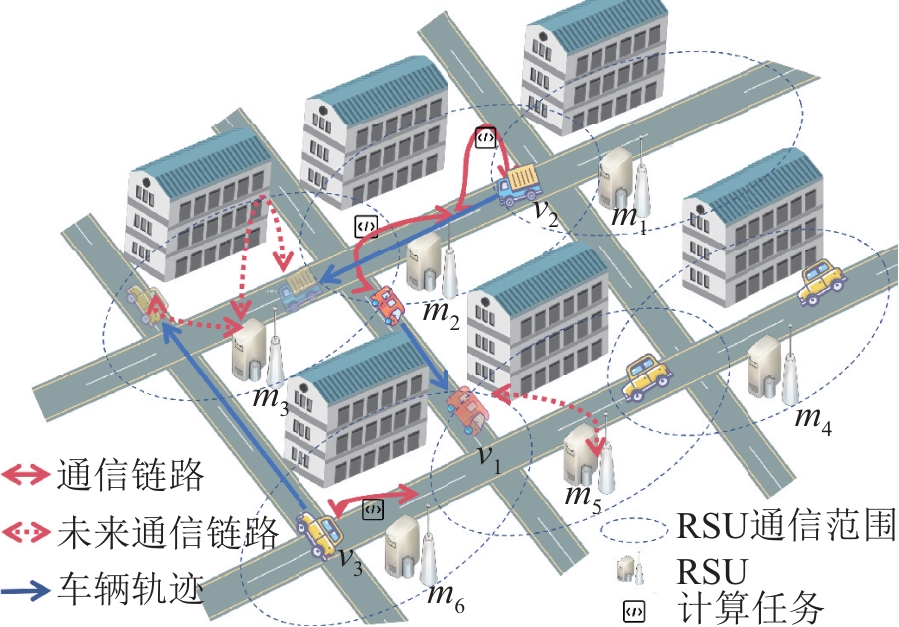
Fig. 2
Trajectory-aware dynamic offloading based on improved DRL
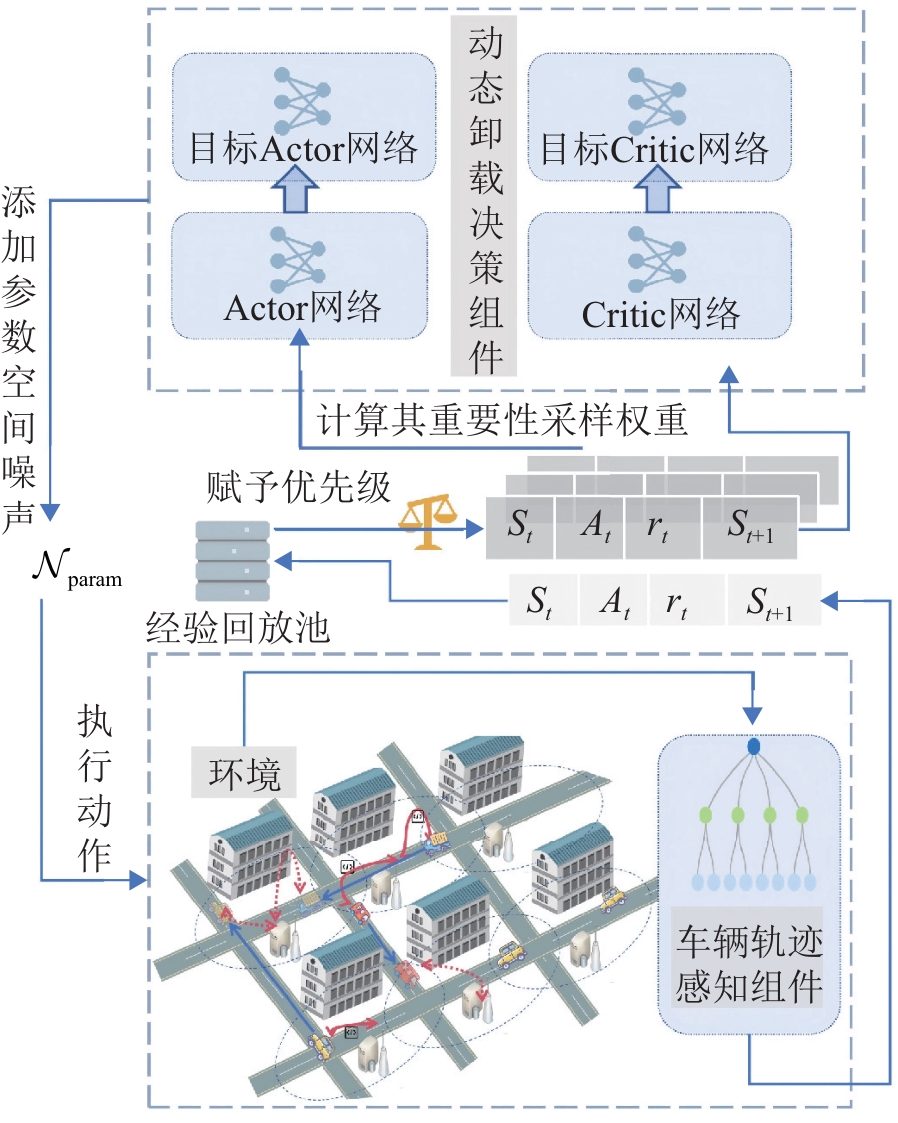

Table 1
Settings of simulation parameters
| 仿真参数 | 设置 |
|---|---|
| 车辆 | [0.4,0.6][ |
| 车辆 | [1.0,2.0] [ |
| 任务输入数据 | [0.4,1.2] [ |
| 任务计算复杂度 | [200,1 000] |
| 最大容忍延迟 | [1.5,3.0] [ |
| 高斯噪声功率 | 10‒9[ |
| 单位距离信道增益 | -30[ |
| 0.7[ | |
| 0.2[ | |
| 0.1 | |
| 经验回放池R | 256 |
| 优先级权重 | 0.6 |
| 重要性采样权重指数 | 0.4 |
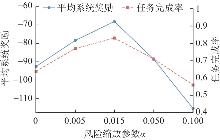
Fig. 3
Sensitivity analysis of risk scaling parameter
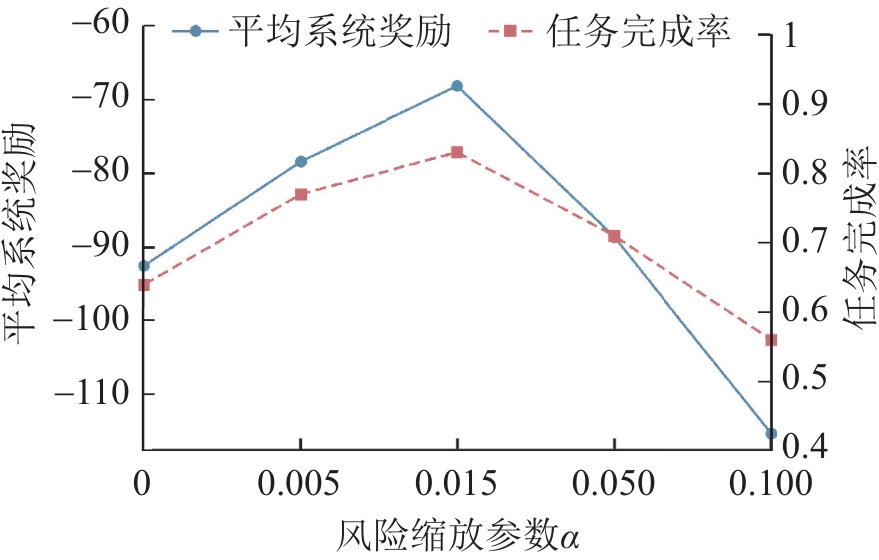
Table 2
Prediction accuracy and time cost of different methods
| 方法 | 精度/% | 时间开销/ms |
|---|---|---|
| T-pattern | 78.42 | 0.12 |
| LSTM | 84.60 | 12.45 |
| Transformer | 86.50 | 16.78 |
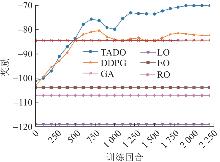
Fig. 4
Convergence comparison among different methods
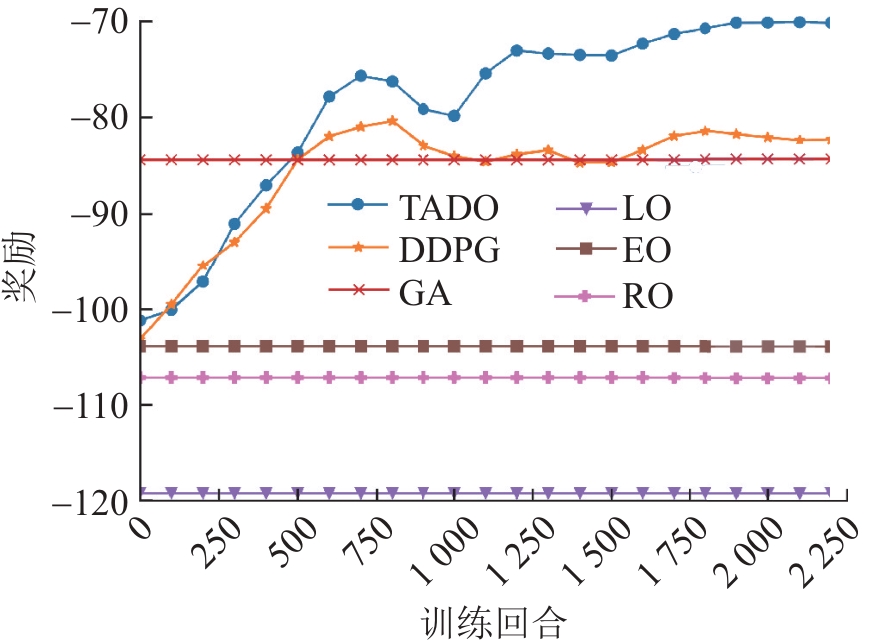
Fig. 5
Convergence analysis of proposed TADO
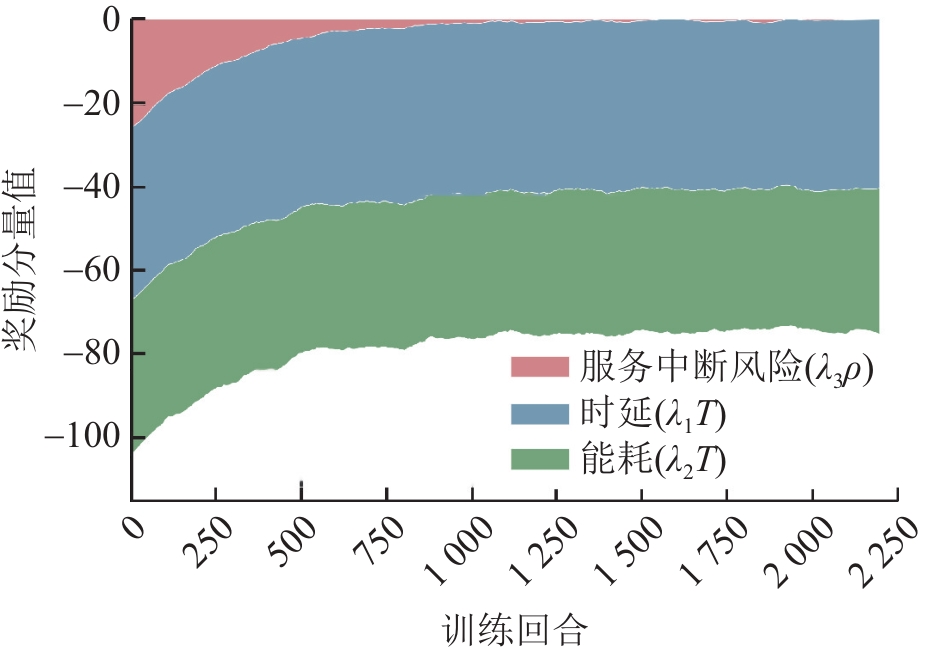
Fig. 6
Impact of computational capability of RSU on different methods
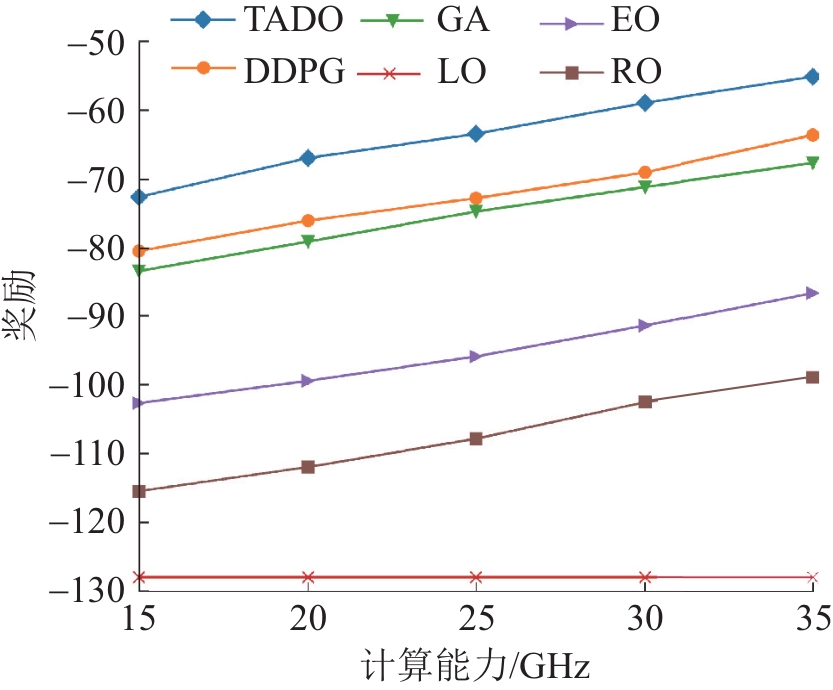
Fig. 7
Impact of number of IVs on different methods
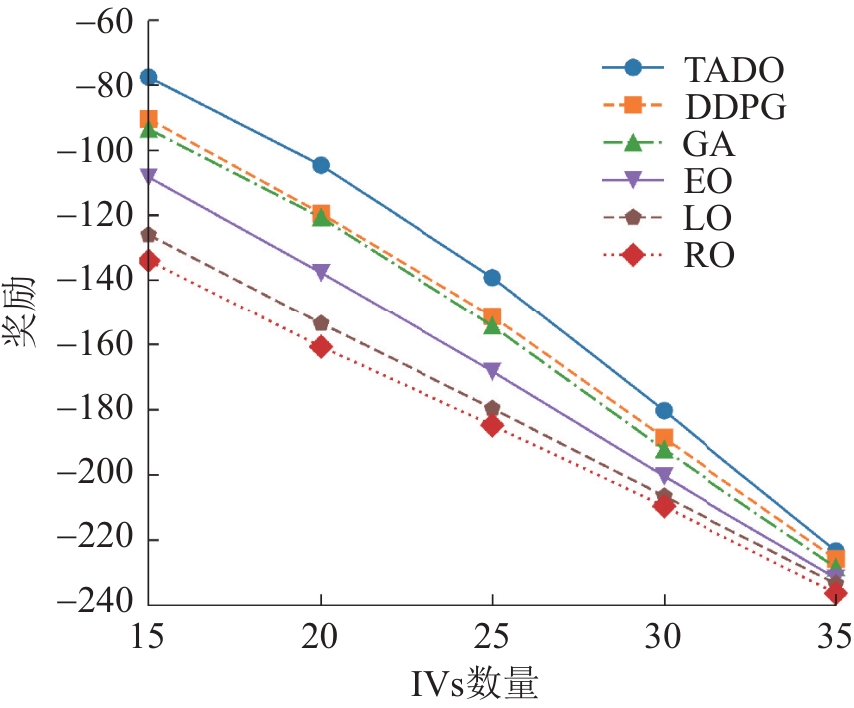
Table 3
Comparison of task completion rate among different methods (Mean ± SD)
| 方法 | 任务最大容忍延迟/s | ||
|---|---|---|---|
| 1.5 | 2.0 | 3.0 | |
| TADO | 62.31±1.12 | 78.80±0.95 | 92.68±0.82 |
| DDPG | 59.26±1.45 | 71.10±1.33 | 87.32±1.21 |
| GA | 55.96±1.87 | 69.76±1.56 | 85.71±1.54 |
| EO | 47.54±0.55 | 58.99±0.48 | 82.45±0.42 |
| RO | 49.12±0.63 | 60.34±0.59 | 79.20±0.51 |
| LO | 45.92±0 | 55.13±0 | 78.82±0 |
Fig. 8
Comparison of average latency and energy consumption among different methods
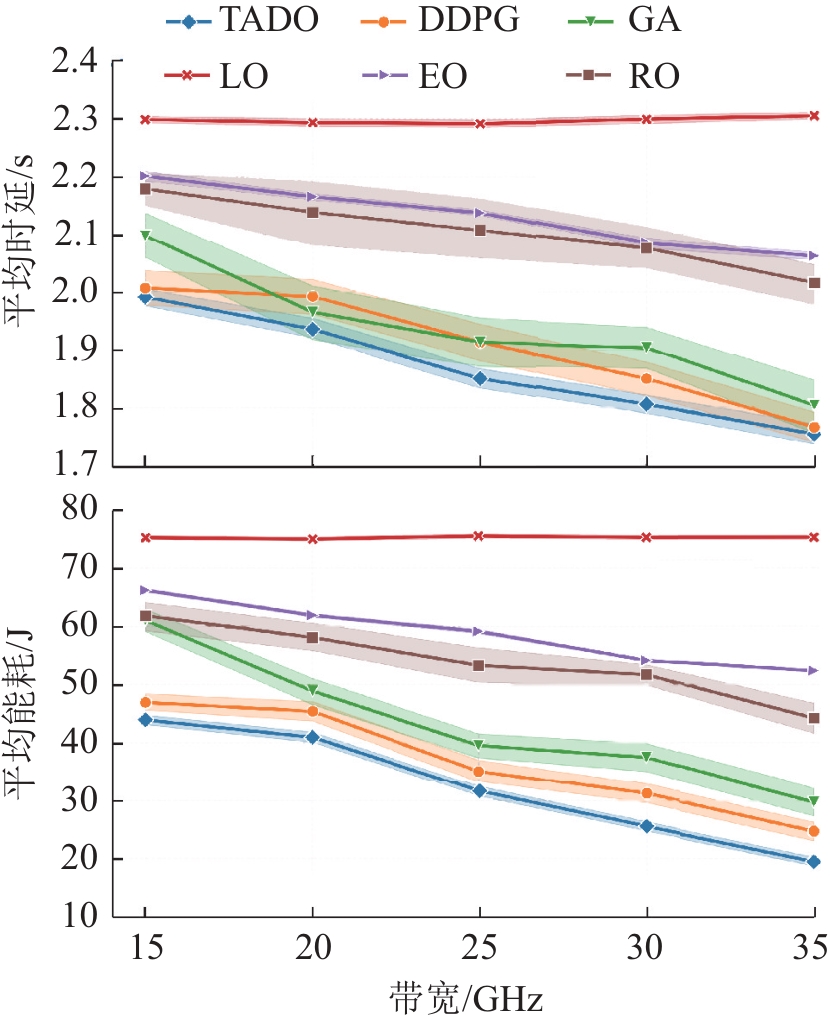
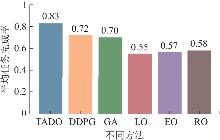
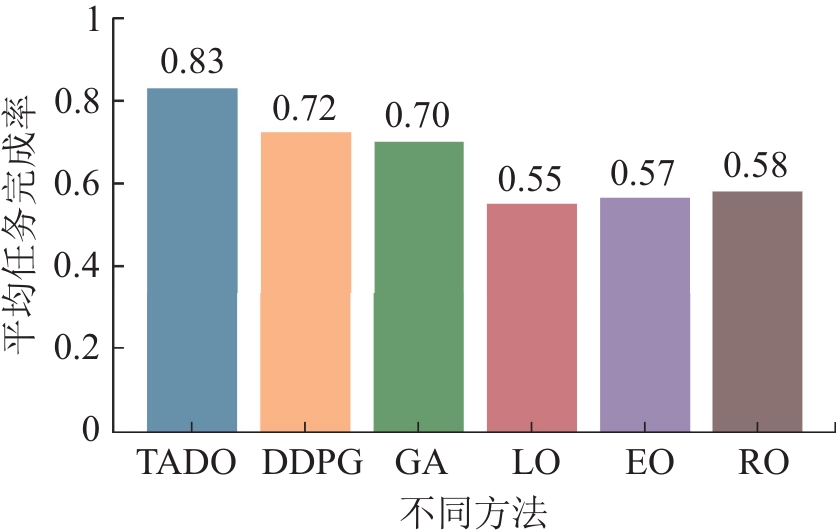
Fig. 9
Universality verification
| [1] | Li Haofei, Chen Chen, Shan Hangguan, et al. Deep Deterministic Policy Gradient-based Algorithm for Computation Offloading in IoV[J]. IEEE Transactions on Intelligent Transportation Systems, 2024, 25(3): 2522-2533. |
| [2] | Dai Xingxia, Xiao Zhu, Jiang Hongbo, et al. UAV-assisted Task Offloading in Vehicular Edge Computing Networks[J]. IEEE Transactions on Mobile Computing, 2024, 23(4): 2520-2534. |
| [3] | Zhang Haijun, Feng Lizhe, Liu Xiangnan, et al. User Scheduling and Task Offloading in Multi-tier Computing 6G Vehicular Network[J]. IEEE Journal on Selected Areas in Communications, 2023, 41(2): 446-456. |
| [4] | 黄智钦, 卢恬英, 陈哲毅. 面向大规模IoT系统的多无人机部署与协作卸载[J]. 系统仿真学报, 2025, 37(1): 25-39. |
| Huang Zhiqin, Lu Tianying, Chen Zheyi. Multi-UAV Deployment and Collaborative Offloading for Large-scale IoT Systems[J]. Journal of System Simulation, 2025, 37(1): 25-39. | |
| [5] | Tian Shujuan, Zhu Xinjie, Feng Bochao, et al. Partial Offloading Strategy Based on Deep Reinforcement Learning in the Internet of Vehicles[J]. IEEE Transactions on Mobile Computing, 2025, 24(7): 6517-6531. |
| [6] | Fan Wenhao, Zhang Yaoyin, Zhou Guangtao, et al. Deep Reinforcement Learning-based Task Offloading for Vehicular Edge Computing with Flexible RSU-RSU Cooperation[J]. IEEE Transactions on Intelligent Transportation Systems, 2024, 25(7): 7712-7725. |
| [7] | Zeng Jiachen, Gou Fangfang, Wu Jia. Task Offloading Scheme Combining Deep Reinforcement Learning and Convolutional Neural Networks for Vehicle Trajectory Prediction in Smart Cities[J]. Computer Communications, 2023, 208: 29-43. |
| [8] | Wu Chaolun, Chiu Te-Chuan, Wang Chih-Yu, et al. Mobility-aware Deep Reinforcement Learning with Seq2seq Mobility Prediction for Offloading and Allocation in Edge Computing[J]. IEEE Transactions on Mobile Computing, 2024, 23(6): 6803-6819. |
| [9] | Xiao Hui, Hu Zhigang, Xu Aikun, et al. Cost and QoS-aware Service Migration in Vehicular Edge Computing Networks with Limited Backhaul Capacity[C]//2024 IEEE Smart World Congress (SWC). Piscataway: IEEE, 2024: 369-376. |
| [10] | Peng Yan, Tang Xiaogang, Zhou Yiqing, et al. Computing and Communication Cost-aware Service Migration Enabled by Transfer Reinforcement Learning for Dynamic Vehicular Edge Computing Networks[J]. IEEE Transactions on Mobile Computing, 2024, 23(1): 257-269. |
| [11] | Gao Zhen, Yang Lei, Dai Yu. VRCCS-AC: Reinforcement Learning for Service Migration in Vehicular Edge Computing Systems[J]. IEEE Transactions on Services Computing, 2024, 17(6): 4436-4450. |
| [12] | Chen Zheyi, Huang Sijin, Min Geyong, et al. Mobility-aware Seamless Service Migration and Resource Allocation in Multi-edge IoV Systems[J]. IEEE Transactions on Mobile Computing, 2025, 24(7): 6315-6332. |
| [13] | Ma Guifu, Wang Xiaowei, Hu Manjiang, et al. DRL-based Computation Offloading with Queue Stability for Vehicular-cloud-assisted Mobile Edge Computing Systems[J]. IEEE Transactions on Intelligent Vehicles, 2023, 8(4): 2797-2809. |
| [14] | Wu Xiang, Dong Jian, Bao Wei, et al. Augmented Intelligence of Things for Emergency Vehicle Secure Trajectory Prediction and Task Offloading[J]. IEEE Internet of Things Journal, 2024, 11(22): 36030-36043. |
| [15] | Zhang Xinyi, Wang Chunyang, Zhu Yanmin, et al. Multi-agent Deep Reinforcement Learning with Trajectory Prediction for Task Migration-assisted Computation Offloading[J]. IEEE Transactions on Mobile Computing, 2025, 24(7): 5839-5856. |
| [16] | Pazho A D, Noghre G A, Katariya V, et al. VT-former: An Exploratory Study on Vehicle Trajectory Prediction for Highway Surveillance Through Graph Isomorphism and Transformer[C]//2024 IEEE/CVF Conference on Computer Vision and Pattern Recognition Workshops (CVPRW). Piscataway: IEEE, 2024: 5651-5662. |
| [17] | Xu Yunheng, Chen Jie, Wang Shuoheng, et al. TrajGNAS: Heterogeneous Multiagent Trajectory Prediction Based on a Graph Neural Architecture Search[C]//2025 IEEE/CVF Conference on Computer Vision and Pattern Recognition Workshops (CVPRW). Piscataway: IEEE, 2025: 2532-2541. |
| [18] | Cheng Chen, Zhai Linbo, Zhu Xiumin, et al. Dynamic Task Offloading and Service Caching Based on Game Theory in Vehicular Edge Computing Networks[J]. Computer Communications, 2024, 224: 29-41. |
| [19] | Zhao Liang, Li Tianyu, Zhang Enchao, et al. Adaptive Swarm Intelligent Offloading Based on Digital Twin-assisted Prediction in VEC[J]. IEEE Transactions on Mobile Computing, 2024, 23(8): 8158-8174. |
| [20] | Sutton R S, Barto A. Reinforcement Learning: An Introduction[M]. 2nd ed. Cambridge: The MIT Press, 2020. |
| [21] | Wang Lei, Liang Hongbin, Zhao Dongmei. Deep-reinforcement-learning-based Computation Offloading and Power Allocation Within Dynamic Platoon Network[J]. IEEE Internet of Things Journal, 2024, 11(6): 10500-10512. |
| [22] | Huang Jiwei, Wan Jiangyuan, Bofeng Lü, et al. Joint Computation Offloading and Resource Allocation for Edge-cloud Collaboration in Internet of Vehicles via Deep Reinforcement Learning[J]. IEEE Systems Journal, 2023, 17(2): 2500-2511. |
| [23] | Wu Sijun, Yang Liang, Li Junjie, et al. DRL-based Pricing-driven for Task Offloading and Dynamic Resource in Vehicle Edge Computing[J]. IEEE Transactions on Mobile Computing, 2025, 24(10): 10389-10404. |
| [24] | Yan Ming, Xiong Rui, Wang Yan, et al. Edge Computing Task Offloading Optimization for a UAV-assisted Internet of Vehicles via Deep Reinforcement Learning[J]. IEEE Transactions on Vehicular Technology, 2024, 73(4): 5647-5658. |
| [25] | Zeng Jiaan, Kuang Zhufang, Chen Rui, et al. Delay-sensitive Dependent Tasks Offloading and Resource Allocation in VEC: A Deep-reinforcement Learning Approach[J]. IEEE Internet of Things Journal, 2025, 12(16): 34190-34203. |
| [26] | Ahmed Manzoor, Muhammad Ayzed Mirza, Raza Salman, et al. Vehicular Communication Network Enabled CAV Data Offloading: A Review[J]. IEEE Transactions on Intelligent Transportation Systems, 2023, 24(8): 7869-7897. |
| [27] | Gao Qinghang, Xiao Jianmao, Feng Zhiyong, et al. Optimization of Models and Strategies for Computation Offloading in the Internet of Vehicles: Efficiency and Trust[J]. IEEE Transactions on Mobile Computing, 2025, 24(4): 3372-3389. |
| [28] | Zhao Liang, Zhang Enchao, Wan Shaohua, et al. MESON: A Mobility-aware Dependent Task Offloading Scheme for Urban Vehicular Edge Computing[J]. IEEE Transactions on Mobile Computing, 2024, 23(5): 4259-4272. |
| [29] | Xiao Zhu, Xu Shenyuan, Li Tao, et al. On Extracting Regular Travel Behavior of Private Cars Based on Trajectory Data Analysis[J]. IEEE Transactions on Vehicular Technology, 2020, 69(12): 14537-14549. |
| [30] | Monreale Anna, Pinelli Fabio, Trasarti Roberto, et al. WhereNext: A Location Predictor on Trajectory Pattern Mining[C]//Proceedings of the 15th ACM SIGKDD International Conference on Knowledge Discovery and Data Mining. New York: ACM, 2009: 637-646. |
| [31] | Yao Liang, Xu Xiaolong, Bilal Muhammad, et al. Dynamic Edge Computation Offloading for Internet of Vehicles with Deep Reinforcement Learning[J]. IEEE Transactions on Intelligent Transportation Systems, 2023, 24(11): 12991-12999. |
| [32] | Jiang Hongbo, Cai Jianghao, Xiao Zhu, et al. Vehicle-assisted Service Caching for Task Offloading in Vehicular Edge Computing[J]. IEEE Transactions on Mobile Computing, 2025, 24(7): 6688-6700. |
| [33] | Piorkowski Michal, Sarafijanovic-Djukic Natasa, Grossglauser Matthias. CRAWDAD epfl/mobility[EB/OL]. (2022-11-15) [2025-07-25]. . |
| [1] | Zhang Wenzhu, Bian Yuewei, Xiong Fuli, Cai Siqi. Online PPO-based Multi-hop Task Offloading Strategy for Vehicular Edge Computing [J]. Journal of System Simulation, 2026, 38(7): 1901-1921. |
| [2] | Wu Shuxia, Zhang Junjie, Chen Delong, Chen Zheyi. Resource-efficient Continuous Learning Framework for Edge Real-time Video Analytics [J]. Journal of System Simulation, 2026, 38(2): 294-306. |
| [3] | Wang Bingkun, Wang Yue, Yang Mei, Zhang Pengnian, Fan Bohao, Tang Jie. Strike Strategy Planning Method of Unmanned Ground Vehicles Based on Improved PPO Algorithm [J]. Journal of System Simulation, 2026, 38(2): 372-386. |
| [4] | Liu Quan, Wang Yu, Liu Linyue, Chen Hao, Huang Jian. Knowledge Closed-loop Driving-based Intelligent Game Confrontation Simulation [J]. Journal of System Simulation, 2026, 38(2): 416-432. |
| [5] | Wang Ziyi, Zhang Kai, Qian Dianwei, Liu Yuzhen. A DRL⁃based Approach for Distributed Equipment Nodes Selection [J]. Journal of System Simulation, 2025, 37(6): 1565-1573. |
| [6] | Zhang Sen, Dai Qiangqiang. UAV Path Planning Based on Improved Deep Deterministic Policy Gradients [J]. Journal of System Simulation, 2025, 37(4): 875-881. |
| [7] | Li Min, Zhang Sen, Zeng Xiangguang, Wang Gang, Zhang Tongwei, Xie Dijie, Ren Wenzhe, Zhang Tao. Trajectory Planning of Quadruped Robot Over Obstacle with Single Leg Based on Deep Reinforcement Learning [J]. Journal of System Simulation, 2025, 37(4): 895-909. |
| [8] | Wang He, Xu Jianing, Yan Guangyu. Research on Pedestrian Avoidance Strategy for AGV Based on Deep Reinforcement Learning [J]. Journal of System Simulation, 2025, 37(3): 595-606. |
| [9] | Zhang Bin, Lei Yonglin, Li Qun, Gao Yuan, Chen Yong, Zhu Jiajun, Bao Chenlong. Reinforcement Learning Modeling of Missile Penetration Decision Based on Combat Simulation [J]. Journal of System Simulation, 2025, 37(3): 763-774. |
| [10] | Fei Shuaidi, Cai Changlong, Liu Fei, Chen Minghui, Liu Xiaoming. Research on the Target Allocation Method for Air Defense and Anti-missile Defense of Naval Ships [J]. Journal of System Simulation, 2025, 37(2): 508-516. |
| [11] | Huang Sijin, Wen Jia, Chen Zheyi. Intelligent Service Migration towards MEC-based IoV Systems [J]. Journal of System Simulation, 2025, 37(2): 379-391. |
| [12] | Zheng Jiayu, Mai Zhuxue, Chen Zheyi. Optimization of Service Caching and Computation Offloading in Digital Twin Cloud-edge Networks [J]. Journal of System Simulation, 2025, 37(11): 2741-2753. |
| [13] | Huang Zhiqin, Lu Tianying, Chen Zheyi. Multi-UAV Deployment and Collaborative Offloading for Large-scale IoT Systems [J]. Journal of System Simulation, 2025, 37(1): 25-39. |
| [14] | Li Chao, Li Jiabao, Ding Caichang, Ye Zhiwei, Zuo Fangwei. Edge Surveillance Task Offloading and Resource Allocation Algorithm Based on DRL [J]. Journal of System Simulation, 2024, 36(9): 2113-2126. |
| [15] | Wang Hongjun, Lin Junqiang, Zou Xiangjun, Zhang Po, Zhou Mingxuan, Zou Weirui, Tang Yunchao, Luo Lufeng. Construction of a Virtual Interactive System for Orchards Based on Digital Twin [J]. Journal of System Simulation, 2024, 36(6): 1493-1508. |
| Viewed | ||||||
|
Full text |
|
|||||
|
Abstract |
|
|||||
 http://www.china-simulation.com

