

Journal of System Simulation ›› 2026, Vol. 38 ›› Issue (3): 670-686.doi: 10.16182/j.issn1004731x.joss.25-0139
• Papers • Previous Articles Next Articles
Chen Yanjun1,2,3, Zhou Min1,2,3, Zha Meng1,2,3, Zhang Meizhou1,2,3
Received:2025-02-27
Revised:2025-06-16
Online:2026-03-18
Published:2026-03-27
Contact:
Zhou Min
CLC Number:
Chen Yanjun, Zhou Min, Zha Meng, Zhang Meizhou. Research and Analysis of Algorithm for Detecting Surface Defects on Automotive Wheel Hubs Based on CCL-YOLOv8[J]. Journal of System Simulation, 2026, 38(3): 670-686.
Fig. 1
YOLOv8n network structure
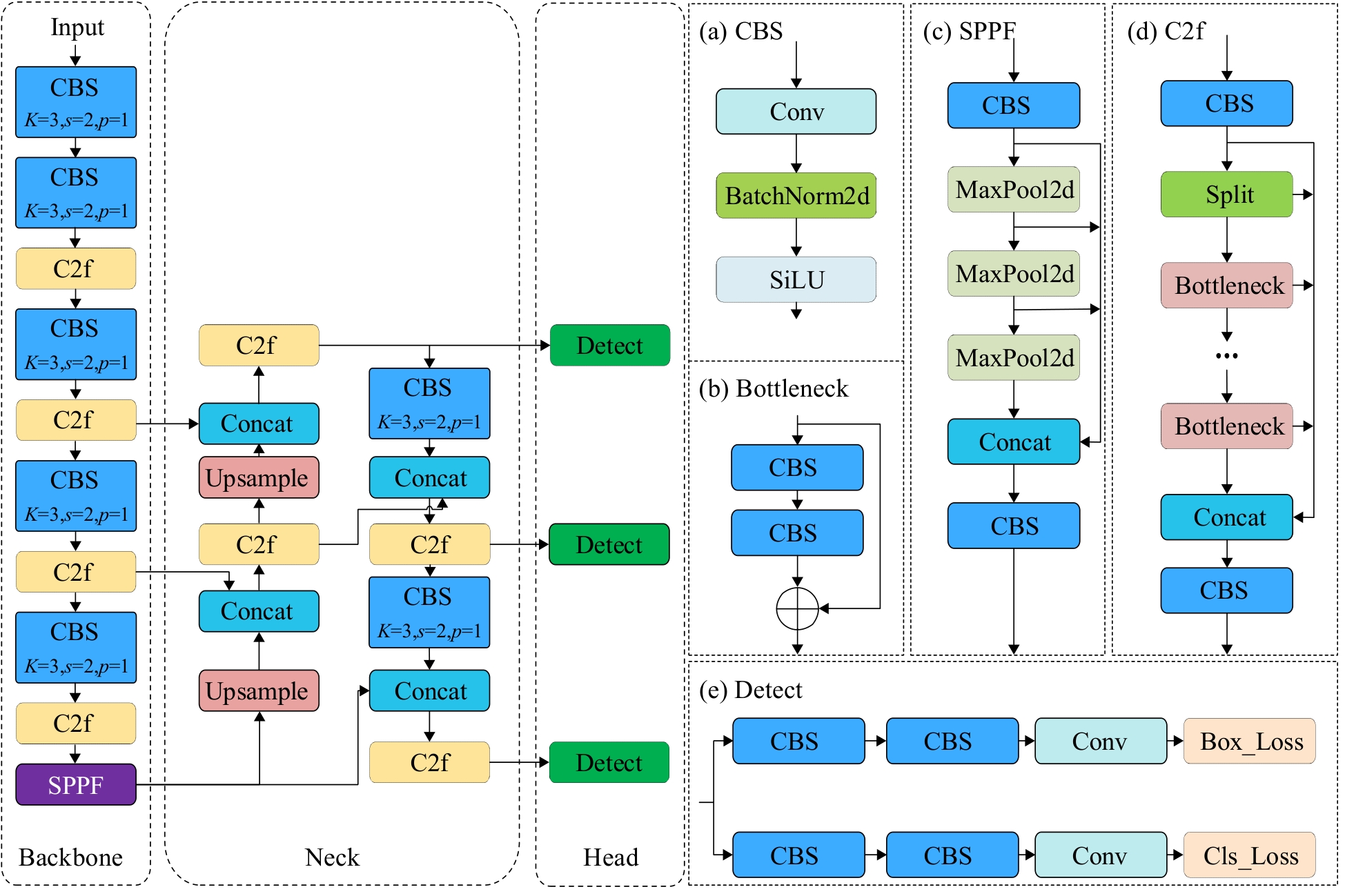
Fig. 2
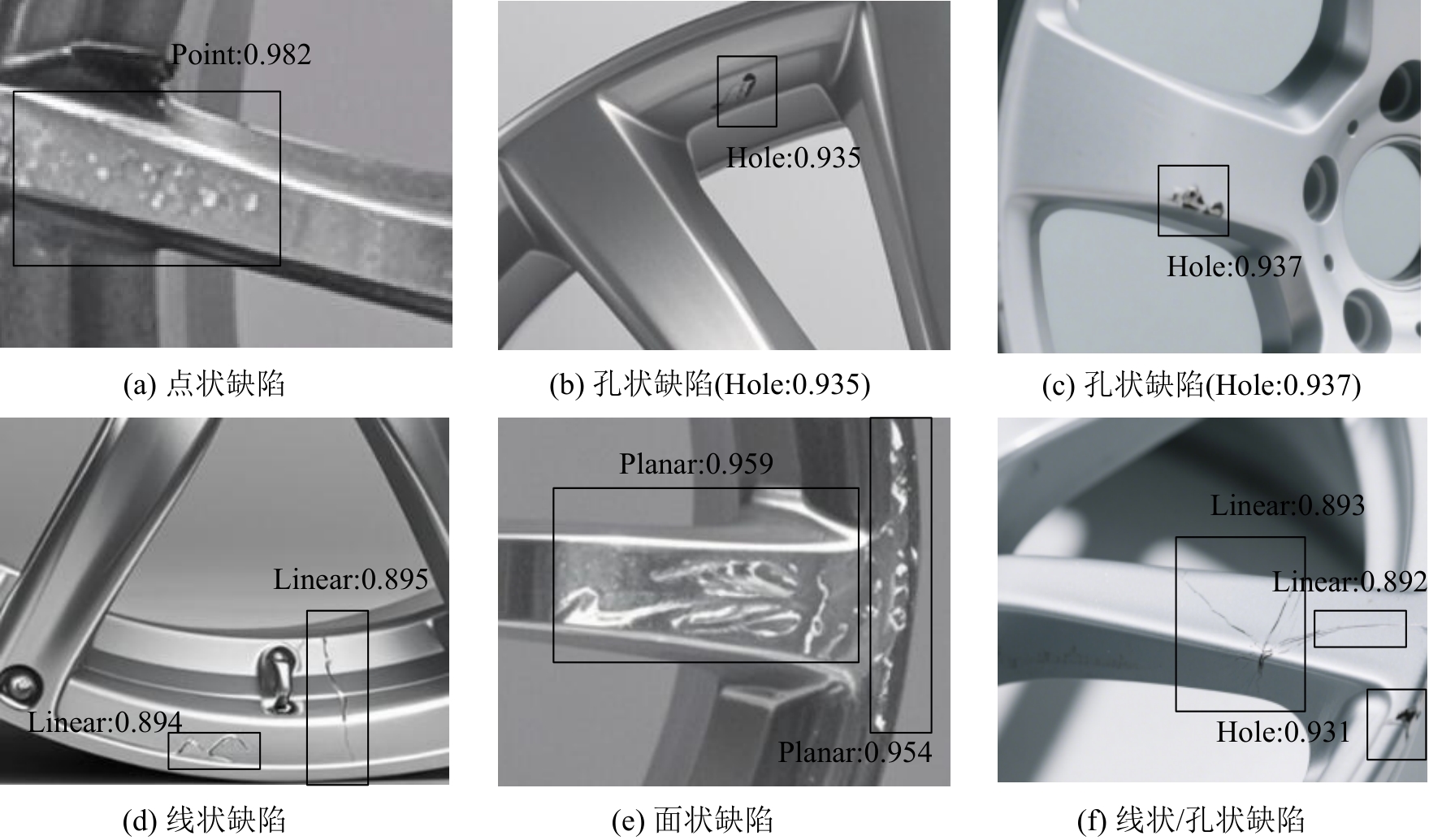
Improved YOLOv8n network structure
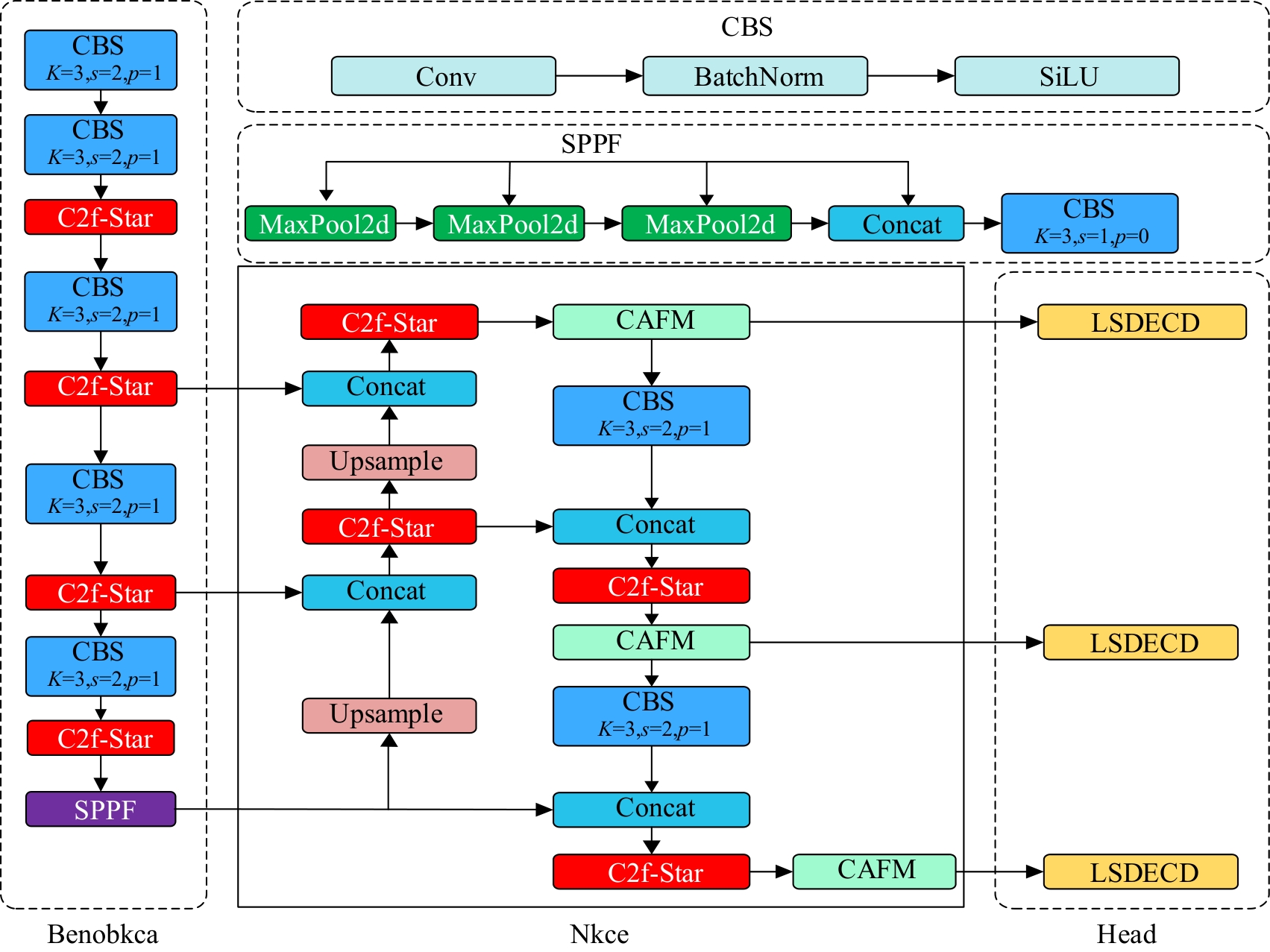
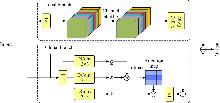
Fig. 3
CAFM module structure
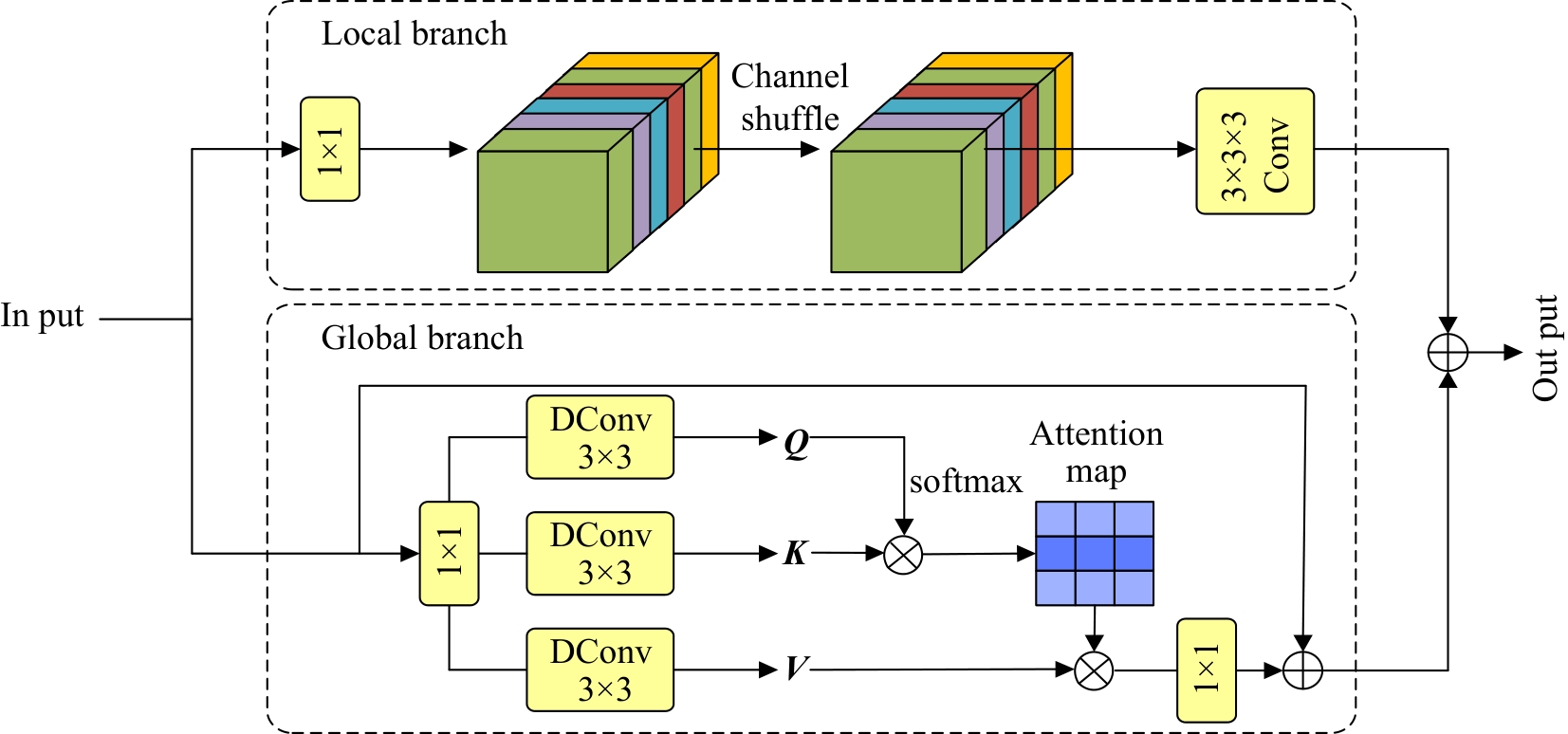
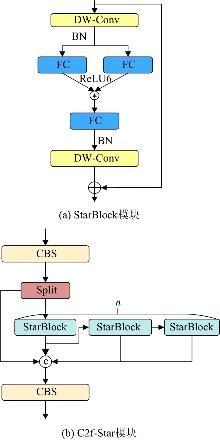
Fig. 4
Improved C2f module structure
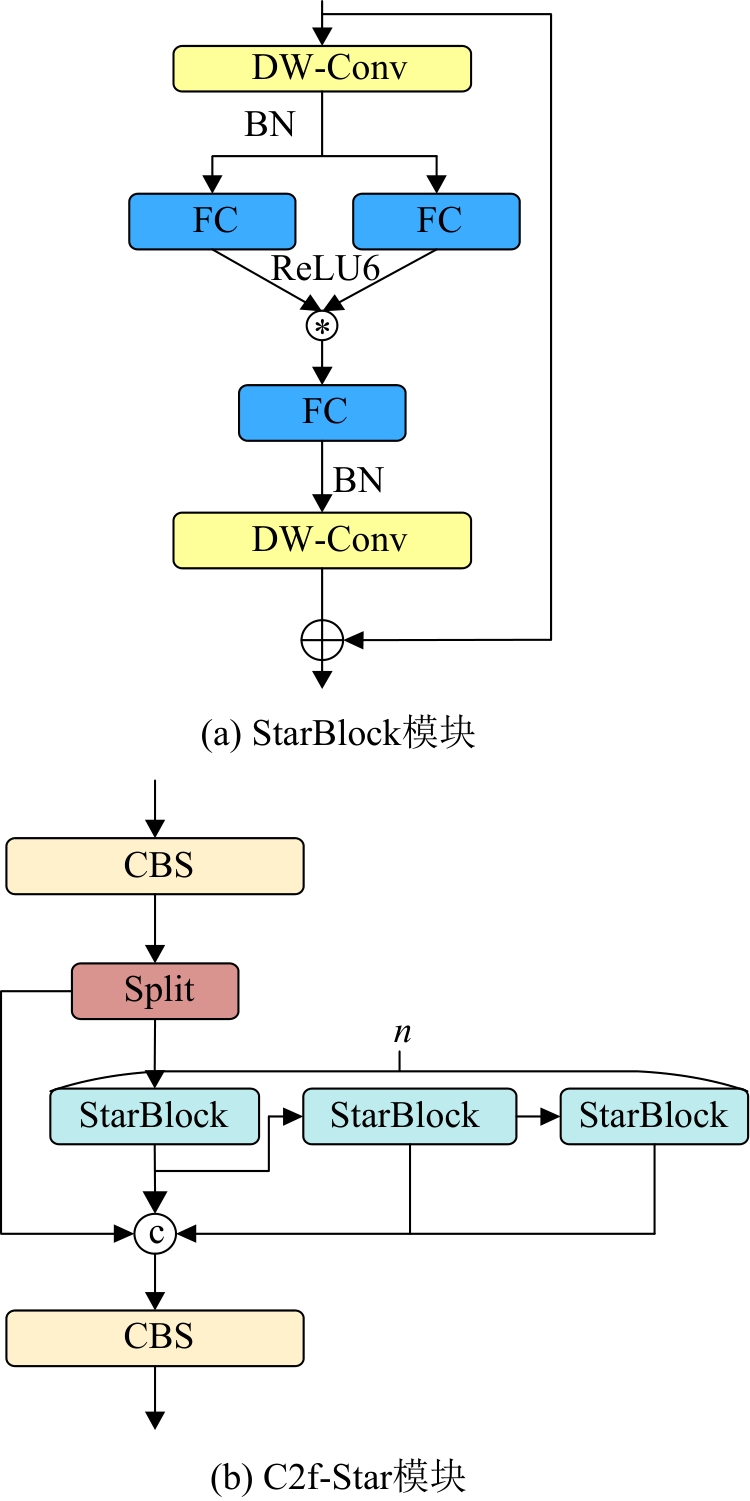
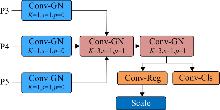
Fig. 5
LSDECD structure
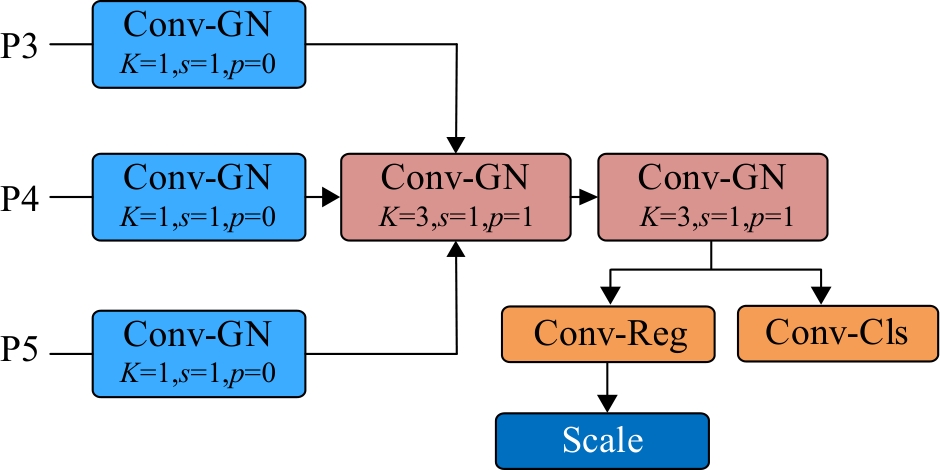
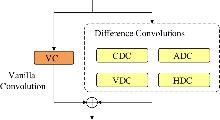
Fig. 6
DEConv structure
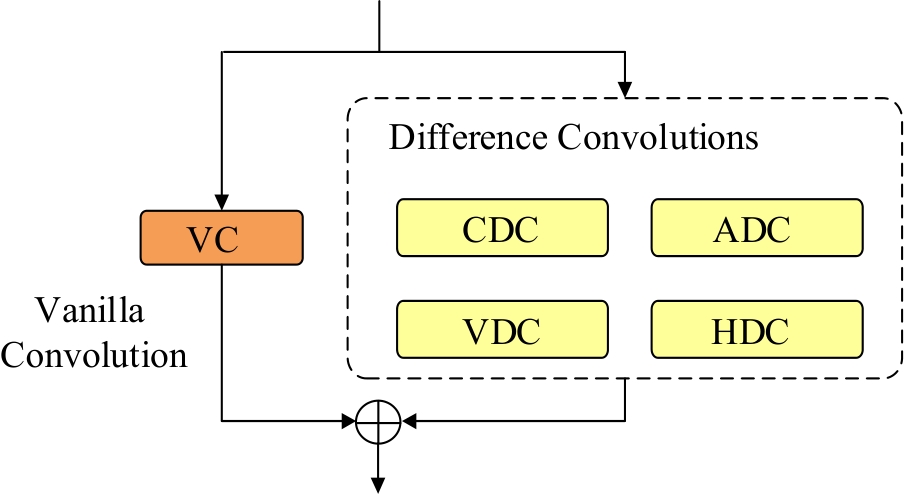
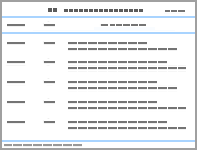
Table 1
Common surface defect types of automotive wheels
| 缺陷类型 | 形成原因 | 缺陷特征 | 缺陷图片示例 |
|---|---|---|---|
| 点状缺陷 | 磕碰、划伤、麻点等 | 缺陷成点状凹坑 | 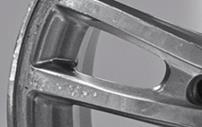 |
| 线状缺陷 | 因应力和温度造成的热裂纹、冷裂纹、拉裂、刀具振动裂纹等 | 缺陷呈细线条状,有明显的凹陷开裂边缘 | 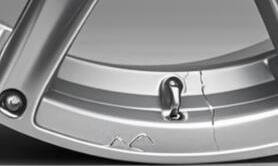 |
| 孔状缺陷 | 气孔、缩孔、夹杂等 | 大小不等的圆孔洞、缩孔、凹陷等 | 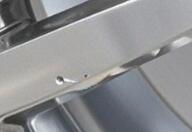 |
| 面状缺陷 | 擦伤、划伤、麻面、拉毛等 | 成连续的面状缺陷,面积较大 | 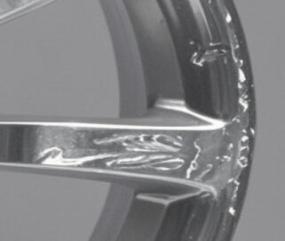 |
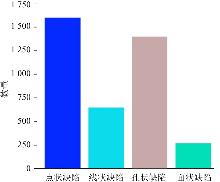
Fig. 7
Defect category instance count statistics chart
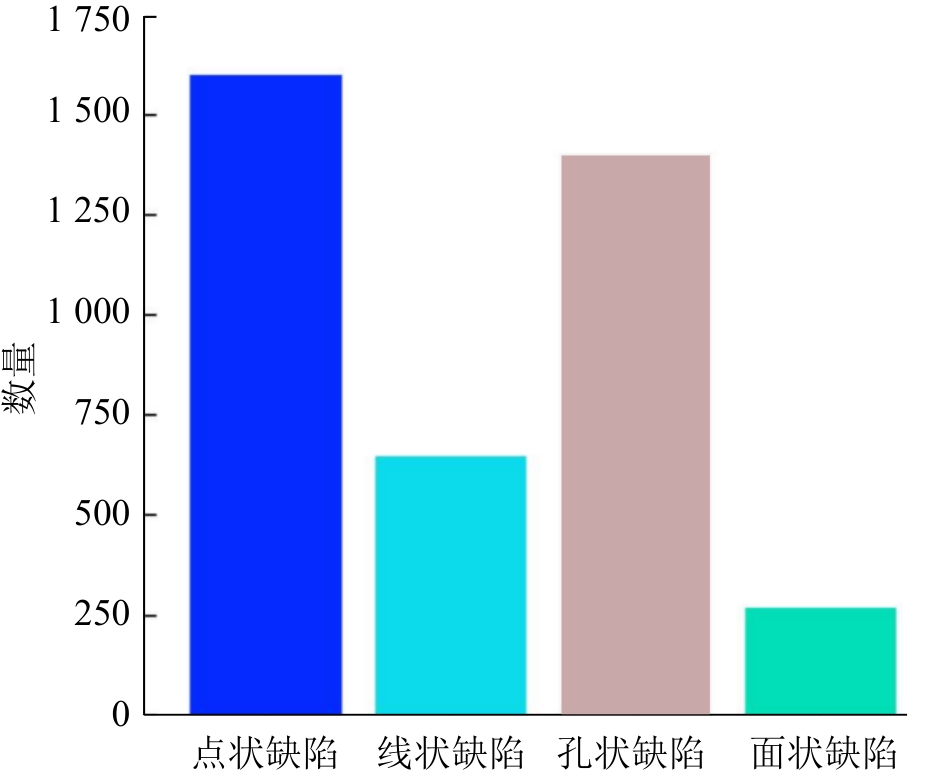
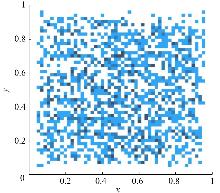
Fig. 8
Distribution map of position of bounding box center relative to entire image
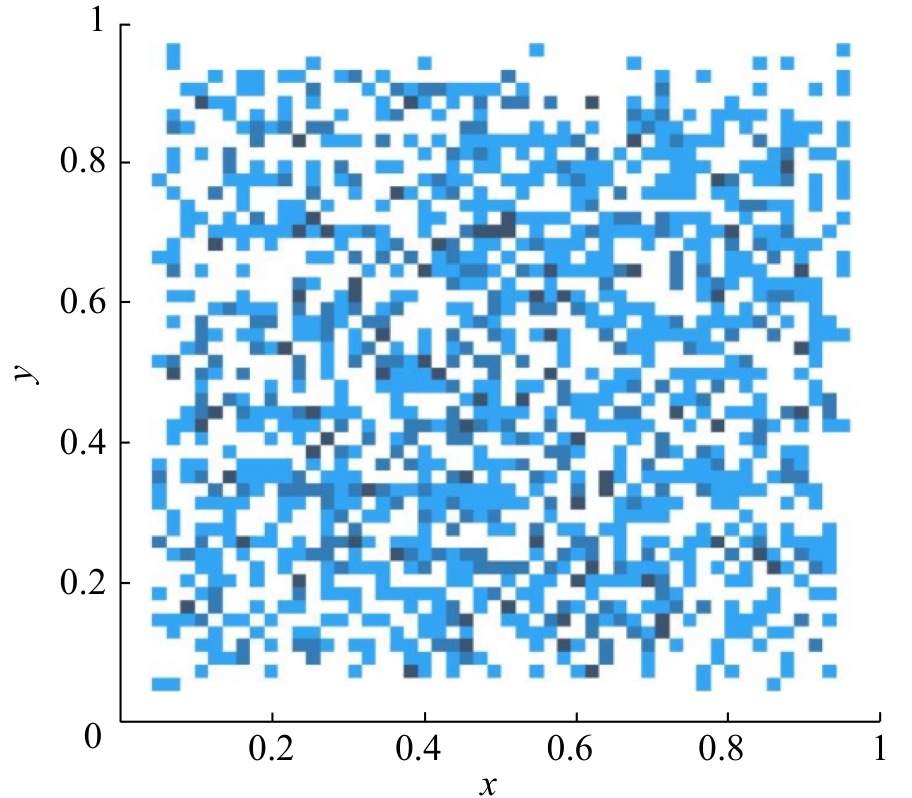
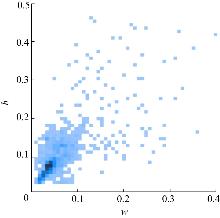
Fig. 9
Distribution of width and height of bounding boxes relative to overall image size
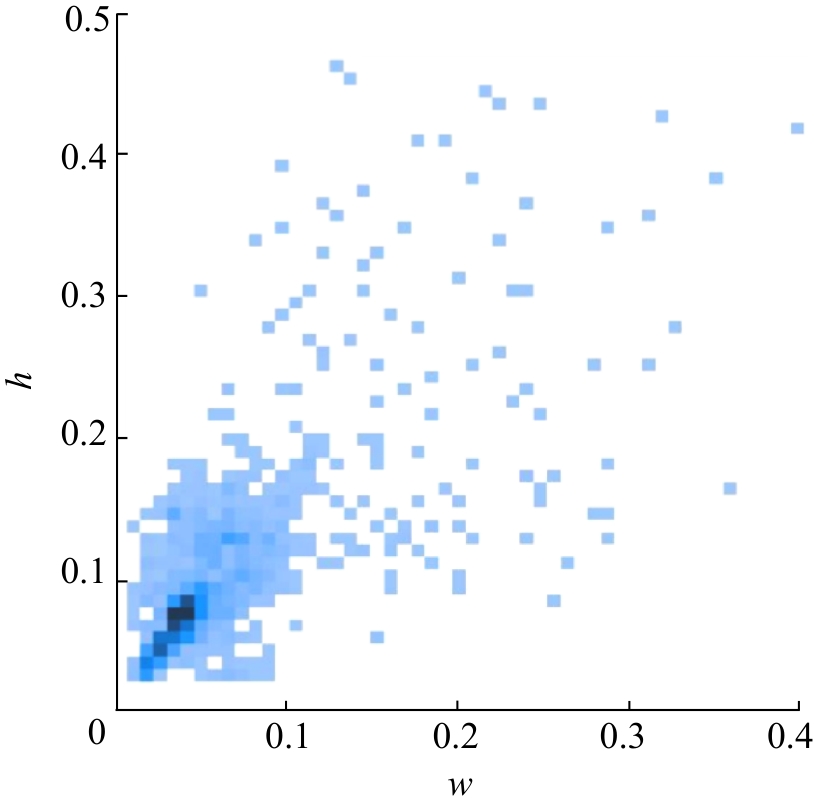
Table 2
Comparison of ablation results
| 实验组 | CAFM | C2f-Star | LSDECD | mAP@0.5/% | mAP@0.5:0.95/% | P/% | R/% | 参数量×106 | GFLOPs |
|---|---|---|---|---|---|---|---|---|---|
| T0 | 88.2 | 74.6 | 83.1 | 80.2 | 12.3 | 8.9 | |||
| T1 | √ | 90.3 | 77.9 | 87.2 | 84.5 | 13.6 | 10 | ||
| T2 | √ | 89.6 | 76.2 | 85.9 | 81.4 | 9.94 | 7.6 | ||
| T3 | √ | 88.7 | 74.3 | 84.5 | 82.2 | 10 | 6.6 | ||
| T4 | √ | √ | 91.4 | 75.6 | 88.6 | 85.3 | 12.1 | 9.1 | |
| T5 | √ | √ | 89.4 | 76.6 | 85.4 | 81.6 | 9.22 | 4.2 | |
| T6 | √ | √ | 89.7 | 78.2 | 87.6 | 86.3 | 11.8 | 7.7 | |
| T7 | √ | √ | √ | 93.2 | 78.9 | 90.1 | 88.5 | 10.3 | 5.7 |
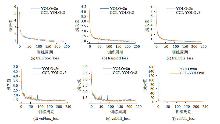
Fig. 10
Comparison of loss convergence characteristics between YOLOv8n and CCL-YOLOv8
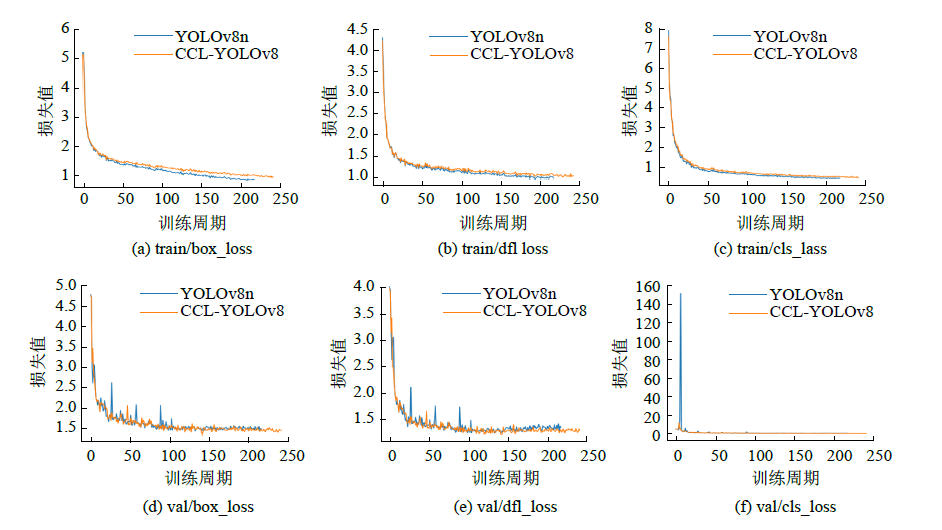
Fig. 11
Performance comparison chart of YOLOv8n and CCL-YOLOv8 models
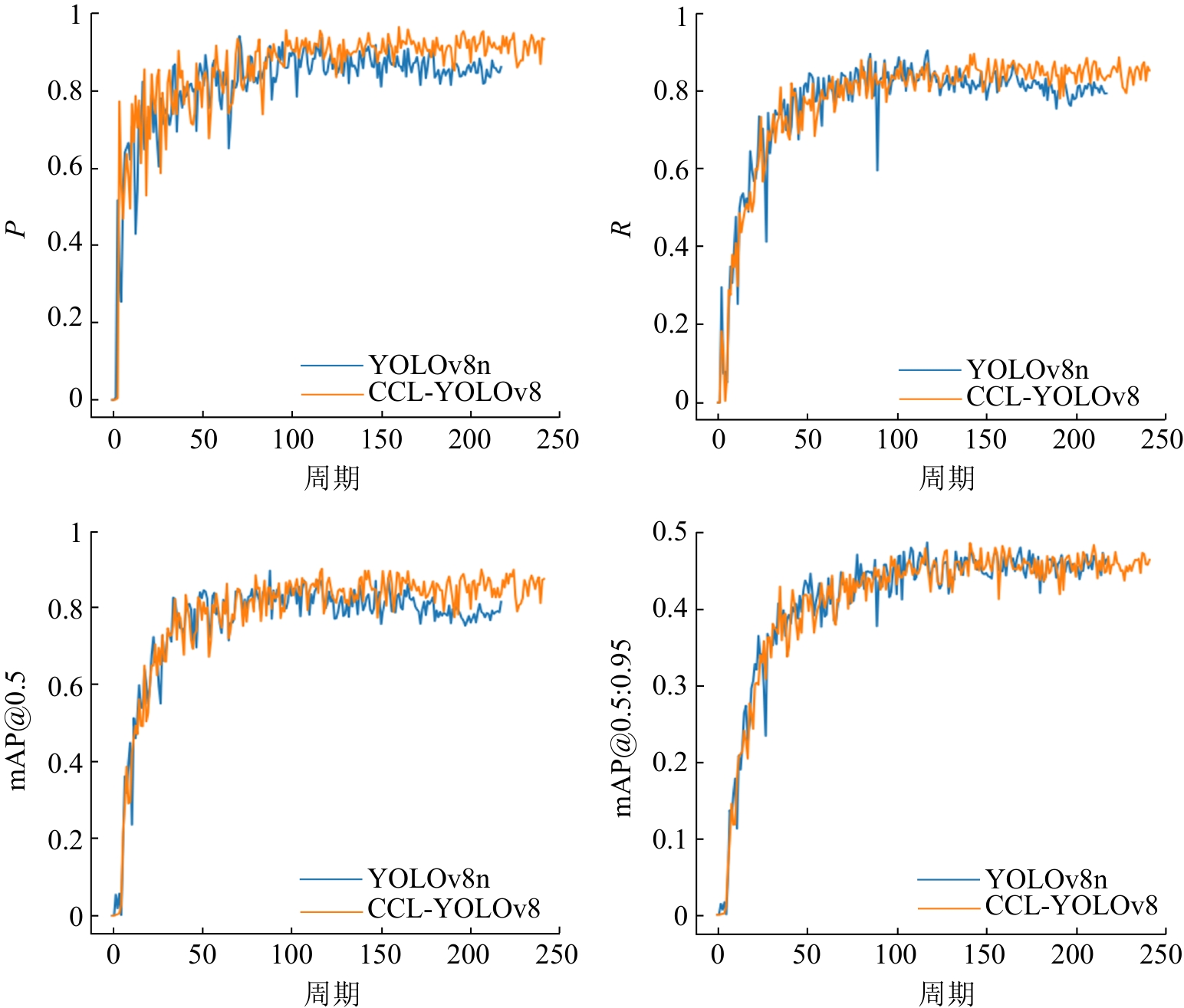
Table 3
Comparison of experimental results of different models
| 模型 | mAP@0.5/% | 参数量×106 | GFLOPs | 帧率/(帧/s) |
|---|---|---|---|---|
| YOLOv8n | 88.2 | 12.30 | 8.9 | 213.4 |
| Faster RCNN | 67.3 | 137.10 | 370.2 | 16.3 |
| SSD | 64.2 | 26.30 | 62.7 | 24.6 |
| YOLOv5n | 81.8 | 1.90 | 4.5 | 373.1 |
| YOLOv7-tiny | 85.7 | 6.03 | 13.2 | 186.2 |
| RT-DETR-R18 | 90.4 | 40.50 | 58.2 | 154.1 |
| YOLOv9-tiny | 90.1 | 1.90 | 6.5 | 169.0 |
| CCL-YOLOv8 | 93.2 | 10.30 | 5.7 | 239.5 |
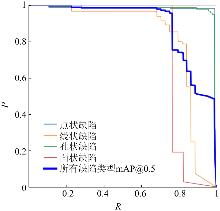
Fig. 12
YOLOV8n model P-R curve
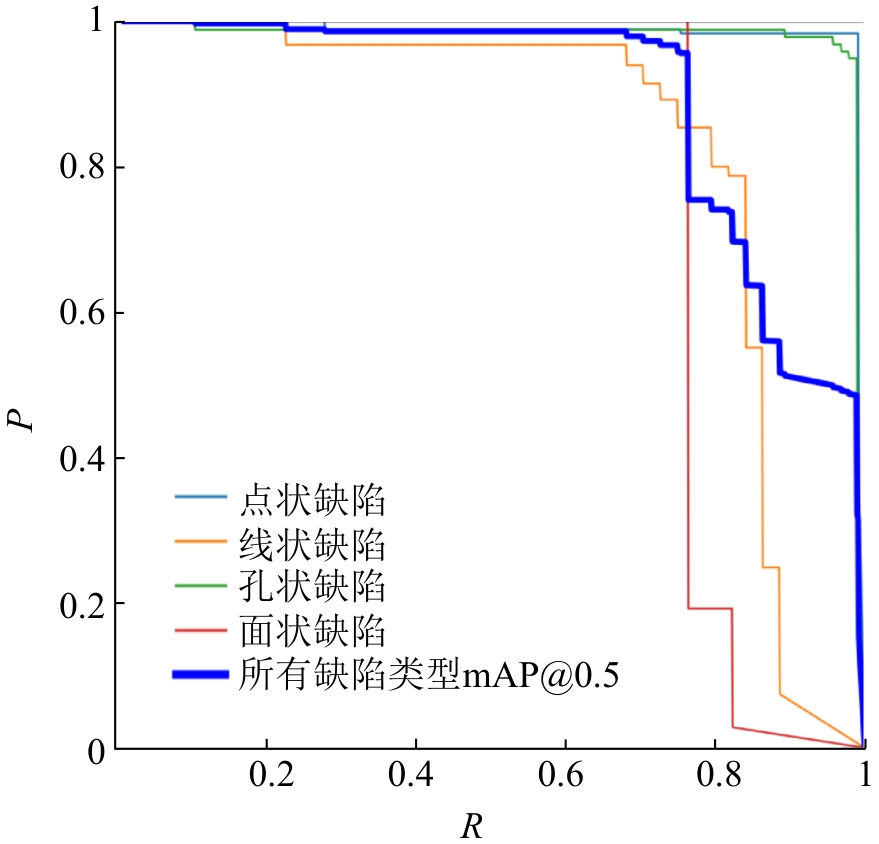
Fig. 13
CCL-YOLOV8 model P-R curve
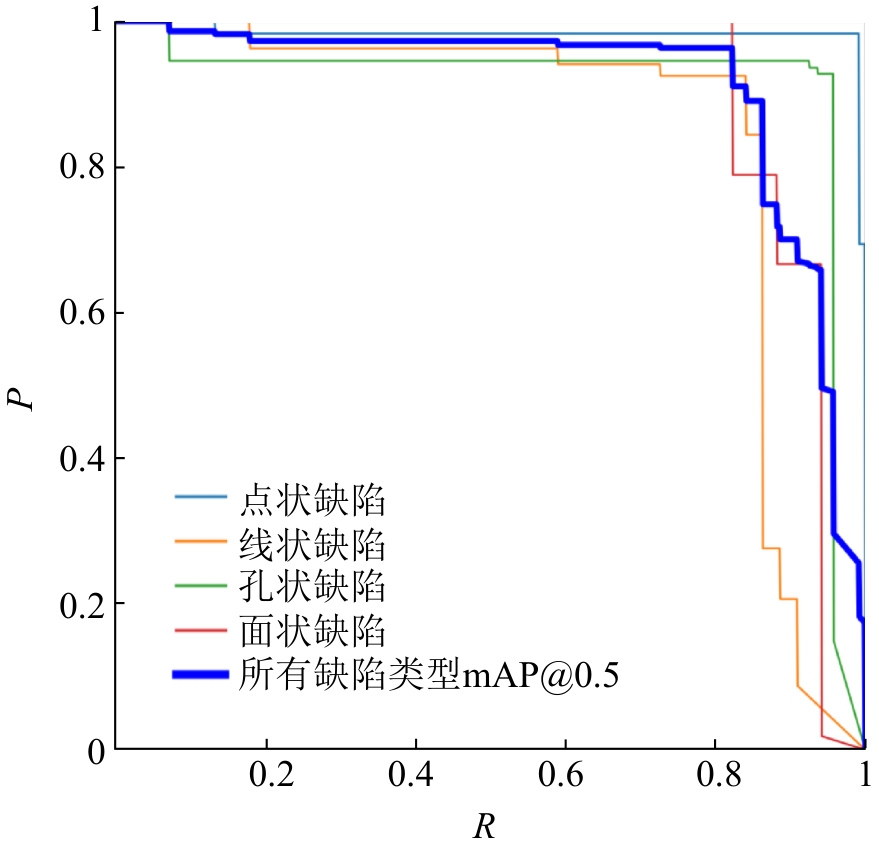
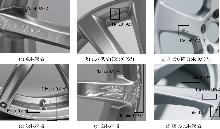
Fig. 14
Schematic diagram of four kinds of defect detection results
| [1] | 李键, 李华, 胡翔坤, 等. 基于深度学习的表面缺陷检测技术研究进展[J]. 计算机集成制造系统, 2024, 30(3): 774-790. |
| Li Jian, Li Hua, Hu Xiangkun, et al. Research Progress of Surface Defect Detection Technology Based on Deep Learning[J]. Computer Integrated Manufacturing Systems, 2024, 30(3): 774-790. | |
| [2] | 曾治霖, 瞿昊, 杜正春. 基于深度学习和生成对抗网络的发动机缸体表面缺陷检测方法[J]. 机械工程学报, 2025, 61(2): 46-55. |
| Zeng Zhilin, Qu Hao, Du Zhengchun. An Engine Cylinder Surface Defect Detection Algorithm Based on the YOLOv5 Network and Pix2Pix Model[J]. Journal of Mechanical Engineering, 2025, 61(2): 46-55. | |
| [3] | Girshick R, Donahue J, Darrell T, et al. Rich Feature Hierarchies for Accurate Object Detection and Semantic Segmentation[C]//2014 IEEE Conference on Computer Vision and Pattern Recognition. Piscataway: IEEE, 2014: 580-587. |
| [4] | Ren Shaoqing, He Kaiming, Girshick R, et al. Faster R-CNN: Towards Real-time Object Detection with Region Proposal Networks[J]. IEEE Transactions on Pattern Analysis and Machine Intelligence, 2017, 39(6): 1137-1149. |
| [5] | Liu Wei, Anguelov D, Erhan D, et al. SSD: Single Shot MultiBox Detector[C]//Computer Vision-ECCV 2016. Cham: Springer International Publishing, 2016: 21-37. |
| [6] | Redmon J, Divvala S, Girshick R, et al. You Only Look Once: Unified, Real-time Object Detection[C]//2016 IEEE Conference on Computer Vision and Pattern Recognition (CVPR). Piscataway: IEEE, 2016: 779-788. |
| [7] | Alkandary K, Yildiz A S, Meng Hongying. A Comparative Study of YOLO Series (v3-v10) with DeepSORT and StrongSORT: A Real-time Tracking Performance Study[J]. Electronics, 2025, 14(5): 876. |
| [8] | 张雷, 严昊, 贾永镒, 等. 采用改进YOLOv3-tiny模型的轻量化莲蓬质量分级算法[J]. 农业工程学报, 2024, 40(23): 248-257. |
| Zhang Lei, Yan Hao, Jia Yongyi, et al. Lightweight Classification of Lotus Seedpod Quality Using Improved YOLOv3-tiny Model[J]. Transactions of the Chinese Society of Agricultural Engineering, 2024, 40(23): 248-257. | |
| [9] | 张震宇, 刘阳, 刘福才. 基于YOLOv3-spp的汽车轮毂表面缺陷检测算法研究与分析[J]. 计量学报, 2023, 44(9): 1375-1382. |
| Zhang Zhenyu, Liu Yang, Liu Fucai. Research and Analysis of Automobile Wheel Hub Surface Defect Detection Algorithm Based on YOLOv3-spp[J]. Acta Metrologica Sinica, 2023, 44(9): 1375-1382. | |
| [10] | 赵海文, 赵亚川, 齐兴悦, 等. 基于深度学习的汽车轮毂表面缺陷检测算法研究[J]. 组合机床与自动化加工技术, 2019(11): 112-115. |
| Zhao Haiwen, Zhao Yachuan, Qi Xingyue, et al. Research on Surface Defect Inspection Algorithms of Automobile Hub Based on Deep Learning[J]. Modular Machine Tool & Automatic Manufacturing Technique, 2019(11): 112-115. | |
| [11] | 朱德平, 程光, 姚景丽. 改进YOLOv5的汽车齿轮配件表面缺陷检测[J]. 计算机工程与应用, 2024, 60(5): 321-327. |
| Zhu Deping, Cheng Guang, Yao Jingli. Improved YOLOv5 Model for Surface Defect Detection of Automotive Gear Components[J]. Computer Engineering and Applications, 2024, 60(5): 321-327. | |
| [12] | Zhao Huan, Wan Fang, Lei Guangbo, et al. LSD-YOLOv5: A Steel Strip Surface Defect Detection Algorithm Based on Lightweight Network and Enhanced Feature Fusion Mode[J]. Sensors, 2023, 23(14): 6558. |
| [13] | Li Lijuan, Zhang Peng, Yang Shipin, et al. YOLOv5-SFE: An Algorithm Fusing Spatio-temporal Features for Detecting and Recognizing Workers' Operating Behaviors[J]. Advanced Engineering Informatics, 2023, 56: 101988. |
| [14] | Wang Xueqiu, Gao Huanbing, Jia Zemeng, et al. BL-YOLOv8: An Improved Road Defect Detection Model Based on YOLOv8[J]. Sensors, 2023, 23(20): 8361. |
| [15] | Zhang Hairong, Xu Dongsheng, Cheng Dayu, et al. An Improved Lightweight Yolo-fastest V2 for Engineering Vehicle Recognition Fusing Location Enhancement and Adaptive Label Assignment[J]. IEEE Journal of Selected Topics in Applied Earth Observations and Remote Sensing, 2023, 16: 2450-2461. |
| [16] | Gao Guohong, Ma Yuxin, Wang Jianping, et al. CFR-YOLO: A Novel Cow Face Detection Network Based on YOLOv7 Improvement[J]. Sensors, 2025, 25(4): 1084. |
| [17] | Zhang Lingyun, Wu Xu, Liu Zihan, et al. ESD-YOLOv8: An Efficient Solar Cell Fault Detection Model Based on YOLOv8[J]. IEEE Access, 2024, 12: 138801-138815. |
| [18] | Hu Jie, Shen Li, Sun Gang. Squeeze-and-Excitation Networks[C]//2018 IEEE/CVF Conference on Computer Vision and Pattern Recognition. Piscataway: IEEE, 2018: 7132-7141. |
| [19] | Gao Hongmin, Zhu Min, Wang Xiangyi, et al. Lightweight Spatial-spectral Network Based on 3D-2D Multi-group Feature Extraction Module for Hyperspectral Image Classification[J]. International Journal of Remote Sensing, 2023, 44(11): 3607-3634. |
| [20] | 张涛源, 谢新林, 谢刚, 等. 融合Transformer的带钢缺陷实时检测算法[J]. 计算机工程与应用, 2023, 59(16): 232-239. |
| Zhang Taoyuan, Xie Xinlin, Xie Gang, et al. Real-time Strip Steel Defect Detection Algorithm Fused with Transformer[J]. Computer Engineering and Applications, 2023, 59(16): 232-239. | |
| [21] | Zhao Yian, Wenyu Lü, Xu Shangliang, et al. DETRs Beat YOLOs on Real-time Object Detection[C]//2024 IEEE/CVF Conference on Computer Vision and Pattern Recognition (CVPR). Piscataway: IEEE, 2024: 16965-16974. |
| [22] | Shen Lingyun, Lang Baihe, Song Zhengxun. DS-YOLOv8-based Object Detection Method for Remote Sensing Images[J]. IEEE Access, 2023, 11: 125122-125137. |
| [23] | Yao Guangzhen, Zhu Sandong, Zhang Long, et al. HP-YOLOv8: High-precision Small Object Detection Algorithm for Remote Sensing Images[J]. Sensors, 2024, 24(15): 4858. |
| [24] | Shen Lingyun, Lang Baihe, Song Zhengxun. Object Detection for Remote Sensing Based on the Enhanced YOLOv8 with WBiFPN[J]. IEEE Access : Practical Innovations, Open Solutions, 2024, 12: 158239-158257. |
| [25] | 郑岚月, 张玉洁. 基于改进YOLOv7的交通信号灯检测[J]. 系统仿真学报, 2025, 37(4): 993-1007. |
| Zheng Lanyue, Zhang Yujie. Traffic Signal Detection Based on Improved YOLOv7[J]. Journal of System Simulation, 2025, 37(4): 993-1007. | |
| [26] | 李杰, 刘扬, 李良, 等. 基于跨阶段双分支特征聚合的遥感小目标检测[J]. 系统仿真学报, 2025, 37(4): 1025-1040. |
| Li Jie, Liu Yang, Li Liang, et al. Remote Sensing Small Object Detection Based on Cross-stage Two-branch Feature Aggregation[J]. Journal of System Simulation, 2025, 37(4): 1025-1040. | |
| [27] | Wang Luyang, Zhang Gongxue, Wang Weijun, et al. A Defect Detection Method for Industrial Aluminum Sheet Surface Based on Improved YOLOv8 Algorithm[J]. Frontiers in Physics, 2024, 12: 1419998. |
| [28] | 孙焕好, 陈龙, 卞佰成, 等. 基于YOLOv8-LAE的电池模组表面小目标缺陷检测算法研究[J/OL]. 智能计算机与应用. (2024-11-19) [2024-12-25]. . |
| Sun Huanhao, Chen Long, Bian Baicheng, et al. Research on Small Target Defect Detection Algorithm for Battery Module Surface Based on YOLOv8-LAE[J/OL]. Intelligent Computer and Applications.(2024-11-19) [2024-12-25]. . | |
| [29] | Yang Guoliang, Wang Jixiang, Nie Ziling, et al. A Lightweight YOLOv8 Tomato Detection Algorithm Combining Feature Enhancement and Attention[J]. Agronomy, 2023, 13(7): 1824. |
| [30] | Liu Qiang, Huang Wei, Duan Xiaoqiu, et al. DSW-YOLOv8n: A New Underwater Target Detection Algorithm Based on Improved YOLOv8n[J]. Electronics, 2023, 12(18): 3892. |
| [31] | Xiang Qingqing, Wu Gang, Liu Zhiqiang, et al. Improved of YOLOv8-n Algorithm for Steel Surface Defect Detection[J]. Metals, 2025, 15(8): 843. |
| [1] | Yang Can, Chen Kai, Zhu Feng. Reinforcement Learning Based Method for UAV Team Orienteering Optimization under Multi-constraint Condition [J]. Journal of System Simulation, 2026, 38(2): 360-371. |
| [2] | Zou Jing, Tan Xu, Mao Junji, Gao Haidong, Tan Jianrong. Defect Detection Method Based on Hierarchical Microscopic Feature Modeling and Simulation [J]. Journal of System Simulation, 2026, 38(1): 1-13. |
| [3] | Jiang Ming, He Tao. Solving the Vehicle Routing Problem Based on Deep Reinforcement Learning [J]. Journal of System Simulation, 2025, 37(9): 2177-2187. |
| [4] | Jiang Yanji, Zhang Yingyang, Dong Hao, Zhang Xiaoguang, Wang Meihui. Lane Detection in Dark Light Based on Instance Association [J]. Journal of System Simulation, 2025, 37(9): 2188-2199. |
| [5] | Lu Bin, Yang Xuan, Yang Zhenyu, Gao Xiaotian. Adaptive Sampling and Ghost Multi-scale Fusion for Lightweight Weld Defect Detection [J]. Journal of System Simulation, 2025, 37(8): 1978-1990. |
| [6] | Liu Zilong, Zhang Lei. Detection of Small Apple Targets Based on Improved YOLOv5 in Natural Environments [J]. Journal of System Simulation, 2025, 37(8): 2124-2138. |
| [7] | Feng Zhiyuan, Chen Ying. Self-supervised Defect Detection via Discriminative Enhancement-based Distillation Learning [J]. Journal of System Simulation, 2025, 37(6): 1499-1511. |
| [8] | Wang Ziyi, Zhang Kai, Qian Dianwei, Liu Yuzhen. A DRL⁃based Approach for Distributed Equipment Nodes Selection [J]. Journal of System Simulation, 2025, 37(6): 1565-1573. |
| [9] | Wu Guohua, Zeng Jiaheng, Wang Dezhi, Zheng Long, Zou Wei. A Quadrotor Trajectory Tracking Control Method Based on Deep Reinforcement Learning [J]. Journal of System Simulation, 2025, 37(5): 1169-1187. |
| [10] | Wang Xiang, Tan Guozhen. Research on Decision-making of Autonomous Driving in Highway Environment Based on Knowledge and Large Language Model [J]. Journal of System Simulation, 2025, 37(5): 1246-1255. |
| [11] | Li Jie, Liu Yang, Li Liang, Su Bengan, Wei Jialong, Zhou Guangda, Shi Yanmin, Zhao Zhen. Remote Sensing Small Object Detection Based on Cross-stage Two-branch Feature Aggregation [J]. Journal of System Simulation, 2025, 37(4): 1025-1040. |
| [12] | Zheng Lanyue, Zhang Yujie. Traffic Signal Detection Based on Improved YOLOv7 [J]. Journal of System Simulation, 2025, 37(4): 993-1007. |
| [13] | Li Xiang, Ren Xiaoyu, Zhou Yongbing, Zhang Jian. Research on Flexible Integrated Scheduling Under Stochastic Processing Times Based on Improved D3QN Algorithm [J]. Journal of System Simulation, 2025, 37(2): 474-486. |
| [14] | Fei Shuaidi, Cai Changlong, Liu Fei, Chen Minghui, Liu Xiaoming. Research on the Target Allocation Method for Air Defense and Anti-missile Defense of Naval Ships [J]. Journal of System Simulation, 2025, 37(2): 508-516. |
| [15] | Zhang Wenkang, Sun Xiaofeng, Zhong Yiping, Yin Yong. Numerical Simulations of Ship Liquid Tank Sloshing Based on Graph Neural Networks [J]. Journal of System Simulation, 2025, 37(12): 3087-3099. |
| Viewed | ||||||
|
Full text |
|
|||||
|
Abstract |
|
|||||
 http://www.china-simulation.com

