

Journal of System Simulation ›› 2025, Vol. 37 ›› Issue (12): 3099-3111.doi: 10.16182/j.issn1004731x.joss.24-0910
• Papers • Previous Articles Next Articles
Wu Shuheng1,2, Liu Yongkui1,2, Zhang Lin3, Xiao Yingying4,5, Wang Lihui6
Received:2024-08-16
Revised:2024-10-04
Online:2025-12-26
Published:2025-12-24
Contact:
Liu Yongkui
CLC Number:
Wu Shuheng, Liu Yongkui, Zhang Lin, Xiao Yingying, Wang Lihui. Lightweight Assembly Workpiece Detection Algorithm Based on Improved YOLOv8[J]. Journal of System Simulation, 2025, 37(12): 3099-3111.
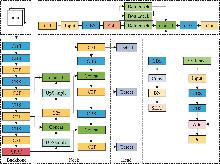
Fig. 1
Network architecture of YOLOv8
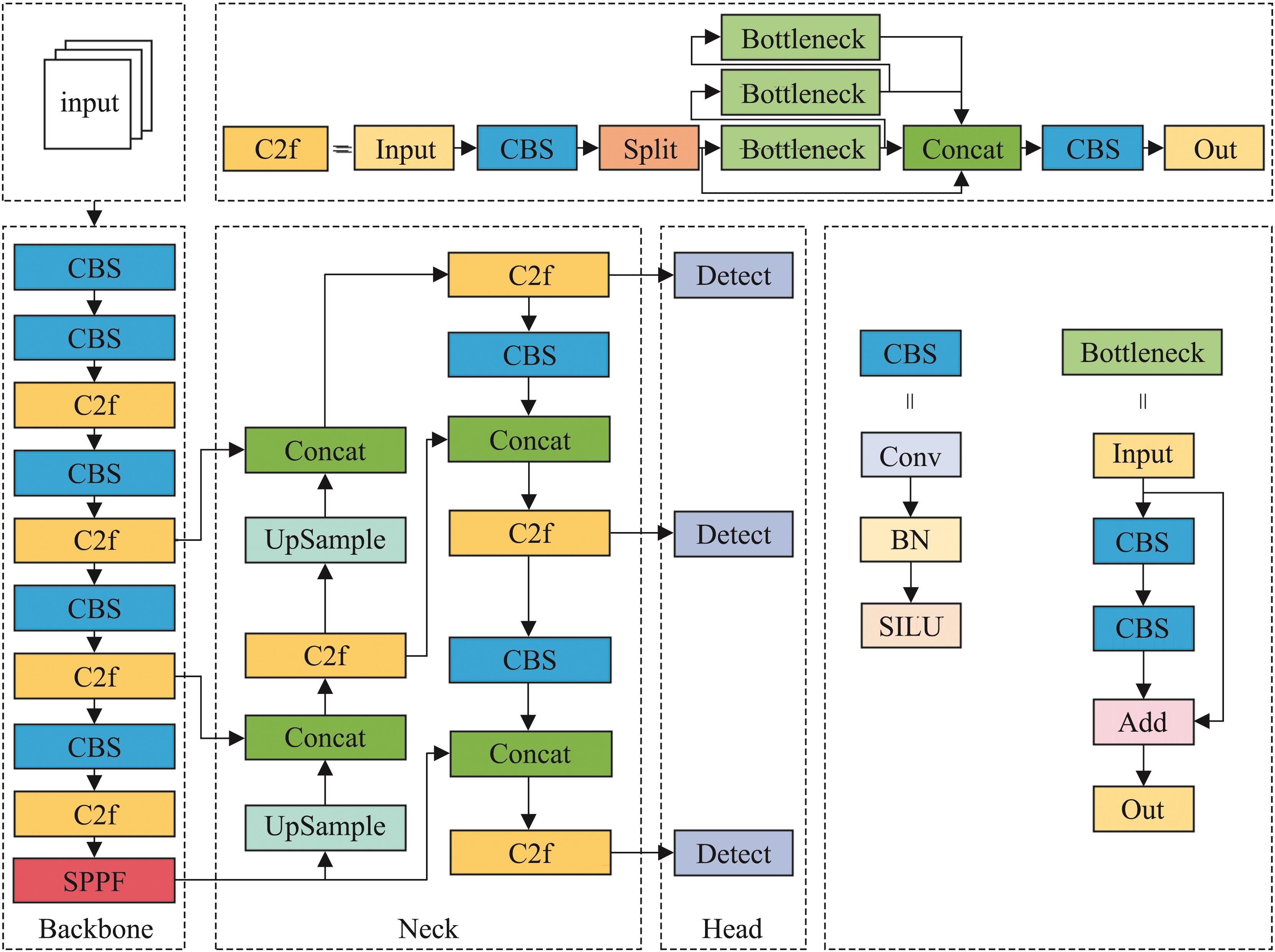
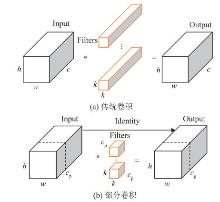
Fig. 2
Comparison between PConv and Conv
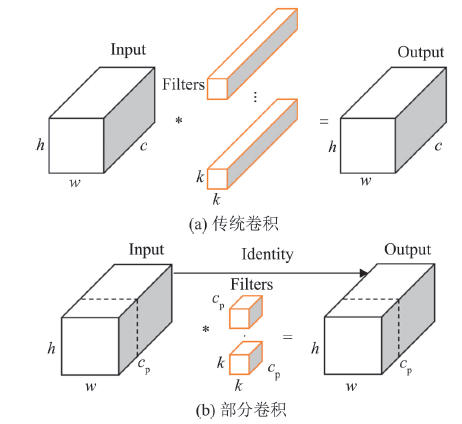
Fig. 3
Bottleneck structure before and after improvement
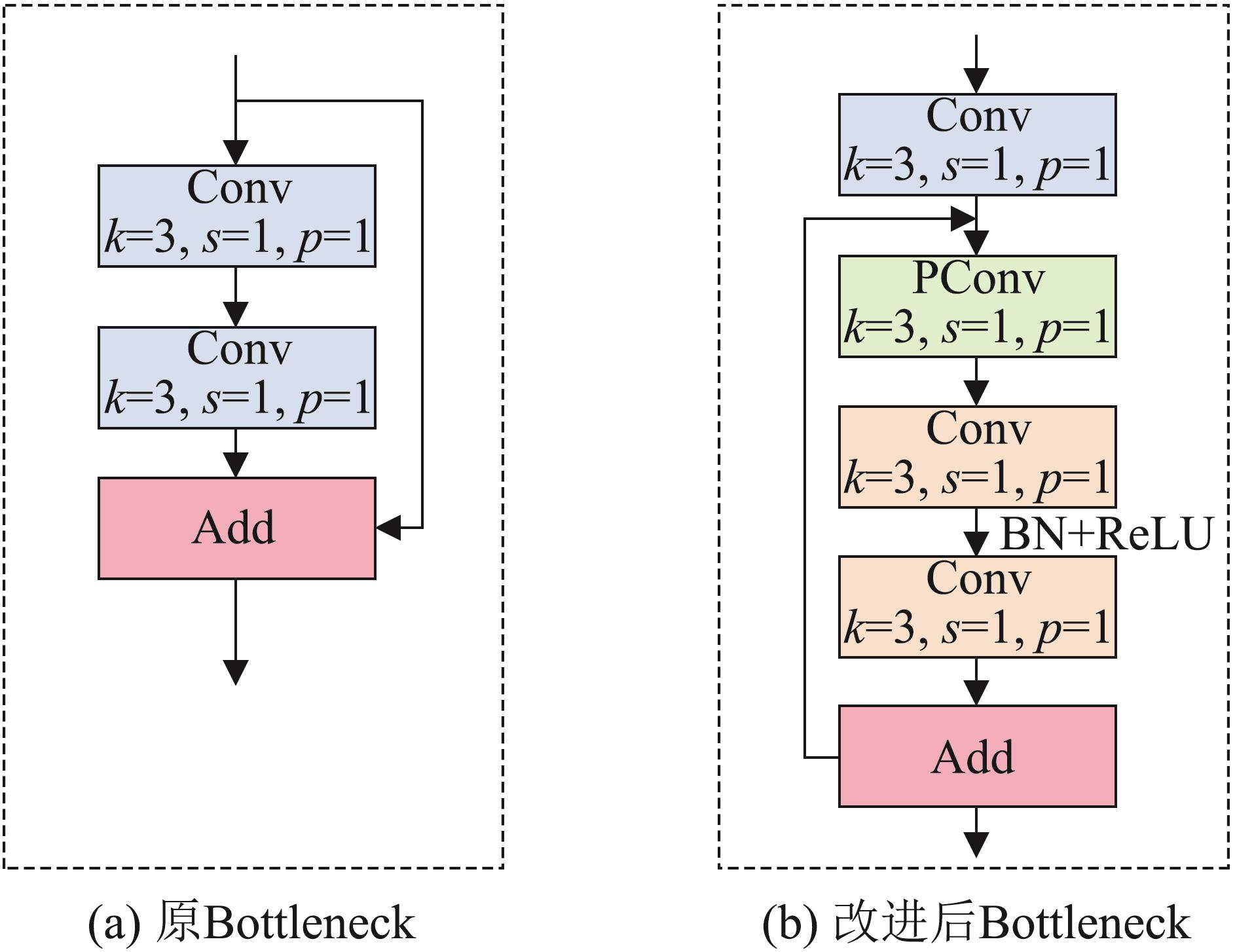
Fig. 4
Structure of C2f module and Faster_C2f module
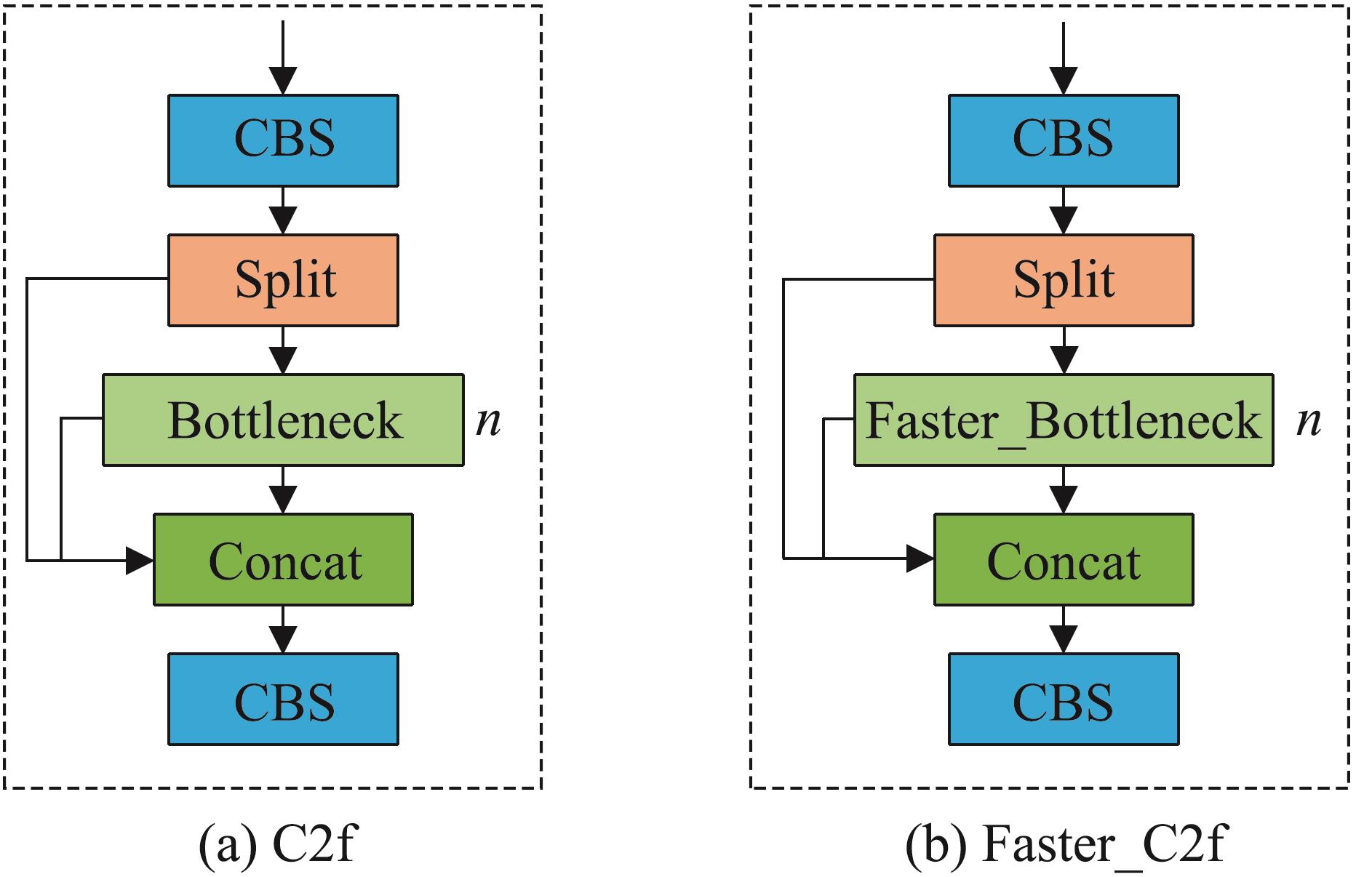
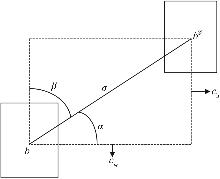
Fig. 5
Scheme for calculation of angle cost contribution to loss function
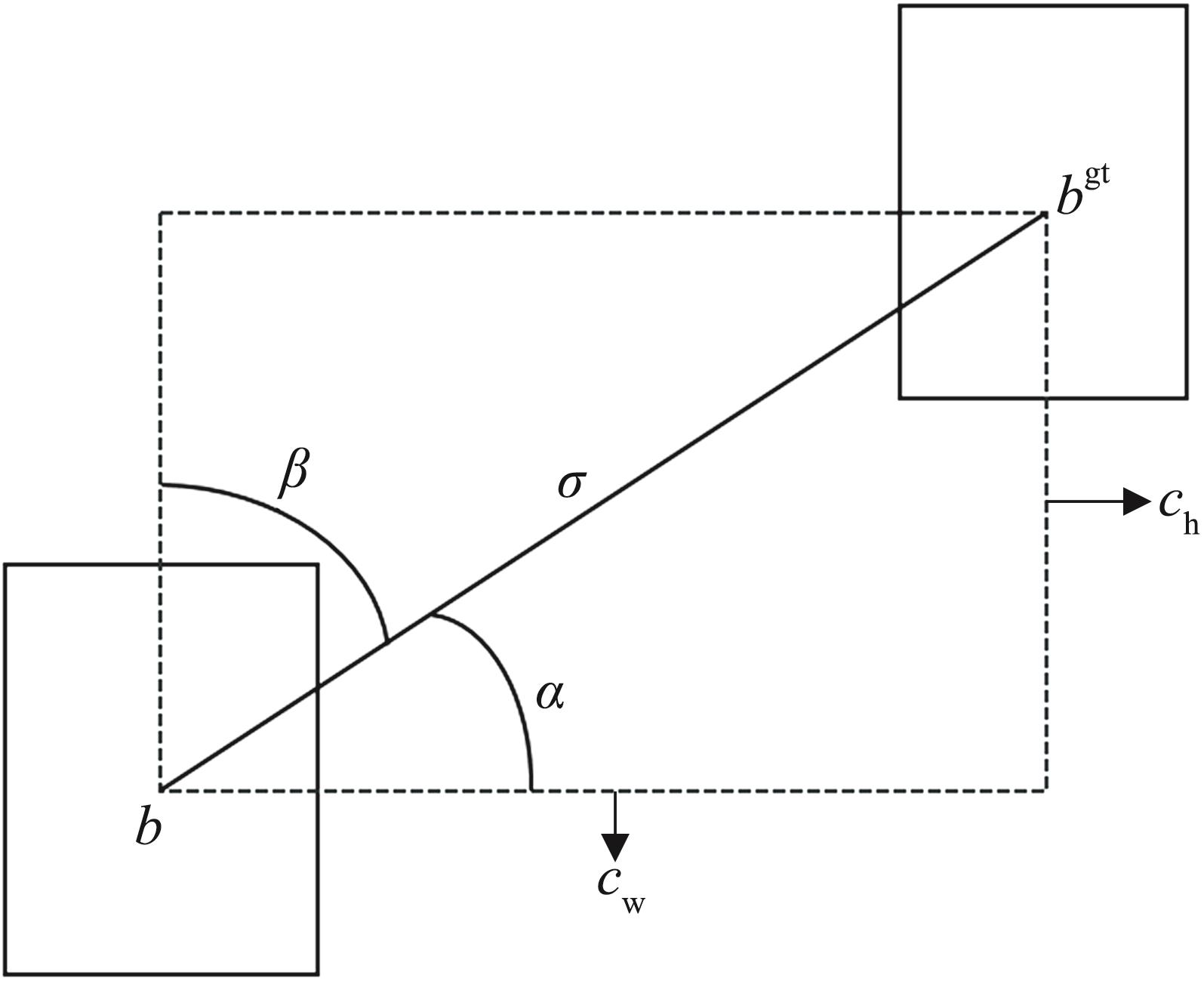
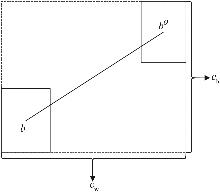
Fig. 6
Scheme for calculation of distance between ground truth bounding box and prediction of it
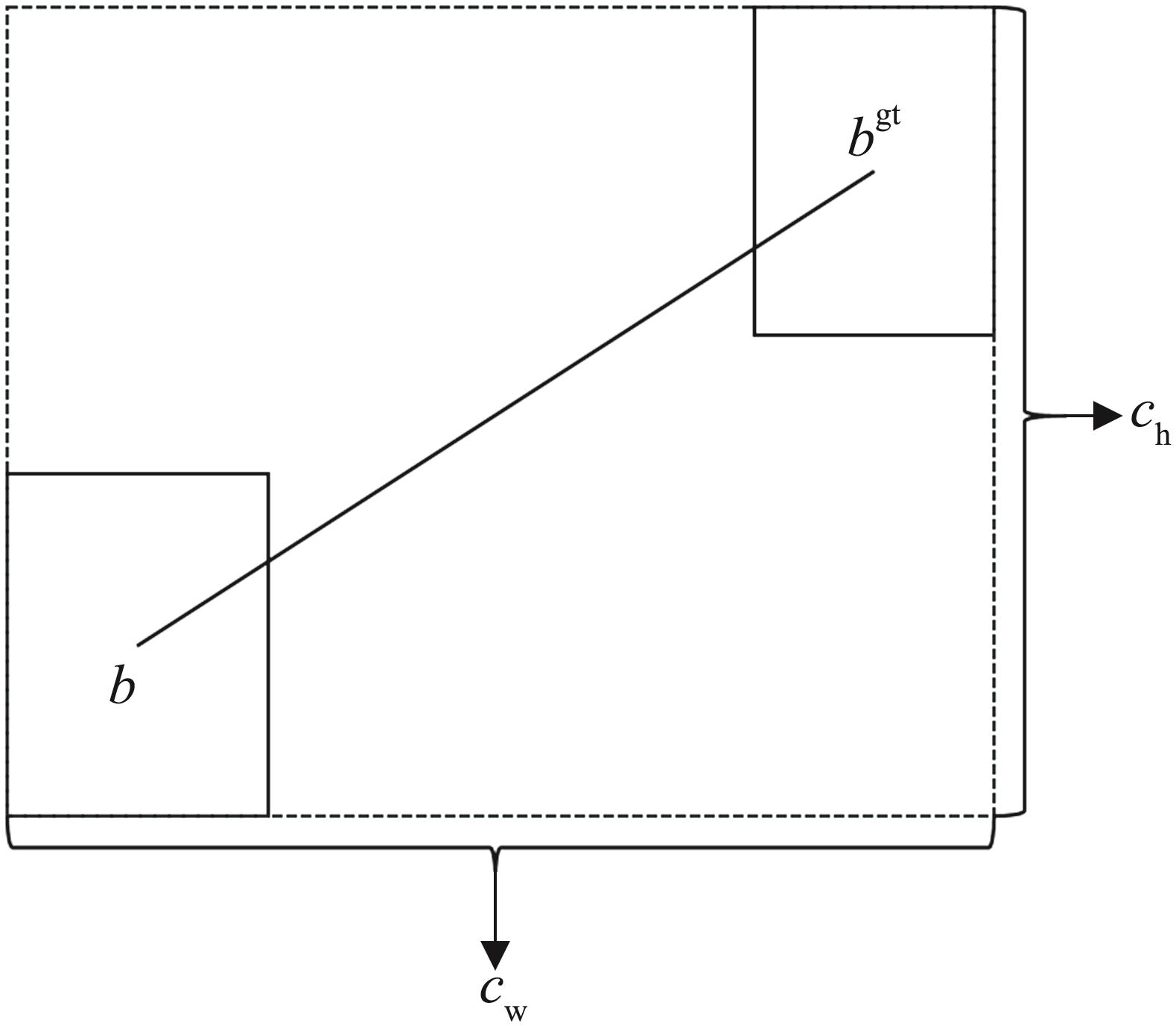
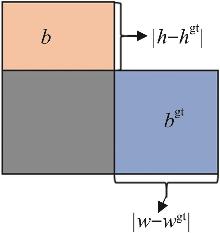
Fig. 7
IoU component contribution to loss function
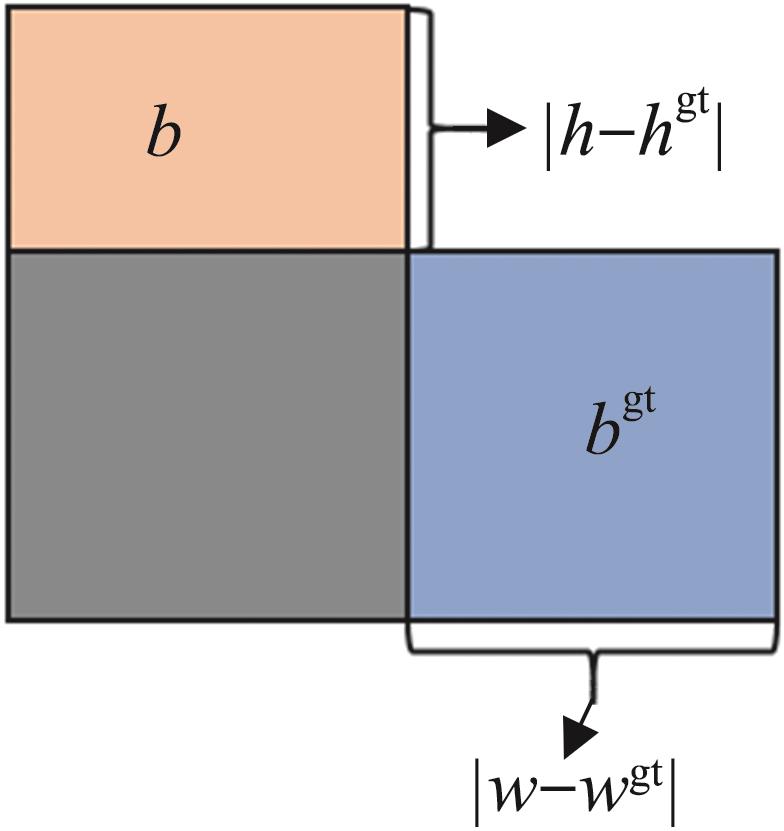
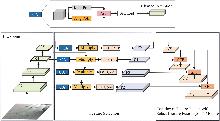
Fig. 8
Structure diagram of high-level selective feature fusion pyramid networks (HS-FPN)
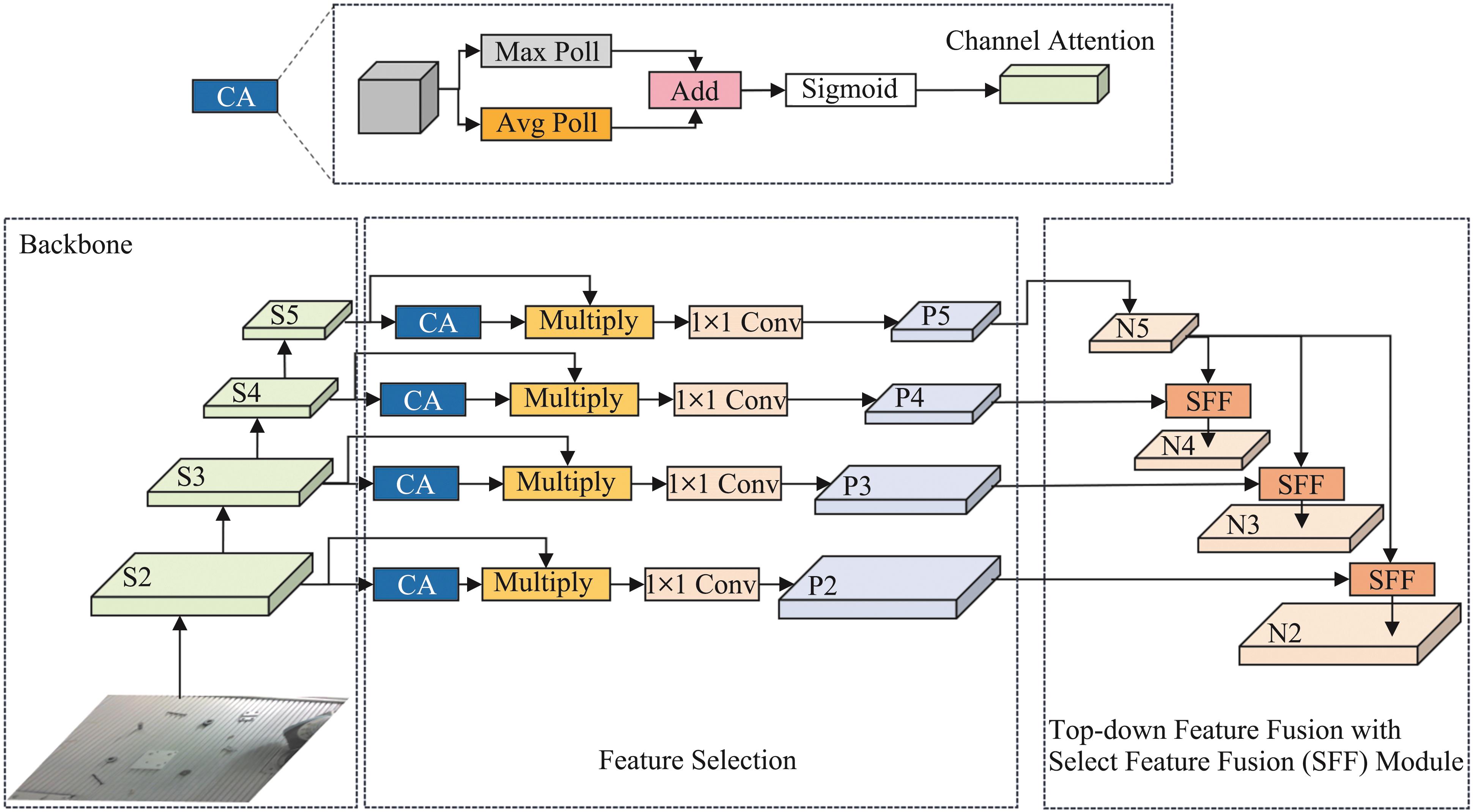
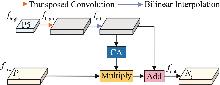
Fig. 9
Framework of selective feature fusion module
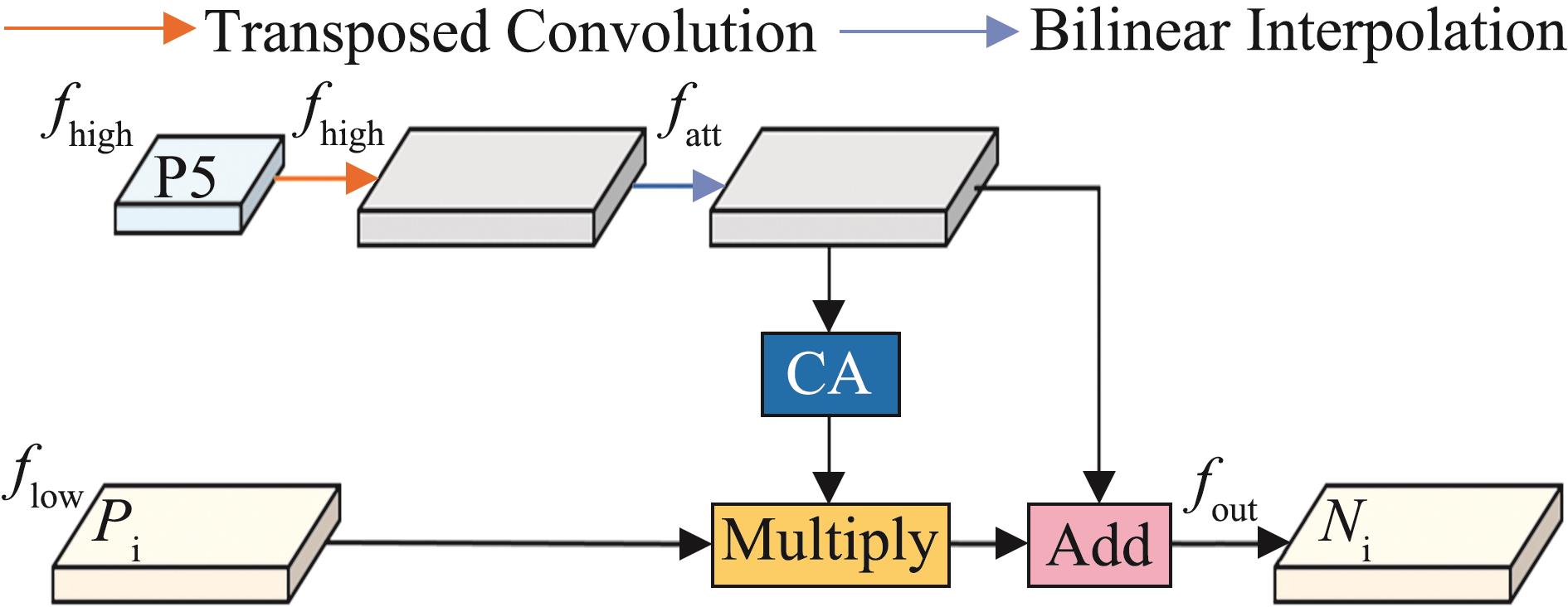
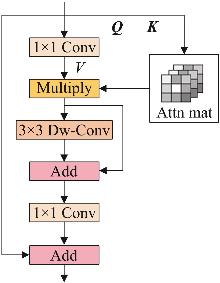
Fig. 10
Paradigm of iRMB structure
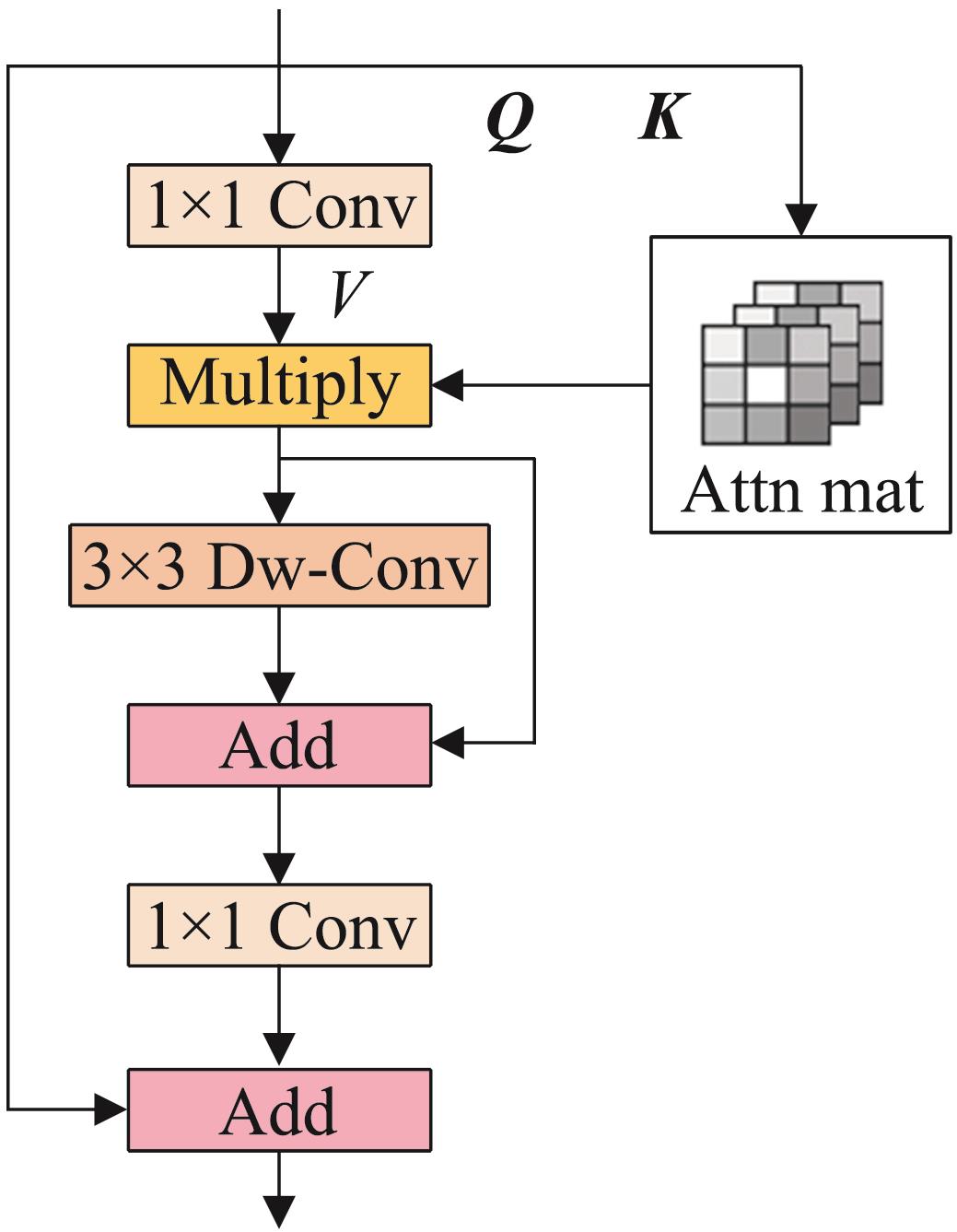
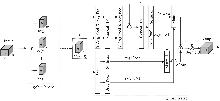
Fig. 11
Schematic diagram of EMA
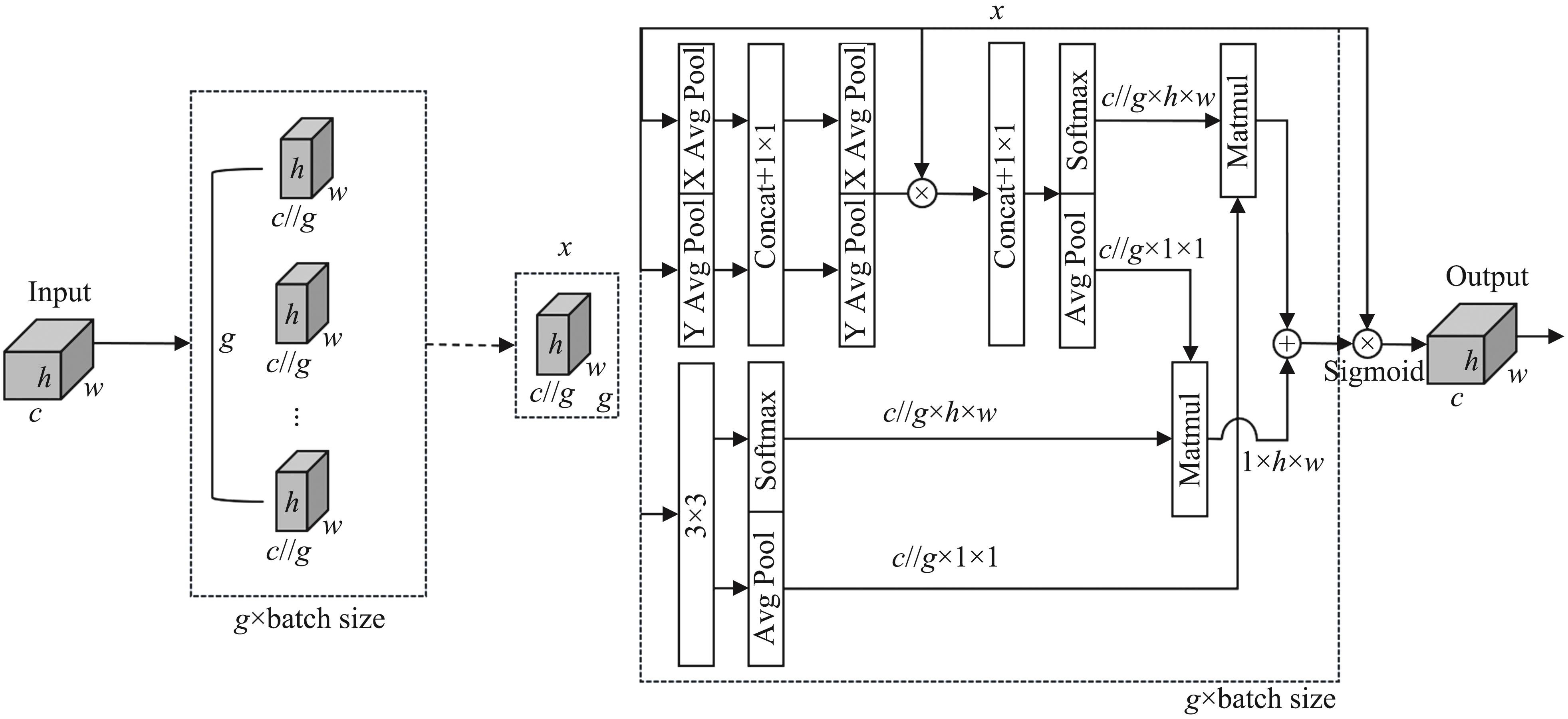
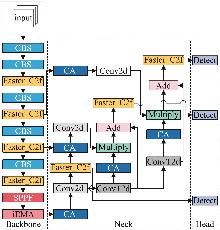
Fig. 12
Improved YOLOv8 network structure diagram
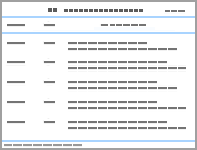
Table 1
Key training parameters and settings
| 参数 | 设置 |
|---|---|
| 训练时长 | 300 |
| 优化器 | AdamW |
| 动量 | 0.9 |
| 学习率 | 0.000 769 |
| 权重衰减 | 0.000 5 |
| 图像大小 | 640×640 |
| 批量大小 | 16 |
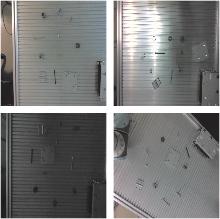
Fig. 13
Dataset examples
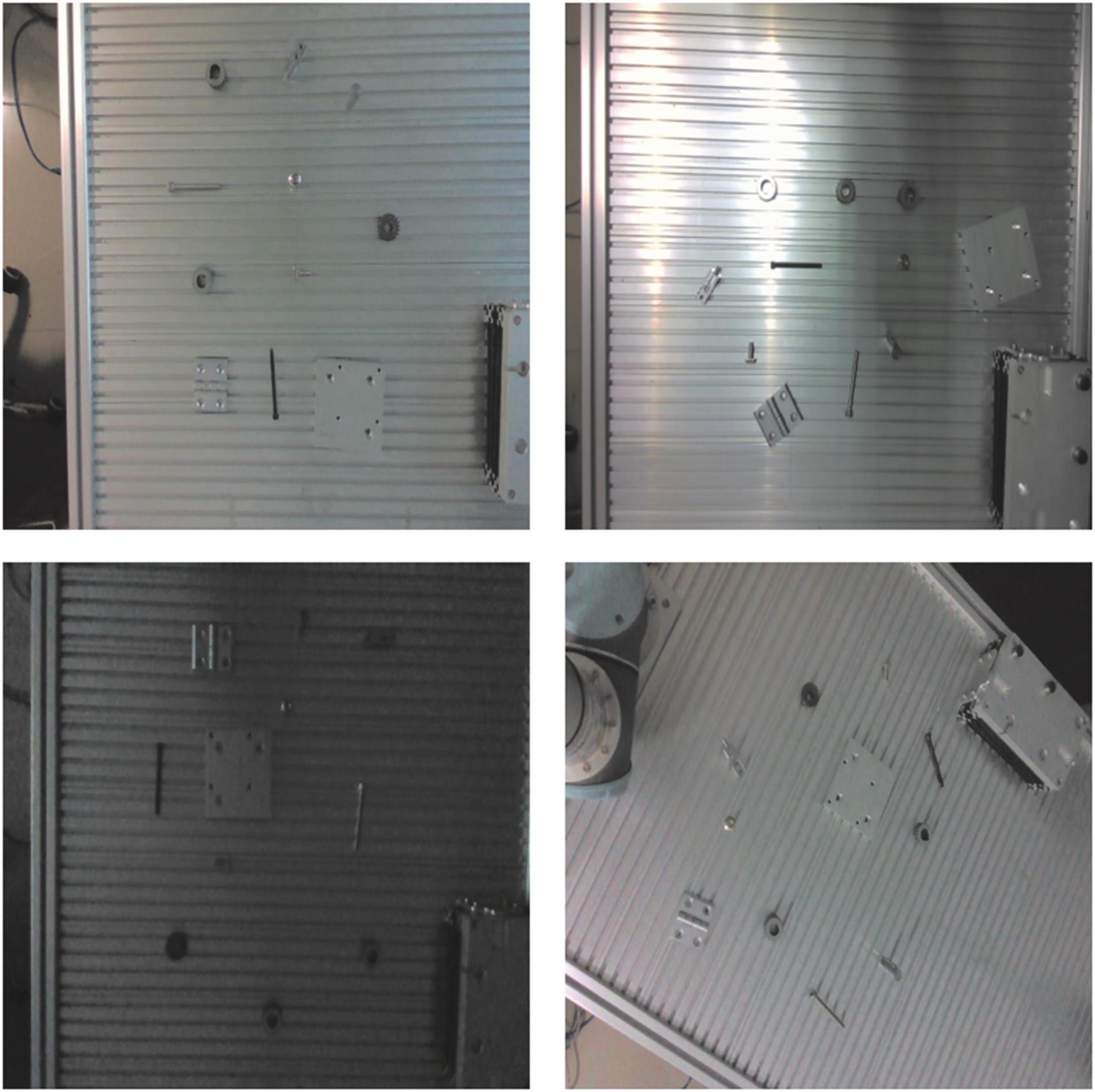
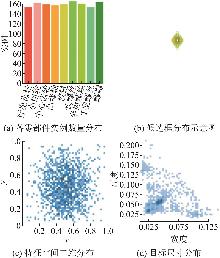
Fig. 14
Label quantity, size, and center point distribution
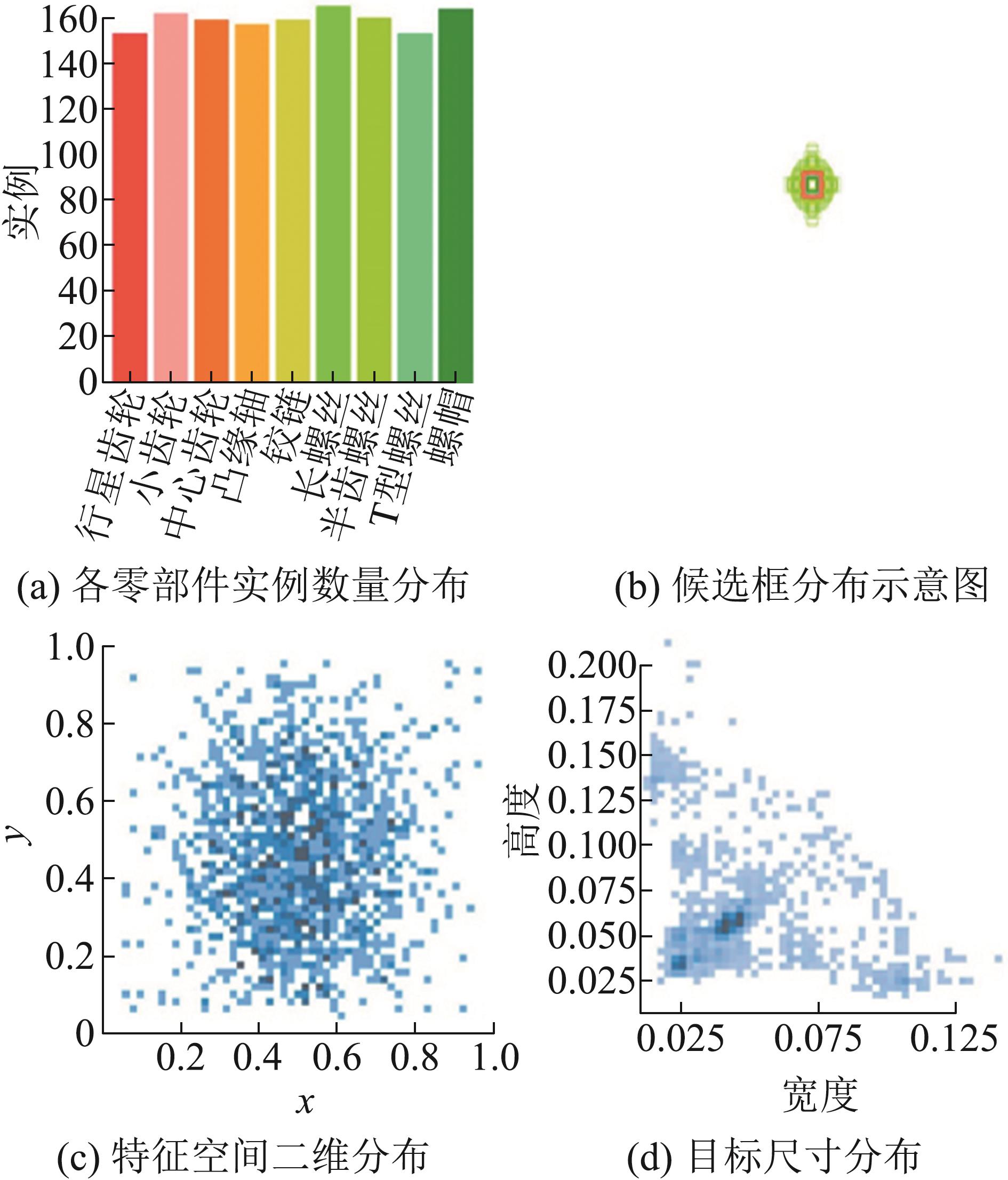
Table 2
Comparison of experimental results of different attention mechanisms
| 模型 | 精确率/% | 召回率/% | F1值/% | 平均精度均值/% | 参数量 | 千兆次浮点计算量 | 帧率/(帧/s) |
|---|---|---|---|---|---|---|---|
| Baseline | 95.0 | 93.7 | 94.3 | 97.2 | 5.6×10⁶ | 19.3 | 78.7 |
| + EMA | 95.0 | 93.8 | 94.3 | 97.1 | 5.6×10⁶ | 19.3 | 76.2 |
| + iRMB | 93.6 | 94.1 | 93.8 | 96.9 | 6.6×10⁶ | 50.3 | 69.5 |
| + CA | 95.8 | 93.3 | 94.5 | 96.7 | 5.7×10⁶ | 19.5 | 72.1 |
| + Biformer[ | 92.6 | 94.7 | 93.6 | 95.8 | 6.6×10⁶ | 60.6 | 71.1 |
| + iEMA | 95.6 | 95.7 | 95.6 | 97.8 | 5.9×10⁶ | 19.6 | 74.6 |
Table 3
Ablation experiment
| 实验 | Faster_C2f | SIoU | HS-FPN | iEMA | 精确率/% | 召回率/% | F1值/% | 平均精度均值/% | 参数量 | 千兆次浮点计算量 | 帧率/(帧/s) |
|---|---|---|---|---|---|---|---|---|---|---|---|
| 1 | 88.0 | 97.3 | 92.4 | 96.1 | 11.1×10⁶ | 28.7 | 67.1 | ||||
| 2 | √ | 93.4 | 92.1 | 92.7 | 95.3 | 9.7×10⁶ | 24.4 | 81.4 | |||
| 3 | √ | 93.7 | 93.4 | 93.5 | 96.3 | 11.1×10⁶ | 28.7 | 67.1 | |||
| 4 | √ | 94.1 | 89.5 | 91.7 | 97.1 | 7.1×10⁶ | 24.4 | 75.2 | |||
| 5 | √ | 93.3 | 92.9 | 93.0 | 96.8 | 11.2×10⁶ | 29.0 | 64.1 | |||
| 6 | √ | √ | 94.2 | 94.0 | 94.1 | 96.4 | 9.7×10⁶ | 24.4 | 81.5 | ||
| 7 | √ | √ | √ | 95.0 | 93.7 | 94.3 | 97.2 | 5.6×10⁶ | 19.3 | 78.7 | |
| 8 | √ | √ | √ | √ | 95.6 | 95.7 | 95.6 | 97.8 | 5.9×10⁶ | 19.6 | 74.6 |
Table 4
Comparative experiments of different algorithms
| 模型 | 精确率/% | 召回率/% | F1值/% | 平均精度均值/% | 参数量 | 千兆次浮点计算量 | 帧率/(帧/s) |
|---|---|---|---|---|---|---|---|
| YOLOv5s | 87.3 | 94.2 | 90.6 | 94.1 | 7.2 | 16.5 | 73.0 |
| YOLOv7-tiny[ | 83.9 | 87.1 | 85.5 | 88.9 | 6.0 | 13.2 | 80.0 |
| GOLD-YOLO[ | 93.1 | 90.8 | 91.6 | 91.2 | 5.6 | 12.1 | 86.4 |
| RT-DERT[ | 95.3 | 92.3 | 93.8 | 93.8 | 42.8 | 130.5 | 19.3 |
| YOLOv8s | 88.0 | 97.3 | 92.4 | 96.1 | 11.1 | 28.7 | 67.1 |
| Ours | 95.6 | 95.7 | 95.6 | 97.8 | 5.9 | 19.6 | 74.6 |
Fig. 15
Comparison of heatmaps
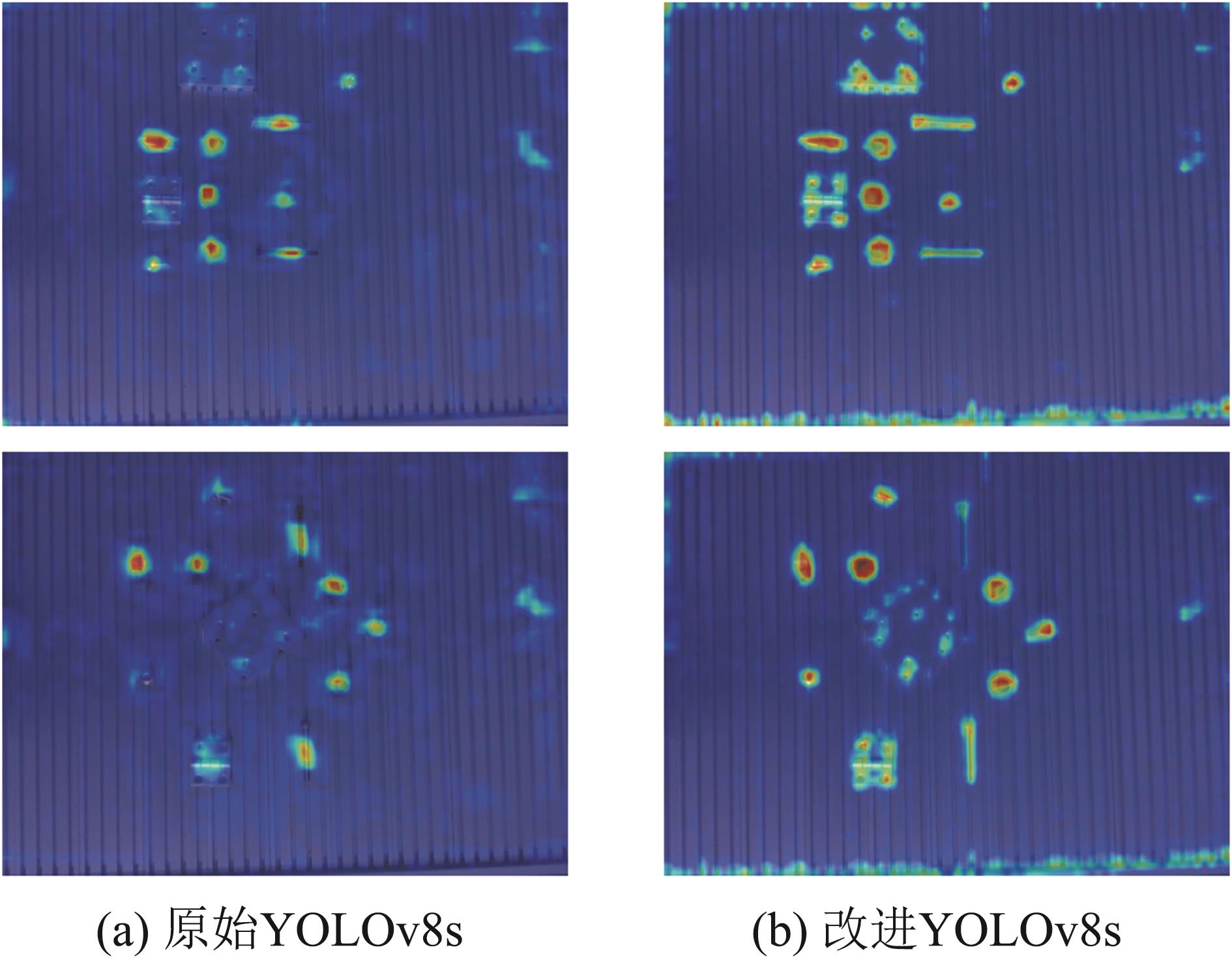
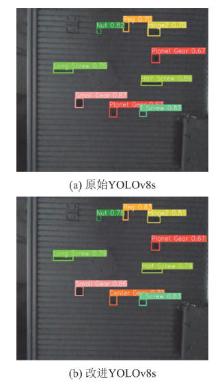
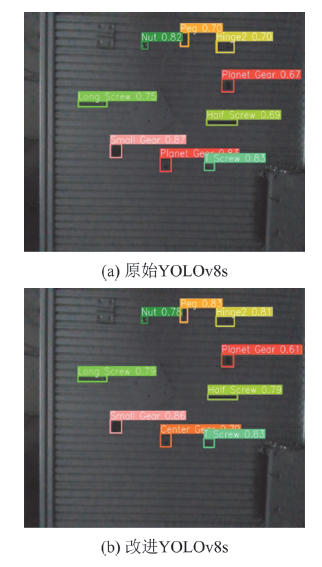
Fig. 16
Comparison of detection results
| [1] | 刘检华, 孙清超, 程晖, 等. 产品装配技术的研究现状、技术内涵及发展趋势[J]. 机械工程学报, 2018, 54(11): 1-28. |
| Liu Jianhua, Sun Qingchao, Cheng Hui, et al. The State-of-the-art, Connotation and Developing Trends of the Products Assembly Technology[J]. Journal of Mechanical Engineering, 2018, 54(11): 1-28. | |
| [2] | 王耀南, 江一鸣, 姜娇, 等. 机器人感知与控制关键技术及其智能制造应用[J]. 自动化学报, 2023, 49(3): 494-513. |
| Wang Yaonan, Jiang Yiming, Jiang Jiao, et al. Key Technologies of Robot Perception and Control and Its Intelligent Manufacturing Applications[J]. Acta Automatica Sinica, 2023, 49(3): 494-513. | |
| [3] | Les Tomasz, Kruk Michal, Osowski Stanislaw. Automatic Recognition of Industrial Tools Using Artificial Intelligence Approach[J]. Expert Systems with Applications, 2013, 40(12): 4777-4784. |
| [4] | Paramarthalingam Arjun, Mirnalinee T T. Machine Parts Recognition and Defect Detection in Automated Assembly Systems Using Computer Vision Techniques[J]. Revista Tecnica De La Facultad De Ingenieria Universidad Del Zulia, 2016, 39(1): 71-80. |
| [5] | Song Rui, Li Fengming, Quan Wei, et al. Skill Learning for Robotic Assembly Based on Visual Perspectives and Force Sensing[J]. Robotics and Autonomous Systems, 2021, 135: 103651. |
| [6] | Wang Xi, Jaume Soriano Pinter, Liu Zhihao, et al. A Machine Learning-based Image Processing Approach for Robotic Assembly System[J]. Procedia CIRP, 2021, 104: 906-911. |
| [7] | Li Jing, Gu Jinan, Huang Zedong, et al. Application Research of Improved YOLO V3 Algorithm in PCB Electronic Component Detection[J]. Applied Sciences, 2019, 9(18): 3750. |
| [8] | Chen Chengjun, Wang Tiannuo, Li Dongnian, et al. Repetitive Assembly Action Recognition Based on Object Detection and Pose Estimation[J]. Journal of Manufacturing Systems, 2020, 55: 325-333. |
| [9] | Chen Wenbai, Yang Genjian, Zhang Bo, et al. Lightweight and Fast Visual Detection Method for 3C Assembly[J]. Displays, 2024, 82: 102631. |
| [10] | Chen Jierun, Kao S H, He Hao, et al. Run, Don't Walk: Chasing Higher FLOPS for Faster Neural Networks[C]//2023 IEEE/CVF Conference on Computer Vision and Pattern Recognition (CVPR). Piscataway: IEEE, 2023: 12021-12031. |
| [11] | Chen Yifei, Zhang Chenyan, Chen Ben, et al. Accurate Leukocyte Detection Based on Deformable-DETR and Multi-level Feature Fusion for Aiding Diagnosis of Blood Diseases[J]. Computers in Biology and Medicine, 2024, 170: 107917. |
| [12] | Zhang Jiangning, Li Xiangtai, Li Jian, et al. Rethinking Mobile Block for Efficient Attention-based Models[C]//2023 IEEE/CVF International Conference on Computer Vision (ICCV). Piscataway: IEEE, 2023: 1389-1400. |
| [13] | Ouyang Daliang, He Su, Zhang Guozhong, et al. Efficient Multi-scale Attention Module with Cross-spatial Learning[C]//ICASSP 2023 - 2023 IEEE International Conference on Acoustics, Speech and Signal Processing (ICASSP). Piscataway: IEEE, 2023: 1-5. |
| [14] | Zhang Haoyang, Wang Ying, Dayoub Feras, et al. VarifocalNet: An IoU-aware Dense Object Detector[C]//2021 IEEE/CVF Conference on Computer Vision and Pattern Recognition (CVPR). Piscataway: IEEE, 2021: 8510-8519. |
| [15] | Li Xiang, Wang Wenhai, Wu Lijun, et al. Generalized Focal Loss: Learning Qualified and Distributed Bounding Boxes for Dense Object Detection[C]//Proceedings of the 34th International Conference on Neural Information Processing Systems. Red Hook: Curran Associates Inc., 2020: 21002-21012. |
| [16] | Yu Jiahui, Jiang Yuning, Wang Zhangyang, et al. UnitBox: An Advanced Object Detection Network[C]//Proceedings of the 24th ACM International Conference on Multimedia. New York: ACM, 2016: 516-520. |
| [17] | Rezatofighi H, Tsoi N, Gwak J Y, et al. Generalized Intersection Over Union: A Metric and a Loss for Bounding Box Regression[C]//2019 IEEE/CVF Conference on Computer Vision and Pattern Recognition (CVPR). Piscataway: IEEE, 2019: 658-666. |
| [18] | Zheng Zhaohui, Wang Ping, Liu Wei, et al. Distance-IoU Loss: Faster and Better Learning for Bounding Box Regression[C]//Proceedings of the AAAI Conference on Artificial Intelligence. Palo Alto: AAAI Press, 2020: 12993-13000. |
| [19] | Lin T Y, Dollár Piotr, Girshick R, et al. Feature Pyramid Networks for Object Detection[C]//2017 IEEE Conference on Computer Vision and Pattern Recognition (CVPR). Piscataway: IEEE, 2017: 936-944. |
| [20] | Liu Shu, Qi Lu, Qin Haifang, et al. Path Aggregation Network for Instance Segmentation[C]//2018 IEEE/CVF Conference on Computer Vision and Pattern Recognition. Piscataway: IEEE, 2018: 8759-8768. |
| [21] | Li Yanyu, Hu Ju, Wen Yang, et al. Rethinking Vision Transformers for MobileNet Size and Speed[C]//2023 IEEE/CVF International Conference on Computer Vision (ICCV). Piscataway: IEEE, 2023: 16843-16854. |
| [22] | Zhu Lei, Wang Xinjiang, Ke Zhanghan, et al. BiFormer: Vision Transformer with Bi-level Routing Attention[C]//2023 IEEE/CVF Conference on Computer Vision and Pattern Recognition (CVPR). Piscataway: IEEE, 2023: 10323-10333. |
| [23] | Wang C Y, Bochkovskiy A, Liao Hongyuan. YOLOv7: Trainable Bag-of-freebies Sets New State-of-the-art for Real-time Object Detectors[C]//2023 IEEE/CVF Conference on Computer Vision and Pattern Recognition (CVPR). Piscataway: IEEE, 2023: 7464-7475. |
| [24] | Wang Chengcheng, He Wei, Nie Ying, et al. Gold-YOLO: Efficient Object Detector via Gather-and-distribute Mechanism[C]//Proceedings of the 37th International Conference on Neural Information Processing Systems. Red Hook: Curran Associates Inc., 2023: 51094-51112. |
| [25] | Zhao Yian, Wenyu Lü, Xu Shangliang, et al. DETRs Beat YOLOs on Real-time Object Detection[C]//2024 IEEE/CVF Conference on Computer Vision and Pattern Recognition (CVPR). Piscataway: IEEE, 2024: 16965-16974. |
| [26] | Selvaraju R R, Cogswell M, Das A, et al. Grad-CAM: Visual Explanations from Deep Networks via Gradient-based Localization[C]//2017 IEEE International Conference on Computer Vision (ICCV). Piscataway: IEEE, 2017: 618-626. |
| [1] | Chen Yanjun, Zhou Min, Zha Meng, Zhang Meizhou. Research and Analysis of Algorithm for Detecting Surface Defects on Automotive Wheel Hubs Based on CCL-YOLOv8 [J]. Journal of System Simulation, 2026, 38(3): 670-686. |
| [2] | Li Xinyi, Wang Zhenfei, Wu Han. Research on UAV Target Tracking Algorithm for Simulation Scenarios [J]. Journal of System Simulation, 2026, 38(2): 346-359. |
| [3] | Yang Can, Chen Kai, Zhu Feng. Reinforcement Learning Based Method for UAV Team Orienteering Optimization under Multi-constraint Condition [J]. Journal of System Simulation, 2026, 38(2): 360-371. |
| [4] | Zhu He, Zhou Feng, Zhang Qi, Zhu Mengxiao, Dai Ju. PL-Mamba: A 3D Point Cloud Semantic Segmentation Network Based on Bimodal Fusion [J]. Journal of System Simulation, 2026, 38(1): 73-83. |
| [5] | Jiang Ming, He Tao. Solving the Vehicle Routing Problem Based on Deep Reinforcement Learning [J]. Journal of System Simulation, 2025, 37(9): 2177-2187. |
| [6] | Jiang Yanji, Zhang Yingyang, Dong Hao, Zhang Xiaoguang, Wang Meihui. Lane Detection in Dark Light Based on Instance Association [J]. Journal of System Simulation, 2025, 37(9): 2188-2199. |
| [7] | Lu Bin, Yang Xuan, Yang Zhenyu, Gao Xiaotian. Adaptive Sampling and Ghost Multi-scale Fusion for Lightweight Weld Defect Detection [J]. Journal of System Simulation, 2025, 37(8): 1978-1990. |
| [8] | Li Mingyu, Lin Jiaquan. Lightweight Driver Face Object Detection Algorithm Based on YOLOv8-DF [J]. Journal of System Simulation, 2025, 37(8): 2103-2114. |
| [9] | Liu Zilong, Zhang Lei. Detection of Small Apple Targets Based on Improved YOLOv5 in Natural Environments [J]. Journal of System Simulation, 2025, 37(8): 2124-2138. |
| [10] | Yang Lu, Pei Junying. Aerial Target Detection Algorithm Fused with Multi-scale Features [J]. Journal of System Simulation, 2025, 37(6): 1486-1498. |
| [11] | Wang Ziyi, Zhang Kai, Qian Dianwei, Liu Yuzhen. A DRL⁃based Approach for Distributed Equipment Nodes Selection [J]. Journal of System Simulation, 2025, 37(6): 1565-1573. |
| [12] | Wu Guohua, Zeng Jiaheng, Wang Dezhi, Zheng Long, Zou Wei. A Quadrotor Trajectory Tracking Control Method Based on Deep Reinforcement Learning [J]. Journal of System Simulation, 2025, 37(5): 1169-1187. |
| [13] | Wang Xiang, Tan Guozhen. Research on Decision-making of Autonomous Driving in Highway Environment Based on Knowledge and Large Language Model [J]. Journal of System Simulation, 2025, 37(5): 1246-1255. |
| [14] | Li Jie, Liu Yang, Li Liang, Su Bengan, Wei Jialong, Zhou Guangda, Shi Yanmin, Zhao Zhen. Remote Sensing Small Object Detection Based on Cross-stage Two-branch Feature Aggregation [J]. Journal of System Simulation, 2025, 37(4): 1025-1040. |
| [15] | Zheng Lanyue, Zhang Yujie. Traffic Signal Detection Based on Improved YOLOv7 [J]. Journal of System Simulation, 2025, 37(4): 993-1007. |
| Viewed | ||||||
|
Full text |
|
|||||
|
Abstract |
|
|||||
 http://www.china-simulation.com

