

Journal of System Simulation ›› 2026, Vol. 38 ›› Issue (8): 2132-2151.doi: 10.16182/j.issn1004731x.joss.26-0115E
• Special Columns:Simulaiton-based Optimization and its Applications in Modern Power Systems • Previous Articles
Zhang Yuanxing1, Li Jianfeng1, Li Taoyong1, Zhang Linjuan2, Liu Jincheng1, Li Bin1
Received:2026-02-02
Revised:2026-03-23
Online:2026-08-28
Published:2026-08-31
About author:Zhang Yuanxing (1988-), male, Senior Engineer, master, research area: vehicle-grid interaction technology.
Supported by:CLC Number:
Zhang Yuanxing, Li Jianfeng, Li Taoyong, Zhang Linjuan, Liu Jincheng, Li Bin. Bi-level Coordinated Scheduling and Optimization of Power Systems Based on Stackelberg-GMO[J]. Journal of System Simulation, 2026, 38(8): 2132-2151.
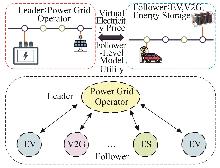
Fig. 1
Game model framework
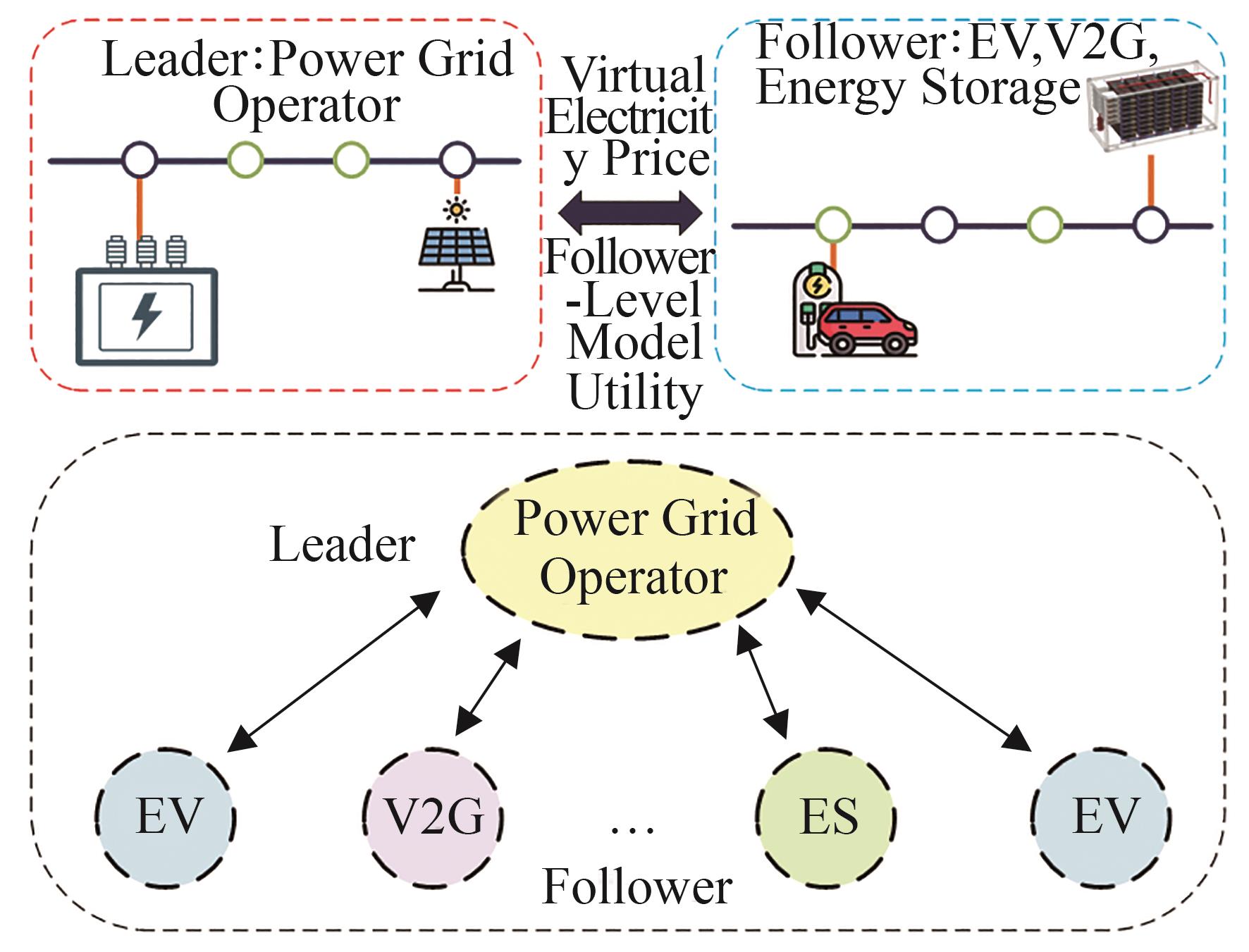

Table 1
Core implementation steps
| Step | Step description |
|---|---|
| 1 | Scenario preprocessing: Generate a set of typical photovoltaic output scenarios and a set of EV spatio-temporal distribution scenarios, and determine the probability of each scenario and the equipment operating parameters |
| 2 | Upper-level initialization: Generate a population of virtual electricity prices that satisfy the lower and upper bound constraints, and initialize the agent positions Xi,0 and velocities Vi,0 |
| 3 | Lower-level initialization: For each upper-level virtual electricity price agent, generate initial EV/V2G/energy storage charging and discharging power schemes that satisfy the technical and user constraints by incorporating the EV spatio-temporal parameters and energy storage life constraints, and set the initial SOC values |
| 4 | Calculation of the upper-level objective function: Based on the current virtual electricity price λt,v, calculate the expected fitness value under multiple scenarios and record the individual best and global best solutions |
| 5 | Lower-level response optimization: Using the upper-level virtual electricity price as input, construct a DR model incorporating EV spatio-temporal constraints and energy storage life constraints, and solve for the optimal charging and discharging power of each participant |
| 6 | Calculation of the DFI in GMO: Collect the individual best fitness values under multiple scenarios, calculate their mean and standard deviation, and then obtain the membership function values and the DFI |
| 7 | Generation and mutation of the GMO global guidance vector: Calculate the global guidance vector Yi,k and perform Gaussian mutation |
| 8 | Update of GMO agent positions and velocities: Update the velocity Vi,k+1 and position Xi,k+1 , and verify the boundary constraints |
| 9 | Update of the individual best and global best solutions: Compare the expected objective values under multiple scenarios after the update. If the updated values are better than the historical values, update the individual best solution. Then, examine all individual best solutions and select the solution with the maximum objective value as the global best solution |
| 10 | Convergence assessment: If ‖ |
| 11 | Equilibrium assessment: Determine whether the game has reached equilibrium. If not, return to Step 4; otherwise, output the optimal solution |
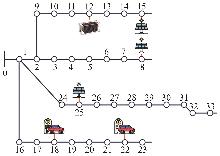
Fig. 2
Network topology
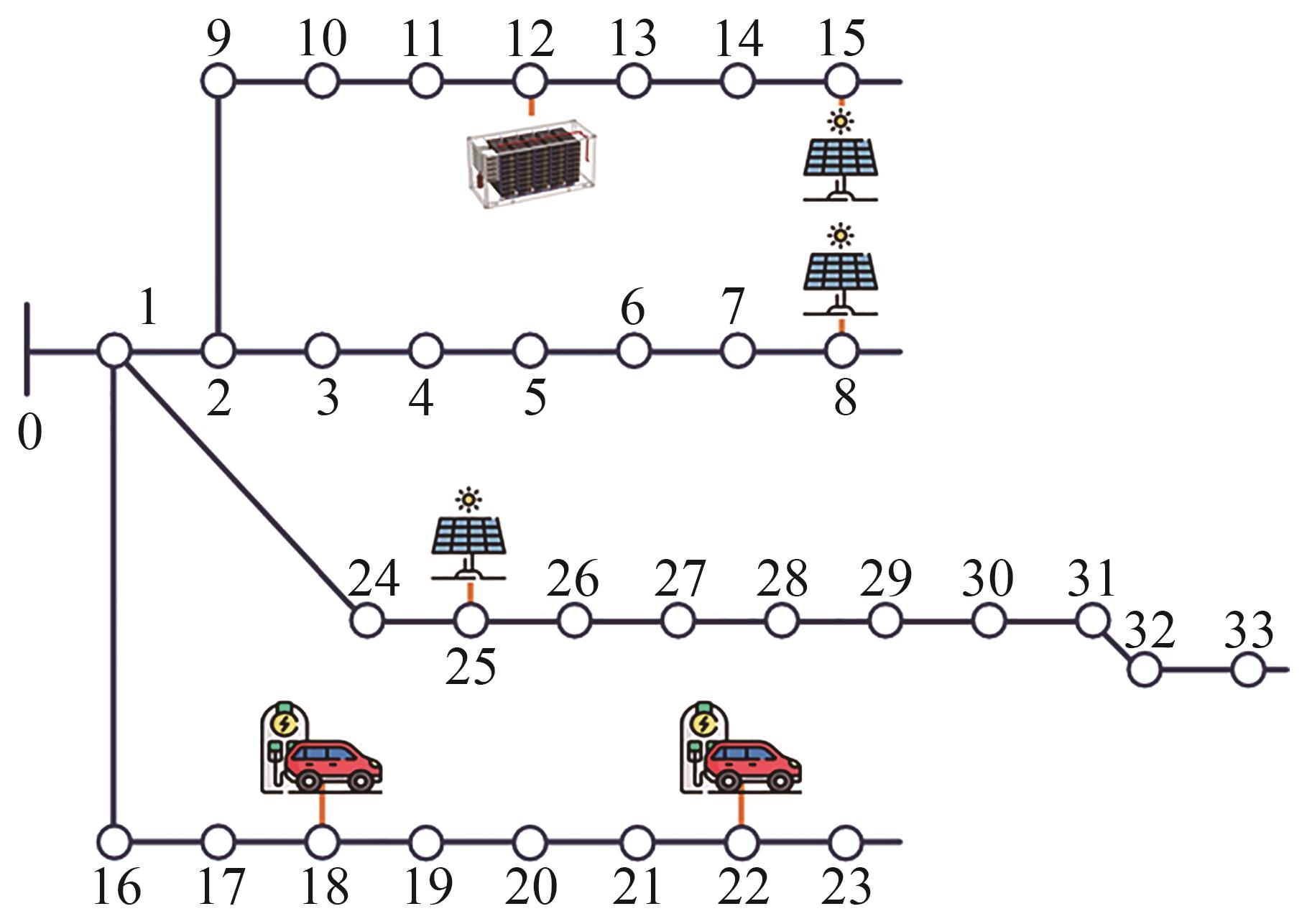
Fig. 3
Typical-day photovoltaic and load curves
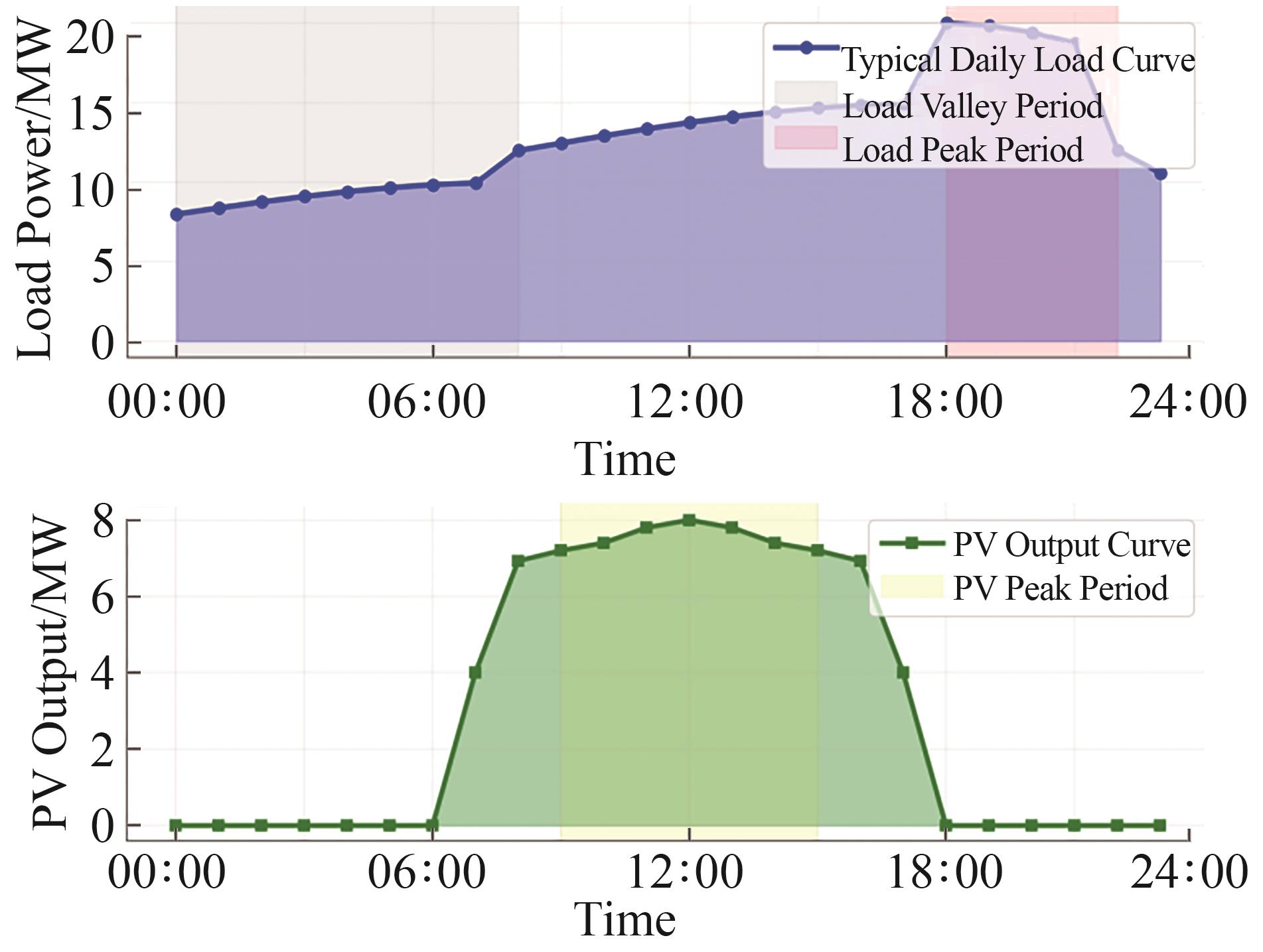
Table 2
Equipment operating parameters
| Parameter | Value |
|---|---|
| Pg,max/MW | 20 |
| Pg,min/MW | 3 |
| Rg,up/down/(MW·h) | 2 |
| ei | 0.8 kg CO2/kW·h |
| kcur/(yuan/kW·h) | 0.2 |
| Ei,bat(Energy storage)/(MW·h) | 8 |
| Pi,c/Pi,d(Energy storage)/MW | 4 |
| ηc/ηd(Energy storage /EV) | 90% |
| Ei,bat (EV)/(kW·h) | 60 |
| Pi,c/Pi,d (EV)/kW | 7 |
Table 3
Key economic parameters
| Parameter | Value |
|---|---|
| α | 0.06 yuan/kg CO2 |
| ci,deg/(yuan/(kW·h)) | 0.08 |
| ki,com | 20 yuan per SOC deviation unit |
| αi,c | 0.8 kg CO2/kW·h |
| αi,d/(yuan/(kW·h)) | 0.2 |
| βi,c/(yuan/(kW·h)) | 0.05 |
| βi,d/(yuan/(kW·h)) | 0.1 |
| ωi,1 | 0.5 |
| ωi,2 | 0.3 |
| ωi,3 | 0.2 |
| μi,1 | 0.7 |
| μi,2 | 0.3 |
Fig. 4
Comparison of algorithm convergence
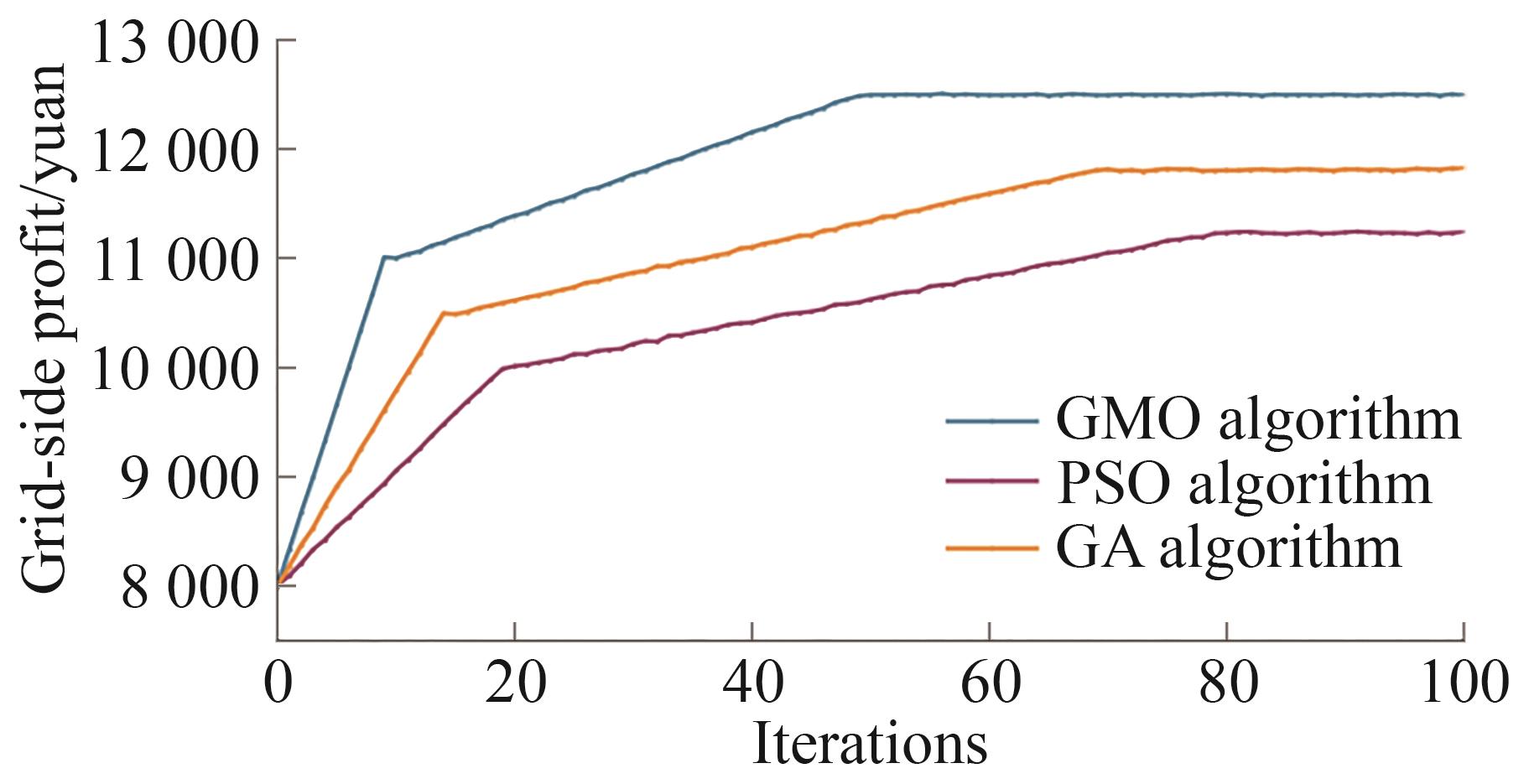
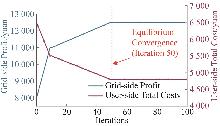
Fig. 5
Convergence trajectory of leader-follower game
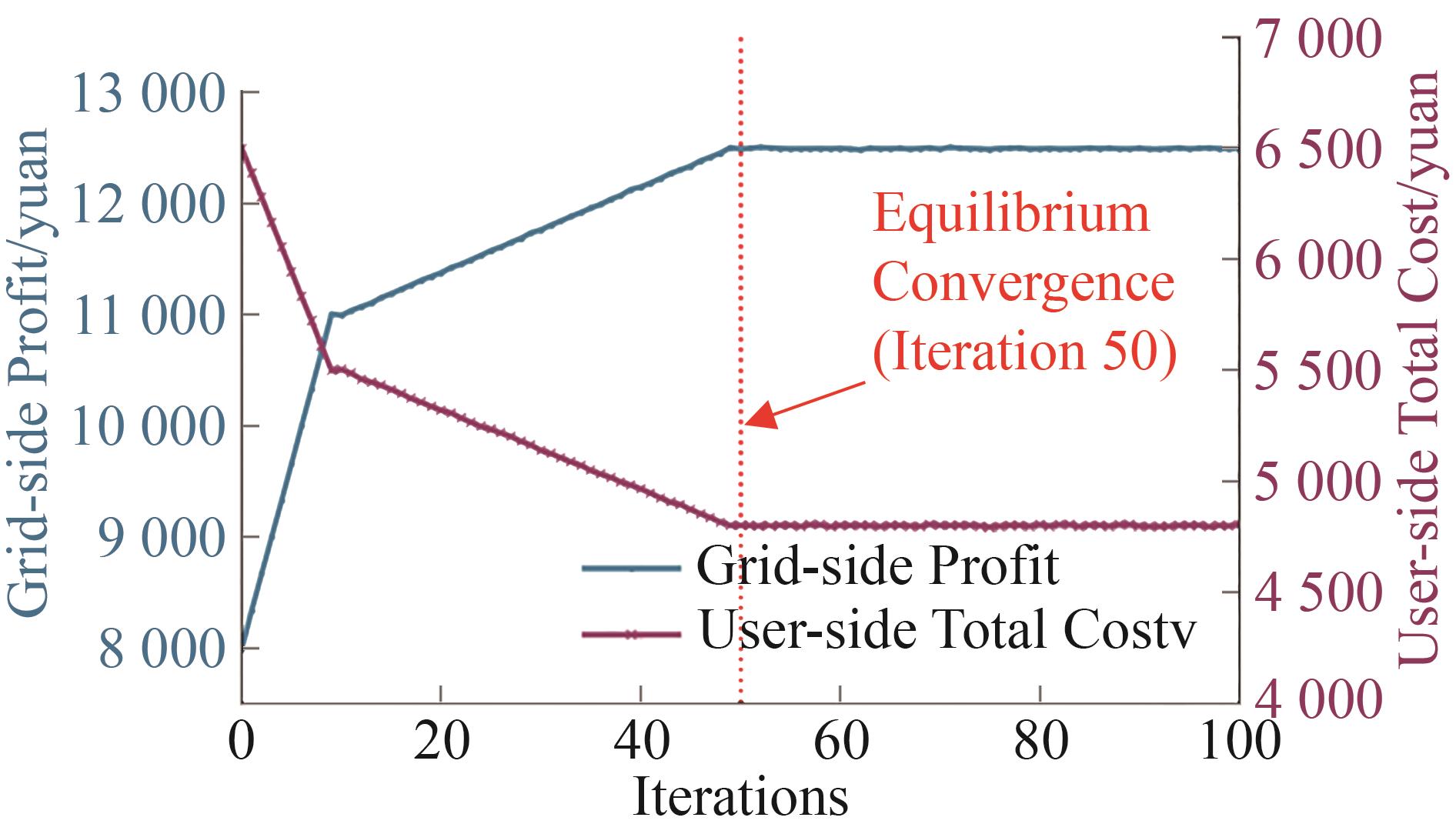
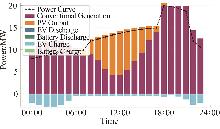
Fig. 6
Power distribution map under uncoordinated operation before optimization
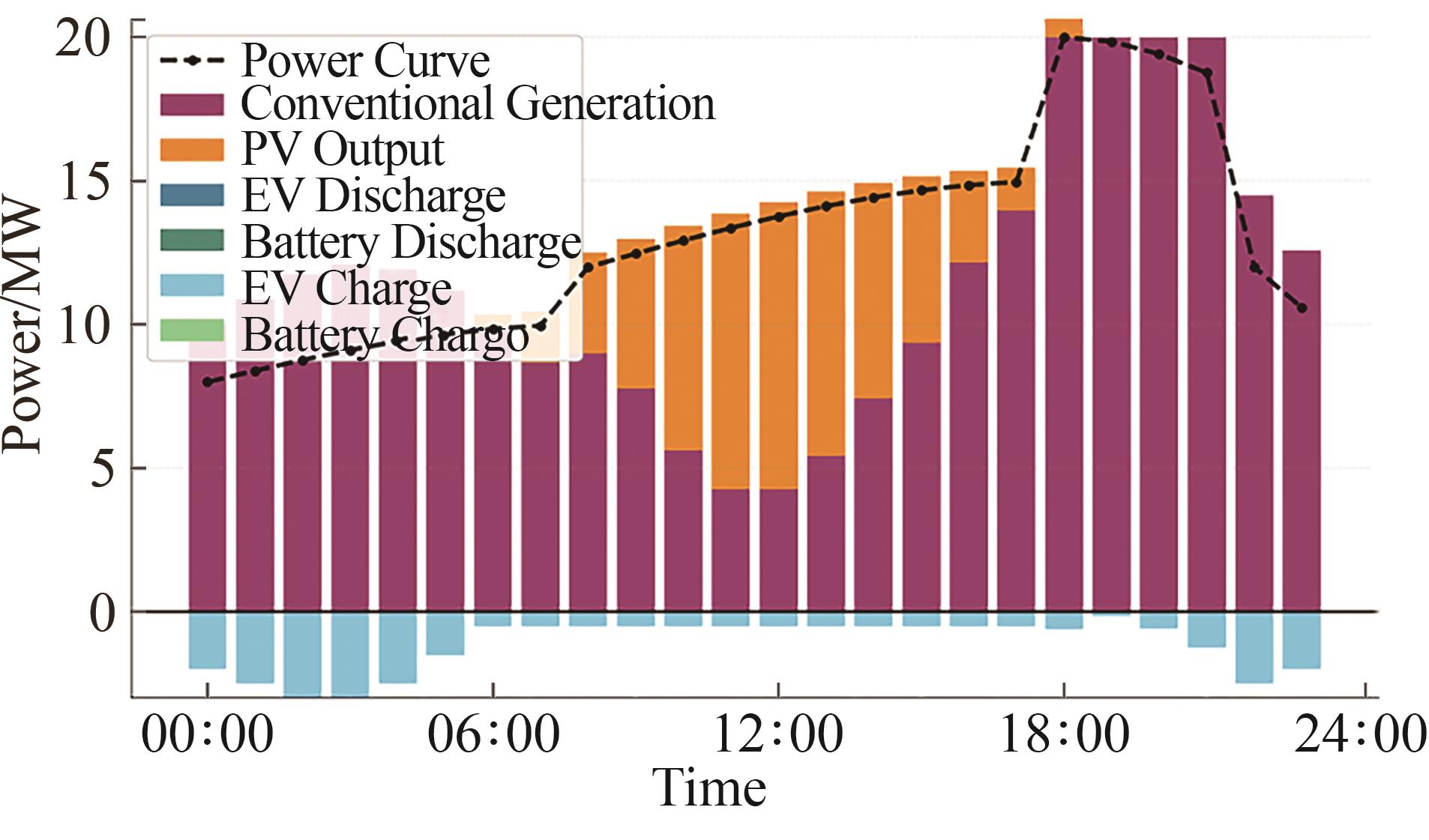
Fig. 7
Power distribution map optimized by GMO algorithm combined with time-of-use electricity pricing
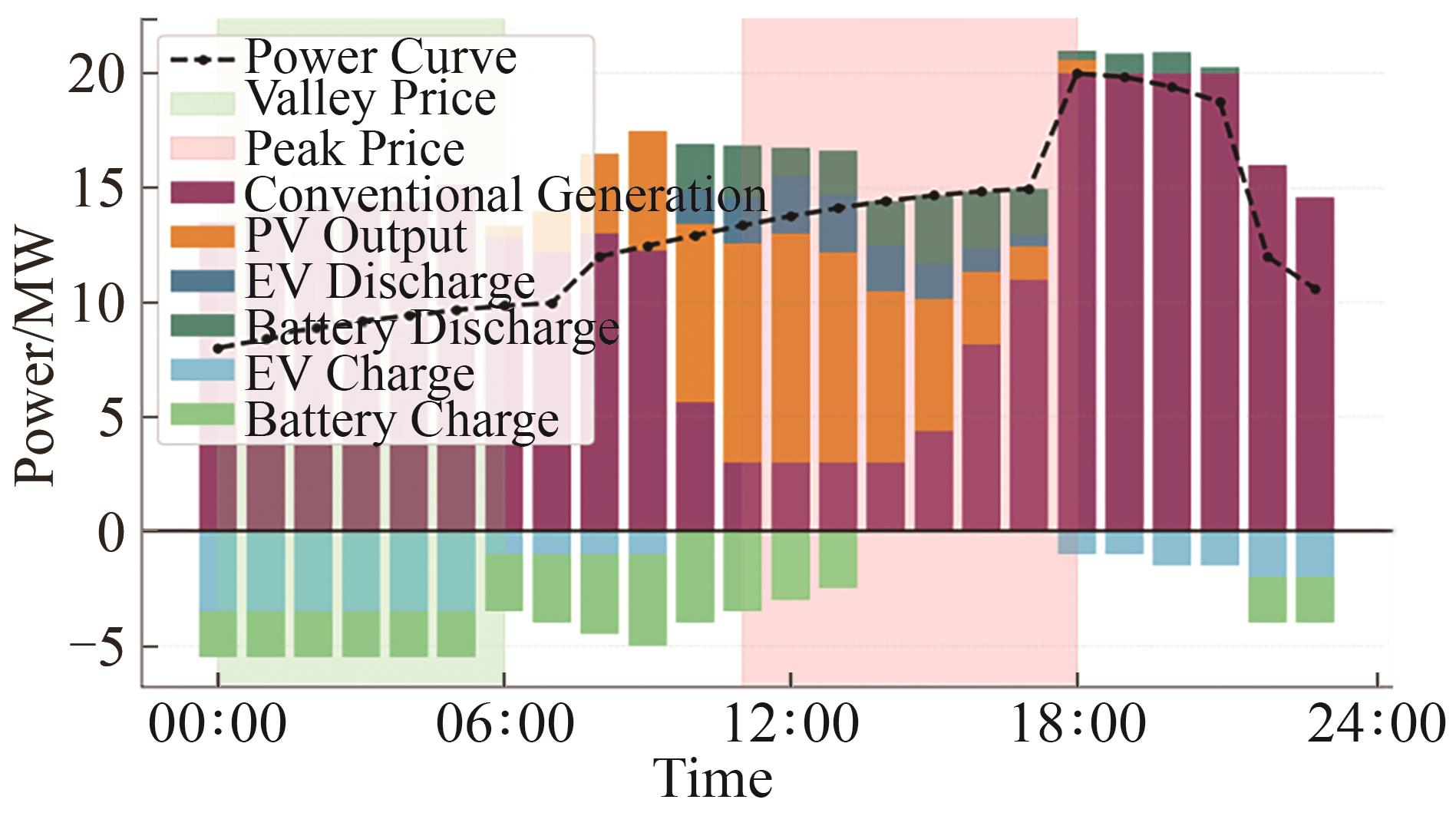
Fig. 8
Power distribution map after optimization with virtual electricity pricing
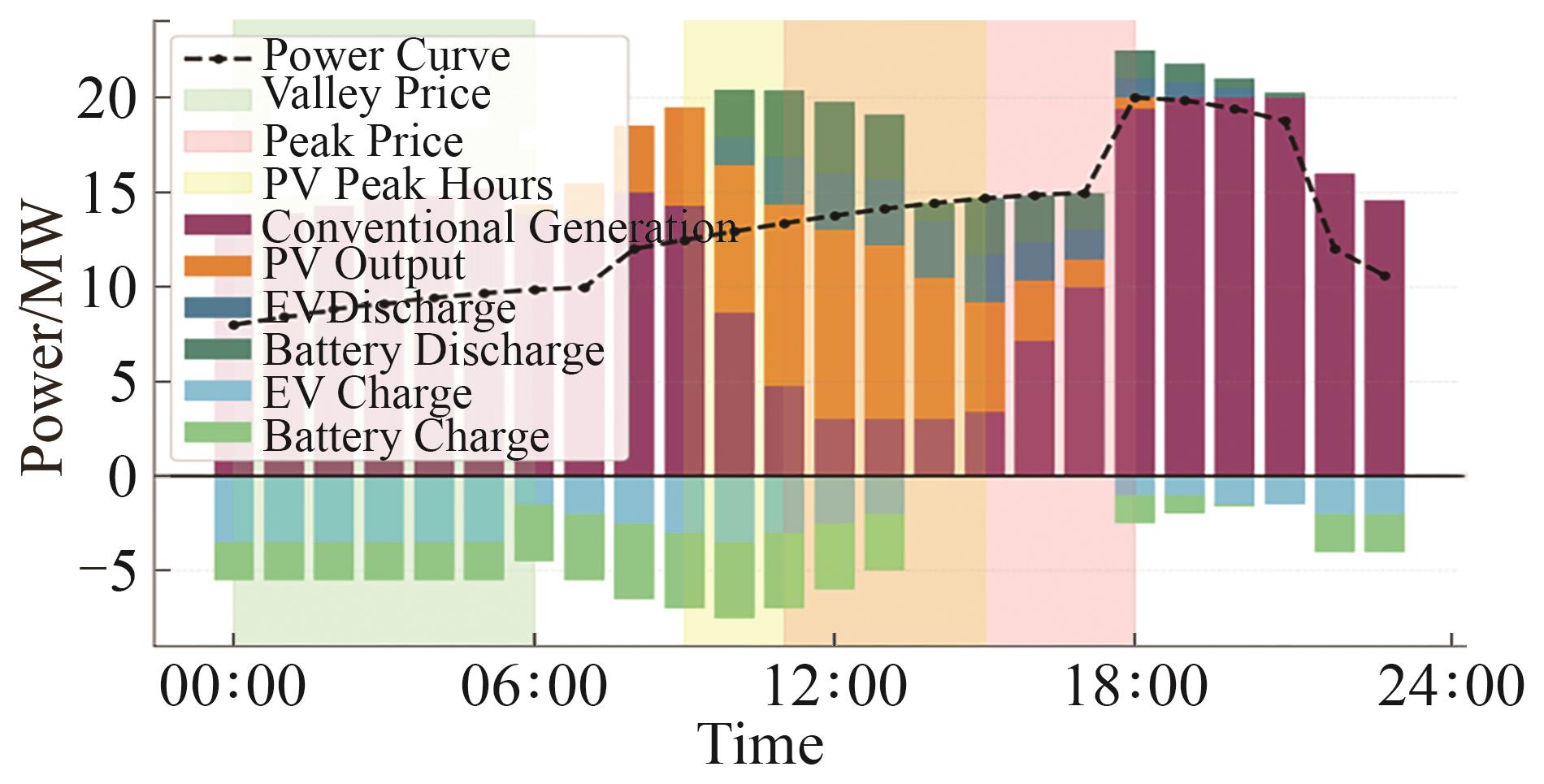
Table 4
Performance comparison of the four schemes
| Indicator | Scheme 1 | Scheme 2 | Scheme 3 | Scheme 4 |
|---|---|---|---|---|
| Total system operating cost/yuan | 2 946.12 | 1 881.67 | 1 465.7 | 1 512.3 |
| Photovoltaic power accommodation rate/% | 62.1 | 85.0 | 96.5 | 95.8 |
| Daily system carbon emissions/(kg CO2) | 243 264 | 159 744 | 118 080 | 120 520 |
| Power generation cost of conventional units/yuan | 2 821.44 | 1 837.06 | 1 458.24 | 1 486.7 |
| PV curtailment penalty cost/yuan | 124.68 | 44.61 | 7.55 | 8.92 |
| EV SOC satisfaction rate at departure/% | — | 82.6 | 89.3 | 100 |
| Number of daily energy storage cycles | — | 3.2 | 2.8 | 1.7 |
| System curtailment rate volatility/% | — | 28.6 | 22.4 | 8.7 |
| [1] | Wu Danman, Ding Yucheng, Xie Guanglong, et al. Economic Analysis Method for Park-level Source-grid-load-storage Integration Project Under Independent Investment Operation Mode[J]. Electric Power, 2026, 59(2): 61-70. |
| [2] | Meng Xuyao, Liu Jiajia, Wen Fushuan, et al. Development Situation and Key Technologies of Source-grid-load-storage Integrated Projects[J]. Automation of Electric Power Systems, 2026, 50(1): 1-19. |
| [3] | Ma Teng, Li Mingjia, Xu Hang, et al. Study on Multi-time Scale Frequency Hierarchical Control Method and Dynamic Response Characteristics of the Generation-grid-load-storage Type Integrated System Under Double-side Randomization Conditions[J]. Applied Energy, 2024, 367: 123436. |
| [4] | Wang Bin, Tian Zengyao, Yang Haotian, et al. Collaborative Planning of Source-grid-load-storage Considering Wind and Photovoltaic Support Capabilities[J]. Energies, 2025, 18(8): 2045. |
| [5] | Yang Xuexin, Zhang Zhiquan, Li Zhenkun. Optimal Operation of Smart Distribution Networks Considering Demand-side Response[J/OL]. Modern Electric Power. (2025-11-18)[2026-01-02].. |
| [6] | Liu Jiejie, Wu Binghui, Meng Xianyang, et al. LearnAMR: Learning-based Adaptive Model Predictive Control Enhanced by Reinforcement Learning for Optimizing Energy Flexibility in Building Energy Systems Incorporating Demand-side Management[J]. Applied Energy, 2025, 401: 126707. |
| [7] | 高赐威, 严兴煜. 支撑分布式新能源入市的需求侧资源参与系统运行和市场交易关键技术[J]. 供用电, 2025, 42(11): 1-2. |
| [8] | Yan Laiqing, Wang Kang, Xu Jiaqi, et al. Hybrid Energy Storage Wind Power Fluctuation Stabilization Strategy Based on Multi-layer Energy Management[J]. Acta Energiae Solaris Sinica, 2025, 46(9): 98-107. |
| [9] | Zhang Zongnan, Shen Xiaojun, Chang Mingjiang. Dual Stochastic Multi-stage Robust Optimization of Integrated Energy System Considering Long Medium and Short-term Uncertainties[J]. Applied Energy, 2025, 400: 126573. |
| [10] | Hua Haochen, Zhang Zhouhe, Zou Yiqun, et al. Review of Low-carbon Co-optimization Research on Demand-side Flexibility Resources for New Power Systems[J]. Electric Power Construction, 2025, 46(6): 60-75. |
| [11] | Li Bin, Wang Fengqiao, Tang Tianyue. Energy Optimization Technology for Parks Based on Demand-side Resource Response Quantity Quota Transfer[J]. Southern Power System Technology, 2025, 19(9): 15-24. |
| [12] | Dengiz Thomas, Raith Andrea, Kleinebrahm Max, et al. Pareto Local Search for a Multi-objective Demand Response Problem in Residential Areas with Heat Pumps and Electric Vehicles[J]. Energy, 2025, 335: 138063. |
| [13] | Li Zening, Sun Hongbin, Xue Yixun, et al. A Stochastic Optimization Method for Coordinated Restoration of Electricity-transportation Systems Considering Demand-side Resources: A Case Study of Building Energy[J]. Proceedings of the CSEE, 2025, 45(20): 8024-8039. |
| [14] | Wang Jinkun, Xue Xian, Wu Huimin, et al. Optimization Model of Distributed Multi Energy Fusion System Considering the Mobile Energy Storage Characteristics of Electric Vehicles[J]. Electric Power, 2025, 58(11): 164-174. |
| [15] | Xiao Renxin, Ma Silin, Pan Nan, et al. Bi-level Optimization Scheduling of Microgrid Considering Demand Response and Ordered Integration of EVS[J]. Acta Energiae Solaris Sinica, 2026, 47(5): 123-134. |
| [16] | Wang Yu, Tong Xiangrui, Xie Yiheng, et al. A Two-stage Robust Optimization for EV User-friendly VPP Participation in Ancillary Service Markets[J]. International Journal of Electrical Power & Energy Systems, 2025, 171: 111004. |
| [17] | Zhang Zhiqiang, Yuan Zhi, Li Ji. Low-carbon Optimization Strategy for Integrated Energy Systems Based on Three-level Stackelberg Game Considering Carbon-source Uncertainties[J]. Power System Technology, 2026, 50(1): 157-167. |
| [18] | Li Jiale, Yang Bo, Pan Zhenning, et al. Stackelberg-nash Bargaining-based Low-carbon Scheduling for Multiple Integrated Multi-energy Systems[J]. Energy, 2025, 339: 139024. |
| [19] | Zheng Mohan, Lin Pengfeng, Zhang Chuanlin, et al. Optimal Configuration of Low-carbon Building Microgrid Clusters and Shared Hydrogen Storage Power Station Systems Based on Stackelberg Game[J/OL]. Journal of Shanghai Jiao Tong University. (2025-10-14) [2026-01-04]. . |
| [20] | Liang Yunyang, Pu Yang, Yu Mengmeng, et al. A Dual Carbon Reward Mechanism for Electric Vehicle Charging Scheduling Based on Multi-level Stackelberg Game[J]. Energy, 2025, 337: 138620. |
| [21] | Wang Xuan, Tang Wei, Zhang Zhigang, et al. Stackelberg Game Collaborative Optimal Scheduling of Distribution Network-plant Factory Based on Adjustable Potential Assessment[J]. Distribution & Utilization, 2025, 42(12): 23-32, 40. |
| [22] | Dorahaki Sobhan, Muyeen S M, Amjady Nima. A Stackelberg Game Theory Model for Integrated Community Energy Storage Systems[J]. IEEE Access, 2024, 12: 152908-152920. |
| [23] | Zhang Linyao, Liao Jinlin, Wu Guilian, et al. Two-level Collaborative Planning Model of Virtual Power Plant and Distribution Network Based on Stackelberg Game[J]. Distribution & Utilization, 2024, 41(6): 21-27. |
| [24] | Qi Bing, Zhang Hengyuan, Li Bin, et al. Strategies for Coordinated Operation of Scaled-up Micro-electric Vehicle Switching Cabinet and Distributed Photovoltaic[J]. Distribution & Utilization, 2025, 42(7): 94-101. |
| [25] | Zhang Linjuan, Zhou Zhiheng, Chen Jinghua, et al. Research on Optimal Allocation of Energy Storage Capacity in County Photovoltaic Distribution Station Area with Electric Vehicles[J]. Distribution & Utilization, 2024, 41(10): 101-113. |
| [26] | Gong Ziqi, Liu Didi, Liu Yituan. Optimal Scheduling Strategy for Integrated Energy Systems Based on Improved Particle Swarm Optimization Algorithm[J]. Journal of Chongqing University of Posts and Telecommunications(Natural Science Edition), 2026, 38(2): 331-341. |
| [27] | Liu Kenan, Cai Yaohui, Sun Wei, et al. Optimal Configuration of a Stand-alone PV/Diesel/Battery Hybrid Energy System Based on Modified PSO for a Translational Sprinkler Irrigation Machine Applied in Remote and Water-scarce Areas[J]. Energy, 2025, 320: 135113. |
| [28] | Xu Zhanpeng, Chen Fuxin, Yang Xuefan, et al. Research on Optimization Model of Capacity Configuration of PV/Storage/Hydrogen Grid-connected Microgrid Based on Improved PSO Algorithm with Genetic Algorithm[J]. Acta Energiae Solaris Sinica, 2025, 46(7): 144-153. |
| [29] | Pei Lijun, Xu Hui, Chen Han, et al. Prediction Method for Winding Temperature of SA-LSTM Transformer Based on PSO Optimization[J]. Distribution & Utilization, 2025, 42(8): 112-119. |
| [30] | Ren Hui, Gao Luli, Su Zhibin, et al. GMO: A General Multimodal Optimization Framework Applicable to Various Global Metaheuristic Algorithms[J]. Swarm and Evolutionary Computation, 2025, 99: 102207. |
| [31] | Joy G, Huyck C, Yang Xinshe. Parameter Tuning of the Firefly Algorithm by Three Tuning Methods: Standard Monte Carlo, Quasi-monte Carlo and Latin Hypercube Sampling Methods[J]. Journal of Computational Science, 2025, 87: 102588. |
| [32] | Wang Shunli, Ma Chao, Gao Haiying, et al. Improved Hyperparameter Bayesian Optimization-bidirectional Long Short-term Memory Optimization for High-precision Battery State of Charge Estimation[J]. Energy, 2025, 328: 136598. |
| [33] | Wang Shunli, Fan Yongcun, Jin Siyu, et al. Improved Anti-noise Adaptive Long Short-term Memory Neural Network Modeling for the Robust Remaining Useful Life Prediction of Lithium-ion Batteries[J]. Reliability Engineering & System Safety, 2023, 230: 108920. |
| [1] | Guo Rongyu, Li Xiaobin, Jiang Pei, Li Chuanjiang, Liu Shanhui, Ma Jun. Benefit Distribution Optimization Model and Simulation for Multi-mode Operation of Industrial Software Platforms [J]. Journal of System Simulation, 2025, 37(9): 2242-2257. |
| [2] | Zhao Yiran, Xue Yong, Tian Haoxin, Zhang Ruixin, Zhang Zhi, Chen Yanbo. Second-order Cone Optimization Modeling and Simulation for Three-phase Unbalanced Active Distribution Networks [J]. Journal of System Simulation, 2025, 37(9): 2258-2268. |
| [3] | Duan Xinhui, Cheng Zelong, Zhang Dongchao, Duan Xiaochong. Optimal Scheduling of an Integrated Energy System Considering Demand Response and Two-stage P2G [J]. Journal of System Simulation, 2025, 37(8): 2139-2151. |
| [4] | Ma Miaomiao, Long Zijuan, Ren Zhiwei, Cheng Yongqiang. Hierarchical Optimal Scheduling of Integrated Energy System with Electric Vehicles Based on EMPC [J]. Journal of System Simulation, 2025, 37(5): 1116-1128. |
| [5] | Chen Shuo, Hu Hao, Fang Huimin, Wang Haiwei, Chen Xiaolong, Mei Chengcheng, Zhu Jiaʹnan, Ai Qian. Electric Vehicle Dispatching Strategy and Incentive Evaluation Based on Virtual Energy Storage [J]. Journal of System Simulation, 2025, 37(3): 732-741. |
| [6] | Zhang Runzhao, Chen Yanbo, Huang Tao, Tian Haoxin, Qiang Tuben, Zhang Zhi. Scheduling Method for Virtual Power Plants Based on Analysis and Forecasting of Heterogeneous Load Characteristics [J]. Journal of System Simulation, 2025, 37(12): 2994-3006. |
| [7] | Chen Yanbo, Yin Jiahao, Qiang Tuben, Tian Haoxin, Liang Yuxin, Zhang Zhi. Distributed Dispatch Method for Distribution Network and Microgrid Considering Diverse Regulating Resources [J]. Journal of System Simulation, 2025, 37(10): 2469-2484. |
| [8] | Liu Weiliang, Yan Qianwen, Zhang Qiliang, Liu Shuai, Liu Changliang, Kang Jiayao, Wang Xin. Optimal Scheduling of Vehicle-network Interaction Based on Interval Stackelberg Game of Virtual Power Plant [J]. Journal of System Simulation, 2024, 36(7): 1559-1572. |
| [9] | Zhuang Helin, Xia Xiaoyun, Li Kangshun, Chen Zefeng, Zhang Xianchao. Research Advances on Electric Vehicle Routing Problem Models and Algorithms [J]. Journal of System Simulation, 2024, 36(2): 320-337. |
| [10] | Jia Dongli, Liu Keyan, Ren Zhaoying, Wang Zezhou, Tang Dongsheng. Optimal Operation Scheduling of Integrated Energy System Considering Energy Priority [J]. Journal of System Simulation, 2024, 36(12): 2771-2781. |
| [11] | Jin Dongyao, Liu Min, Zhu Yena, Zhao Yijiang. A Hybrid Genetic Search Algorithm for Capacitated Electric Vehicle Routing Problem [J]. Journal of System Simulation, 2024, 36(11): 2528-2541. |
| [12] | Yu Yang, Xia Yuxing, Lu Wentao, Liu Mai, Gao Shixuan, Chen Dongyang. Two-level Optimal Dispatch of Power System Based on Load-storage Carbon Flow Model [J]. Journal of System Simulation, 2024, 36(10): 2288-2299. |
| [13] | Xianwei Zhou, Qixu Gong, Songsen Yu. Computation Offloading Strategy Based on Stackelberg Game and DRL [J]. Journal of System Simulation, 2023, 35(2): 372-385. |
| [14] | Wang Lixiao, Wang Zhonghui. Charging Facility Layouts Based on Charging Selection Behavior [J]. Journal of System Simulation, 2023, 35(11): 2312-2320. |
| [15] | Liying Wang, Jialin Lin, Houqi Dong, Ming Zeng, Yuqing Wang. Optimal Dispatch of Integrated Energy System Considering Ladder-Type Carbon Trading [J]. Journal of System Simulation, 2022, 34(7): 1393-1404. |
| Viewed | ||||||
|
Full text |
|
|||||
|
Abstract |
|
|||||
 http://www.china-simulation.com

