

Journal of System Simulation ›› 2026, Vol. 38 ›› Issue (4): 959-973.doi: 10.16182/j.issn1004731x.joss.25-1216
• Papers • Previous Articles Next Articles
Liu Wei, Chen Delong, Liu Ze, Wang Rui, Li Kaiwen, Zhang Tao
Received:2025-12-11
Revised:2026-01-09
Online:2026-04-20
Published:2026-04-22
Contact:
Wang Rui
CLC Number:
Liu Wei, Chen Delong, Liu Ze, Wang Rui, Li Kaiwen, Zhang Tao. Optimization of Air Defense and Antimissile Firepower Resource Allocation Based on Adaptive Hybrid Evolution[J]. Journal of System Simulation, 2026, 38(4): 959-973.
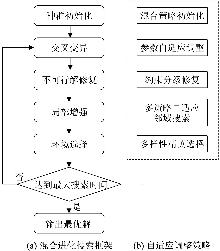
Fig. 1
Framework of AHEA
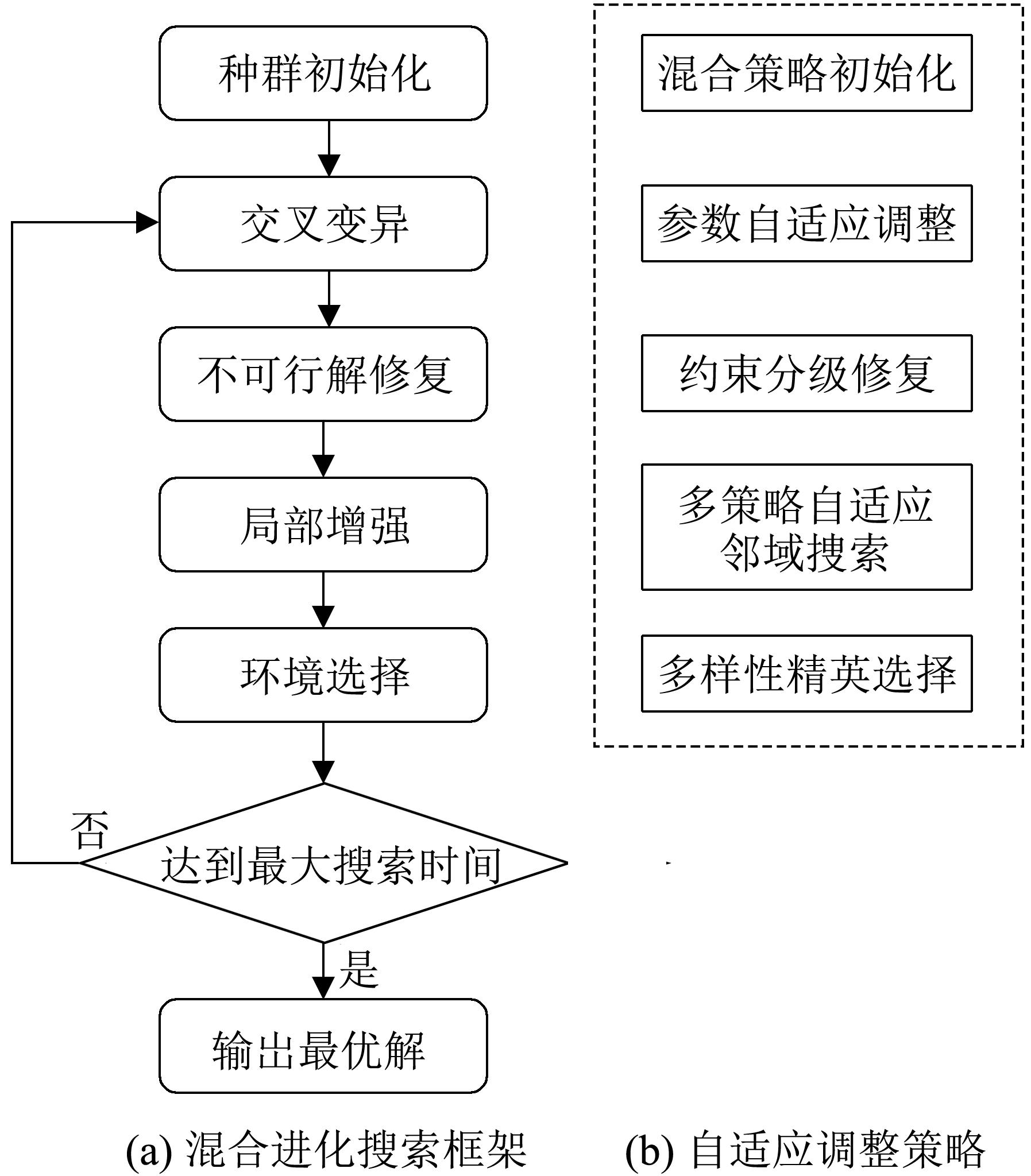
Table 1
Characteristics of 7 neighborhood search operators
| 算子 | 操作类型 | 优化目标 |
|---|---|---|
| 1交换分配 | 两拦截器威胁互换 | 结构调整多样性 |
| 2威胁重分配 | 增加低覆盖威胁的拦截器 | 防御强度 |
| 3移除冗余 | 削减高覆盖威胁的拦截器 | 成本控制 |
| 4局部强化 | 单拦截器全可行集搜索 | 精细优化 |
| 5跨威胁优化 | 不同威胁间拦截器交换 | 资源均衡 |
| 6覆盖平衡 | 重新分配实现覆盖均衡 | 鲁棒性 |
| 7成本降低 | 用低成本拦截器替换 | 成本优化 |
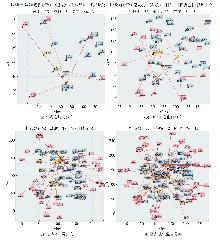
Fig. 2
Spatial distribution of test case instances

Fig. 3
Statistical information of test case instances
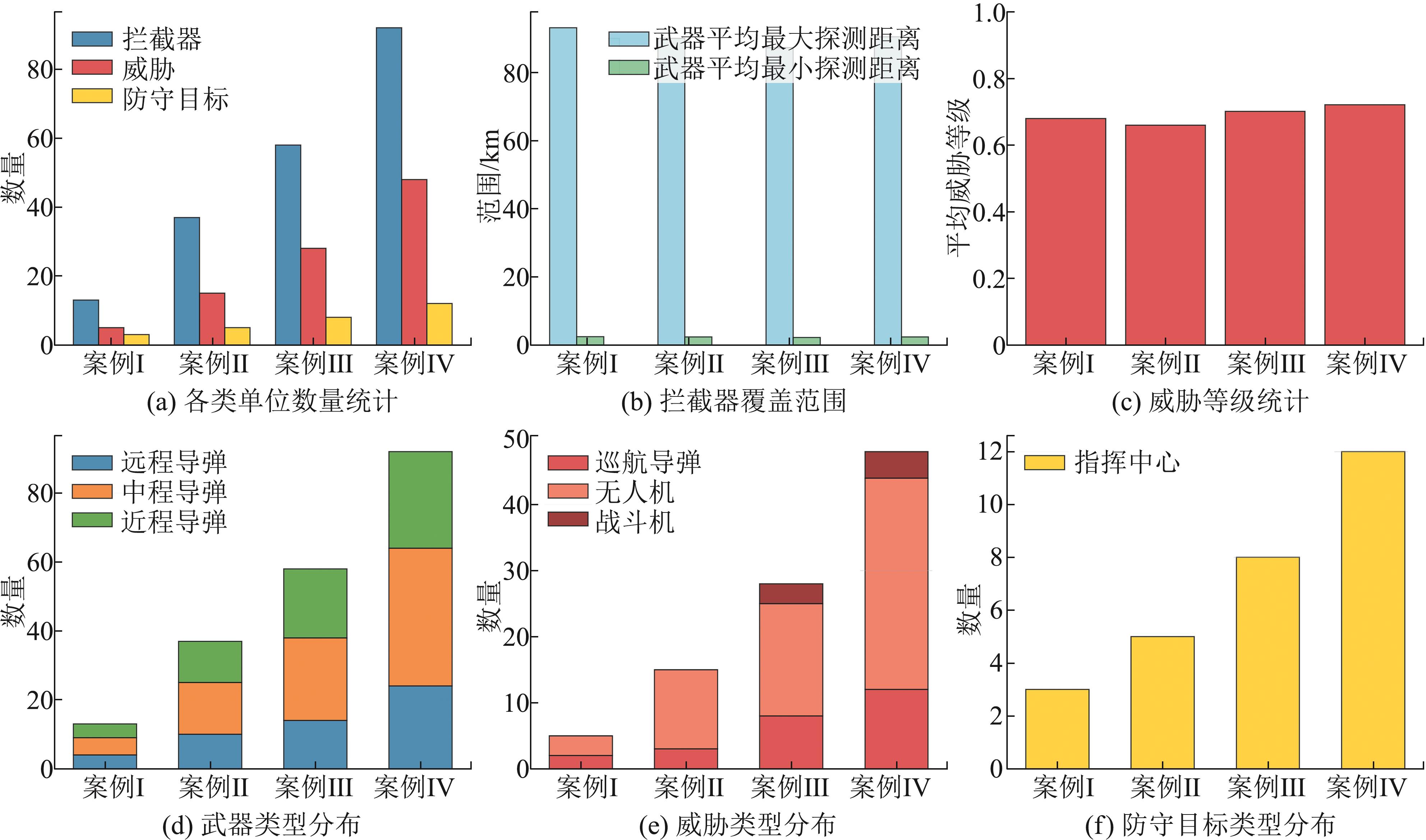
Table 2
Performance parameters of threat targets
| 威胁类型 | 飞行速度/Ma |
|---|---|
| 巡航导弹 | 0.2~0.26 |
| 无人机 | 0.03~0.05 |
| 战斗机 | 0.28~0.4 |
Table 3
Performance parameters of interceptors
| 类型 | 飞行速度/Ma | 射程/km | 单位成本/万元 |
|---|---|---|---|
| 远程 | 2.2 | 5~150 | 1500 |
| 中程 | 1.5 | 2~90 | 800 |
| 近程 | 1.1 | 0.5~40 | 300 |
Table 4
Basic interception probability matrix
| 拦截器类型 | 巡航导弹 | 无人机 | 战斗机 |
|---|---|---|---|
| 远程 | 0.85 | 0.65 | 0.72 |
| 中程 | 0.80 | 0.78 | 0.75 |
| 近程 | 0.70 | 0.90 | 0.88 |
Table 5
Performance comparison of six algorithms on four test cases
| 测试案例 | 算法 | 适应度 | AHEA的适应度提升百分比/% | 防御成功率/% | 资源消耗 | 平均响应时间/s |
|---|---|---|---|---|---|---|
| 案例Ⅰ | Hungarian | 0.459 1 | 14.62 | 81.07 | 3 500 | 45.90 |
| SEGA | 0.523 4 | 0.53 | 90.69 | 4 876 | 24.36 | |
| DE | 0.523 9 | 0.44 | 90.69 | 4 876 | 23.91 | |
| ES | 0.510 5 | 3.08 | 92.17 | 6 180 | 24.34 | |
| HGS | 0.523 3 | 0.55 | 90.69 | 4 876 | 24.52 | |
| AHEA | 0.526 2 | 90.8 | 4 820 | 25.57 | ||
| 案例Ⅱ | Hungarian | 0.474 6 | 5.06 | 82.85 | 10 200 | 38.73 |
| SEGA | 0.485 8 | 2.63 | 86.55 | 14 000 | 28.56 | |
| DE | 0.496 2 | 0.48 | 87.12 | 12 656 | 30.87 | |
| ES | 0.434 4 | 14.78 | 86.03 | 20 800 | 31.87 | |
| HGS | 0.491 5 | 1.44 | 86.88 | 13 502 | 28.45 | |
| AHEA | 0.498 6 | 87.38 | 13 120 | 27.64 | ||
| 案例Ⅲ | Hungarian | 0.450 8 | 5.21 | 81.80 | 18 400 | 42.21 |
| SEGA | 0.461 2 | 2.84 | 87.75 | 27 110 | 35.71 | |
| DE | 0.469 6 | 1.00 | 87.68 | 25 512 | 33.74 | |
| ES | 0.385 4 | 23.07 | 80.19 | 32 090 | 37.00 | |
| HGS | 0.460 9 | 2.91 | 86.79 | 25 830 | 34.75 | |
| AHEA | 0.474 3 | 88.63 | 26 600 | 31.11 | ||
| 案例Ⅳ | Hungarian | 0.429 7 | 1.23 | 80.79 | 33 400 | 48.45 |
| SEGA | 0.425 0 | 2.35 | 84.13 | 46 460 | 42.21 | |
| DE | 0.432 8 | 0.51 | 83.92 | 42 630 | 43.06 | |
| ES | 0.311 4 | 39.69 | 68.26 | 46 930 | 43.60 | |
| HGS | 0.427 5 | 1.75 | 82.94 | 42 310 | 42.28 | |
| AHEA | 0.435 0 | 85.93 | 51 700 | 40.81 |
Fig. 4
Fitness values and mean values of solutions obtained by comparison algorithms in 10 independent repeated experiments on four test cases
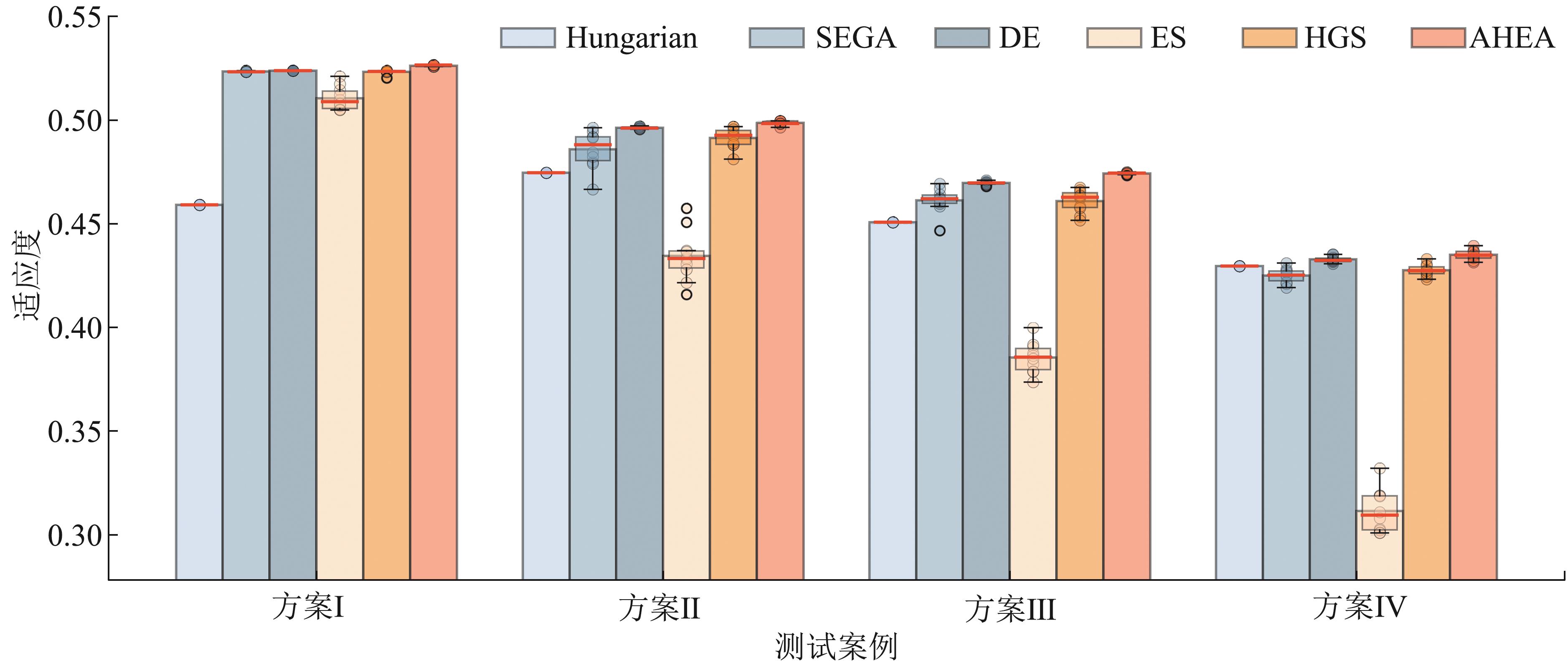
Fig. 5
Convergence curves of fitness values for comparison algorithms during evolution process on four test cases
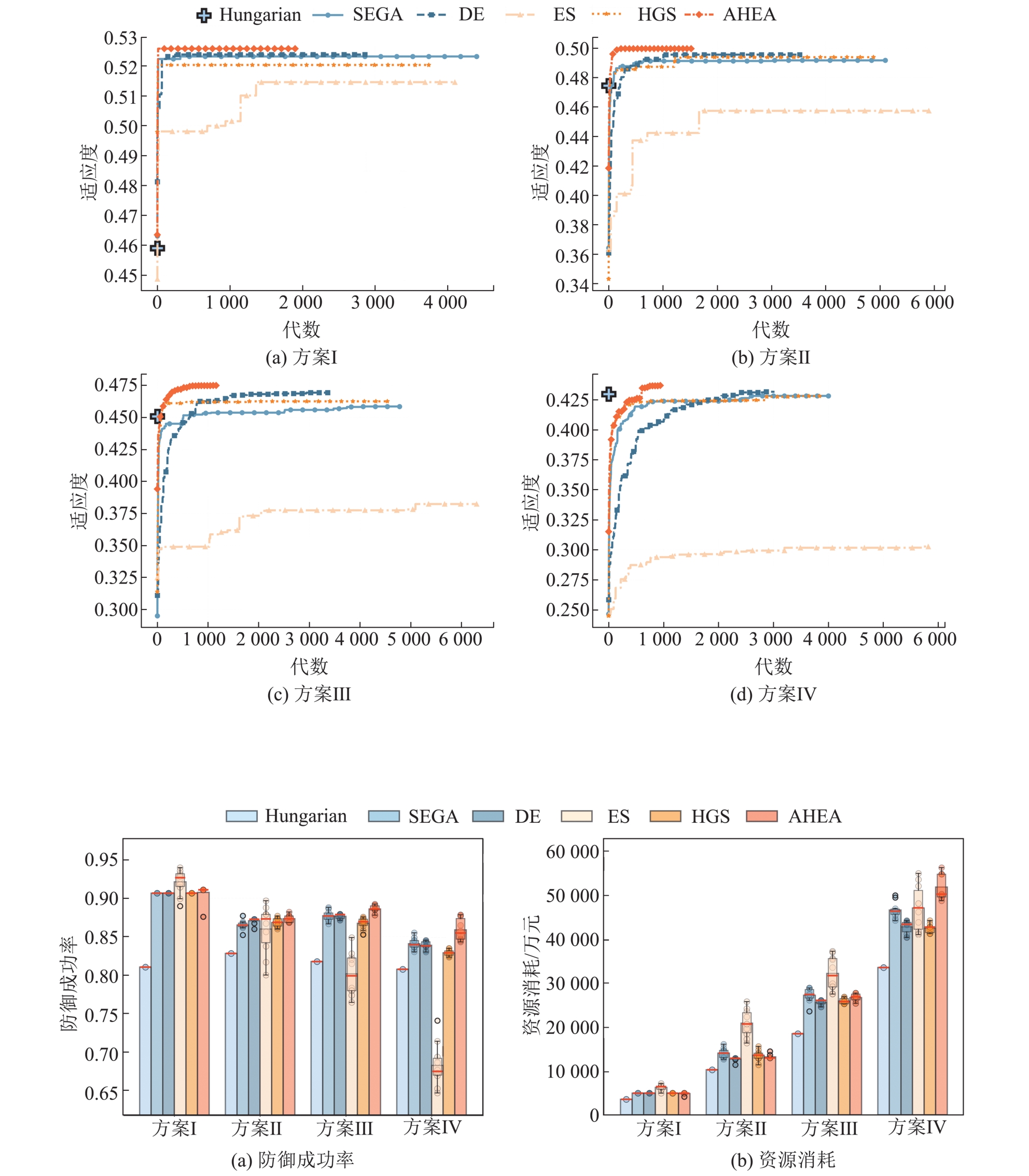
Fig. 6
Solutions generated by six algorithms on four test cases
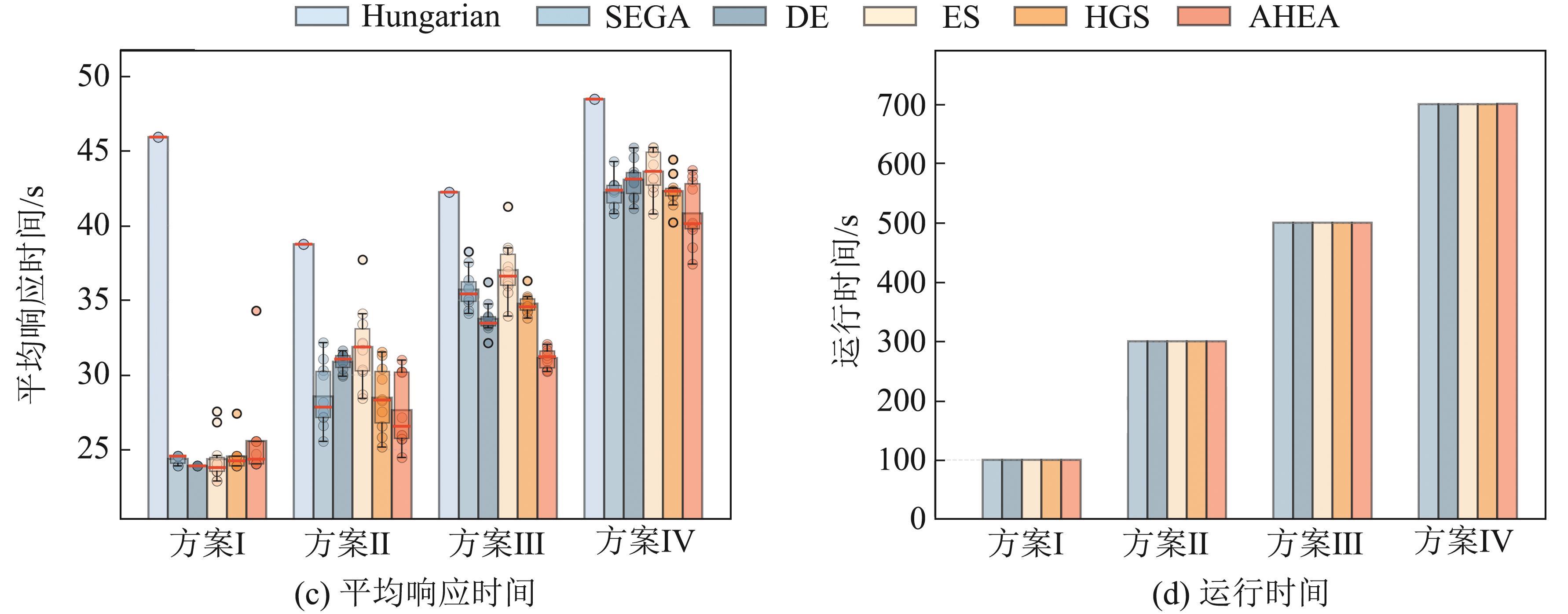
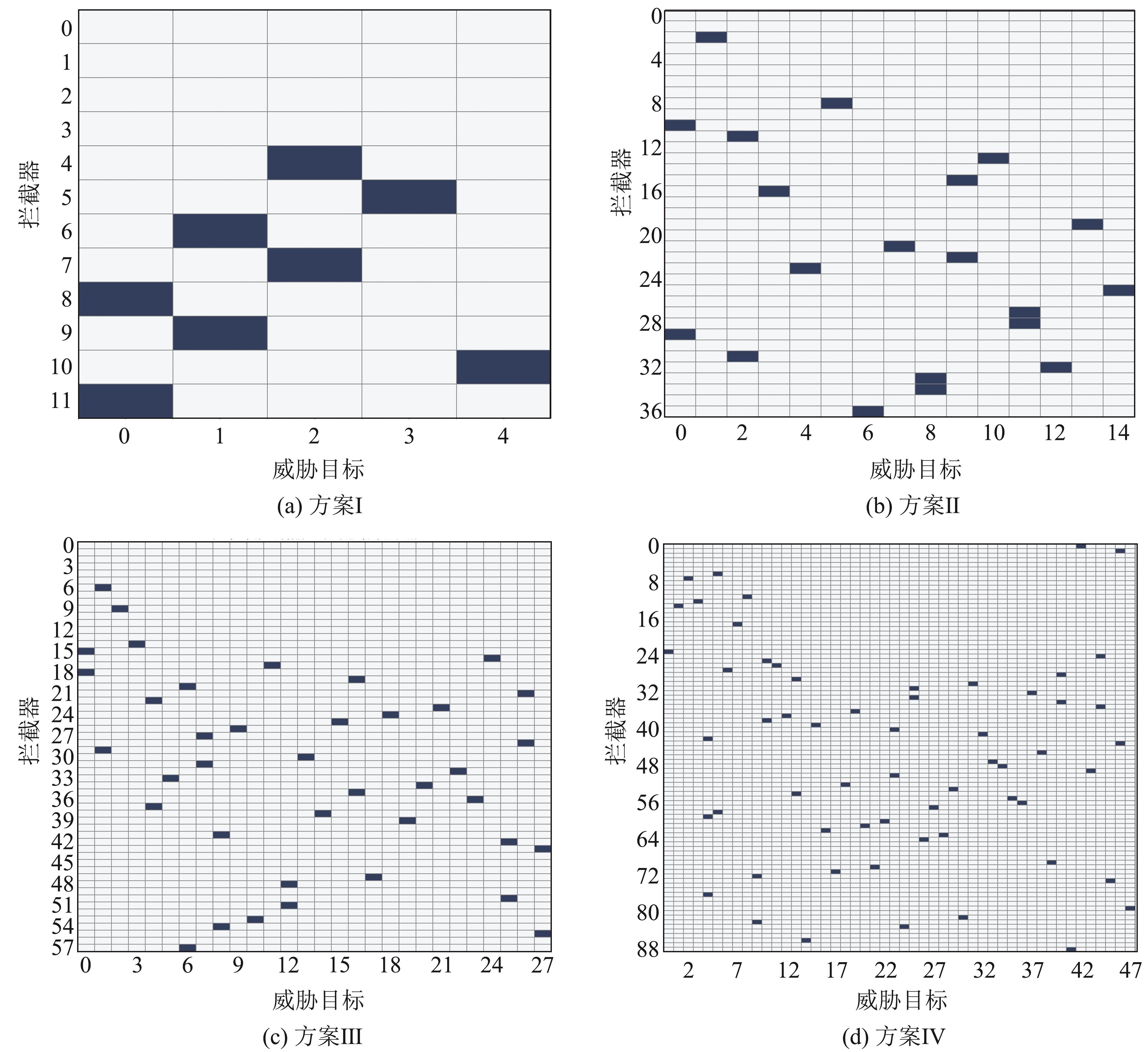
Fig. 7
Optimal interceptor allocation matrix generated by AHEA on four standard test cases
| [1] | Ahner D, Parson C. Weapon Tradeoff Analysis Using Dynamic Programming for a Dynamic Weapon Target Assignment Problem Within a Simulation[C]//2013 Winter Simulations Conference (WSC). Piscataway: IEEE, 2013: 2831-2841. |
| [2] | Soland R M. Optimal Defensive Missile Allocation: A Discrete Min-max Problem[J]. Operations Research, 1973, 21(2): 590-596. |
| [3] | Kim Yeonseung, Cho Jaeyoung, Han Sangwoo, et al. Weapon Target Assignment Model for Small Unit Ground Combat Using Mixed Integer Nonlinear Program and Lagrangian Relaxation[J]. Mathematical Problems in Engineering, 2022, 2022(1): 9228993. |
| [4] | Liles J M IV, Robbins M J, Lunday B J. Improving Defensive Air Battle Management by Solving a Stochastic Dynamic Assignment Problem via Approximate Dynamic Programming[J]. European Journal of Operational Research, 2023, 305(3): 1435-1449. |
| [5] | 刘学, 王俊, 张伟, 等. 基于BPSO的联合火力打击武器目标分配优化[J]. 兵工自动化, 2025, 44(3): 1-3. |
| Liu Xue, Wang Jun, Zhang Wei, et al. Joint Fire Strike Weapon Target Assignment Optimization Based on BPSO[J]. Ordnance Industry Automation, 2025, 44(3): 1-3. | |
| [6] | 孙昕, 邢立宁, 王锐, 等. 基于多目标进化算法的防空导弹武器目标分配[J]. 系统仿真学报, 2024, 36(6): 1298-1308. |
| Sun Xin, Xing Lining, Wang Rui, et al. Air Defense Missile Weapon Target Assignment Based on Multi-objective Evolutionary Algorithm[J]. Journal of System Simulation, 2024, 36(6): 1298-1308. | |
| [7] | Li Wenhua, Wang Rui, Heng Yong, et al. Knowledge-guided Evolutionary Optimization for Large-scale Air Defense Resource Allocation[J]. IEEE Transactions on Artificial Intelligence, 2024, 5(12): 6267-6279. |
| [8] | 陈阳, 李姜, 王烨, 等. 基于改进灰狼算法求解武器目标分配问题[J]. 兵器装备工程学报, 2025, 46(6): 227-233. |
| Chen Yang, Li Jiang, Wang Ye, et al. Solving Weapon Target Assignment Problem Based on Modified Gray Wolf Algorithm[J]. Journal of Ordnance Equipment Engineering, 2025, 46(6): 227-233. | |
| [9] | 周玉虎, 王桐, 陈立伟, 等. 基于人工蜂群算法的大规模武器目标分配研究[J]. 哈尔滨工程大学学报, 2024, 45(6): 1187-1195. |
| Zhou Yuhu, Wang Tong, Chen Liwei, et al. Large-scale Weapon-target Allocation Based on an Artificial Bee Colony Algorithm[J]. Journal of Harbin Engineering University, 2024, 45(6): 1187-1195. | |
| [10] | Yi Xiaojian, Yu Huiyang, Xu Tao. Solving Multi-objective Weapon-target Assignment Considering Reliability by Improved MOEA/D-AM2M[J]. Neurocomputing, 2024, 563: 126906. |
| [11] | Wang Yang, Wang Junpeng, Hao Jinkao, et al. Efficient Adaptive Large Neighborhood Search for Sensor-weapon-target Assignment[J]. IEEE Transactions on Systems, Man, and Cybernetics: Systems, 2024, 54(10): 6397-6409. |
| [12] | 杨玉, 张嘉佳, 马金慧, 等. 局部搜索灰狼优化算法求解武器-目标分配问题[J]. 科学技术与工程, 2023, 23(27): 11722-11729. |
| Yang Yu, Zhang Jiajia, Ma Jinhui, et al. Local Search Strategy Based Grey Wolf Optimization for Weapon Target Assignment Problem[J]. Science Technology and Engineering, 2023, 23(27): 11722-11729. | |
| [13] | 闫世祥, 刘海军. 基于深度强化学习的传感器-武器-目标分配方法[J]. 现代防御技术, 2025, 53(4): 10-17. |
| Yan Shixiang, Liu Haijun. Sensor-weapon-target Assignment Method Based on Deep Reinforcement Learning[J]. Modern Defence Technology, 2025, 53(4): 10-17. | |
| [14] | 马超, 赵敏睿, 王刚, 等. 基于元强化学习的防空作战任务分配方法研究[J]. 军事运筹与评估, 2025, 40(1): 53-59. |
| Ma Chao, Zhao Minrui, Wang Gang, et al. Air Defence Combat Task Assignment Method Based on Meta-reinforcement Learning[J]. Military Operations Research and Assessments, 2025, 40(1): 53-59. | |
| [15] | 刘家义, 王刚, 夏智权, 等. 基于深度强化学习的防空反导智能任务分配[J]. 火力与指挥控制, 2024, 49(1): 43-48, 55. |
| Liu Jiayi, Wang Gang, Xia Zhiquan, et al. Intelligent Task Assignment Research for Air Defense and Anti-missiles Based on Deep Reinforcement Learning[J]. Fire Control & Command Control, 2024, 49(1): 43-48, 55. | |
| [16] | 费帅迪, 蔡长龙, 刘飞, 等. 舰船防空反导的目标分配方法研究[J]. 系统仿真学报, 2025, 37(2): 508-516. |
| Fei Shuaidi, Cai Changlong, Liu Fei, et al. Research on the Target Allocation Method for Air Defense and Anti-missile Defense of Naval Ships[J]. Journal of System Simulation, 2025, 37(2): 508-516. | |
| [17] | 肖友刚, 金升成, 毛晓, 等. 基于深度强化学习的舰船导弹目标分配方法[J]. 控制理论与应用, 2024, 41(6): 990-998. |
| Xiao Yougang, Jin Shengcheng, Mao Xiao, et al. Missile-target Assignment Method of Naval Ship Based on Deep Reinforcement Learning[J]. Control Theory & Applications, 2024, 41(6): 990-998. | |
| [18] | 吕娜, 王茂桓, 钟元芾, 等. 二分图匹配模型下的武器目标分配问题[J]. 系统工程与电子技术, 2024, 46(2): 549-560. |
| Na Lü, Wang Maohuan, Zhong Yuanfu, et al. Weapon Target Allocation Problem Based on Matching Model of Bipartite Graphs[J]. Systems Engineering and Electronics, 2024, 46(2): 549-560. | |
| [19] | Sonuc Emrullah, Sen Baha, Bayir Safak. A Parallel Simulated Annealing Algorithm for Weapon-target Assignment Problem[J]. International Journal of Advanced Computer Science and Applications, 2017, 8(4): 87-92. |
| [20] | Kuhn H W. The Hungarian Method for the Assignment Problem[J]. Naval Research Logistics Quarterly, 1955, 2(1/2): 83-97. |
| [21] | Li Pengcheng, Chu Shibo, Qin Shuang, et al. Optimisation of Prestressed Stayed Steel Columns Based on Strengthen Elitist Genetic Algorithm[J]. Journal of Constructional Steel Research, 2025, 227: 109324. |
| [22] | Opara Karol R, Arabas Jarosław. Differential Evolution: A Survey of Theoretical Analyses[J]. Swarm and Evolutionary Computation, 2019, 44: 546-558. |
| [23] | Emmerich Michael, Shir Ofer M, Wang Hao. Evolution Strategies[M]//Rafael Martí, Pardalos P M, Resende M G C. Handbook of Heuristics. Cham: Springer Nature Switzerland, 2025: 89-123. |
| [24] | Vidal Thibaut. Hybrid Genetic Search for the CVRP: Open-source Implementation and SWAP* Neighborhood[J]. Computers & Operations Research, 2022, 140: 105643. |
| [1] | Liang Binhao, Wei Jingxuan, Liang Fengqin. Large-scale Multi-objective Evolutionary Algorithm Based on Multi-region Dynamic Grouping [J]. Journal of System Simulation, 2026, 38(4): 974-987. |
| [2] | Shi Xuanli, Chen Weineng, Song An, Zhao Tianfang. Resource Allocation Method for Virus Spreading Control Based on Multi-granularity Cooperative Coevolution [J]. Journal of System Simulation, 2025, 37(8): 2043-2060. |
| [3] | Ji Zhicheng, Quan Zhen, Wang Yan. Optimization and Simulation of Adaptive Production Scheduling Based on Hybrid Decision-making Mechanism [J]. Journal of System Simulation, 2025, 37(7): 1791-1803. |
| [4] | Li Xiutian, Wang Ling, Chen Yingwu, Xing Lining, Chen Yingguo. Multi-scenario Multi-satellite Mission Planning Method Based on Adaptive Large Neighborhood Search [J]. Journal of System Simulation, 2025, 37(7): 1836-1847. |
| [5] | Huang Sijin, Wen Jia, Chen Zheyi. Intelligent Service Migration towards MEC-based IoV Systems [J]. Journal of System Simulation, 2025, 37(2): 379-391. |
| [6] | Cui Huanhuan, Guan Lihe. A Hybrid Heuristic Algorithm for Solving the Green VRP with Priority Delivery [J]. Journal of System Simulation, 2025, 37(2): 413-423. |
| [7] | Ren Liang, Zhou Zerong, Ma Yunfeng. Optimization of Order Picking and Sorting Coordintion in “Goods-to-person” System [J]. Journal of System Simulation, 2025, 37(12): 3128-3139. |
| [8] | Ma Zhenpeng, Jiao Hanyang, Zhang Zhe, Liu Cheng, Jiang Bo, Wang Lin. Research on Vehicle Path Optimization Algorithms for Urban Logistics and Distribution [J]. Journal of System Simulation, 2025, 37(11): 2768-2777. |
| [9] | Di Jian, Wan Xue, Jiang Limei. Evolutionary Reinforcement Learning Based on Elite Instruction and Random Search [J]. Journal of System Simulation, 2025, 37(11): 2877-2887. |
| [10] | Li Chao, Li Jiabao, Ding Caichang, Ye Zhiwei, Zuo Fangwei. Edge Surveillance Task Offloading and Resource Allocation Algorithm Based on DRL [J]. Journal of System Simulation, 2024, 36(9): 2113-2126. |
| [11] | Zhang Wenqiang, Wang Xiaomeng, Zhang Xiaoxiao, Zhang Guohui. Hybrid Evolutionary Multi-objective Optimization Algorithm for Vehicle Routing Problem with Simultaneous Delivery and Pickup [J]. Journal of System Simulation, 2024, 36(8): 1914-1928. |
| [12] | Luo Tianyu, Xing Lining, Wang Rui, Wang Ling, Shi Jianmai, Sun Xin. Dynamic Air Defense Resource Allocation Optimization Based on Improved Differential Evolution Algorithm [J]. Journal of System Simulation, 2024, 36(6): 1285-1297. |
| [13] | Sun Xin, Xing Lining, Wang Rui, Wang Ling, Shi Jianmai, Luo Tianyu. Air Defense Missile Weapon Target Assignment Based on Multi-objective Evolutionary Algorithm [J]. Journal of System Simulation, 2024, 36(6): 1298-1308. |
| [14] | Zhang Hu, Zhang Heng, Huang Zilu, Wang Zhe, Fu Qingpo, Peng Jin, Wang Feng. Mixed-variable Particle Swarm Optimization Algorithm Based on Competitive Coevolution [J]. Journal of System Simulation, 2024, 36(4): 844-858. |
| [15] | Li Gaoyang, Li Xiangfeng, Zhao Kang, Jin Yuchao, Yi Zhidong, Zuo Dunwen. Three-Dimensional Path Planning of UAV Based on All Particles Driving Wild Horse Optimizer Algorithm [J]. Journal of System Simulation, 2024, 36(3): 595-607. |
| Viewed | ||||||
|
Full text |
|
|||||
|
Abstract |
|
|||||
 http://www.china-simulation.com

