

Journal of System Simulation ›› 2026, Vol. 38 ›› Issue (6): 1711-1721.doi: 10.16182/j.issn1004731x.joss.25-FZ0635
• Papers • Previous Articles Next Articles
Liu Yijia1, Zhou Chenjing1, Pan Dong1, Rong Jian1, Xiao Yang2
Received:2025-07-03
Revised:2025-11-29
Online:2026-06-25
Published:2026-06-25
Contact:
Zhou Chenjing
CLC Number:
Liu Yijia, Zhou Chenjing, Pan Dong, Rong Jian, Xiao Yang. Two-stage Calibration and Optimization Method for Microscopic Traffic Simulation Model Parameters Based on Neural Network Surrogate Models[J]. Journal of System Simulation, 2026, 38(6): 1711-1721.
Fig. 1
Parameter calibration framework of microscopic traffic simulation model
Fig. 2
Data flow
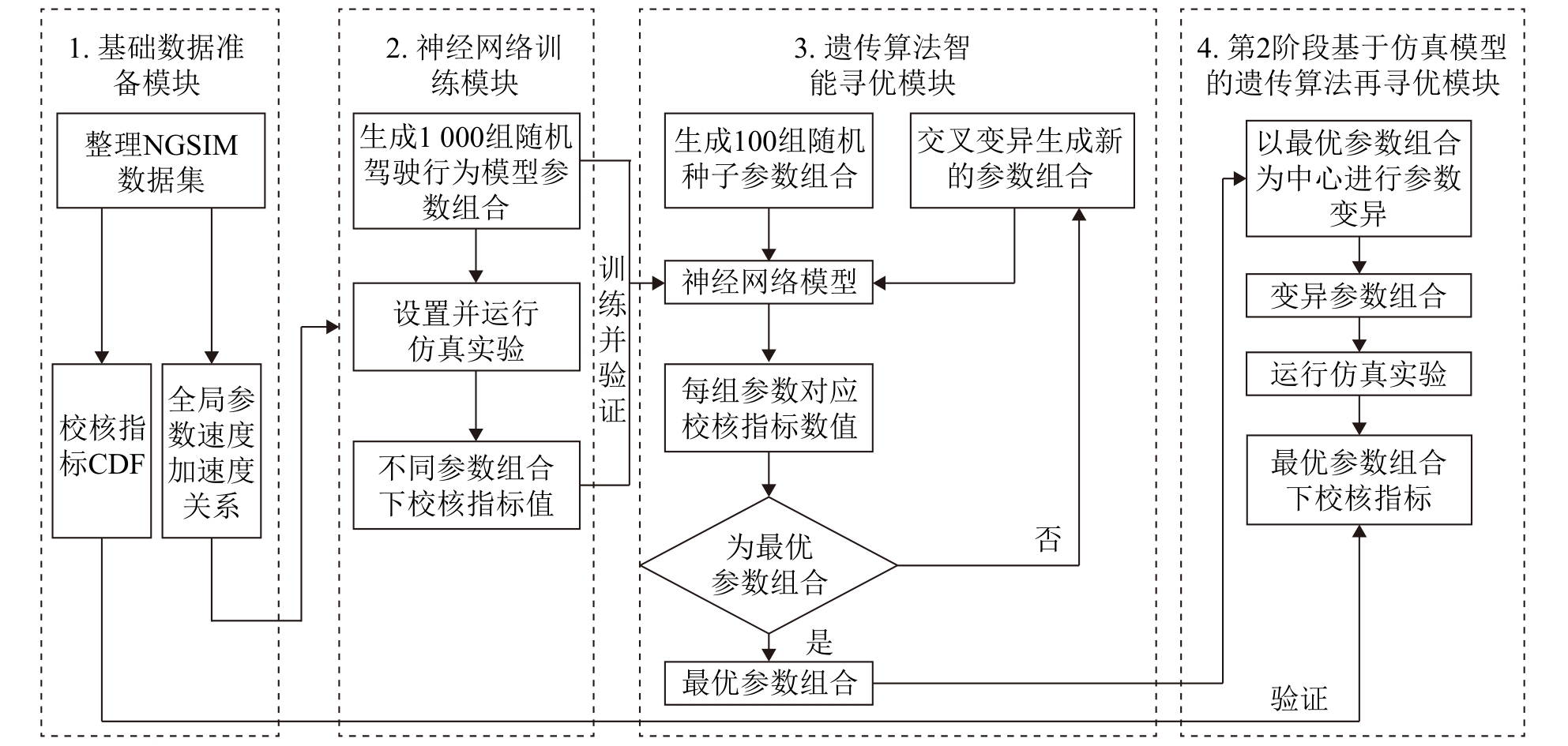
Fig. 3
Study area
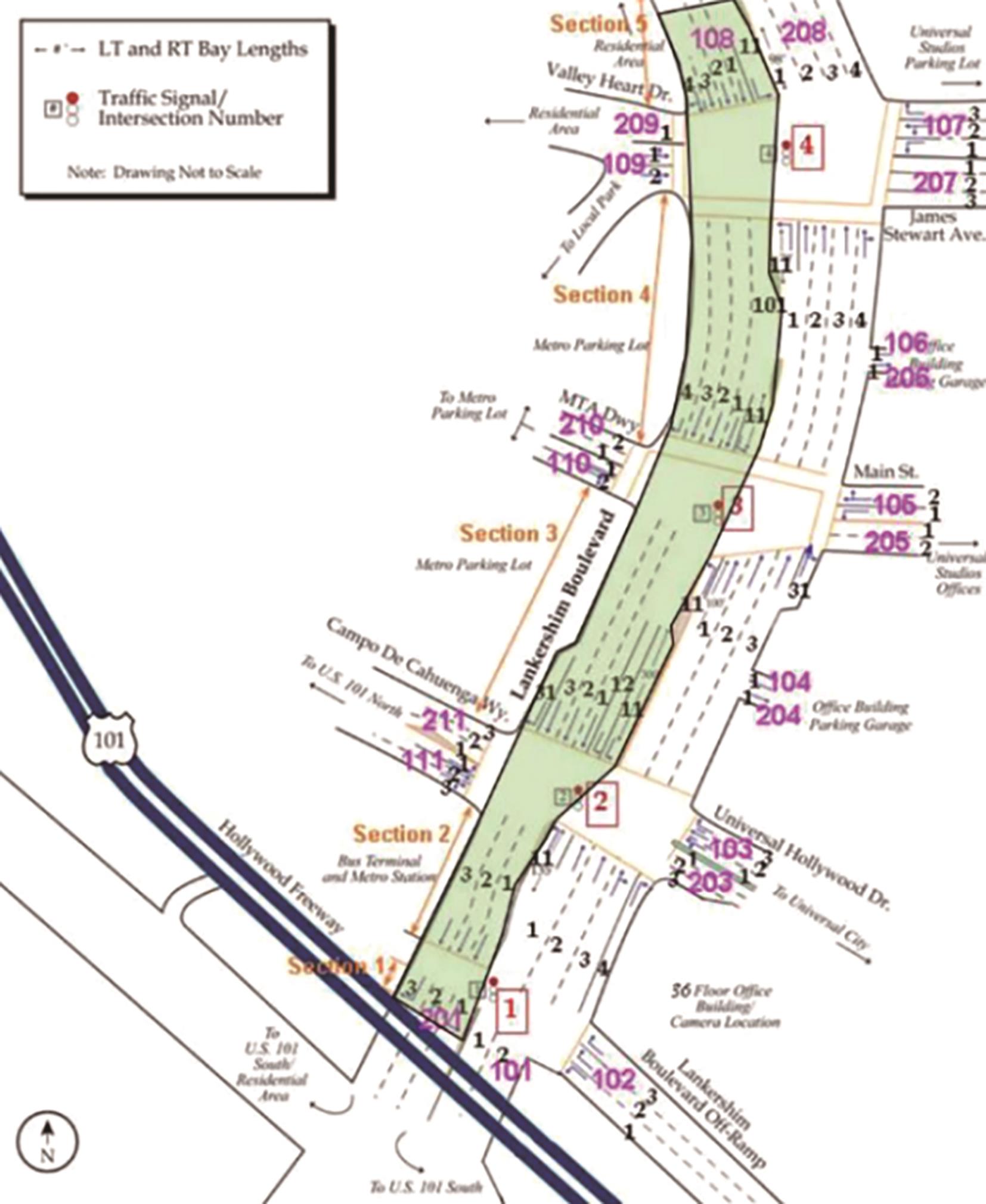
Fig. 4
Car speed-acceleration curves
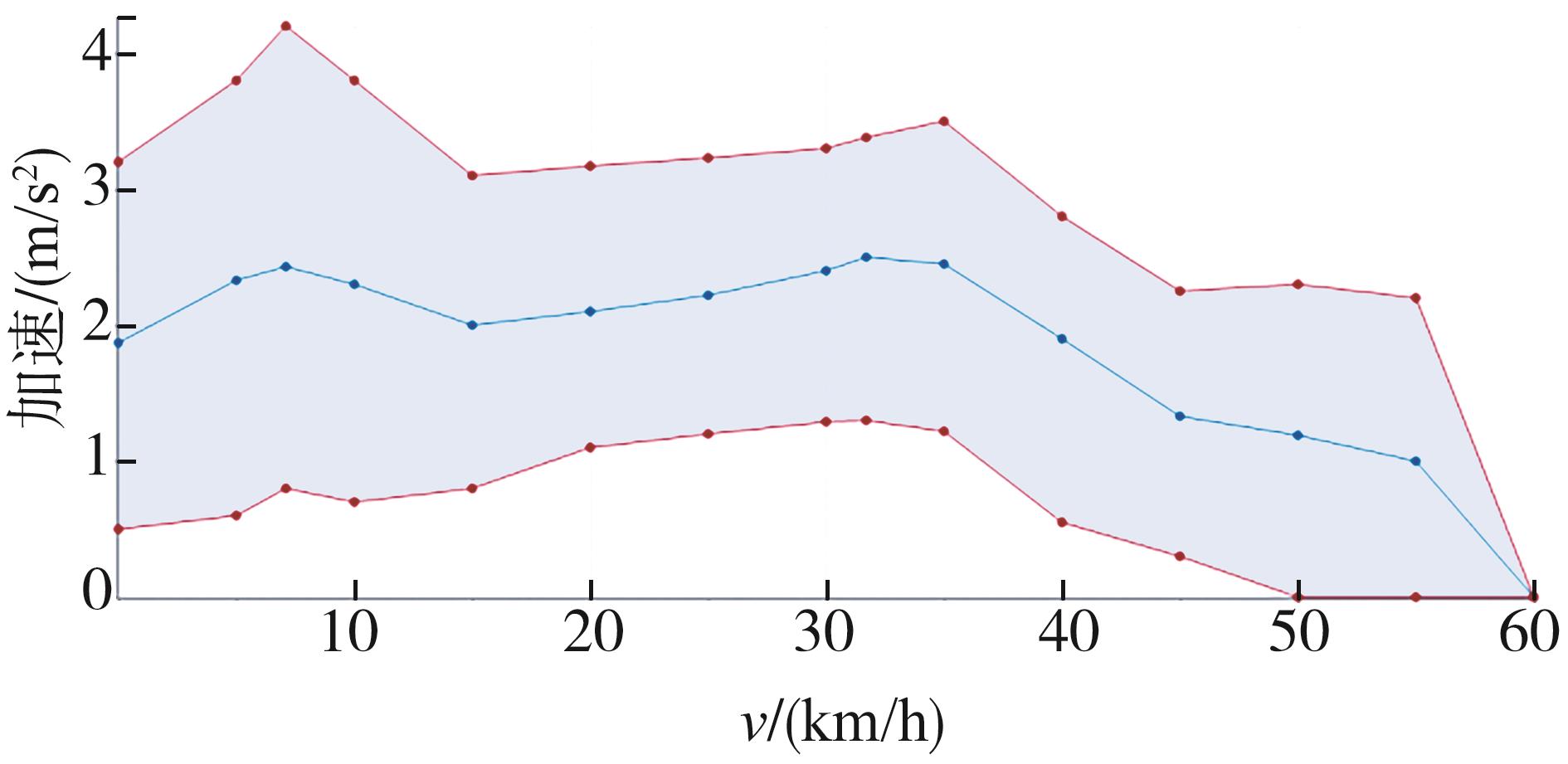
Fig. 5
Truck speed-acceleration curves
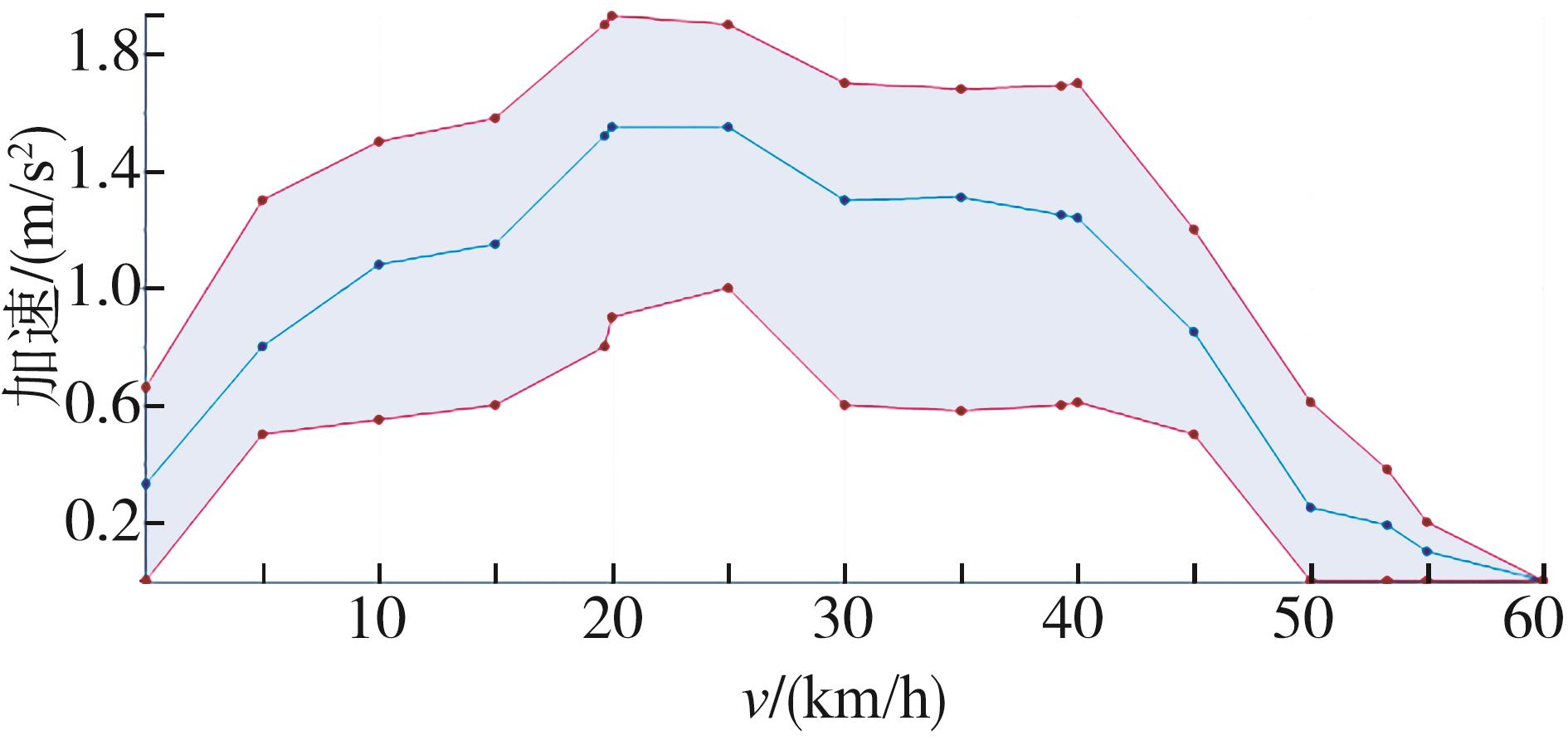
Fig. 6
Car speed-deceleration curves
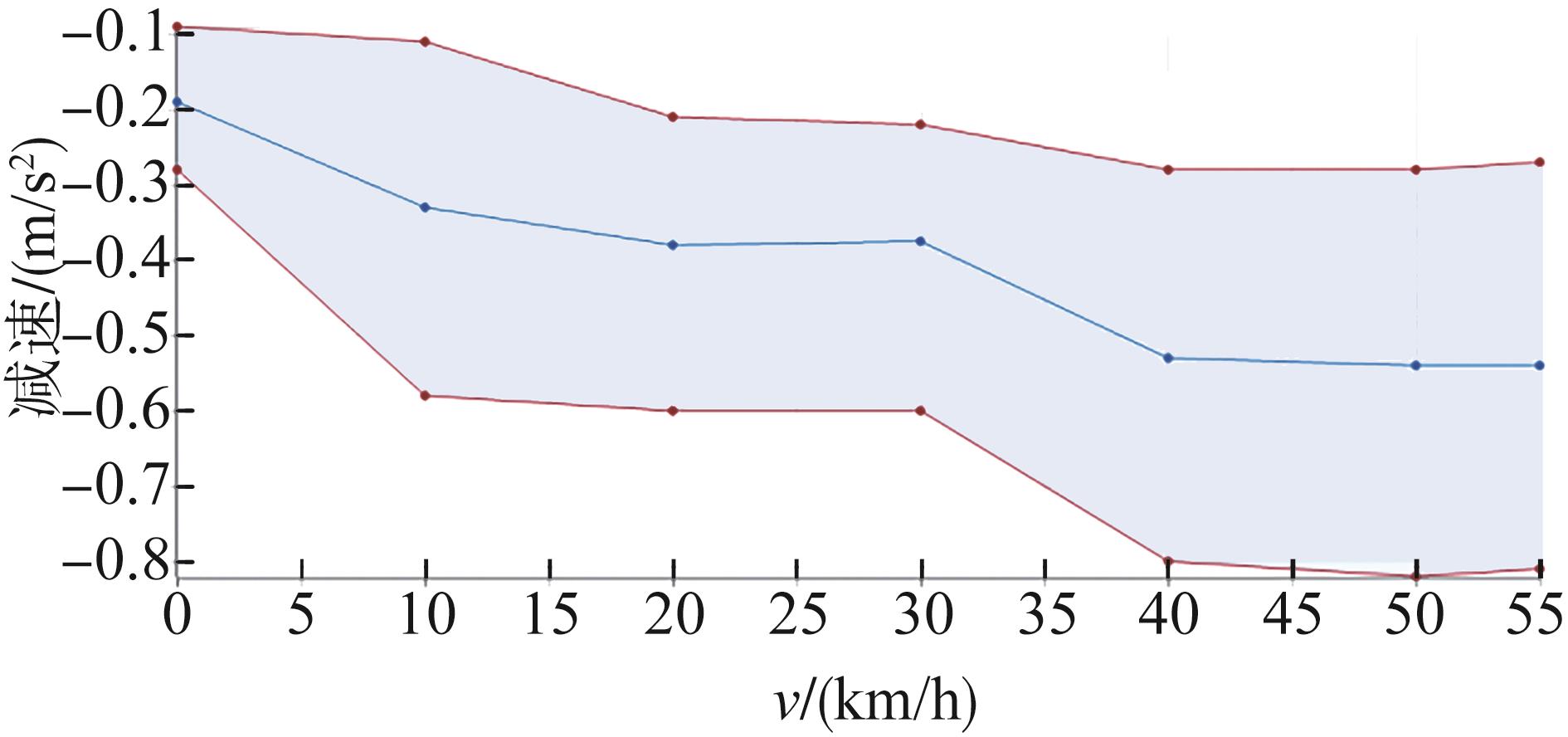
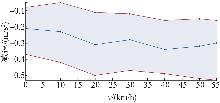
Fig. 7
Truck speed-deceleration curves
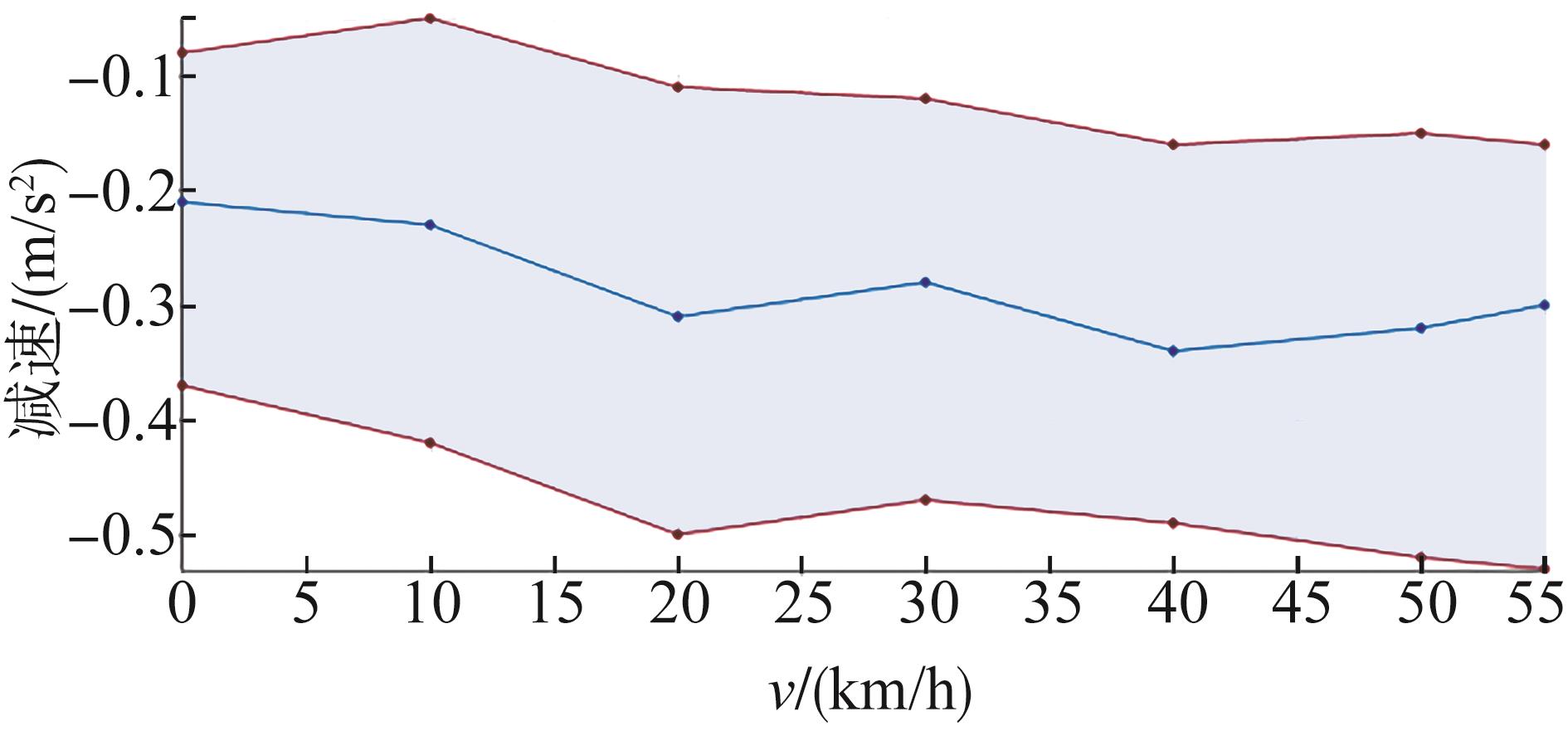
Table 1
Explanations and value ranges of calibration parameters
| 参数名称 | 参数解释 | 数值范围 |
|---|---|---|
| OB_d/m | 车辆在纵向能感知到的前车距离范围(影响响应延迟与跟驰起点) | [150, 350] |
| N_pr | 驾驶员同时感知与判断的前车数量,影响反应保守程度 | [ |
| AXE_average/s | 停车状态下车辆之间的平均期望车头间距 | [ |
| BX_add | 安全距离的加法部分,反映最小跟驰容忍程度 | [ |
| BX_mult | 安全距离乘法项,调整随速度增长的安全距离幅度 | [ |
| ACC_max/(m/s2) | 车辆能实现的最大加速度上限 | [-6, -2] |
| ACC_ac | 加速过程中的平滑性调节因子 | [-2, -0.5] |
| GAP_min/m | 变道所需的最小安全车间距 | [0.5, 5] |
| ABX | 驾驶员对邻车横向距离变化的敏感程度 | [0.1, 1] |
| CO_ac | 当前车对前车强行变道时的减速容忍度,反映交通流中的合作性水平 | [-5, -1] |
| D/m | 换道过程中保持目标车道稳定间距的下限 | [50, 250] |
| T_dis/s | 驾驶员在决定换道后可容忍的最大等待时长 | [ |
Table 2
Prediction accuracy of different neural network tructures
网络结构 (隐藏层节点) | 网络 层数 | 测试集 MAPE/% | 备注 |
|---|---|---|---|
| 64 | 1 | 10.40 | 简单结构,拟合精度不足 |
| 64-32 | 2 | 9.08 | 最终选择,结构紧凑、精度较优 |
| 128-64-32 | 3 | 8.60 | 精度最优,但结构复杂、训练耗时 |
| 128-64 | 2 | 9.10 | 相比最终方案结构更复杂 |
Table 3
Approximate optimal combination after iteration
| 参数名称 | 取值 |
|---|---|
| OB_d/m | 251.25 |
| N_pr | 3 |
| AXE_average/s | 2.77 |
| BX_add | 3.54 |
| BX_mult | 4.03 |
| ACC_max/(m/s2) | -2.8 |
| ACC_ac | -1.4 |
| GAP_min/m | 3.3 |
| ABX | 0.64 |
| CO_ac | -2.5 |
| D/m | 150.69 |
| T_dis/s | 60 |
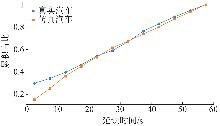
Fig. 8
Car CDF validation for approximate optimal parameters
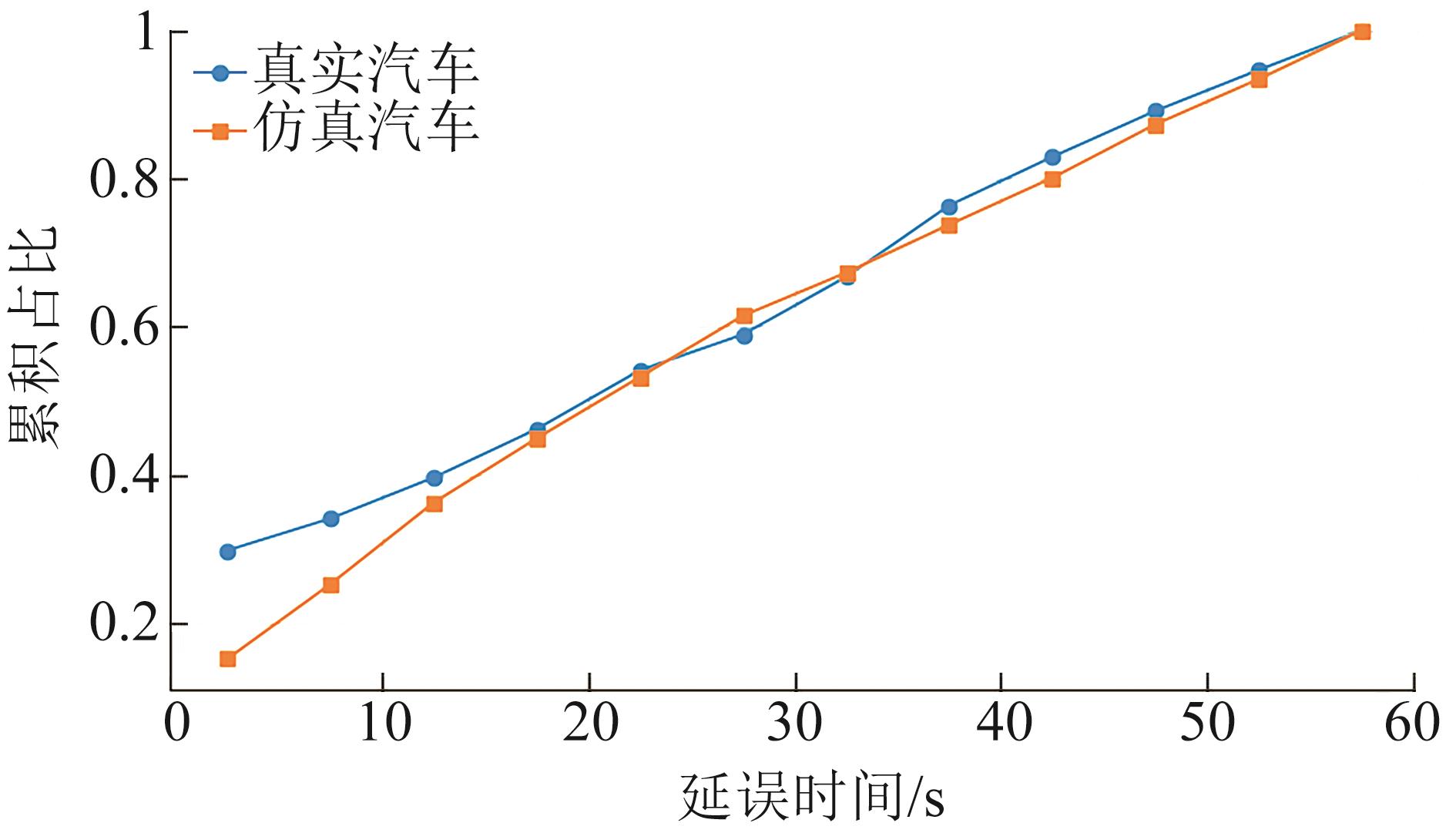
Fig. 9
Truck CDF validation for approximate optimal parameters
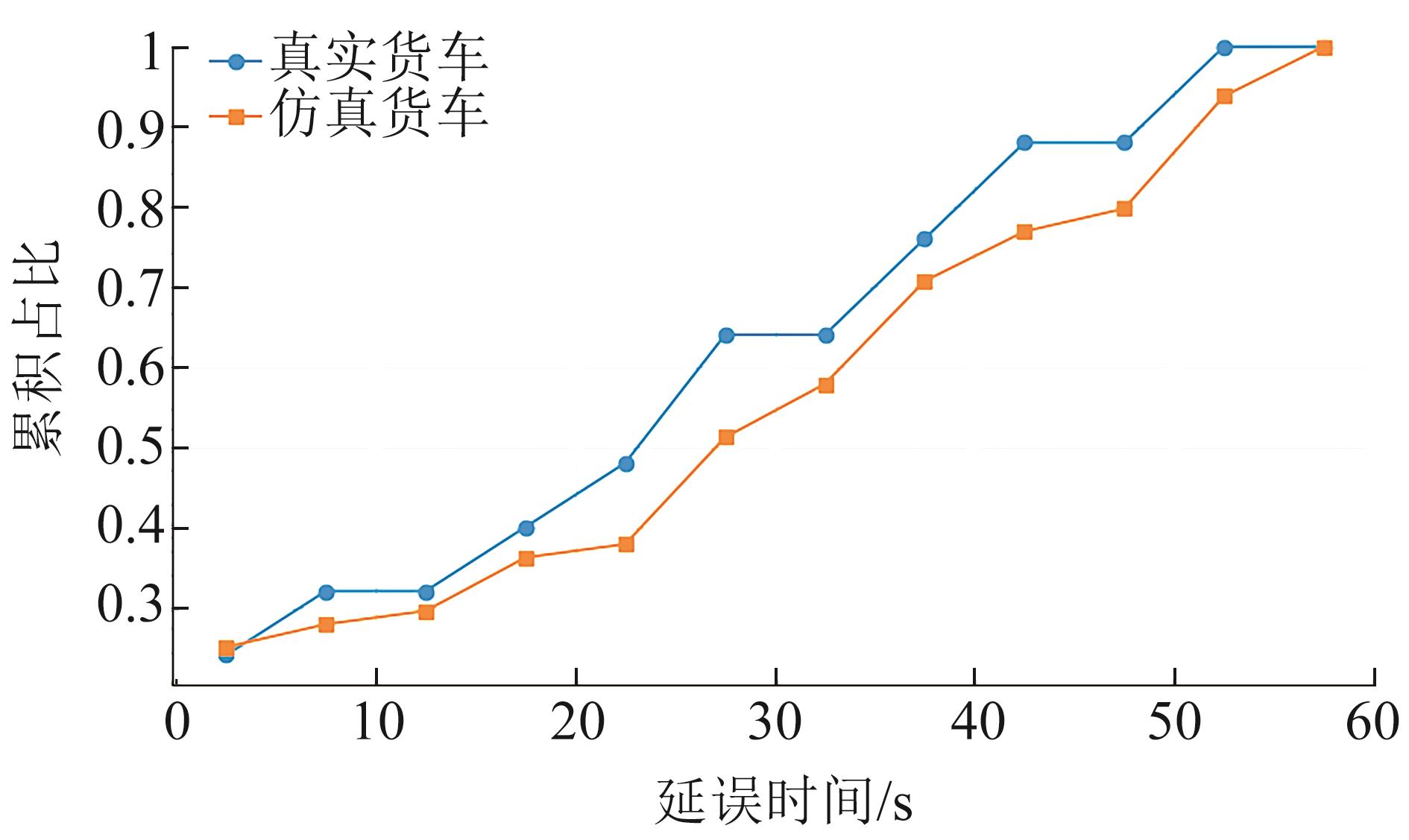
Table 4
Optimal combination after two stages
| 参数名称 | 取值 |
|---|---|
| OB_d/m | 250.25 |
| N_pr | 3 |
| AXE_average/s | 2.59 |
| BX_add | 3.57 |
| BX_mult | 4.43 |
| ACC_max/(m/s2) | -2.7 |
| ACC_ac | -1.36 |
| GAP_min/m | 3.05 |
| ABX | 0.60 |
| CO_ac | -2.5 |
| D/m | 160.69 |
| T_dis/s | 60 |
Fig. 10
Car CDF validation for optimal parameters
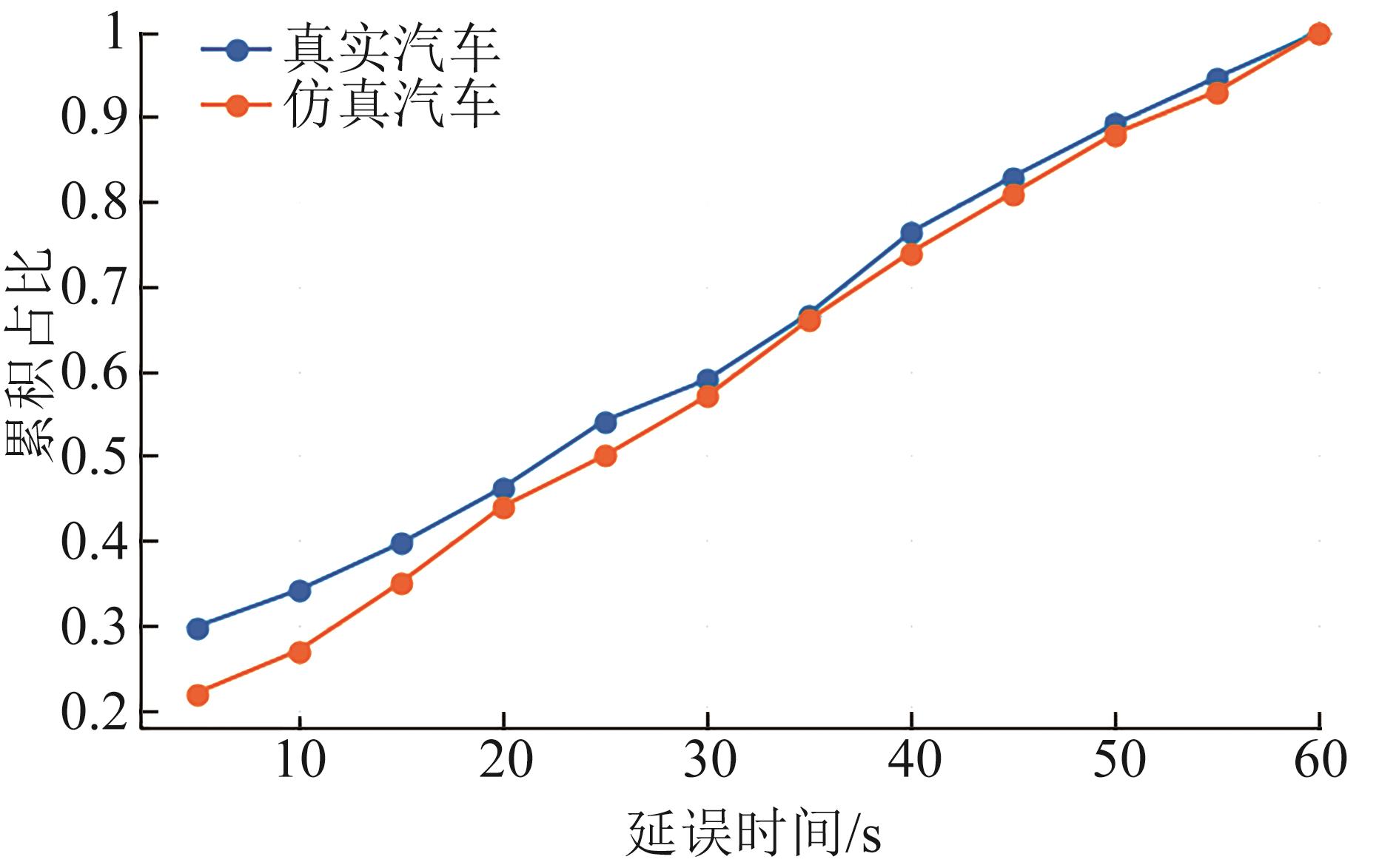
Fig. 11
Truck CDF validation for optimal parameters
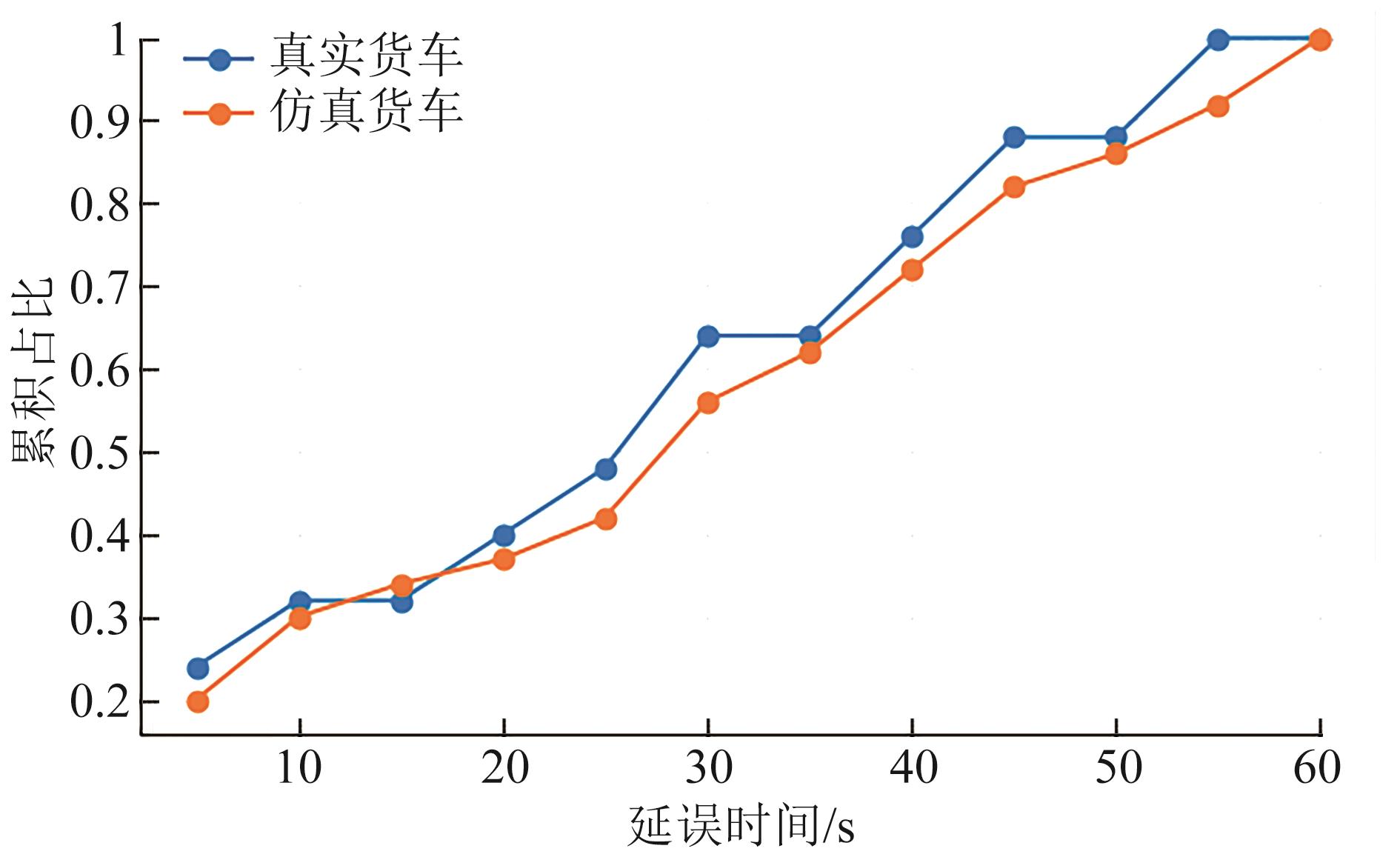
Table 5
Prediction results of car and truck %
| 车辆类型 | 一阶段 | 两阶段优化 |
|---|---|---|
| 汽车 | 8.61 | 6.6 |
| 货车 | 10.01 | 7.9 |
Table 6
Process and time consumption of traditional parameter calibration
| 流程阶段 | 操作内容 | 时间/h |
|---|---|---|
| 参数组生成(100组) | COM接口生成VISSIM文件 | ≈1.0 |
| 仿真运行(100组×5次) | VISSIM 批量运行 | ≈3.5 |
| 延误提取与CDF生成 | 数据解析与统计 | ≈1.0 |
| 每代总耗时(传统) | ≈5.5 |
Table 7
Process and time consumption for parameter calibration of neural network surrogate model
| 操作环节 | 时间消耗 |
|---|---|
| 生成初始1 000组参数文件/h | 10 |
| 仿真运行(1 000组×5次)/h | 35 |
| 延误提取与CDF生成/h | 10 |
| 神经网络训练/s | 10 |
| 遗传算法50代迭代预测/s | 15 |
| 第二阶段再寻优与验证/h | 2 |
Table 8
Performance comparison of traditional method and two-stage optimization method
| 方法类型 | 总耗时/h | MAPE/% |
|---|---|---|
| 传统方法 | 280.5 | 7.96 |
| 一阶段代理方法 | 55.0 | 9.06 |
| 两阶段优化方法 | 57.0 | 7.25 |
| [1] | Benekohal R R. Procedure for Validation of Microscopic Traffic Flow Simulation Models[J]. Transportation Research Record, 1911(1320): 190-202. |
| [2] | Bhattacharyya Kinjal, Maitra Bhargab, Boltze Manfred. Calibration of Micro-simulation Model Parameters for Heterogeneous Traffic Using Mode-specific Performance Measure[J]. Transportation Research Record, 2020, 2674(1): 135-147. |
| [3] | Sebastian Buck H, Mallig Nicolai, Vortisch Peter. Calibrating Vissim to Analyze Delay at Signalized Intersections[J]. Transportation Research Record, 2017, 2615(1): 73-81. |
| [4] | Cheu Ruey-Long, Jin Xin, Ng Kim-Chwee, et al. Calibration of FRESIM for Singapore Expressway Using Genetic Algorithm[J]. Journal of Transportation Engineering, 1998, 124(6): 526-535. |
| [5] | Gao Yacong, Zhou Chenjing, Rong Jian, et al. Enhancing Parameter Calibration for Micro-simulation Models: Investigating Improvement Methods[J]. Simulation Modelling Practice and Theory, 2024, 134: 102950. |
| [6] | 单籽跃, 周晨静, 韦昌永, 等. 微观交通仿真模型参数标定发展与优化实证研究[J]. 交通工程, 2022, 22(4): 46-53. |
| Shan Ziyue, Zhou Chenjing, Wei Changyong, et al. Empirical Study on Development and Optimization of Microscopic Traffic Simulation Model Parameter Calibration[J]. Journal of Transportation Engineering, 2022, 22(4): 46-53. | |
| [7] | 林子赫, 周晨静, 荣建, 等. 基于工程实测的加速度-速度参数阈值分析[J]. 交通信息与安全, 2019, 37(2): 107-113. |
| Lin Zihe, Zhou Chenjing, Rong Jian, et al. An Analysis of Acceleration-speed Parameter Threshold Based on Actual Engineering Measurement[J]. Journal of Transport Information and Safety, 2019, 37(2): 107-113. | |
| [8] | 周晨静, 荣建, 郭琳科. 微观交通仿真模型参数标定结果取值方法研究[J]. 系统仿真学报, 2019, 31(12): 2802-2809. |
| Zhou Chenjing, Rong Jian, Guo Linke. Research on the Value Accessing Method for Calibrating Micro Traffic Simulation Model Parameters[J]. Journal of System Simulation, 2019, 31(12): 2802-2809. | |
| [9] | 周晨静, 高亚聪, 荣建. 微观交通仿真模型参数标定方法改善研究[J]. 系统仿真学报, 2020, 32(11): 2112-2120. |
| Zhou Chenjing, Gao Yacong, Rong Jian. Research on Improvement of Parameters Calibration Method of Microscopic Traffic Simulation Model[J]. Journal of System Simulation, 2020, 32(11): 2112-2120. | |
| [10] | He C, Jin Y, Ong Y S, et al. A Review of Surrogate-assisted Evolutionary Algorithms[J]. Expert Systems with Applications, 2023, 223: 119875. |
| [11] | Naing Htet, Cai Wentong, Yu Jinqiang, et al. Fine-grained Trajectory Reconstruction by Microscopic Traffic Simulation with Dynamic Data-driven Evolutionary Optimization[J]. IEEE Transactions on Intelligent Transportation Systems, 2025, 26(2): 1930-1950. |
| [12] | Xie D, Zhang Y, Li Z, et al. Metamodel-based Calibration of Microscopic Traffic Simulation: A VISSIM Case Study[J]. Transportation Research Part C: Emerging Technologies, 2023, 155: 104264. |
| [13] | Shi Y, Li S, Zhao J. Traffic Simulation Optimization Considering Driving Styles: A Bayesian Optimization Approach[J]. Communications in Transportation Research, 2025, 5: 100128. |
| [14] | 高亚聪, 周晨静, 荣建. 基于行程时间累积分布曲线的微观交通仿真模型参数标定[J]. 公路交通科技, 2021, 38(4): 121-130. |
| Gao Yacong, Zhou Chenjing, Rong Jian. Parameter Calibration of Microscopic Traffic Simulation Model Based on Cumulative Distribution Curve of Travel Time[J]. Journal of Highway and Transportation Research and Development, 2021, 38(4): 121-130. | |
| [15] | Marcello Montanino, Vincenzo Punzo. Making NGSIM Data Usable for Studies on Traffic Flow Theory: A Multistep Method for Vehicle Trajectory Reconstruction[M]. Washington: Transportation Research Board of the National Academies, 2013: JRC76757. |
| [16] | Wang Shuling, Patwary A U Z, Huang Wei, et al. A General Framework for Combining Traffic Flow Models and Bayesian Network for Traffic Parameters Estimation[J]. Transportation Research Part C: Emerging Technologies, 2022, 139: 103664. |
| [17] | Li Yong, Zhou Shaoping. A New Instantaneous Wavelet Bicoherence for Local Fault Detection of Rotating Machinery[J]. IEEE Transactions on Instrumentation and Measurement, 2020, 69(1): 135-143. |
| [18] | Errachid M, Essanhaji A, Messaoudi A. RMVPIA: A New Algorithm for Computing the Lagrange Multivariate Polynomial Interpolation[J]. Numerical Algorithms, 2020, 84(4): 1507-1534. |
| [19] | 周晨静, 荣建, 陈春安. 面向微观交通仿真实验的模型参数敏感性分析方法[J]. 北京工业大学学报, 2016, 42(11): 1728-1733. |
| Zhou Chenjing, Rong Jian, Chen Chunan. Parameter Sensitivity Analysis Method for Microscopic Traffic Simulation Experiment[J]. Journal of Beijing University of Technology, 2016, 42(11): 1728-1733. | |
| [20] | Manjunatha P, Vortisch P, Mathew T V. Methodology for the Calibration of VISSIM in Mixed Traffic[C]//Transportation Research Board 92nd Annual Meeting.Washington, D.C.: Transportation Research Board, 2013: 1-11. |
| [21] | Song Rui, Sun Jian. Calibration of a Micro-traffic Simulation Model with Respect to the Spatial-temporal Evolution of Expressway On-ramp Bottlenecks[J]. Simulation, 2016, 92(6): 535-546. |
| [1] | Wang Jun, Liu Min, Zhang Xiaochuan, Ding Yishan, Feng Juhui, Zhuang Ye. Modelling Method of Unmanned Vehicle Dynamics Based on Neural Network [J]. Journal of System Simulation, 2026, 38(4): 932-947. |
| [2] | Wang Jiheng, Hu Yang, Song Ziqiu, Fang Fang, Liu Jizhen. Prediction of Inflow Wind Field for Large-scale Wind Turbines Based on Multimodal Hybrid Deep Learning [J]. Journal of System Simulation, 2026, 38(2): 501-517. |
| [3] | Li Zhiqiang, Shen Xukun, Hu Yong, Zhou Xueyang, Chen Yifan. Material Reconstruction from Single Image Combining Neural Networks with Singular Value Decomposition [J]. Journal of System Simulation, 2026, 38(1): 189-199. |
| [4] | Wei Chengbiao, Zhao Taoyan, Cao Jiangtao, Li Ping. Design and Prediction of Deep Fuzzy Neural Network [J]. Journal of System Simulation, 2025, 37(9): 2200-2210. |
| [5] | Lü Jinhu, Jiang Hongyi, Liu Deyuan, Tan Shaolin. Modeling and Simulation of Complex Systems Based on Graph Neural Networks [J]. Journal of System Simulation, 2025, 37(7): 1624-1638. |
| [6] | Wang Ziyi, Zhang Kai, Qian Dianwei, Liu Yuzhen. A DRL⁃based Approach for Distributed Equipment Nodes Selection [J]. Journal of System Simulation, 2025, 37(6): 1565-1573. |
| [7] | Zhang Peng, Feng Ke, Gong Jiancheng, Yang Xiaoqiang, Shen Jinxing. Combat Effectiveness Evaluation of Air Defense Missile Weapon System Based on RBF Neural Network [J]. Journal of System Simulation, 2025, 37(2): 529-540. |
| [8] | Shen Jiawei, Cai Daye, Yang Guoqing, Lü Pan, Li Hong. Dynamic Loading Simulation Method for Large-scale Spiking Neural Network [J]. Journal of System Simulation, 2025, 37(2): 541-550. |
| [9] | Li Xiaobin, Hu Bing, Yin Chao, Li Bo, Ma Jun. Spatiotemporal Graph Convolution-based Demand Forecasting and Simulation Analysis for Automotive Parts Supply Chain [J]. Journal of System Simulation, 2025, 37(12): 3060-3074. |
| [10] | Zhang Wenkang, Sun Xiaofeng, Zhong Yiping, Yin Yong. Numerical Simulations of Ship Liquid Tank Sloshing Based on Graph Neural Networks [J]. Journal of System Simulation, 2025, 37(12): 3087-3099. |
| [11] | Xu Jinglin, Chen Qianru, Peng Yang, Yu Fangqiang. Self-calibrating Passenger Flow Simulation and Spatial Optimization for Public Building Based on GRU-SA [J]. Journal of System Simulation, 2025, 37(11): 2826-2838. |
| [12] | Tian Yuanxing, Han Zeyin, Wang Ning, Su Baoding, Xiang Weilin. Twin Modeling of Gearbox Fault Early Warning System Based on Spatio-Temporal Characteristics [J]. Journal of System Simulation, 2025, 37(11): 2867-2876. |
| [13] | Zhang Zhili, Liu Jin, Zhou Zhaofa, Liang Zhe, Zhang Yunhao. Research on Temperature Compensation Technology of Fiber Optic Gyroscope based on ISCSO-BP Neural Network Model [J]. Journal of System Simulation, 2025, 37(11): 2904-2917. |
| [14] | Li Boning, Chen Ming, Qi Shuchang, Meng Haoran, Wang Lei. Attitude Control of Quadrotor UAV Based on Disturbance Observer and Command Filtering [J]. Journal of System Simulation, 2025, 37(11): 2793-2803. |
| [15] | Huang Deqi, Tu Yating, Zhang Zhenhua, Guo Xin. Modeling and Simulation of Traffic Signal Control Based on MLP with Improved GCN-TD3 [J]. Journal of System Simulation, 2025, 37(10): 2568-2577. |
| Viewed | ||||||
|
Full text |
|
|||||
|
Abstract |
|
|||||
 http://www.china-simulation.com

