

Journal of System Simulation ›› 2026, Vol. 38 ›› Issue (7): 1783-1800.doi: 10.16182/j.issn1004731x.joss.25-1221
• Overview • Next Articles
Li Gengpeng, Cai Wei, Yang Zhiyong, Zhang Zhili, Wang Xiaowei
Received:2025-12-12
Revised:2026-04-01
Online:2026-07-28
Published:2026-07-31
Contact:
Cai Wei
CLC Number:
Li Gengpeng, Cai Wei, Yang Zhiyong, Zhang Zhili, Wang Xiaowei. Evolution and Prospects of Polarization Image Simulation Technology[J]. Journal of System Simulation, 2026, 38(7): 1783-1800.
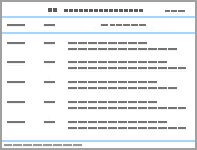
Table 1
Basic methods, process, and difficulties of physical mechanism simulation
| 主要步骤 | 意义 | 难点 | 示例 |
|---|---|---|---|
| 三维建模 | 为偏振光线追踪提供几何基础;支持复杂表面法向量计算 | 真实世界的复杂性可能导致模型过于复杂,也存在模型过于简化导致逼真度不足 | 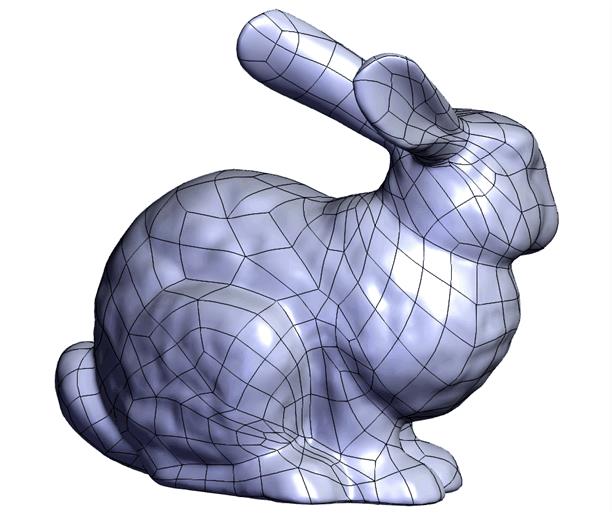 |
| ↓ | |||
| 偏振仿真计算 | 通过求解偏振特性方程,将三维场景的几何属性与物理属性转化为偏振量 | 光-物作用偏振建模复杂;准确的材质偏振参数获取困难 | 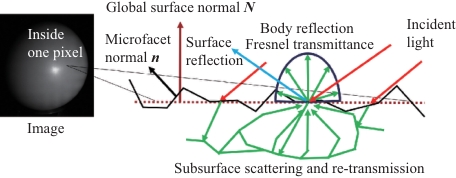 |
| ↓ | |||
| 偏振光线追踪 | 通过光线追踪模拟偏振光在复杂环境中的多次反射过程,生成中间偏振图像数据 | 在不牺牲结果准确性前提下提高计算速度和效率 | 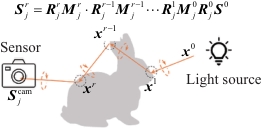 |
| ↓ | |||
| 偏振可视化 | 利用偏振渲染方程得到不同像素处的斯托克斯矢量图像及偏振度图像、偏振角图像等 | 如何有效呈现大量偏振图像数据,同时保持结果的清晰度和可解释性 | 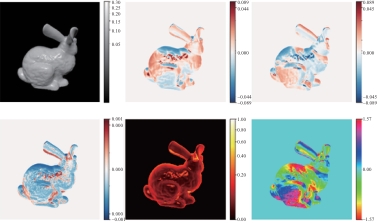 |
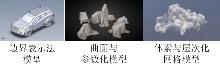
Fig. 1
Examples of common simulation object models in 3D modeling technology
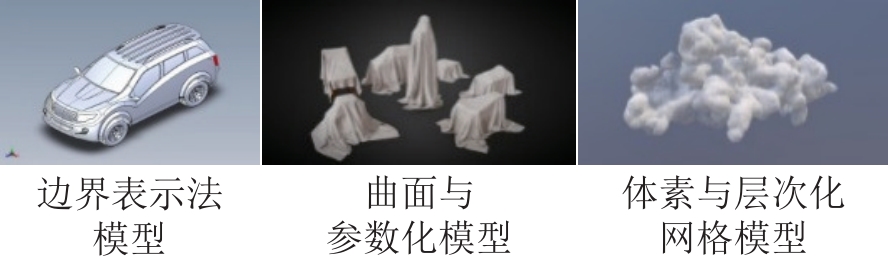
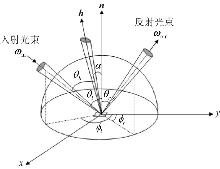
Fig. 2
Schematic of BRDF geometric relationships
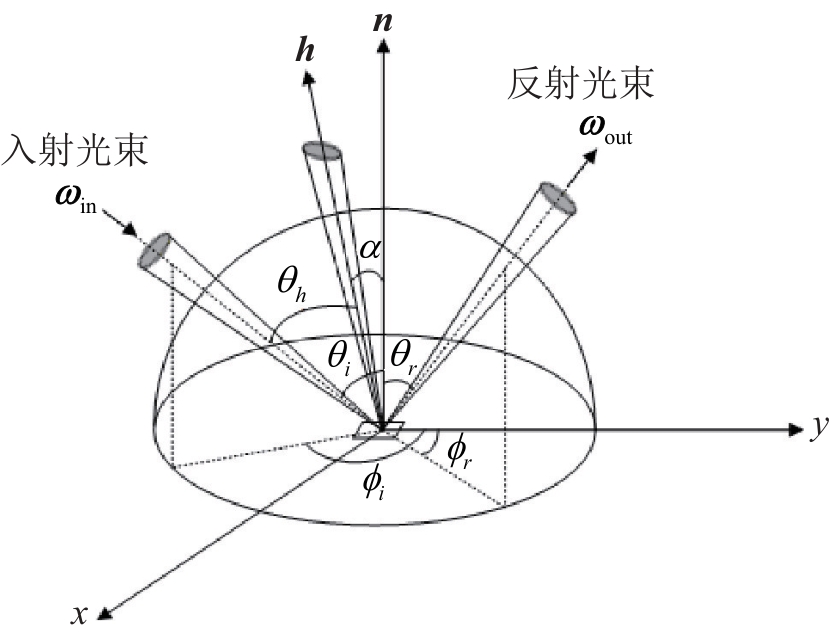
Fig. 3
Schematic diagram of micromirror reflection
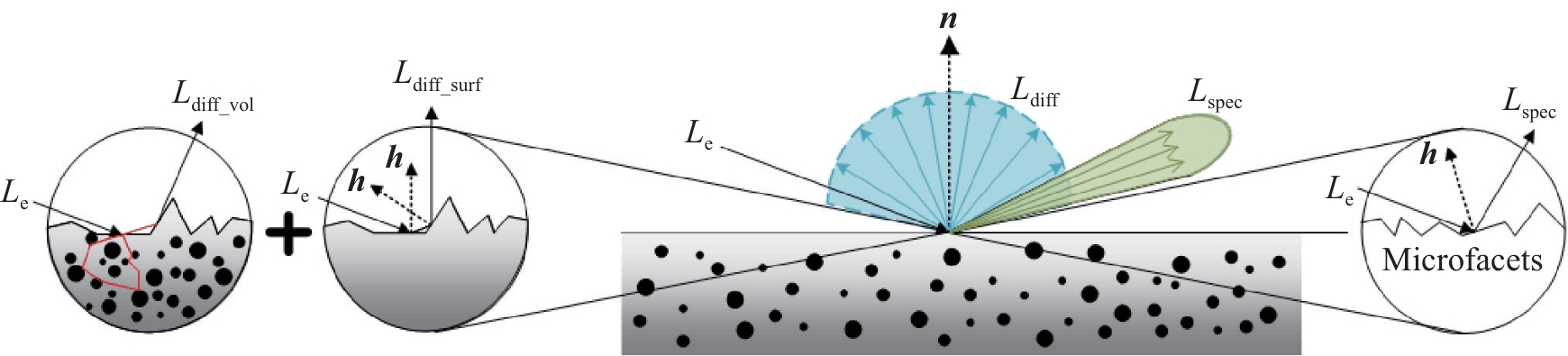
Table 2
Polarization simulation software and platforms
| 类别 | 代表工具 | 偏振实现 | 主要用途 |
|---|---|---|---|
| 专业系统 | DIRSIG, OSMOSIS | 原生支持,模型完备,工业级精度,物理保真度高 | 军事 航天 遥感仿真 |
| 通用引擎 | Vega Prime, Unity 3D | 插件/自定义,依赖开发,实时渲染,生态成熟,交互性强 | 训练模拟 虚拟现实 可视化 |
| 可微分引擎 | Mitsuba 3 | 物理正确,可微分,开源灵活 | 逆向渲染 计算机视觉/图形学研究 |
Fig. 4
Overview of NeSpoF
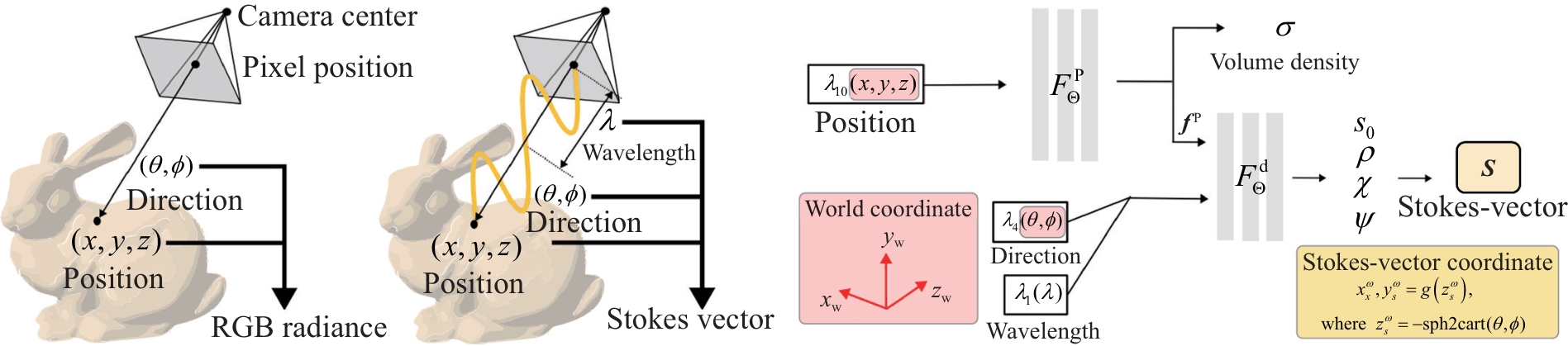
Fig. 5
Polarization image physical-data fusion simulation schematic
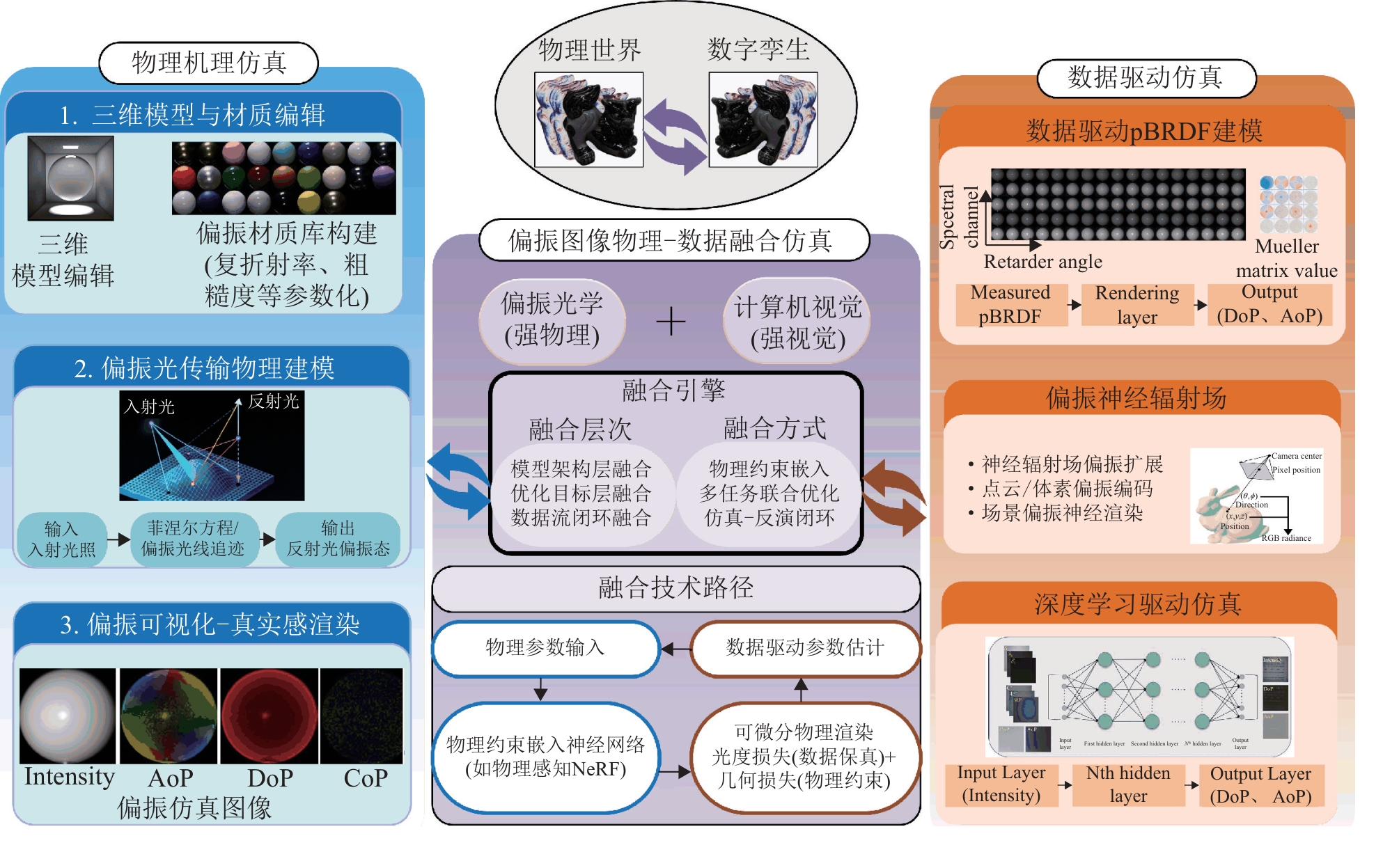
Fig. 6
Overview of NeISF
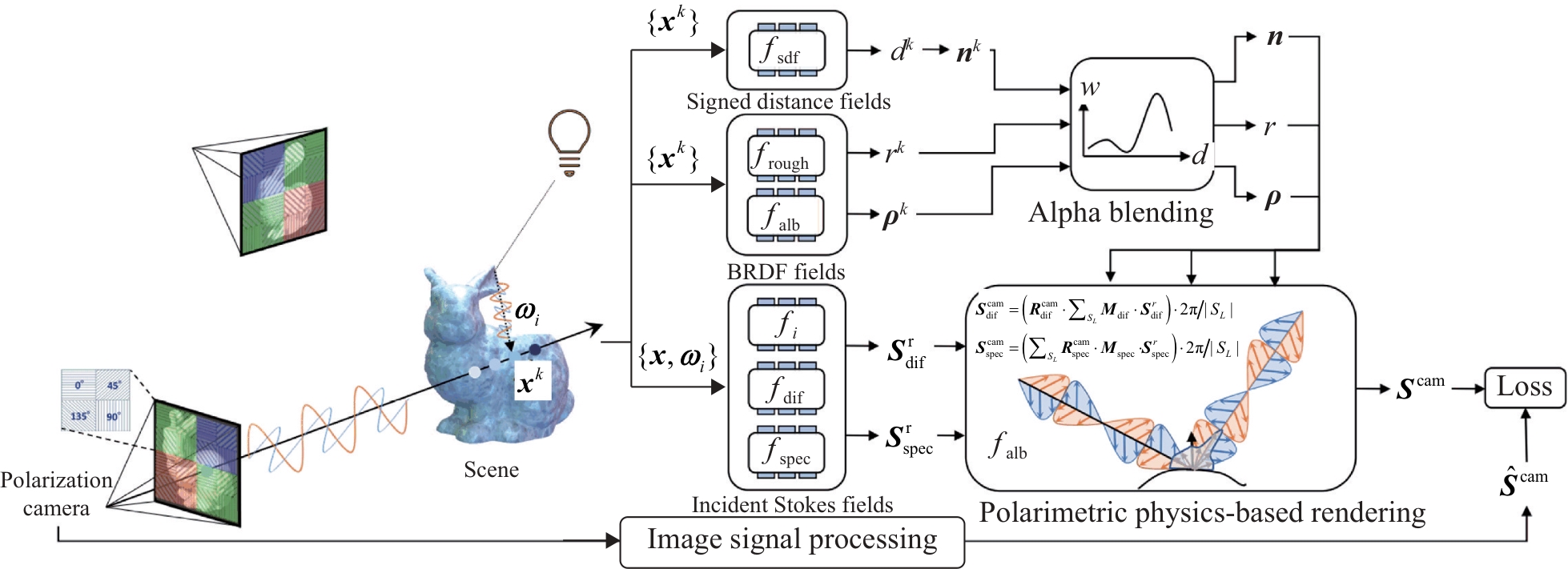
Fig. 7
Overview of NeRSP
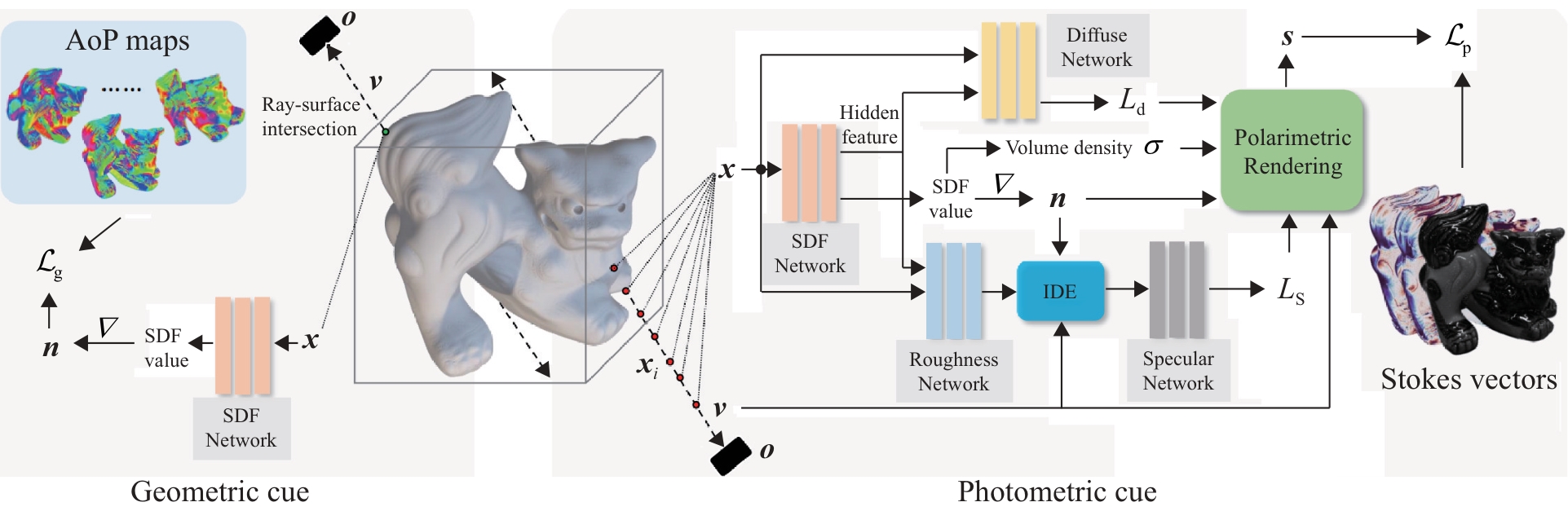
Table 3
Analysis of polarimetric imaging dataset
| 数据集 | 偏振态 | 波段数 | 场景数量 | 场景多样性 |
|---|---|---|---|---|
| SfP-Wild Dataset [ | LP | 1 | 522 | 户外场景 |
| UCLA DeepSfP [ | LP | 1 | 300 | 室内物体 |
| IRIMAS [ | LP | 6 | 10 | 室内物体 |
| KAUST [ | LP | 3 | 40 | 室内物体 |
| PANDORA [ | LP | 3 | 3/2 | 室内多视角/合成多视角 |
| Polarimetric Pose Dataset [ | LP | 3 | 6 | 室内多视角 |
| PolarRR [ | LP | 3 | 807 | 高反光物体 |
| MCubeS [ | LP | 3 | 500 | 户外场景 |
| Synthetic Dataset [ | LP | 3 | 44 300 | 合成场景 |
| Unpol-Pol Image Pairs Dataset [ | LP | 3 | 3 200 | 高反光物体 |
| RGBP-Glass Dataset [ | LP | 3 | 4 500 | 透明物体 |
| Sparse Polarization Dataset [ | LP | 3 | 2 000 | 室内/户外场景 |
| FSPMI [ | LP, CP | 18 | 67 | 平面物体 |
| NeSpoF [ | LP, CP | 21/21 | 4 | 合成多视角/室内户外视角 |
| Spectro-polarimetric Real-world Dataset [ | LP, CP | 3/21 | 2 022/311 | 室内/户外视角 |
Table 4
Comprehensive performance of polarized image simulation paradigms
| 方法类型 | 驱动核心 | 性能评估 | 适用场景 | 发展方向 |
|---|---|---|---|---|
| 物理机理仿真 | 物理模型 | 物理正确;可解释性强;计算昂贵;视觉真实感不足 | 光电系统原始设计;遥感载荷性能前期仿真;基础偏振光学机理研究 | 发展更高效的渲染算法;构建更精细的微面元模型;开发大规模的材质参数数据库 |
| 数据驱动仿真 | 真实数据 | 视觉真实;生成效率高;物理一致性弱;可解释性差 | 计算机视觉算法(如目标检测、分割);物理参数难以获取的复杂外观合成场景 | 探索更高效的生成模型;研究小样本/弱监督学习方法 |
| 物理-数据融合仿真 | 物理建模+ 真实数据 | 物理正确;视觉真实;可编辑/可泛化;系统设计复杂 | 数字孪生系统;逆向工程;军事对抗仿真;自动驾驶仿真 | 开发更高效的隐式物理表达;物理模型与数据驱动的深度耦合;统一的、可微的仿真优化框架 |
| [1] | Goudail F, Tyo J S. When Is Polarimetric Imaging Useful for Material Classification?[J]. Journal of the Optical Society of America, 2011, 28(1): 46-53. |
| [2] | Yang Kui, Liu Fei, Liang Shiyang, et al. Data-driven Polarimetric Imaging: A Review[J]. Opto-Electronic Science, 2024, 3(2): 230042. |
| [3] | 段锦, 张昊, 宋靖远, 等. 深度学习偏振图像融合研究现状[J]. 红外技术, 2024, 46(2): 119-128. |
| Duan Jin, Zhang Hao, Song Jingyuan, et al. Review of Polarization Image Fusion Based on Deep Learning[J]. Infrared Technology, 2024, 46(2): 119-128. | |
| [4] | Fan A, Xu Tingfa, Teng Geer, et al. Multi-angle and Full-stokes Polarization Multispectral Images Using Quarter-wave Plate and Tunable Filter[J]. Scientific Data, 2024, 11(1): 1401. |
| [5] | Liu Q, Liu H, Yan L, et al. A Physics-based Polarization Simulation Method for Synthetic Scenes[J]. Remote Sensing, 2022, 14(15): 3678. |
| [6] | Yan Changda, Wang Xia, Zhang Xin, et al. Training a Dataset Simulated Using RGB Images for an End-to-end Event-based DoLP Recovery Network[J]. Photonics, 2024, 11(5): 481. |
| [7] | Yan Changda, Zhang Xin, Wang Xia, et al. A Novel Simulation for Polarization Dehazing[J]. IEEE Signal Processing Letters, 2024, 31: 341-345. |
| [8] | He Chao, He Honghui, Chang Jintao, et al. Polarisation Optics for Biomedical and Clinical Applications: A Review[J]. Light: Science & Applications, 2021, 10(1): 194. |
| [9] | Li Yuanhao, Guo Xiaohan, Zhang Kai, et al. The Structural Types of the Polarization Detection Unit in Imaging Polarimeter Based on the Stokes Parameter Method[J]. Sensors, 2025, 25(13): 4069. |
| [10] | Zhao Yongqiang, Pan Quan, Zhang Hongcai. Material Classification Based on Multiband Polarimetric Images Fusion[C]//Polarization: Measurement, Analysis, and Remote Sensing VII. Bellingham: SPIE, 2006: 624007. |
| [11] | 丁源, 谭畅, 王世勇, 等. 目标场景红外偏振成像仿真技术发展综述[J]. 光电技术应用, 2023, 38(5): 13-18, 61. |
| Ding Yuan, Tan Chang, Wang Shiyong, et al. Review of Development of Infrared Polarization Imaging Simulation Technology in Target Scenarios[J]. Electro-Optic Technology Application, 2023, 38(5): 13-18, 61. | |
| [12] | 谭畅, 王世勇, 高思莉, 等. 基于改进偏振双向反射分布函数的海面场景红外偏振成像仿真[J]. 光子学报, 2022, 51(6): 243-252. |
| Tan Chang, Wang Shiyong, Gao Sili, et al. Infrared Polarization Imaging Simulation of Sea Scenes Based on Improved Polarized Bidirectional Reflectivity Distribution Function[J]. Acta Photonica Sinica, 2022, 51(6): 243-252. | |
| [13] | Yang Pengfei, Li Yanhui, Wu Zhensen, et al. Polarimetric Bidirectional Reflectance Distribution Function Empirical Model Considering Diffuse Reflection Polarization[J]. Chinese Journal of Physics, 2025, 97: 1135-1148. |
| [14] | 缪裕培, 陈佳盈, 张小杰, 等. 金属表面偏振双向反射分布函数建模与逆向绘制[J]. 光学学报, 2024, 44(22): 187-200. |
| Miao Yupei, Chen Jiaying, Zhang Xiaojie, et al. Modeling and Inverse Rendering of Polarimetric Bidirectional Reflectance Distribution Function for Metal Surfaces[J]. Acta Optica Sinica, 2024, 44(22): 187-200. | |
| [15] | Lin Beibei, Yuan Zifeng, Chen Tingting. RGB-to-polarization Estimation: A New Task and Benchmark Study[EB/OL]. (2025-10-04) [2025-12-06]. . |
| [16] | 周强国, 黄志明, 周炜. 偏振成像技术的研究进展及应用[J]. 红外技术, 2021, 43(9): 817-828. |
| Zhou Qiangguo, Huang Zhiming, Zhou Wei. Research Progress and Application of Polarization Imaging Technology[J]. Infrared Technology, 2021, 43(9): 817-828. | |
| [17] | Rodriguez Joaquin, Lew-Yan-Voon Lew-Fock-Chong, Martins Renato, et al. Pola4All: Survey of Polarimetric Applications and an Open-source Toolkit to Analyze Polarization[J]. Journal of Electronic Imaging, 2024, 33(1): 010901. |
| [18] | Yao Mingde, Wang Menglu, Tam King-Man, et al. PolarFree: Polarization-based Reflection-free Imaging[C]//2025 IEEE/CVF Conference on Computer Vision and Pattern Recognition (CVPR). Piscataway: IEEE, 2025: 10890-10899. |
| [19] | Pham Thi-Thu-Hien, Vo Quoc-Hoang-Quyen, Nguyen Thao-Vi, et al. ColoPola: A Polarimetric Imaging Dataset for Colorectal Cancer Detection[J]. GigaScience, 2025, 14: giaf120. |
| [20] | Duan Jin, Song Jingyuan, Zhu Yong, et al. Polarization Image Fusion Method Based on Polarization Saliency with Generator Adversarial Network[J]. Optics and Lasers in Engineering, 2024, 178: 108159. |
| [21] | 孙晓兵, 刘晓, 黄红莲, 等. 光学遥感偏振成像全链路仿真[M]. 北京: 科学出版社, 2022. |
| Sun Xiaobing, Liu Xiao, Huang Honglian, et al. Simulation of Polarization Imaging in Optical Remote Sensing[M]. Beijing: Science Press, 2022. | |
| [22] | 李岩, 张伟杰, 陈嘉玉. 偏振场景目标探测的建模与仿真[J]. 光学精密工程, 2017, 25(8): 2233-2243. |
| Li Yan, Zhang Weijie, Chen Jiayu. Modeling and Simulation for Target Detection in Polarization Scene[J]. Optics and Precision Engineering, 2017, 25(8): 2233-2243. | |
| [23] | 高辉. 基于偏振的红外成像目标模拟技术研究进展[J]. 红外, 2014, 35(2): 9-16, 43. |
| Gao Hui. Progress of IR Target Simulation Based on Polarization Technology[J]. Infrared, 2014, 35(2): 9-16, 43. | |
| [24] | 姜会林, 付强, 段锦, 等. 红外偏振成像探测技术及应用研究[J]. 红外技术, 2014, 36(5): 345-349. |
| Jiang Huilin, Fu Qiang, Duan Jin, et al. Research on Infrared Polarization Imaging Detection Technology and Application[J]. Infrared Technology, 2014, 36(5): 345-349. | |
| [25] | 汤倩, 张仁斌, 凌晋江, 等. 热辐射偏振建模与仿真[J]. 光电工程, 2015, 42(8): 41-46. |
| Tang Qian, Zhang Renbin, Ling Jinjiang, et al. Modeling and Simulation of Thermal Emission Polarization[J]. Opto-Electronic Engineering, 2015, 42(8): 41-46. | |
| [26] | Yan Shijie, Jacques S L, Ramella-Roman J C, et al. Graphics-processing-unit-accelerated Monte Carlo Simulation of Polarized Light in Complex Three-dimensional Media[J]. Journal of Biomedical Optics, 2022, 27(8): 083015. |
| [27] | Zhao Jinyu, Monno Yusuke, Okutomi Masatoshi. Polarimetric Multi-view Inverse Rendering[J]. IEEE Transactions on Pattern Analysis and Machine Intelligence, 2023, 45(7): 8798-8812. |
| [28] | Wu Xianyu, Li Penghao, Zhang Xin, et al. Three Dimensional Shape Reconstruction via Polarization Imaging and Deep Learning[J]. Sensors, 2023, 23(10): 4592. |
| [29] | Qiu Yu, Wen Sijia, Zhang Hainan, et al. High-fidelity Polarimetric Implicit 3D Reconstruction with View-dependent Physical Representation[C]//Proceedings of the Thirty-Ninth AAAI Conference on Artificial Intelligence and Thirty-Seventh Conference on Innovative Applications of Artificial Intelligence and Fifteenth Symposium on Educational Advances in Artificial Intelligence. Palo Alto: AAAI Press, 2025: 6621-6629. |
| [30] | 袁祯泷, 李泽昊, 陈科桦, 等. 多视角立体匹配三维重建研究综述[J]. 中国图象图形学报, 2026, 31(3): 657-685. |
| Yuan Zhenlong, Li Zehao, Chen Kehua, et al. Multiview Stereo 3D Reconstruction Research: A Survey[J]. Journal of Image and Graphics, 2026, 31(3): 657-685. | |
| [31] | 马帅, 白廷柱, 曹峰梅, 等. 基于双向反射分布函数模型的红外偏振仿真[J]. 光学学报, 2009, 29(12): 3357-3361. |
| Ma Shuai, Bai Tingzhu, Cao Fengmei, et al. Infrared Polarimetric Scene Simulation Based on Bidirectional Reflectance Distribution Function Model[J]. Acta Optica Sinica, 2009, 29(12): 3357-3361. | |
| [32] | 张景华, 张焱, 石志广. 基于长波红外的海面场景偏振特性分析与建模[J]. 红外与毫米波学报, 2018, 37(5): 586-594. |
| Zhang Jinghua, Zhang Yan, Shi Zhiguang. Study and Modeling of Infrared Polarization Characteristics Based on Sea Scene in Long Wave Band[J]. Journal of Infrared and Millimeter Waves, 2018, 37(5): 586-594. | |
| [33] | 柳祎, 史浩东, 姜会林, 等. 粗糙目标表面红外偏振特性研究[J]. 中国光学, 2020, 13(3): 459-471. |
| Liu Yi, Shi Haodong, Jiang Huilin, et al. Infrared Polarization Properties of Targets with Rough Surface[J]. Chinese Optics, 2020, 13(3): 459-471. | |
| [34] | 张弛, 吴鑫, 谢建. 基于双向反射分布函数的海面红外偏振特性表征模型[J]. 光学精密工程, 2020, 28(6): 1303-1313. |
| Zhang Chi, Wu Xin, Xie Jian. Infrared Polarization Characteristics on Sea Surface Based on Bidirectional Reflection Distribution Function[J]. Optics and Precision Engineering, 2020, 28(6): 1303-1313. | |
| [35] | Gu Xiansong, Fu Qiang, Wang Liya, et al. Analysis and Inversion of Target Polarization Characteristics Based on pBRDF[J]. Journal of Systems Engineering and Electronics, 2024, 35(5): 1073-1083. |
| [36] | Priest R G, Germer T A. Polarimetric BRDF in the Microfacet Model: Theory and Measurements[C]//Proceedings of the 2000 Meeting of the MSS Specialty Sensors Group on Passive Sensors. Laurel: MSS, 2000, 1: 169-183. |
| [37] | Westlund H B, Meyer G W. A BRDF Database Employing the Beard-maxwell Reflection Model[C]//Proceedings of Graphics Interface 2002. Calgary: Canadian Human-Computer Communications Society, 2002: 189-200. |
| [38] | 段锦, 丁华藤, 杨嘉豪, 等. 基于粗糙表面的高阶镜面反射pBRDF模型[J]. 光学精密工程, 2025, 33(14): 2153-2165. |
| Duan Jin, Ding Huateng, Yang Jiahao, et al. High Order Specular Reflection pBRDF Model Based on Rough Surface[J]. Optics and Precision Engineering, 2025, 33(14): 2153-2165. | |
| [39] | Smith B. Geometrical Shadowing of a Random Rough Surface[J]. IEEE Transactions on Antennas and Propagation, 1967, 15(5): 668-671. |
| [40] | Heitz E. Understanding the Masking-shadowing Function in Microfacet-based BRDFs[J]. Journal of Computer Graphics Techniques, 2014, 3(2): 48-107. |
| [41] | Tamisier Elsa, Ribardière Mickaël, Meneveaux Daniel, et al. Data-driven Correction for the Masking Model of Smith[J]. Journal of the Optical Society of America, 2024, 41(9): 1777-1785. |
| [42] | Beckmann P, Spizzichino A. The Scattering of Electromagnetic Waves from Rough Surfaces[M]. Oxford: Pergamon Press, 1963: 1-503. |
| [43] | Trowbridge T S, Reitz K P. Average Irregularity Representation of a Rough Surface for Ray Reflection[J]. Journal of the Optical Society of America, 1975, 65(5): 531-536. |
| [44] | Weyrich T, Lawrence J, Lensch H P A, et al. Principles of Appearance Acquisition and Representation[J]. Foundations and Trends in Computer Graphics and Vision, 2009, 4(2): 75-191. |
| [45] | Ribardière Mickaël, Bringier Benjamin, Simonot Lionel, et al. Microfacet BSDFs Generated from NDFs and Explicit Microgeometry[J]. ACM Transactions on Graphics, 2019, 38(5): 143. |
| [46] | Oren M, Nayar S K. Generalization of Lambert's Reflectance Model[C]//Proceedings of the 21st Annual Conference on Computer Graphics and Interactive Techniques. New York: Association for Computing Machinery, 1994: 239-246. |
| [47] | Yang Min, Xu Wenbin, Sun Zhenyuan, et al. Degree of Polarization Modeling Based on Modified Microfacet pBRDF Model for Material Surface[J]. Optics Communications, 2019, 453: 124390. |
| [48] | Feng Weiwei, Li Jinhua, Wei Qingnong, et al. A Hybrid Model of Polarized BRDF for Rough Surfaces[J]. Infrared Physics & Technology, 2010, 53(5): 336-341. |
| [49] | 颛孙晓博, 武文远, 黄雁华, 等. 基于MB模型的简化偏振BRDF模型建立与仿真[J]. 红外与激光工程, 2015, 44(3): 1098-1102. |
| Zhuansun Xiaobo, Wu Wenyuan, Huang Yanhua, et al. Establishment and Simulation of Simplified Polarimetric BRDF Model Based on MB Model[J]. Infrared and Laser Engineering, 2015, 44(3): 1098-1102. | |
| [50] | Wilkie Alexander, Weidlich Andrea. A Standardised Polarisation Visualisation for Images[C]//Proceedings of the 26th Spring Conference on Computer Graphics. New York: Association for Computing Machinery, 2010: 43-50. |
| [51] | Jarabo Adrian, Gutierrez Diego. Bidirectional Rendering of Polarized Light Transport[C]//Proceedings of the XXVI Spanish Computer Graphics Conference. Goslar: Eurographics Association, 2016: 15-22. |
| [52] | Nimier-David Merlin, Vicini Delio, Zeltner Tizian, et al. Mitsuba 2: A Retargetable Forward and Inverse Renderer[J]. ACM Transactions on Graphics, 2019, 38(6): 203. |
| [53] | Walter B, Marschner S R, Li Hongsong, et al. Microfacet Models for Refraction Through Rough Surfaces[C]//Rendering Techniques. Eindhoven: The Eurographics Association, 2007: 195-206. |
| [54] | Weidlich A, Wilkie Alexander. Arbitrarily Layered Micro-facet Surfaces[C]//Proceedings of the 5th International Conference on Computer Graphics and Interactive Techniques in Australia and Southeast Asia. New York: Association for Computing Machinery, 2007: 171-178. |
| [55] | Omer K, Kupinski M. Compression, Interpolation, and Importance Sampling for Polarized BRDF Models[J]. Optics Express, 2022, 30(14): 25734-25752. |
| [56] | Matusik W, Pfister H, Brand M, et al. A Data-driven Reflectance Model[J]. ACM Transactions on Graphics, 2003, 22(3): 759-769. |
| [57] | Baek Seung-Hwan, Zeltner Tizian, Jin Ku Hyun, et al. Image-based Acquisition and Modeling of Polarimetric Reflectance[J]. ACM Transactions on Graphics, 2020, 39(4): 139. |
| [58] | Guo Yu, Smith C, Hašan Miloš, et al. MaterialGAN: Reflectance Capture Using a Generative SVBRDF Model[J]. ACM Transactions on Graphics, 2020, 39(6): 254. |
| [59] | Peters C, Tsogkas S, Gygli M. Polarimetric Neural Radiance Fields[C]//International Conference on 3D Vision. Piscataway: IEEE, 2022: 555-565. |
| [60] | Kim Youngchan, Jin Wonjoon, Cho Sunghyun, et al. Neural Spectro-polarimetric Fields[EB/OL]. (2023-12-10) [2025-12-16]. . |
| [61] | Dave A, Zhao Yongyi, Veeraraghavan A. PANDORA: Polarization-aided Neural Decomposition of Radiance[C]//Computer Vision - ECCV 2022. Cham: Springer Nature Switzerland, 2022: 538-556. |
| [62] | 孙红雨, 李军, 袁博, 等. 基于深度学习的偏振图像融合方法[J]. 红外技术, 2025, 47(2): 193-200. |
| Sun Hongyu, Li Jun, Yuan Bo, et al. Deep Learning-based Polarization Image Fusion Method[J]. Infrared Technology, 2025, 47(2): 193-200. | |
| [63] | 韩涵, 王昕, 蒲先坤, 等. 基于多尺度对抗的遮蔽偏振图像重构方法[J]. 激光与光电子学进展, 2025, 62(14): 459-471. |
| Han Han, Wang Xin, Pu Xiankun, et al. Multiscale Adversarial-based Reconstruction Method for Occluded Polarized Images[J]. Laser & Optoelectronics Progress, 2025, 62(14): 459-471. | |
| [64] | 刘贺东, 韩宜霖, 李校博, 等. 基于深度神经网络的水下图像偏振信息复原方法[J]. 光学学报, 2024, 44(12): 53-62. |
| Liu Hedong, Han Yilin, Li Xiaobo, et al. Polarization Information Restoration of Underwater Images Based on Deep Neural Network[J]. Acta Optica Sinica, 2024, 44(12): 53-62. | |
| [65] | 胡浩丰, 李天赐, 申凌皓. 散射介质中偏振图像模拟方法及应用[J]. 陕西师范大学学报(自然科学版), 2024, 52(6): 1-11. |
| Hu Haofeng, Li Tianci, Shen Linghao. Simulation Method of Polarization Imaging in the Scattering Medium and Its Applications[J]. Journal of Shaanxi Normal University(Natural Science Edition), 2024, 52(6): 1-11. | |
| [66] | Qi Pengfei, Li Xiaobo, Han Yilin, et al. U2R-pGAN: Unpaired Underwater-image Recovery with Polarimetric Generative Adversarial Network[J]. Optics and Lasers in Engineering, 2022, 157: 107112. |
| [67] | Li Chenhao, Ono Taishi, Uemori Takeshi, et al. NeISF: Neural Incident Stokes Field for Geometry and Material Estimation[C]//2024 IEEE/CVF Conference on Computer Vision and Pattern Recognition (CVPR). Piscataway: IEEE, 2024: 21434-21445. |
| [68] | Han Yufei, Guo Heng, Fukai Koki, et al. NeRSP: Neural 3D Reconstruction for Reflective Objects with Sparse Polarized Images[EB/OL]. (2024-06-11) [2025-12-16]. . |
| [69] | Lei Chenyang, Qi Chenyang, Xie Jiaxin, et al. Shape from Polarization for Complex Scenes in the Wild[C]//2022 IEEE/CVF Conference on Computer Vision and Pattern Recognition (CVPR). Piscataway: IEEE, 2022: 12622-12631. |
| [70] | Ba Yunhao, Gilbert A, Wang F, et al. Deep Shape from Polarization[C]//Computer Vision - ECCV 2020. Cham: Springer International Publishing, 2020: 554-571. |
| [71] | Lapray Pierre-Jean, Luc Gendre, Foulonneau Alban, et al. Database of Polarimetric and Multispectral Images in the Visible and NIR Regions[C]//Unconventional Optical Imaging. Bellingham: SPIE, 2018: 1067738. |
| [72] | Qiu Simeng, Fu Qiang, Wang Congli, et al. Linear Polarization Demosaicking for Monochrome and Colour Polarization Focal Plane Arrays[J]. Computer Graphics Forum, 2021, 40(6): 77-89. |
| [73] | Gao Daoyi, Li Yitong, Ruhkamp Patrick, et al. Polarimetric Pose Prediction[C]//Computer Vision – ECCV 2022. [S.l. : Springer Nature Switzerland, 2022: 735-752. |
| [74] | Lei Chenyang, Huang Xuhua, Zhang Mengdi, et al. Polarized Reflection Removal with Perfect Alignment in the Wild[C]//2020 IEEE/CVF Conference on Computer Vision and Pattern Recognition (CVPR). Piscataway: IEEE, 2020: 1747-1755. |
| [75] | Liang Yupeng, Wakaki Ryosuke, Nobuhara Shohei, et al. Multimodal Material Segmentation[C]//2022 IEEE/CVF Conference on Computer Vision and Pattern Recognition (CVPR). Piscataway: IEEE, 2022: 19768-19776. |
| [76] | Kondo Yuhi, Ono Taishi, Sun Legong, et al. Accurate Polarimetric BRDF for Real Polarization Scene Rendering[C]//Computer Vision - ECCV 2020. Cham: Springer International Publishing, 2020: 220-236. |
| [77] | Youwei Lü, Cui Zhaopeng, Li Si, et al. Reflection Separation Using a Pair of Unpolarized and Polarized Images[C]//Proceedings of the 33rd International Conference on Neural Information Processing Systems. Red Hook: Curran Associates Inc., 2019: 14559-14569. |
| [78] | Mei Haiyang, Dong Bo, Dong Wen, et al. Glass Segmentation Using Intensity and Spectral Polarization Cues[C]//2022 IEEE/CVF Conference on Computer Vision and Pattern Recognition (CVPR). Piscataway: IEEE, 2022: 12612-12621. |
| [79] | Kurita Teppei, Kondo Yuhi, Sun Legong, et al. Simultaneous Acquisition of High Quality RGB Image and Polarization Information Using a Sparse Polarization Sensor[C]//2023 IEEE/CVF Winter Conference on Applications of Computer Vision (WACV). Piscataway: IEEE, 2023: 178-188. |
| [80] | Fan Axin, Xu Tingfa, Teng Geer, et al. Full-stokes Polarization Multispectral Images of Various Stereoscopic Objects[J]. Scientific Data, 2023, 10(1): 328. |
| [81] | Jeon Yujin, Choi Eunsue, Kim Youngchan, et al. Spectral and Polarization Vision: Spectro-polarimetric Real-world Dataset[C]//2024 IEEE/CVF Conference on Computer Vision and Pattern Recognition (CVPR). Piscataway: IEEE, 2024: 22098-22108. |
| [1] | Wang Ziying, Sun Congjun, Li Guihu, Zhang Tianhao. Virtual Train Operation Platform Based on Digital Twin [J]. Journal of System Simulation, 2026, 38(3): 736-745. |
| [2] | Xie Xu, Ma Yuqing. Dynamic Data Driven Simulation Based on Macro-microscopic Hierarchical Simulation Models [J]. Journal of System Simulation, 2025, 37(7): 1848-1864. |
| [3] | Xie Xu, Qiu Xiaogang, Bao Yizheng, Xu Kai. Dynamic Data Driven Simulation: An Overview [J]. Journal of System Simulation, 2024, 36(8): 1832-1842. |
| [4] | Zhao Yanbo, Cai Yuanli, Hu Huaizhong. Recursive Subspace-based Model Refinement Method for Digital Twin of Thermal Power Unit [J]. Journal of System Simulation, 2024, 36(1): 195-202. |
| [5] | Xu Peng, Feng Guoqi, Dai Xuewu, Cui Dongliang, Wei Qilong, Li Baoxu, Li Jianming. Small-data Driven Modeling and Simulation of High-speed Train Running Time Under Limited Speeds [J]. Journal of System Simulation, 2021, 33(8): 1892-1904. |
| [6] | Ge Yuanzheng, Song Zhichao, Meng Rongqing. The Method Summary of Generating Large-scale Artificial Population in an Artificial Society [J]. Journal of System Simulation, 2019, 31(10): 1951-1959. |
| [7] | Yang Xing, Wu Jing, Zhou Jianguo, Jiang Hao, Zhu Jie. Simulation Data-Driven Modeling Approach for Space Information Network [J]. Journal of System Simulation, 2018, 30(11): 4323-4334. |
| [8] | Wang Rongxiao, Chen Bin, Qiu Sihang, Zhu Zhengqiu, Qiu Xiaogang. Data Driven Simulation of Polluted Gas Dispersion Using Source Estimation and Particle Filter [J]. Journal of System Simulation, 2017, 29(9): 2100-2108. |
| Viewed | ||||||
|
Full text |
|
|||||
|
Abstract |
|
|||||
 http://www.china-simulation.com

