

Journal of System Simulation ›› 2026, Vol. 38 ›› Issue (1): 158-173.doi: 10.16182/j.issn1004731x.joss.25-0896
• Papers • Previous Articles Next Articles
Zhang De1,2, Liang Zishan1,2, Liu Ningning3
Received:2025-09-15
Revised:2025-11-11
Online:2026-01-18
Published:2026-01-28
Contact:
Liu Ningning
CLC Number:
Zhang De, Liang Zishan, Liu Ningning. Cross-domain Crowd Counting Model Based on Frequency Domain Enhancement[J]. Journal of System Simulation, 2026, 38(1): 158-173.
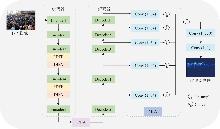
Fig. 1
Overview of the proposed FDE-Net
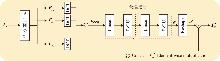
Fig. 2
Structure of FDFE module
Fig. 3
Structure of DIFA module
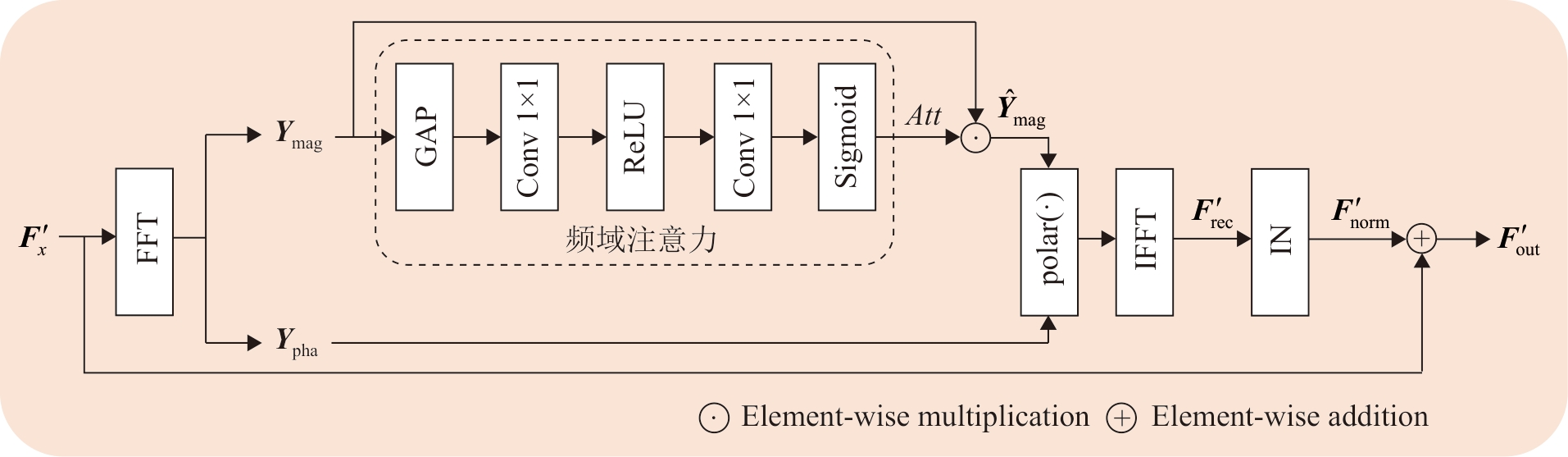
Fig. 4
Structure of PDA module
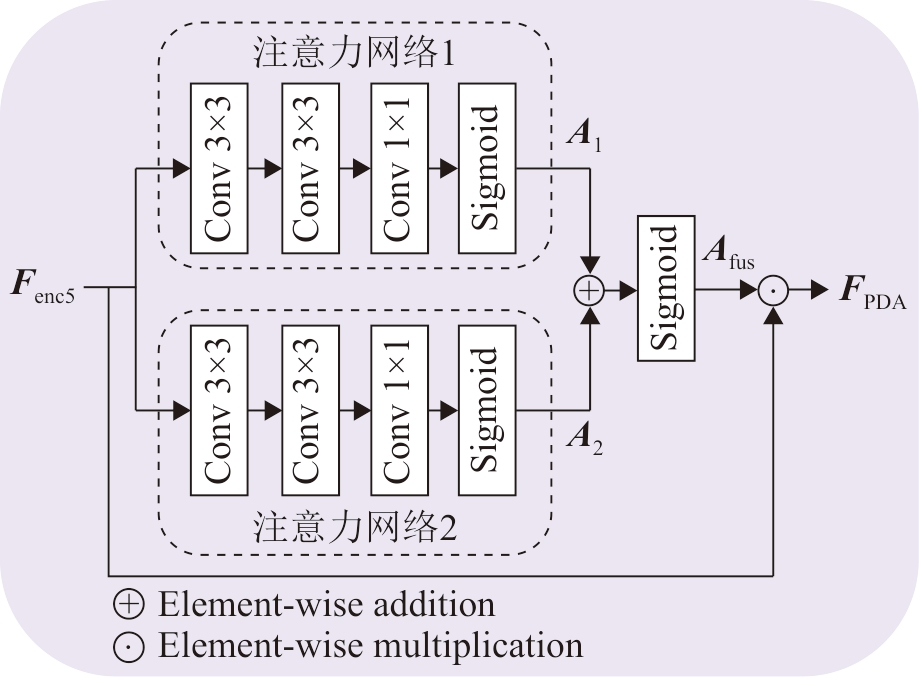
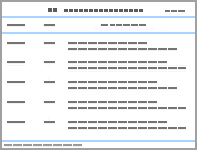
Table 1
Comparison results of cross-domain crowd counting by using SHA as source domain
| 方法 | 发表来源 | SHA→SHB | SHA→UQ | SHA→UC | |||
|---|---|---|---|---|---|---|---|
| MAE | MSE | MAE | MSE | MAE | MSE | ||
| BL[ | ICCV (2019) | 15.9 | 25.8 | 166.7 | 287.6 | 432.7 | 683.3 |
| SPN+L2SM[ | ICCV (2019) | 21.2 | 38.7 | 227.2 | 405.2 | 332.4 | 588.4 |
| DMNet[ | NeurIPS (2020) | 22.6 | 33.9 | 148.9 | 281.3 | 417.7 | 664.2 |
| LibraNet[ | ECCV (2020) | 11.9 | 20.7 | 127.9 | 204.9 | — | — |
| RDBT[ | ACM MM (2020) | 13.4 | 29.3 | 175.0 | 294.8 | 368.0 | 518.9 |
| LSC[ | TPAMI (2020) | 23.4 | 35.9 | 207.6 | 371.9 | 456.8 | 696.1 |
| AutoScale[ | IJCV (2022) | 23.1 | 39.0 | — | — | — | — |
| FIDTM[ | TMM (2022) | 17.4 | 35.1 | 193.6 | 457.9 | 423.1 | 602.5 |
| GENet[ | TCSVT (2022) | 14.1 | 24.6 | 184.8 | 371.1 | 333.5 | 504.0 |
| CSS-CCNN++[ | ECCV (2022) | — | — | 472.4 | — | 468.1 | — |
| CTASNet[ | TCSVT (2023) | 13.4 | 25.2 | 133.4 | 224.0 | — | — |
| DCCUS[ | AAAI (2023) | 12.6 | 24.6 | 119.4 | 216.6 | 241.8 | 402.2 |
| MFFNet[ | TIM (2023) | 12.7 | 30.2 | 142.1 | 271.1 | 323.5 | 482.8 |
| CrowdFormer[ | JVCI (2023) | 16.0 | 26.0 | 147.6 | 300.8 | — | — |
| MPCount[ | CVPR (2024) | 19.7 | 115.7 | 199.8 | 172.6 | 257.1 | |
| MGFNet[ | Neurocomputing (2024) | 11.3 | 319.8 | 475.3 | |||
| CCSC[ | TMM (2025) | 11.7 | 20.8 | 124.5 | 220.9 | — | — |
| FDE-Net | 本文 | 12.1 | 21.5 | 124.2 | 222.3 | ||
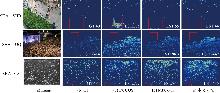
Fig. 5
Comparison of density map visualization
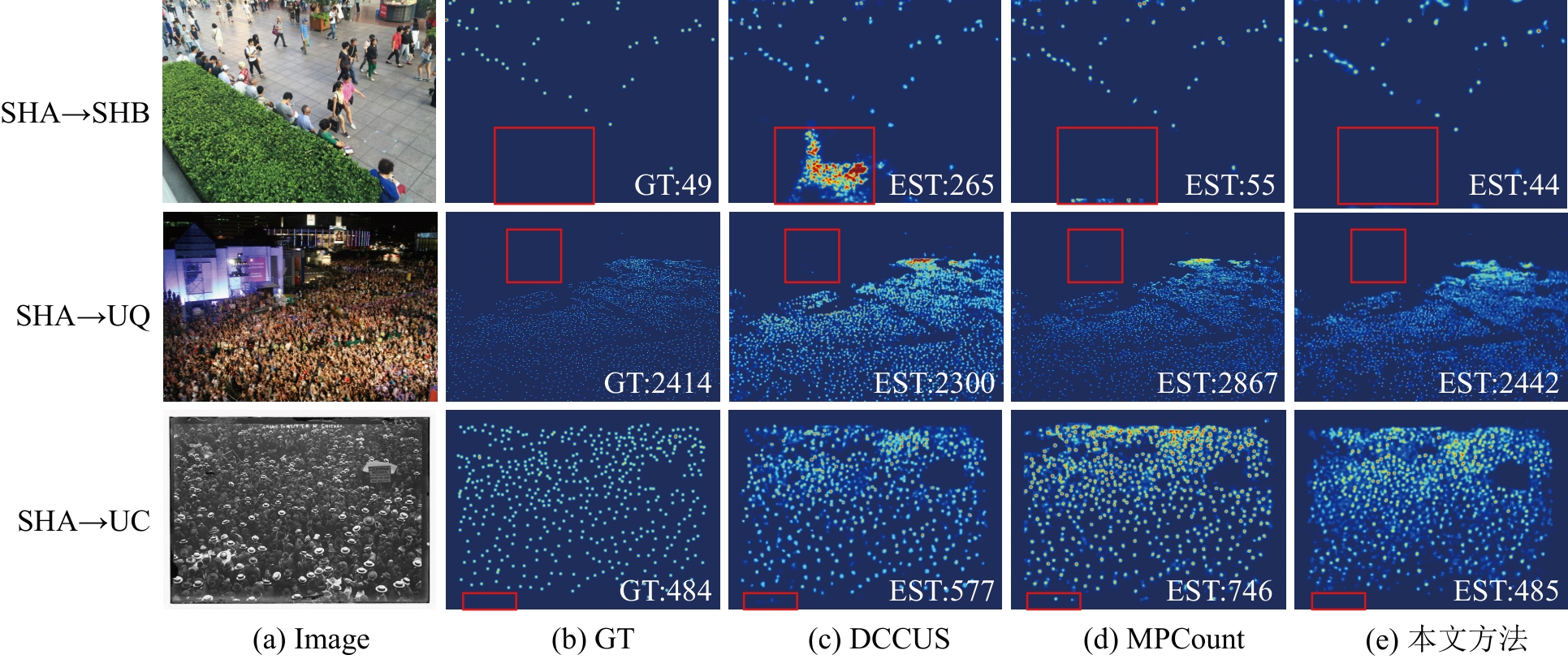
Table 2
Comparison results of cross-domain crowd counting by using SHB as source domain
| 方法 | 发表来源 | SHB→SHA | SHB→UQ | SHB→UC | |||
|---|---|---|---|---|---|---|---|
| MAE | MSE | MAE | MSE | MAE | MSE | ||
| BL[ | ICCV (2019) | 138.1 | 228.1 | 226.4 | 411.0 | 645.5 | 940.1 |
| SPN+L2SM[ | ICCV (2019) | 126.8 | 203.9 | — | — | — | — |
| DMNet[ | NeurIPS (2020) | 142.4 | 241.3 | 223.6 | 418.6 | 1093.9 | 1405.6 |
| RDBT[ | ACM MM (2020) | 112.2 | 218.2 | 211.3 | 381.9 | — | — |
| LSC[ | TPAMI (2020) | 153.5 | 250.4 | 279.0 | 490.0 | 731.2 | 1065.9 |
| FIDTM[ | TMM (2022) | 147.6 | 282.2 | — | — | — | — |
| GENet[ | TCSVT (2022) | 144.4 | 233.1 | 318.9 | 556.9 | 751.8 | 1106.1 |
| CTASNet[ | TCSVT (2023) | 126.9 | 222.3 | 183.8 | 319.2 | — | — |
| DCCUS[ | AAAI (2023) | 121.8 | 203.1 | 179.1 | 316.2 | 548.2 | 895.3 |
| MFFNet[ | TIM (2023) | 107.3 | 188.5 | — | — | — | — |
| CrowdFormer[ | JVCI (2023) | 121.6 | 208.8 | 304.4 | 586.1 | — | — |
| MPCount[ | CVPR (2024) | 99.6 | 165.6 | 290.4 | |||
| MGFNet[ | Neurocomputing (2024) | 105.7 | 183.7 | 176.8 | 631.4 | 927.1 | |
| CCSC[ | TMM (2025) | 174.9 | 312.6 | — | — | ||
| FDE-Net | 本文方法 | 110.7 | 191.9 | 187.1 | 326.7 | 478.2 | 783.2 |
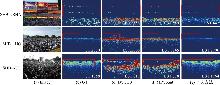
Fig. 6
Comparison of density map visualization
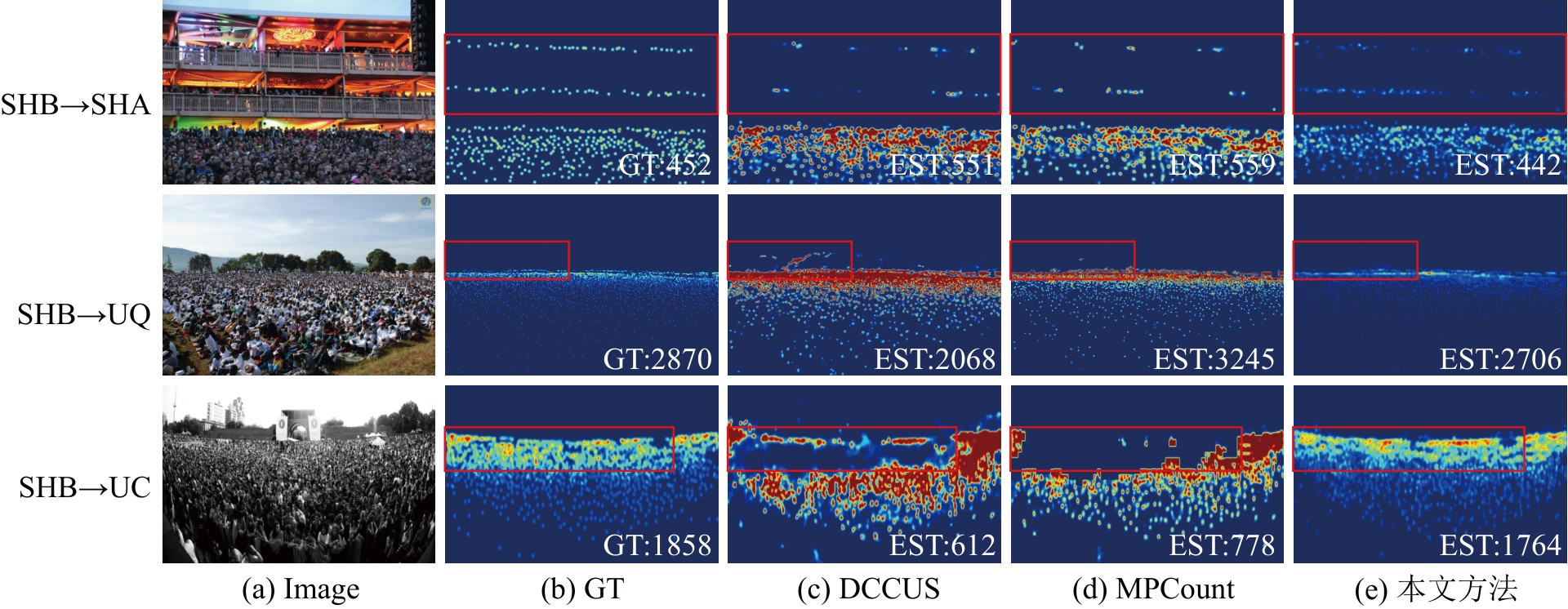
Table 3
Comparison results of cross-domain crowd counting by using UQ as source domain
| 方法 | 发表来源 | UQ→SHA | UQ→SHB | UQ→UC | |||
|---|---|---|---|---|---|---|---|
| MAE | MSE | MAE | MSE | MAE | MSE | ||
| BL[ | ICCV19 | 67.8 | 118.2 | 16.2 | 27.5 | 387.4 | 614.5 |
| SPN+L2SM[ | ICCV19 | 73.4 | 119.4 | — | — | — | — |
| DMNet[ | NeurIPS20 | 70.1 | 130.3 | 14.0 | 27.1 | 391.1 | 583.8 |
| LibraNet[ | ECCV20 | 67.0 | 109.2 | 11.6 | 22.0 | — | — |
| LSC[ | TPAMI20 | 97.1 | 154.7 | 12.5 | 21.9 | 535.2 | 822.3 |
| GENet[ | TCSVT22 | 76.8 | 124.3 | 10.6 | 336.3 | 499.2 | |
| CTASNet[ | TCSVT23 | 68.7 | 118.2 | 12.0 | 23.3 | 278.7 | 445.0 |
| DCCUS[ | AAAI23 | 67.4 | 112.8 | 12.1 | 20.9 | ||
| CrowdFormer[ | JVCI23 | 70.8 | 114.9 | 16.0 | — | — | |
| MPCount[ | CVPR2024 | 65.5 | 110.1 | 12.3 | 24.1 | 196.7 | 341.2 |
| MGFNet[ | Neurocomputing24 | 60.4 | 98.6 | 9.7 | 14.8 | 259.3 | 379.7 |
| CCSC[ | TMM25 | 67.0 | 111.5 | 11.3 | 19.7 | — | — |
| FDE-Net | 本文方法 | 12.8 | 23.0 | 126.3 | 176.1 | ||
Fig. 7
Comparison of density map visualization
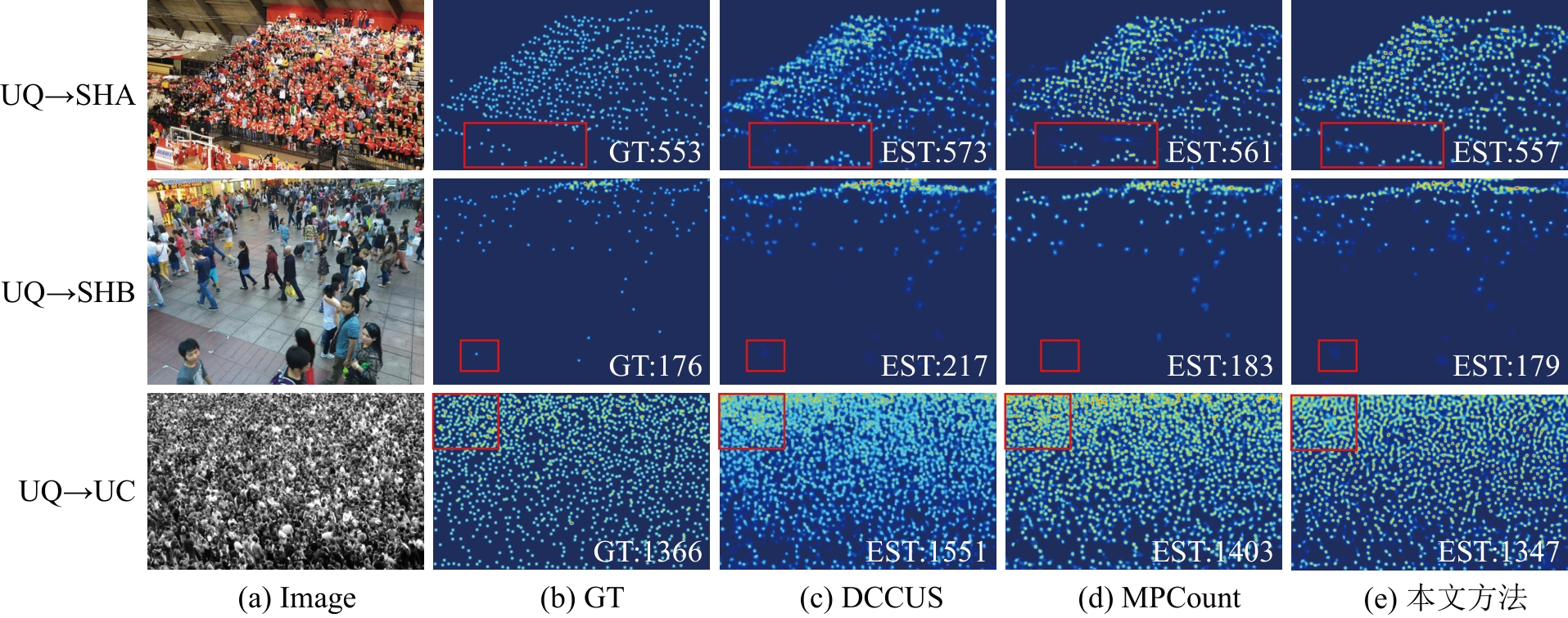
Fig. 8
Comparison of density map visualization under adverse weather
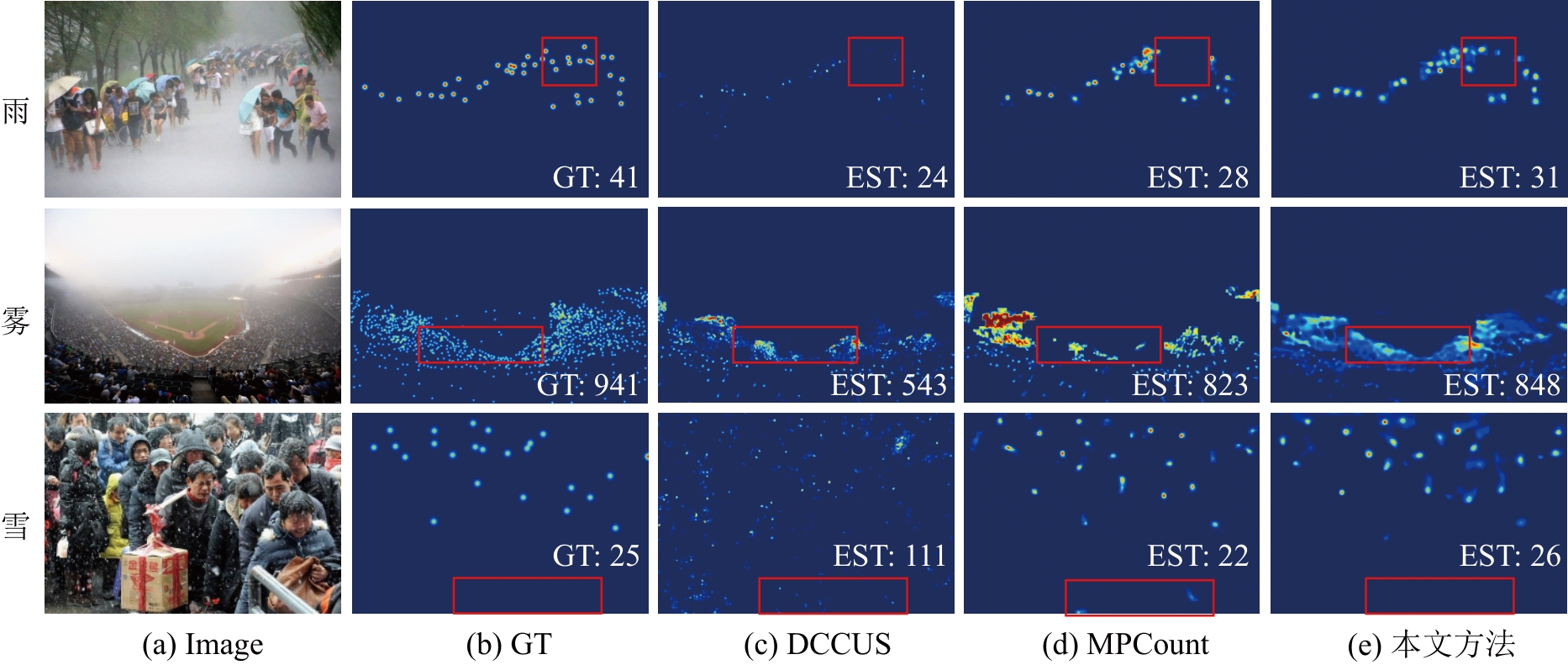
Fig. 9
Comparison of density map visualization under severe environmental conditions
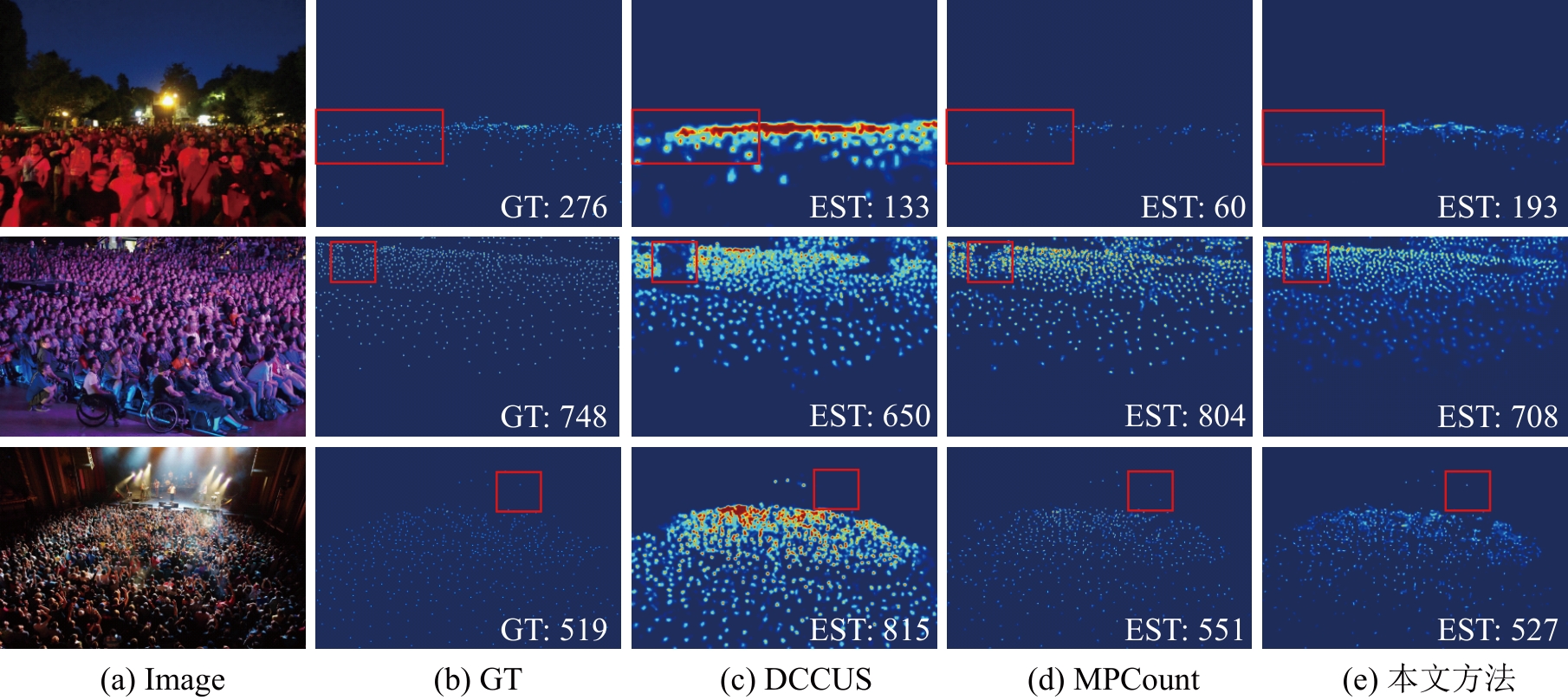
Table 4
Ablation study of each component of FDE-Net
| 模块 | SHA→SHB | SHA→UQ | |||||||
|---|---|---|---|---|---|---|---|---|---|
| FDFE | DIFA | MFA | PDA | MAE | MSE | MAE | MSE | ||
| 33.1 | 56.1 | 335.5 | 520.2 | ||||||
| √ | 17.6 | 29.6 | 167.4 | 267.9 | |||||
| √ | √ | 16.1 | 24.6 | 164.0 | 266.8 | ||||
| √ | √ | √ | 14.2 | 23.6 | 138.7 | 240.7 | |||
| √ | √ | √ | √ | 12.1 | 21.5 | 124.2 | 222.3 | ||
Table 5
Effect of inserting position of FDFE-DIFA
| 插入位置 | SHA→SHB | SHA→UQ | ||
|---|---|---|---|---|
| MAE | MSE | MAE | MSE | |
| 基线模型 | 33.1 | 56.1 | 335.5 | 520.2 |
| Encoder1后面 | 25.8 | 35.6 | 165.1 | 268.3 |
| Encoder2后面 | 18.8 | 29.0 | 157.4 | 286.1 |
| Encoder3后面 | 14.1 | 26.5 | 138.1 | 241.0 |
| Encoder4后面 | 14.0 | 29.0 | 147.8 | 262.3 |
| Encoder5后面 | 17.3 | 25.6 | 208.9 | 325.9 |
| Encoder3后面和Encoder4后面 | 12.1 | 21.5 | 124.2 | 222.3 |
Table 6
Effect of hyper-parameter β in DIFA
| SHA→SHB | SHA→UQ | |||
|---|---|---|---|---|
| MAE | MSE | MAE | MSE | |
| 0.1 | 18.4 | 31.6 | 214.4 | 495.1 |
| 0.3 | 19.0 | 28.1 | 159.6 | 276.2 |
| 0.5 | 12.1 | 21.5 | 124.2 | 222.3 |
| 0.7 | 19.1 | 27.4 | 158.6 | 272.8 |
| 0.9 | 23.3 | 34.6 | 224.5 | 629.7 |
| [1] | Han Run, Qi Ran, Lu Xuequan, et al. Counting in Congested Crowd Scenes with Hierarchical Scale-aware Encoder-decoder Network[J]. Expert Systems with Applications, 2024, 238, Part D: 122087. |
| [2] | Chen I H, Chen Weiting, Liu Yuwei, et al. Improving Point-based Crowd Counting and Localization Based on Auxiliary Point Guidance[C]//Computer Vision – ECCV 2024. Cham: Springer Nature Switzerland, 2025: 428-444. |
| [3] | 钟竞辉, 林育钿, 李稳强, 等. 基于数字孪生的机场人群智慧管控技术[J]. 系统仿真学报, 2024, 36(1): 27-38. |
| Zhong Jinghui, Lin Yudian, Li Wenqiang, et al. Intelligent Airport Crowd Management Technology Based on Digital Twin[J]. Journal of System Simulation, 2024, 36(1): 27-38. | |
| [4] | 栾方军, 龚琪, 袁帅. 基于注意力机制和多尺度融合的人群计数网络[J]. 计算机工程, 2025, 51(3): 352-361. |
| Luan Fangjun, Gong Qi, Yuan Shuai. Crowd Counting Network Based on Attention Mechanism and Multiscale Fusion[J]. Computer Engineering, 2025, 51(3): 352-361. | |
| [5] | 余鹰, 范在昌, 曾康利, 等. 渐进式认知引导的双域半监督人群计数[J]. 计算机研究与发展, 2025, 62(9): 2194-2207. |
| Yu Ying, Fan Zaichang, Zeng Kangli, et al. Progressive Cognition-guided Dual-domain Semi-Supervised Crowd Counting[J]. Journal of Computer Research and Development, 2025, 62(9): 2194-2207. | |
| [6] | Zhao Zhiyuan, Han Tao, Gao Junyu, et al. A Flow Base Bi-path Network for Cross-scene Video Crowd Understanding in Aerial View[C]//Computer Vision – ECCV 2020 Workshops. Cham: Springer International Publishing, 2020: 574-587. |
| [7] | Zhang Xinfeng, Han Lina, Shan Wencong, et al. A Multi-scale Feature Fusion Network with Cascaded Supervision for Cross-scene Crowd Counting[J]. IEEE Transactions on Instrumentation and Measurement, 2023, 72: 1-15. |
| [8] | Liu Yanbo, Hu Yingxiang, Cao Guo, et al. MGFNet: Cross-scene Crowd Counting via Multistage Gated Fusion Network[J]. Neurocomputing, 2024, 607: 128431. |
| [9] | Zhang Anran, Xu Jun, Luo Xiaoyan, et al. Cross-domain Attention Network for Unsupervised Domain Adaptation Crowd Counting[J]. IEEE Transactions on Circuits and Systems for Video Technology, 2022, 32(10): 6686-6699. |
| [10] | Zhao Wenda, Wang Mingyue, Liu Yu, et al. Generalizable Crowd Counting via Diverse Context Style Learning[J]. IEEE Transactions on Circuits and Systems for Video Technology, 2022, 32(8): 5399-5410. |
| [11] | Du Zhipeng, Deng Jiankang, Shi Miaojing. Domain-general Crowd Counting in Unseen Scenarios[C]//Proceedings of the Thirty-Seventh AAAI Conference on Artificial Intelligence and Thirty-Fifth Conference on Innovative Applications of Artificial Intelligence and Thirteenth Symposium on Educational Advances in Artificial Intelligence. Palo Alto: AAAI Press, 2023: 561-570. |
| [12] | Liu Yuting, Wang Zheng, Shi Miaojing, et al. Towards Unsupervised Crowd Counting via Regression-detection Bi-knowledge Transfer[C]//Proceedings of the 28th ACM International Conference on Multimedia. New York: Association for Computing Machinery, 2020: 129-137. |
| [13] | Xu Kai, Qin Minghai, Sun Fei, et al. Learning in the Frequency Domain[C]//2020 IEEE/CVF Conference on Computer Vision and Pattern Recognition (CVPR). Piscataway: IEEE, 2020: 1737-1746. |
| [14] | Qin Zequn, Zhang Pengyi, Wu Fei, et al. FcaNet: Frequency Channel Attention Networks[C]//2021 IEEE/CVF International Conference on Computer Vision (ICCV). Piscataway: IEEE, 2021: 763-772. |
| [15] | Yu Xiaoyuan, Liang Yanyan, Lin Xuxin, et al. Frequency Feature Pyramid Network with Global-local Consistency Loss for Crowd-and-vehicle Counting in Congested Scenes[J]. IEEE Transactions on Intelligent Transportation Systems, 2022, 23(7): 9654-9664. |
| [16] | Shu Weibo, Wan Jia, Tan Chen, et al. Crowd Counting in the Frequency Domain[C]//2022 IEEE/CVF Conference on Computer Vision and Pattern Recognition (CVPR). Piscataway: IEEE, 2022: 19586-19595. |
| [17] | Simonyan K, Zisserman A. Very Deep Convolutional Networks for Large-scale Image Recognition[EB/OL]. (2014-09-04) [2025-08-16]. . |
| [18] | Zhang Yingying, Zhou Desen, Chen Siqin, et al. Single-image Crowd Counting via Multi-column Convolutional Neural Network[C]//2016 IEEE Conference on Computer Vision and Pattern Recognition (CVPR). Piscataway: IEEE, 2016: 589-597. |
| [19] | Idrees H, Tayyab M, Athrey K, et al. Composition Loss for Counting, Density Map Estimation and Localization in Dense Crowds[C]//Computer Vision – ECCV 2018. Cham: Springer International Publishing, 2018: 544-559. |
| [20] | Idrees H, Saleemi I, Seibert C, et al. Multi-source Multi-scale Counting in Extremely Dense Crowd Images[C]//2013 IEEE Conference on Computer Vision and Pattern Recognition. Piscataway: IEEE, 2013: 2547-2554. |
| [21] | Peng Zhuoxuan, Chan S H G. Single Domain Generalization for Crowd Counting[C]//2024 IEEE/CVF Conference on Computer Vision and Pattern Recognition (CVPR). Piscataway: IEEE, 2024: 28025-28034. |
| [22] | Ma Zhiheng, Wei Xing, Hong Xiaopeng, et al. Bayesian Loss for Crowd Count Estimation with Point Supervision[C]//2019 IEEE/CVF International Conference on Computer Vision (ICCV). Piscataway: IEEE, 2019: 6141-6150. |
| [23] | Xu Chenfeng, Qiu Kai, Fu Jianlong, et al. Learn to Scale: Generating Multipolar Normalized Density Maps for Crowd Counting[C]//2019 IEEE/CVF International Conference on Computer Vision (ICCV). Piscataway: IEEE, 2019: 8381-8389. |
| [24] | Wang Boyu, Liu Huidong, Samaras D, et al. Distribution Matching for Crowd Counting[C]//Proceedings of the 34th International Conference on Neural Information Processing Systems. Red Hook: Curran Associates Inc., 2020: 1595-1607. |
| [25] | Liu Liang, Lu Hao, Zou Hongwei, et al. Weighing Counts: Sequential Crowd Counting by Reinforcement Learning[C]//Computer Vision – ECCV 2020. Cham: Springer International Publishing, 2020: 164-181. |
| [26] | Deepak Babu Sam, Skand Vishwanath Peri, Mukuntha Narayanan Sundararaman, et al. Locate, Size, and Count: Accurately Resolving People in Dense Crowds via Detection[J]. IEEE Transactions on Pattern Analysis and Machine Intelligence, 2021, 43(8): 2739-2751. |
| [27] | Xu Chenfeng, Liang Dingkang, Xu Yongchao, et al. AutoScale: Learning to Scale for Crowd Counting[J]. International Journal of Computer Vision, 2022, 130(2): 405-434. |
| [28] | Liang Dingkang, Xu Wei, Zhu Yingying, et al. Focal Inverse Distance Transform Maps for Crowd Localization[J]. IEEE Transactions on Multimedia, 2023, 25: 6040-6052. |
| [29] | Deepak Babu Sam, Agarwalla Abhinav, Joseph Jimmy, et al. Completely Self-supervised Crowd Counting via Distribution Matching[C]//Computer Vision – ECCV 2022. Cham: Springer Nature Switzerland, 2022: 186-204. |
| [30] | Chen Yuehai, Yang Jing, Chen Badong, et al. Counting Varying Density Crowds Through Density Guided Adaptive Selection CNN and Transformer Estimation[J]. IEEE Transactions on Circuits and Systems for Video Technology, 2023, 33(3): 1055-1068. |
| [31] | Siddharth Singh Savner, Kanhangad Vivek. CrowdFormer: Weakly-supervised Crowd Counting with Improved Generalizability[J]. Journal of Visual Communication and Image Representation, 2023, 94: 103853. |
| [32] | Chen Yuehai, Wang Qingzhong, Yang Jing, et al. CSCC: Cross-scene Crowd Counting via Learning to Diversify for Domain Generalization[J]. IEEE Transactions on Multimedia, 2025, 27: 3320-3330. |
| [33] | Sindagi V A, Yasarla R, Patel V M. JHU-CROWD++: Large-scale Crowd Counting Dataset and a Benchmark Method[J]. IEEE Transactions on Pattern Analysis and Machine Intelligence, 2022, 44(5): 2594-2609. |
| [1] | Li Xin, Liu Xiu, Wan Xinxin. Overview of Digital Twins Application and safe Development [J]. Journal of System Simulation, 2019, 31(3): 385-392. |
| [2] | Chen li, Zhang HaiXia. Evaluation of Green Smart Cities in China Based on Entropy Weight - Cloud Model [J]. Journal of System Simulation, 2019, 31(1): 136-144. |
| [3] | Han Feng, Li Xiaoling, Sun Xiuwen, Ji Lingyu. Design and Implementation of Human-computer Interactive System for Public Information Service in Smart City [J]. Journal of System Simulation, 2018, 30(5): 1893-1899. |
| Viewed | ||||||
|
Full text |
|
|||||
|
Abstract |
|
|||||
 http://www.china-simulation.com

