

Journal of System Simulation ›› 2026, Vol. 38 ›› Issue (1): 174-188.doi: 10.16182/j.issn1004731x.joss.25-0863
• Papers • Previous Articles Next Articles
Liao Guoqiong1,2, Huang Longjie3, Li Qingxin3, Zhang Jiajun1, Chen Kefan1
Received:2025-09-07
Revised:2025-11-19
Online:2026-01-18
Published:2026-01-28
Contact:
Huang Longjie
CLC Number:
Liao Guoqiong, Huang Longjie, Li Qingxin, Zhang Jiajun, Chen Kefan. DEHPR: A Diffusion-based End-to-end Hand Pose Reconstruction Network[J]. Journal of System Simulation, 2026, 38(1): 174-188.
Fig. 1
Diffusion-based end-to-end hand pose reconstruction network
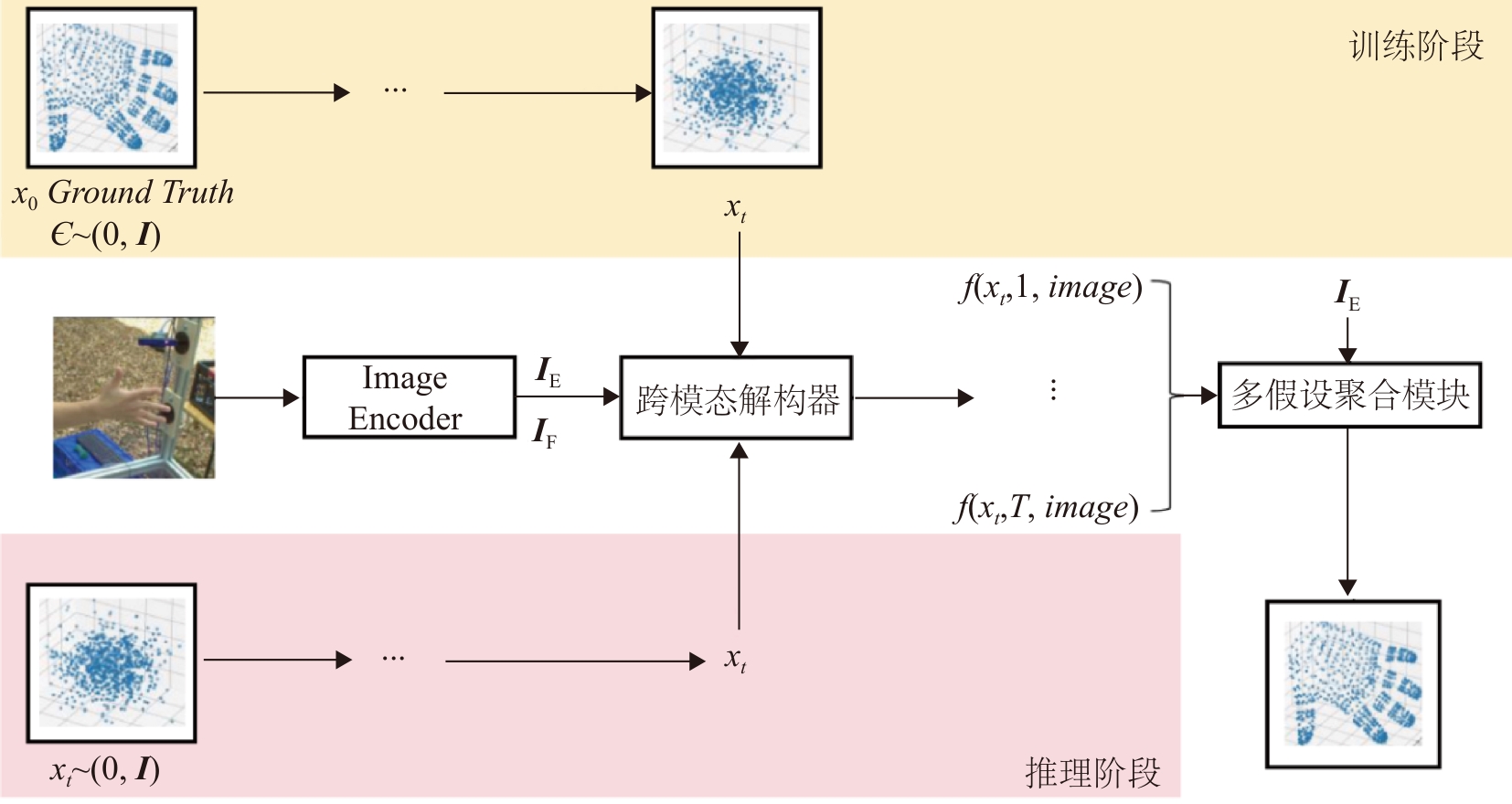
Fig. 2
Cross-modal decoder
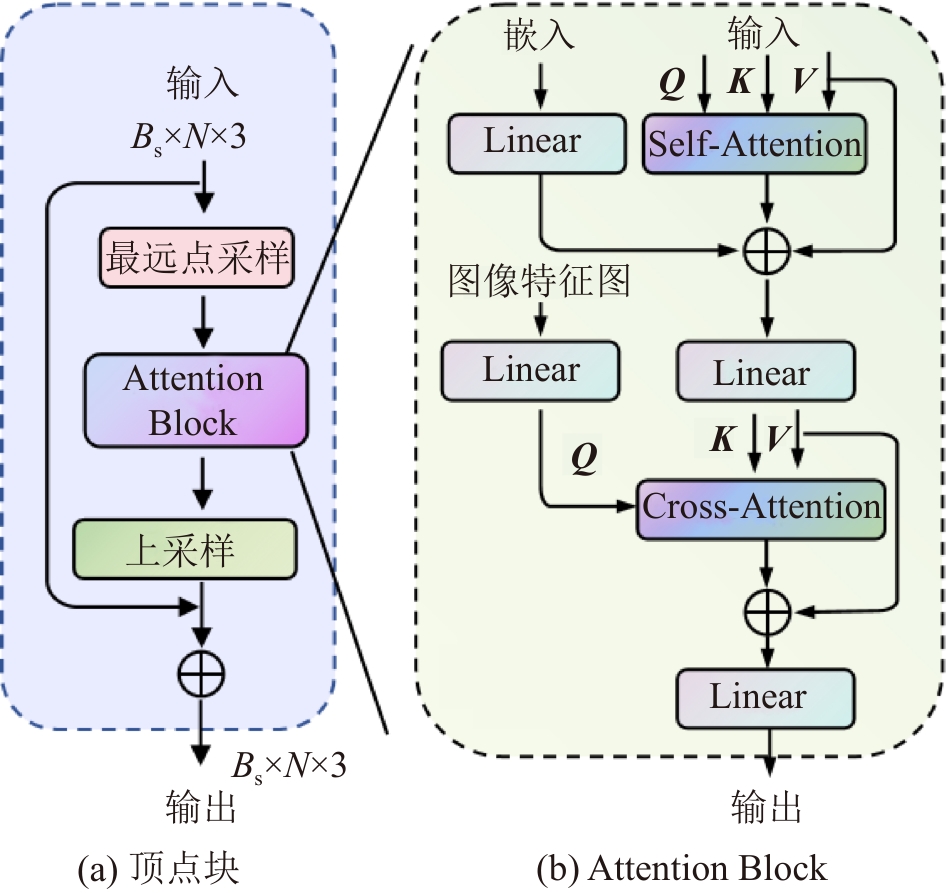
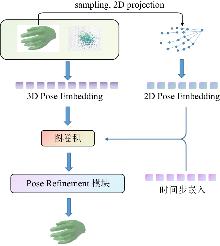
Fig. 3
Multi-hypothesis optimization network
Table 1
Image encoder ablation experiments
| 编码器类型 | FreiHand | DexYCB | ||
|---|---|---|---|---|
| EPV | EPJ | EPV | EPJ | |
| HRNet-W64 | 6.48 | 6.72 | 5.02 | 5.90 |
| Deit-Large | 6.38 | 6.65 | 5.08 | 6.02 |
Table 2
Number of parameters and inference video memory corresponding to the model for different encoders/resolutions
| 编码器类型 | 输入分辨率 | 参数量(M) | 推理显存(G) |
|---|---|---|---|
| HRNet-W48 | 224×224 | 77.50 | 2.50 |
| 256×256 | 3.16 | ||
| HRNet-W64 | 224×224 | 128.10 | 3.75 |
| 256×256 | 4.58 | ||
| Deit-Large | 224×224 | 304.15 | 5.31 |
| 256×256 | 6.28 |
Table 3
Effect of different number of hypotheses on inference speed
| 实验配置 | 假设数 | 推理速度(FPS) |
|---|---|---|
| RTX3060 | 2 | 22 |
| 4 | 14 | |
| 8 | 5 | |
| RTX4080 | 2 | 42 |
| 4 | 28 | |
| 8 | 12 |
Table 4
Ablation experiments for each module
| 跨模态解码器 | 扩散模型 | 关节优化网络 | EPV | EPJ |
|---|---|---|---|---|
| × | × | × | 7.87 | 7.08 |
| × | √ | √ | 6.99 | 6.74 |
| × | × | √ | 7.88 | 8.15 |
| × | √ | × | 9.88 | 7.82 |
| × | √ | √ | 7.09 | 6.59 |
| × | √ | √ | 7.85 | 8.10 |
| √ | √ | × | 7.65 | 7.85 |
| √ | √ | √ | 6.48 | 6.72 |
Table 5
Ablation experiments on different hand modeling networks
| 建模网络 | EPV/mm | EPJ/mm | 参数量(M) |
|---|---|---|---|
| GCN | 7.90 | 8.08 | 12.20 |
| 标准Transformer | 6.89 | 7.21 | 47.30 |
| Graphormer[ | 6.52 | 6.78 | 52.10 |
| 跨模态解码器 | 6.48 | 6.72 | 37.19 |
Table 6
Effectiveness of multi-hypothesis optimization networks
| 投影级别 | 方法 | EPV | EPJ |
|---|---|---|---|
| 姿势 | 平均值 | 7.09 | 7.96 |
| 姿势 | 4层MLP | 8.67 | 9.48 |
| 关节 | 4层MLP | 8.28 | 8.88 |
| 姿势 | 重投影 | 7.16 | 7.58 |
| 关节 | 重投影 | 6.48 | 6.72 |
Table 7
Impact of different 2D hand keypoint sources on model accuracy
| 2D手部关键点来源 | EPV | EPJ |
|---|---|---|
| 3D网格采样 | 6.48 | 6.72 |
| 无2D手部关键点 | 9.05 | 8.28 |
| 外部2D手部关键点 | 6.83 | 7.41 |
Table 8
Robustness validation in a few-shot setting
| 标注数据比例/% | EPV/mm | EPJ/mm |
|---|---|---|
| 10 | 96.70 | 101.12 |
| 25 | 88.45 | 92.65 |
| 50 | 18.33 | 20.61 |
| 75 | 7.44 | 7.91 |
| 100 | 5.02 | 5.90 |
Table 9
Effectiveness of different inference step sizes on model accuracy
| step | EPV/mm | EPJ/mm |
|---|---|---|
| 5 | 10.23 | 10.56 |
| 10 | 6.48 | 6.72 |
| 15 | 6.51 | 6.70 |
| 20 | 6.52 | 6.70 |
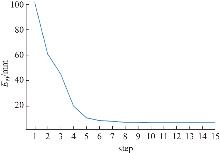
Fig. 4
Decreasing curve of EPJ with the number of denoising steps
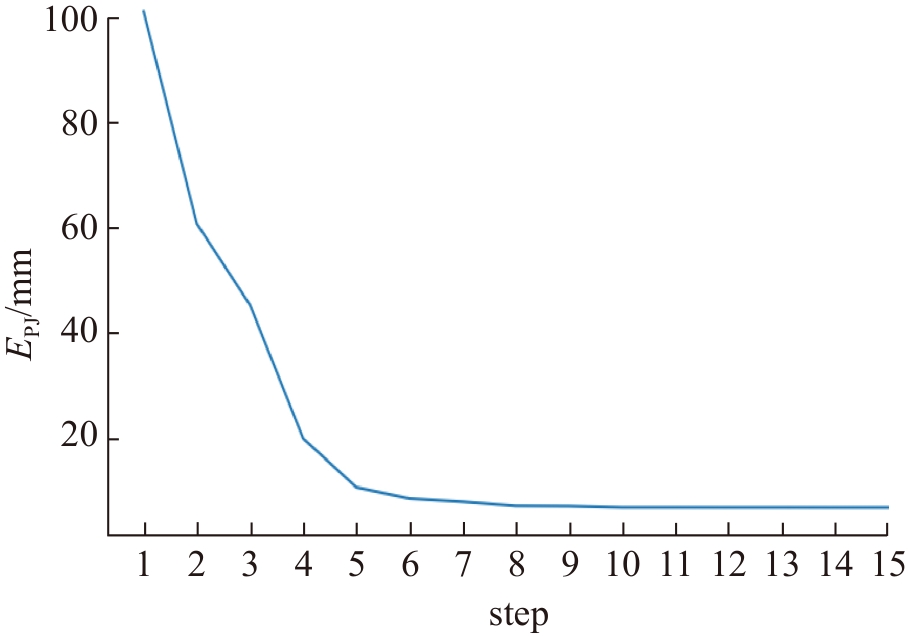
Table 10
Error comparison on the FreiHand dataset
| 方法 | EPV/mm | EPJ/mm | F@5 | F@15 |
|---|---|---|---|---|
| IdHandMesh[ | 10.67 | 11.31 | 0.68 | 0.76 |
| HandOccNet[ | 8.21 | 8.47 | 0.80 | 0.89 |
| Homan[ | 8.75 | 8.33 | 0.76 | 0.86 |
| HANDiff[ | 10.41 | 9.89 | 0.72 | 0.80 |
| GaussianHand[ | 13.50 | 13.96 | 0.62 | 0.70 |
| DEHPR | 6.48 | 6.72 | 0.83 | 0.91 |
Table 11
Error comparison on the DexYCB dataset
| 方法 | EPV/mm | EPJ/mm | F@5 | F@15 |
|---|---|---|---|---|
| IdHandMesh[ | 8.44 | 8.10 | 0.72 | 0.94 |
| HandOccNet[ | 6.88 | 6.11 | 0.75 | 0.96 |
| Homan[ | 10.36 | 9.44 | 0.68 | 0.86 |
| HANDiff[ | 9.48 | 8.61 | 0.70 | 0.93 |
| GaussianHand[ | 11.01 | 9.87 | 0.57 | 0.81 |
| DEHPR | 5.02 | 5.90 | 0.77 | 0.98 |
Table 12
Error comparison on the HO3D V2 dataset
| 方法 | EPV/mm | EPJ/mm | F@5 | F@15 |
|---|---|---|---|---|
| Keypoint Transformer[ | 11.0 | 11.3 | 0.44 | 0.93 |
| HandOccNet | 9.1 | 8.8 | 0.56 | 0.96 |
| Homan | 9.8 | 10.1 | 0.48 | 0.93 |
| DEHPR | 9.5 | 9.7 | 0.48 | 0.94 |
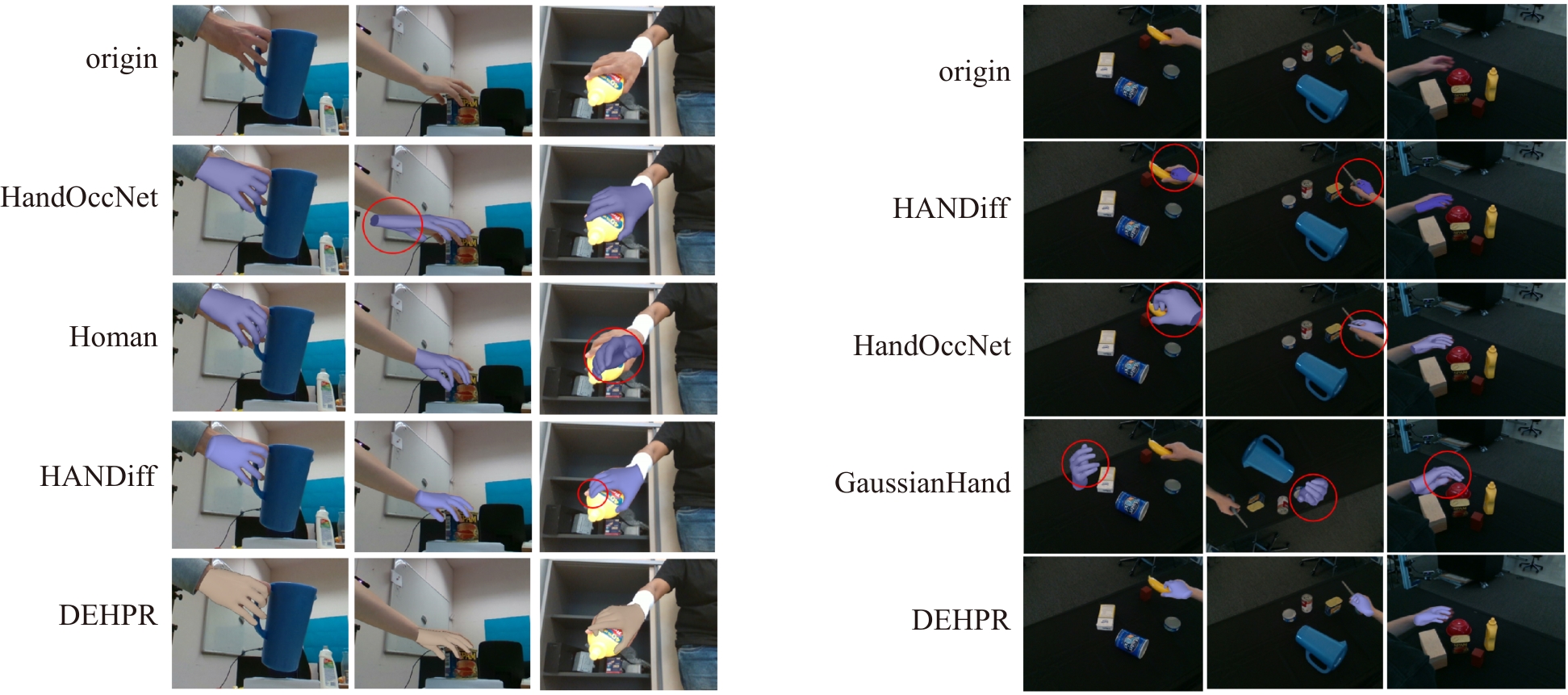

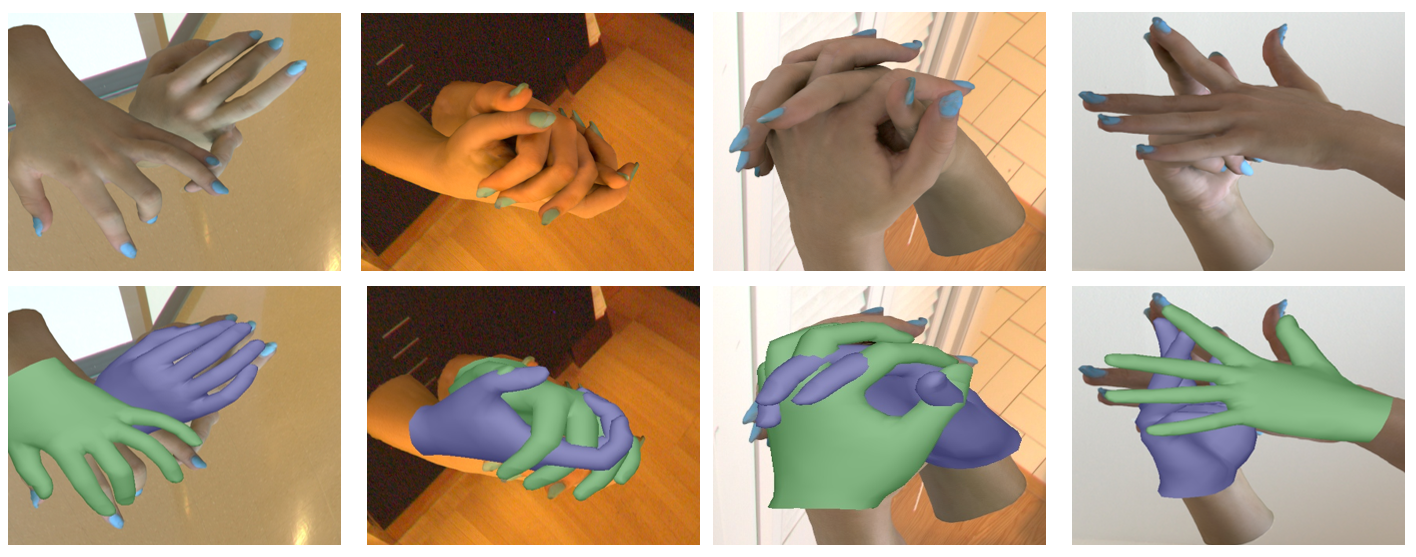
Fig. 7
Pose visualization in different backward diffusion processe

Fig. 8
Visualization of failure cases for hand reconstruction
| [1] | Gao Chengying, Yang Yujia, Li Wensheng. 3D Interacting Hand Pose and Shape Estimation from a Single RGB Image[J]. Neurocomputing, 2022, 474: 25-36. |
| [2] | Taylor J, Tankovich V, Tang Danhang, et al. Articulated Distance Fields for Ultra-fast Tracking of Hands Interacting[J]. ACM Transactions on Graphics, 2017, 36(6): 244. |
| [3] | Wang Jiayi, Mueller F, Bernard Florian, et al. RGB2Hands: Real-time Tracking of 3D Hand Interactions from Monocular RGB Video[J]. ACM Transactions on Graphics, 2020, 39(6): 218. |
| [4] | Zhang Yuxiang, Li Zhe, An Liang, et al. Lightweight Multi-person Total Motion Capture Using Sparse Multi-view Cameras[C]//2021 IEEE/CVF International Conference on Computer Vision (ICCV). Piscataway: IEEE, 2021: 5540-5549. |
| [5] | Romero J, Tzionas D, Black M J. Embodied Hands: Modeling and Capturing Hands and Bodies Together[J]. ACM Transactions on Graphics, 2017, 36(6): 245. |
| [6] | Chen Yujin, Tu Zhigang, Kang Di, et al. Model-based 3D Hand Reconstruction via Self-supervised Learning[C]//2021 IEEE/CVF Conference on Computer Vision and Pattern Recognition (CVPR). Piscataway: IEEE, 2021: 10446-10455. |
| [7] | Zhang Hongwen, Tian Yating, Zhang Yuxiang, et al. PyMAF-X: Towards Well-aligned Full-body Model Regression from Monocular Images[J]. IEEE Transactions on Pattern Analysis and Machine Intelligence, 2023, 45(10): 12287-12303. |
| [8] | Zhang Xiong, Li Qiang, Mo Hong, et al. End-to-end Hand Mesh Recovery from a Monocular RGB Image[C]//2019 IEEE/CVF International Conference on Computer Vision (ICCV). Piscataway: IEEE, 2019: 2354-2364. |
| [9] | Zhang Yuxiang, Zhang Hongwen, Hu Liangxiao, et al. ProxyCap: Real-time Monocular Full-body Capture in World Space via Human-centric Proxy-to-motion Learning[C]//2024 IEEE/CVF Conference on Computer Vision and Pattern Recognition (CVPR). Piscataway: IEEE, 2024: 1954-1964. |
| [10] | Zhou Yuxiao, Habermann M, Xu Weipeng, et al. Monocular Real-time Hand Shape and Motion Capture Using Multi-modal Data[C]//2020 IEEE/CVF Conference on Computer Vision and Pattern Recognition (CVPR). Piscataway: IEEE, 2020: 5345-5354. |
| [11] | Chen Xingyu, Liu Yufeng, Ma Chongyang, et al. Camera-space Hand Mesh Recovery via Semantic Aggregation and Adaptive 2D-1D Registration[C]//2021 IEEE/CVF Conference on Computer Vision and Pattern Recognition (CVPR). Piscataway: IEEE, 2021: 13269-13278. |
| [12] | Chen Xingyu, Liu Yufeng, Dong Yajiao, et al. MobRecon: Mobile-friendly Hand Mesh Reconstruction from Monocular Image[C]//2022 IEEE/CVF Conference on Computer Vision and Pattern Recognition (CVPR). Piscataway: IEEE, 2022: 20512-20522. |
| [13] | Ge Liuhao, Ren Zhou, Li Yuncheng, et al. 3D Hand Shape and Pose Estimation from a Single RGB Image[C]//2019 IEEE/CVF Conference on Computer Vision and Pattern Recognition (CVPR). Piscataway: IEEE, 2019: 10825-10834. |
| [14] | Kulon D, Riza Alp Güler, Kokkinos I, et al. Weakly-supervised Mesh-convolutional Hand Reconstruction in the Wild[C]//2020 IEEE/CVF Conference on Computer Vision and Pattern Recognition (CVPR). Piscataway: IEEE, 2020: 4989-4999. |
| [15] | Li Mengcheng, An Liang, Zhang Hongwen, et al. Interacting Attention Graph for Single Image Two-hand Reconstruction[C]//2022 IEEE/CVF Conference on Computer Vision and Pattern Recognition (CVPR). Piscataway: IEEE, 2022: 2751-2760. |
| [16] | Tang Xiao, Wang Tianyu, Fu C W. Towards Accurate Alignment in Real-time 3D Hand-mesh Reconstruction[C]//2021 IEEE/CVF International Conference on Computer Vision (ICCV). Piscataway: IEEE, 2021: 11678-11687. |
| [17] | Moon Gyeongsik, Mu Lee Kyoung. I2L-MeshNet: Image-to-lixel Prediction Network for Accurate 3D Human Pose and Mesh Estimation from a Single RGB Image[C]//Computer Vision – ECCV 2020. Cham: Springer International Publishing, 2020: 752-768. |
| [18] | Chen Ping, Chen Yujin, Yang Dong, et al. I2UV-HandNet: Image-to-UV Prediction Network for Accurate and High-fidelity 3D Hand Mesh Modeling[C]//2021 IEEE/CVF International Conference on Computer Vision (ICCV). Piscataway: IEEE, 2021: 12909-12918. |
| [19] | Lin K, Wang Lijuan, Liu Zicheng. Mesh Graphormer[C]//2021 IEEE/CVF International Conference on Computer Vision (ICCV). Piscataway: IEEE, 2021: 12919-12928. |
| [20] | Lin K, Wang Lijuan, Liu Zicheng. End-to-end Human Pose and Mesh Reconstruction with Transformers[C]//2021 IEEE/CVF Conference on Computer Vision and Pattern Recognition (CVPR). Piscataway: IEEE, 2021: 1954-1963. |
| [21] | Feng Runyang, Gao Yixing, Elden Tse T H, et al. DiffPose: SpatioTemporal Diffusion Model for Video-based Human Pose Estimation[C]//2023 IEEE/CVF International Conference on Computer Vision (ICCV). Piscataway: IEEE, 2023: 14815-14826. |
| [22] | Gong Jia, Geng Lin, Fan Zhipeng, et al. DiffPose: Toward More Reliable 3D Pose Estimation[C]//2023 IEEE/CVF Conference on Computer Vision and Pattern Recognition (CVPR). Piscataway: IEEE, 2023: 13041-13051. |
| [23] | Holmquist Karl, Wandt Bastian. DiffPose: Multi-hypothesis Human Pose Estimation Using Diffusion Models[C]//2023 IEEE/CVF International Conference on Computer Vision (ICCV). Piscataway: IEEE, 2023: 15931-15941. |
| [24] | Shan Wenkang, Liu Zhenhua, Zhang Xinfeng, et al. Diffusion-based 3D Human Pose Estimation with Multi-hypothesis Aggregation[C]//2023 IEEE/CVF International Conference on Computer Vision (ICCV). Piscataway: IEEE, 2023: 14715-14725. |
| [25] | Nichol A, Jun H, Dhariwal P, et al. Point-E: A System for Generating 3D Point Clouds from Complex Prompts[EB/OL]. (2022-12-16) [2025-07-16]. . |
| [26] | Jun H, Nichol A. Shap-E: Generating Conditional 3D Implicit Functions[EB/OL]. (2023-05-03) [2025-07-16]. . |
| [27] | Ying Chengxuan, Cai Tianle, Luo Shengjie, et al. Do Transformers Really Perform Bad for Graph Representation?[C]//Proceedings of the 35th International Conference on Neural Information Processing Systems. Red Hook: Curran Associates Inc., 2021: 28877-28888. |
| [28] | Kong Deying, Zhang Linguang, Chen Liangjian, et al. Identity-aware Hand Mesh Estimation and Personalization from RGB Images[C]//Computer Vision-ECCV 2022. Cham: Springer Nature Switzerland, 2022: 536-553. |
| [29] | Park JoonKyu, Oh Yeonguk, Moon Gyeongsik, et al. HandOccNet: Occlusion-robust 3D Hand Mesh Estimation Network[C]//2022 IEEE/CVF Conference on Computer Vision and Pattern Recognition (CVPR). Piscataway: IEEE, 2022: 1486-1495. |
| [30] | Hasson Yana, Varol Gül, Schmid Cordelia, et al. Towards Unconstrained Joint Hand-object Reconstruction from RGB Videos[C]//2021 International Conference on 3D Vision (3DV). Piscataway: IEEE, 2021: 659-668. |
| [31] | Luan Tianyu, Zhai Yuanhao, Meng Jingjing, et al. High Fidelity 3D Hand Shape Reconstruction via Scalable Graph Frequency Decomposition[C]//2023 IEEE/CVF Conference on Computer Vision and Pattern Recognition (CVPR). Piscataway: IEEE, 2023: 16795-16804. |
| [32] | Zhao Lizhi, Lu Xuequan, Fan Runze, et al. GaussianHand: Real-time 3D Gaussian Rendering for Hand Avatar Animation[J]. IEEE Transactions on Visualization and Computer Graphics, 2025, 31(9): 6484-6496. |
| [33] | Hampali Shreyas, Sayan Deb Sarkar, Rad Mahdi, et al. Keypoint Transformer: Solving Joint Identification in Challenging Hands and Object Interactions for Accurate 3D Pose Estimation[C]//2022 IEEE/CVF Conference on Computer Vision and Pattern Recognition (CVPR). Piscataway: IEEE, 2022: 11080-11090. |
| [1] | Zhang Shuozhe, Song Wenfeng, Hou Xia, Li Shuai. Full-body Co-speech Gesture Generation Based on Spatial-temporal Enhanced Generation Model [J]. Journal of System Simulation, 2026, 38(1): 211-224. |
| [2] | Jiang Binze, Song Wenfeng, Hou Xia, Li Shuai. Diffusion Model for Human Motion Generation with Fine-grained Text and Spatial Control Signals [J]. Journal of System Simulation, 2026, 38(1): 136-157. |
| [3] | Jiaxin Chen, Guohui Zhou, Jianbai Yang. Construction Technology of Hand Posture Dataset Based on Virtual Simulation Method [J]. Journal of System Simulation, 2023, 35(4): 862-870. |
| [4] | Liu Shunhua, Fang Min. Research on Chemical Simulation Environment Modeling Based on Complex Terrain [J]. Journal of System Simulation, 2021, 33(6): 1258-1267. |
| [5] | Zhao Yong, Chen Bin, Wang Xiaodong, Zhu Zhengqiu, Wang Rongxiao, Qiu Xiaogang. Research on Source Seeking Methods of Harmful Gas leakage in Chemical Industry Parks [J]. Journal of System Simulation, 2019, 31(12): 2810-2815. |
| [6] | Wu Zhengxiong, Guo Gang, Duan Hong. Accuracy of New Lattice Monte Carlo Simulation Algorithm of Biased Diffusion Model [J]. Journal of System Simulation, 2017, 29(10): 2247-2253. |
| Viewed | ||||||
|
Full text |
|
|||||
|
Abstract |
|
|||||
 http://www.china-simulation.com

