

系统仿真学报 ›› 2026, Vol. 38 ›› Issue (2): 235-260.doi: 10.16182/j.issn1004731x.joss.25-0997
• 大模型社会仿真 • 下一篇
李济廷, 孙毅, 王一戎, 蔺义芹, 贾珺, 丁纲松
收稿日期:2025-10-16
修回日期:2025-12-06
出版日期:2026-02-18
发布日期:2026-02-11
通讯作者:
孙毅
第一作者简介:李济廷(1993-),男,满族,助理研究员,博士,研究方向为社会计算、系统优化与决策。
Li Jiting, Sun Yi, Wang Yirong, Lin Yiqin, Jia Jun, Ding Gangsong
Received:2025-10-16
Revised:2025-12-06
Online:2026-02-18
Published:2026-02-11
Contact:
Sun Yi
摘要:
大语言模型技术的突破性发展为社交网络研究提供了强大工具,推动社交网络多智能体仿真进入全新发展阶段。梳理了人工智能、心理学、传播学、社会学等多学科融合视域下,大模型驱动的社交网络多智能体仿真研究的最新进展,总结出该领域逐渐形成的涵盖微观个体行为、中观互动关系与宏观系统涌现的三层研究体系。微观层面的研究聚焦人类个体仿真,许多研究工作通过融合心理学理论与大模型来构建具有复杂认知-情感架构的“人性化”智能体;中观层面关注人类社交交互行为仿真,主要研究智能体间的动态互动与关系演化;宏观层面致力于通过仿真手段揭示信息传播、群体极化等复杂社会现象的涌现机制。归纳了各层次研究中的关键理论、技术路径及跨学科融合案例,分析了当前研究在智能体行为效度验证、生成不确定性和计算成本等方面面临的挑战。展望了虚实联动验证、标准化评估基准构建、记忆与计算效率优化等未来研究方向。
中图分类号:
李济廷,孙毅,王一戎等 . 大模型驱动的社交网络多智能体仿真综述[J]. 系统仿真学报, 2026, 38(2): 235-260.
Li Jiting,Sun Yi,Wang Yirong,et al . LLM-driven Multi-agent Social Network Simulation: Interdisciplinary Integration and Cutting-edge Development[J]. Journal of System Simulation, 2026, 38(2): 235-260.
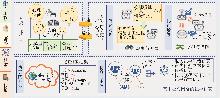
图1
跨学科视域下大模型驱动的社交网络多智能体仿真研究体系框架图
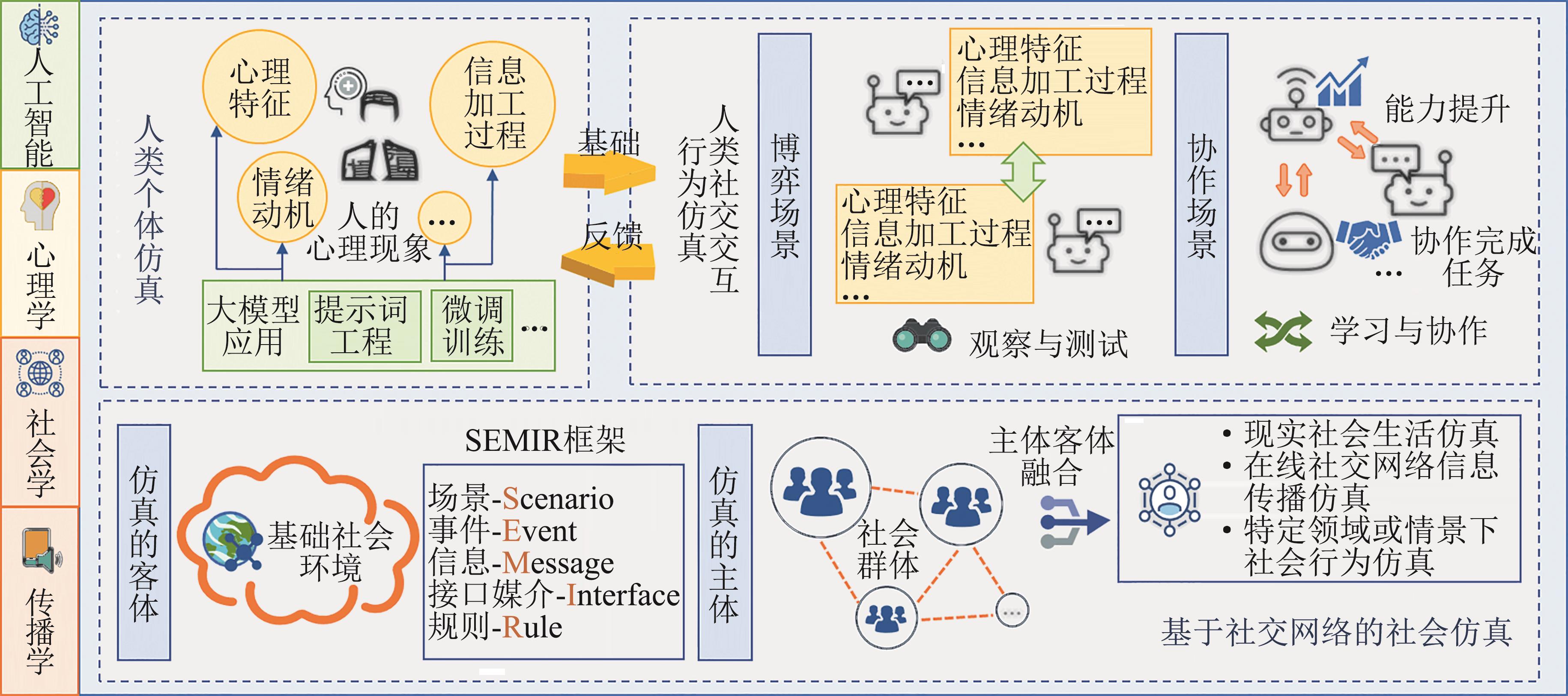
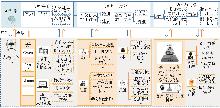
图2
融合心理学理论和人工智能的人类个体仿真研究框架
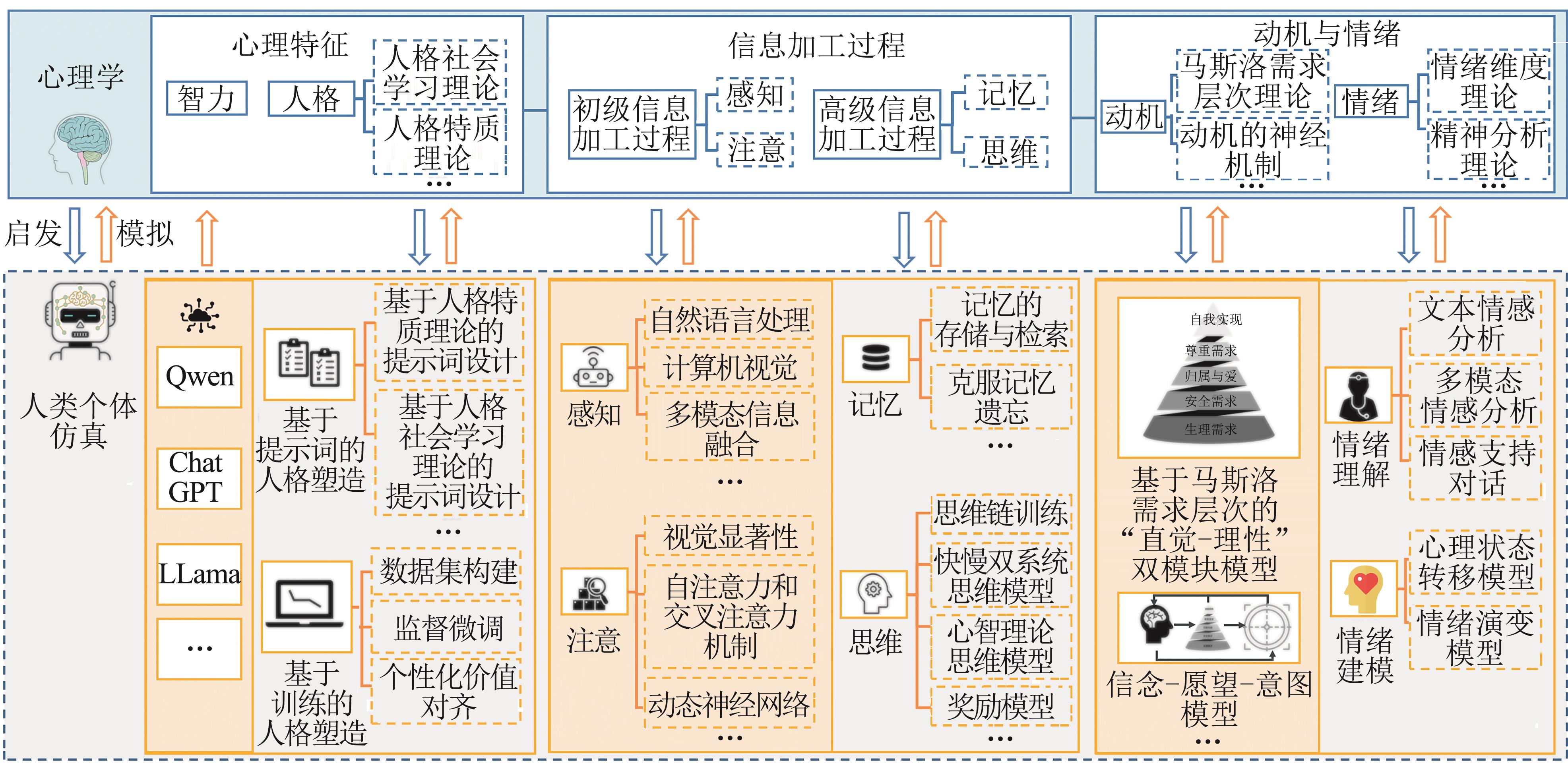
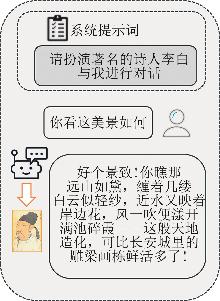
图3
基于提示词的人格塑造
图4
人类社交交互行为仿真研究框架图
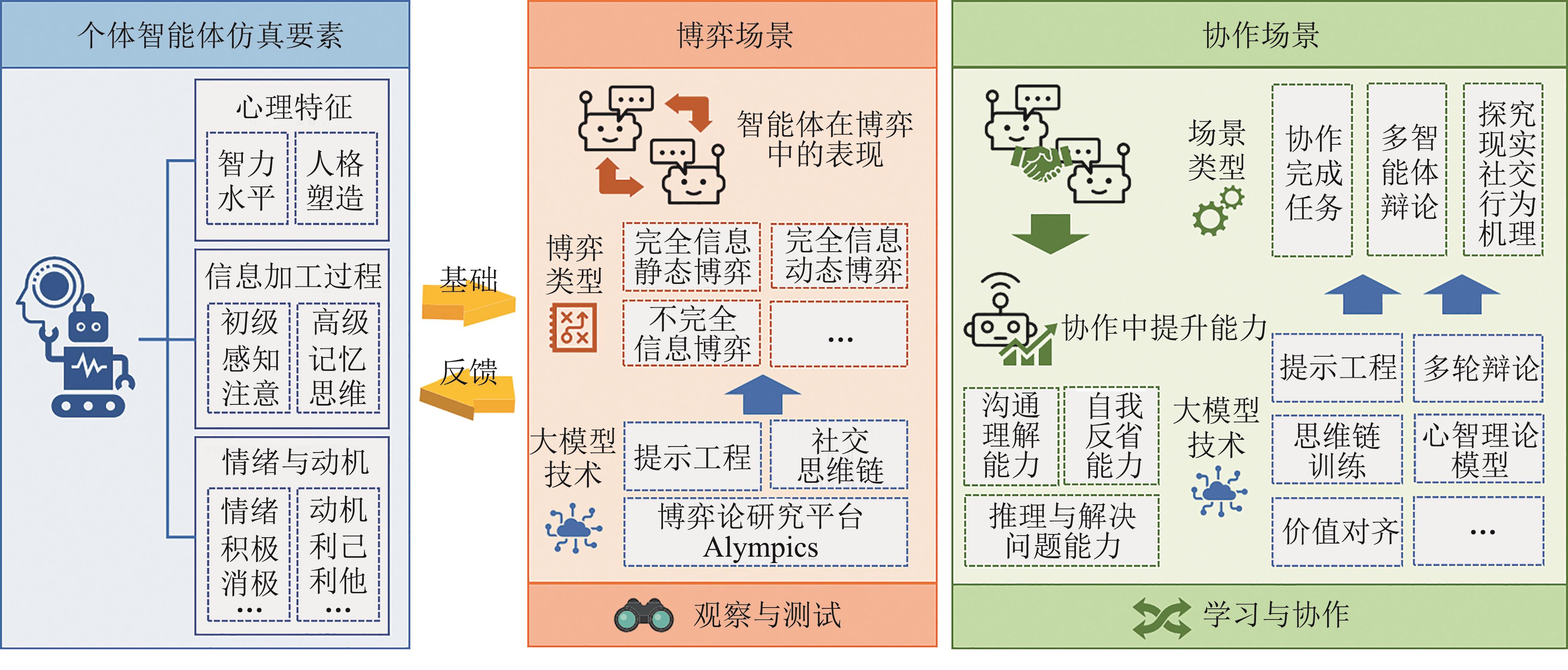
图5
基于社交网络的社会仿真研究框架
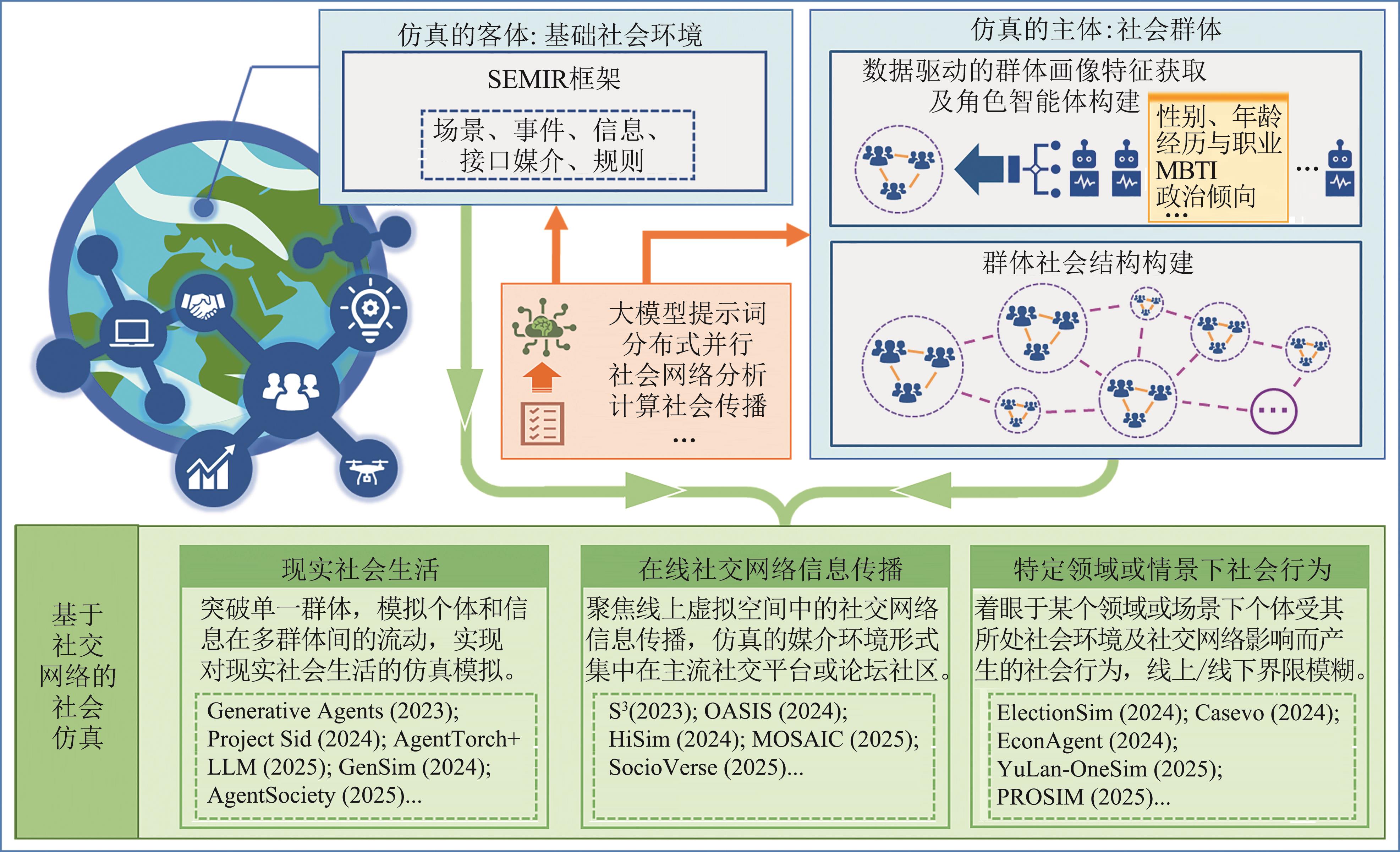
图6
基础社会环境的构建框架SEMIR
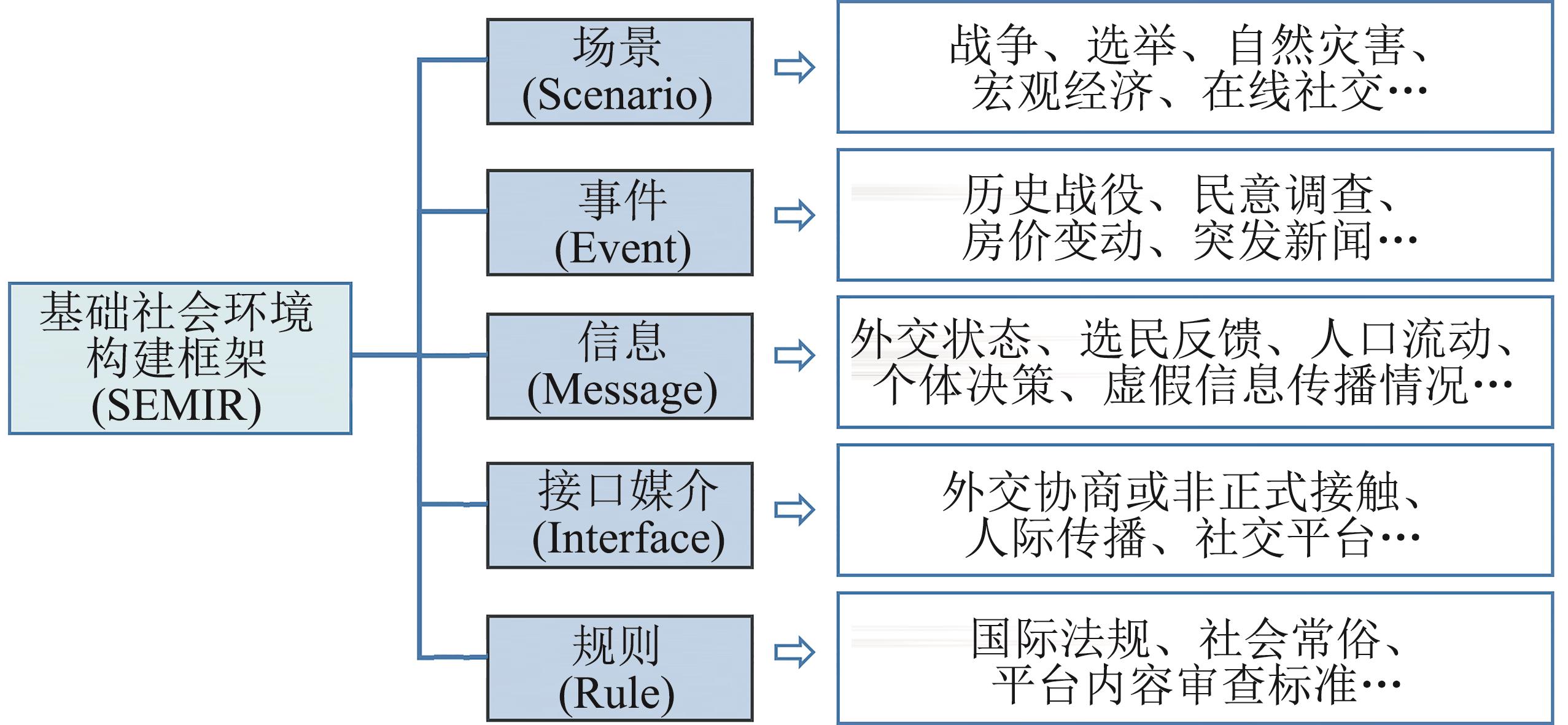
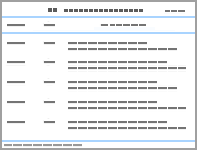
表1
SEMIR框架视角下的基础环境构建
| 要素 | 内容 |
|---|---|
| 场景 | OASIS以验证X和Reddit平台的信息传播、群体极化和羊群效应为目的构建实验场景,设置并构建对应场景下的社交网络,确定社交网络的规模以及分布,初始化已产生的帖文等信息 |
| 事件 | 综合利用Twitter15/Twitter16数据集、X平台、Reddit平台等渠道采集经济、政治等领域的事件,以此实例化仿真系统中的信息生产与传递行为。如OASIS使用“亚马逊无人机配送计划”这一经济事件的数据为支撑,模拟了社交网络中的谣言传播现象 |
| 信息 | OASIS进行社交网络模拟时,在环境和智能体之间传递的信息包括事件发生之前的初始帖文集,以及各帖文的发帖时间、转评赞等信息;事件发生之后,智能体围绕相关事件的发帖内容,以及帖文的时间、转评赞等信息。OASIS目前只支持纯文本信息的帖文,未来会扩展至多模态帖文。此外,OASIS根据不同社交平台的特点,对智能体生成帖文的方式进行约束。例如,在针对Reddit平台的社交网络模拟中,用户的发帖主要围绕某个话题在对应的社区中进行 |
| 接口媒介 | OASIS模拟了X和Reddit 2个平台的推荐系统(RecSys),并使用推荐系统作为智能体与外界进行交互的接口媒介。推荐系统负责管理帖文信息在社交网络上的传递,根据智能体的角色属性、帖文热度等控制各类信息对不同智能体的可见度 |
| 规则 | OASIS综合使用社交网络形成演化规则、社交平台信息推荐机制、人类社交行为的时序规律、人类社交行为的平台化差异现象等设计社交网络仿真框架,以提升社交网络仿真结果的可信度 |
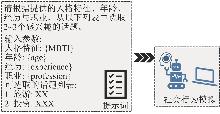
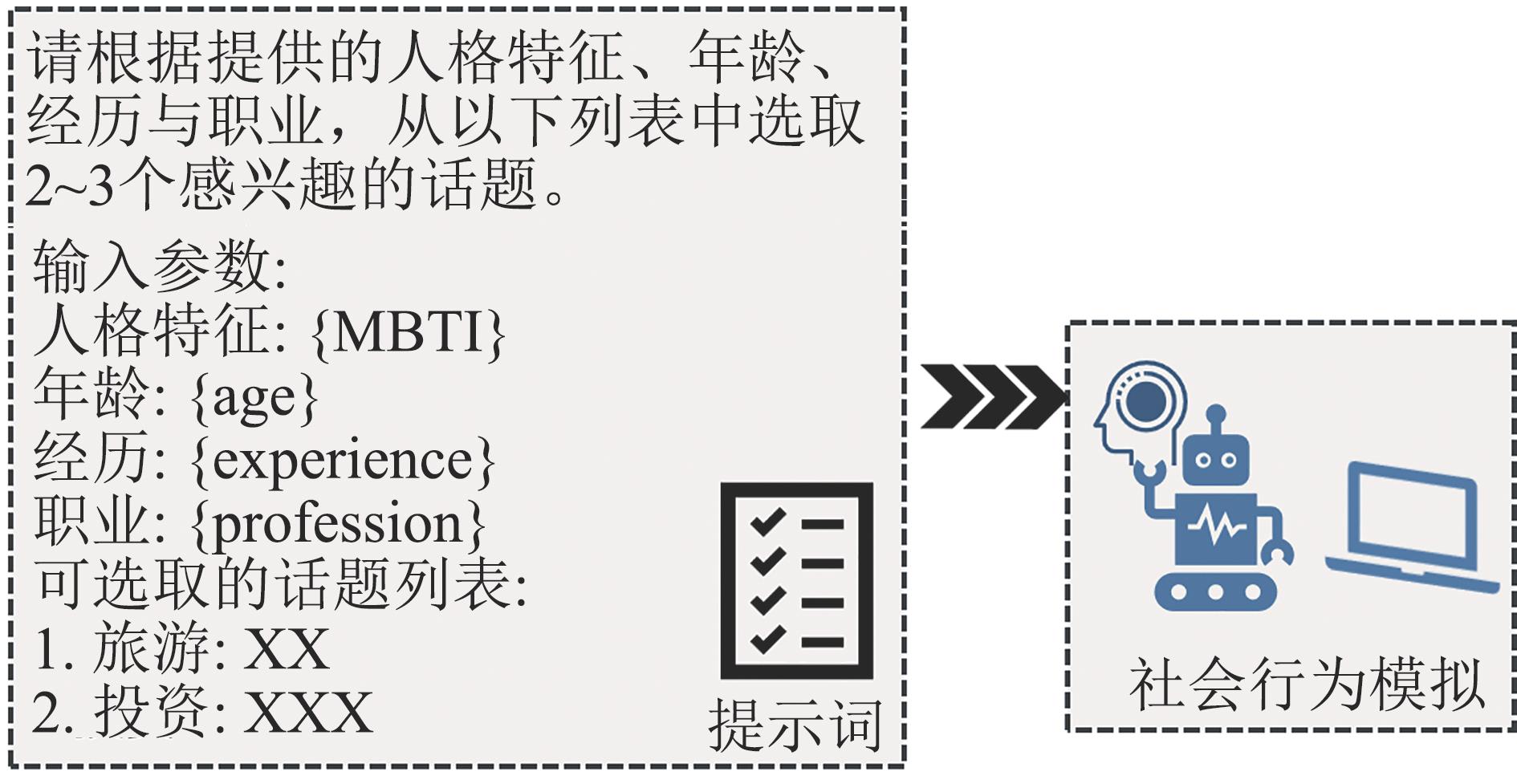
图7
基于提示词的社会行为模拟
| [1] | Moreno J L. Who Shall Survive?: A New Approach to the Problem of Human Interrelations[M]. Washington, D. C.: Nervous and Mental Disease Publishing Company, 1934. |
| [2] | Lazarsfeld P F, Berelson B, Gaudet H. The People's Choice: How the Voter Makes up His Mind in a Presidential Campaign[M]. New York : Columbia University Press, 1948. |
| [3] | Milgram S. The Small World Problem[J]. Psychology Today, 1967, 2(1): 60-67. |
| [4] | Granovetter M S. The Strength of Weak Ties[J]. American Journal of Sociology, 1973, 78(6): 1360-1380. |
| [5] | Keuchenius Anna, Törnberg Petter, Uitermark Justus. Adoption and Adaptation: A Computational Case Study of the Spread of Granovetter's Weak Ties Hypothesis[J]. Social Networks, 2021, 66: 10-25. |
| [6] | Gilbert N. Agent-based Models[M]. Los Angeles: Sage Publications, 2008. |
| [7] | 王志超, 吕泽宇. 从ABM到GABM-生成式人工智能对社会模拟的重塑[J]. 智能社会研究, 2025, 4(2): 138-157, 251. |
| Wang Zhichao, Zeyu Lü. From ABM to GABM: How Generative AI is Reshaping Social Simulation[J]. Journal of Intelligent Society, 2025, 4(2): 138-157, 251. | |
| [8] | Vespignani A. Modelling Dynamical Processes in Complex Socio-technical Systems[J]. Nature Physics, 2012, 8(1): 32-39. |
| [9] | Gao Jianxi, Barzel Baruch, Barabási Albert-László. Universal Resilience Patterns in Complex Networks[J]. Nature, 2016, 530(7590): 307-312. |
| [10] | Epstein J M, Axtell R L. Growing Artificial Societies: Social Science from the Bottom Up[M]. Cambridge: The MIT Press, 1996. |
| [11] | Axelrod R. The Dissemination of Culture: A Model with Local Convergence and Global Polarization[J]. The Journal of Conflict Resolution, 1997, 41(2): 203-226. |
| [12] | Macy M W, Willer R. From Factors to Actors: Computational Sociology and Agent-based Modeling[J]. Annual Review of Sociology, 2002, 28: 143-166. |
| [13] | 吴声, 樊虹, 张彭燕, 等. 智能体模型在艾滋病流行病学中的应用[J]. 中国卫生统计, 2024, 41(5): 734-738. |
| [14] | Alatas Husin, Nurhimawan Salamet, Asmat Fikri, et al. Dynamics of an Agent-based Opinion Model with Complete Social Connectivity Network[J]. Chaos Solitons & Fractals, 2017, 101: 24-32. |
| [15] | Fan Ruguo, Yao Qianyi, Chen Rongkai, et al. Agent-based Simulation Model of Panic Buying Behavior in Urban Public Crisis Events: A Social Network Perspective[J]. Sustainable Cities and Society, 2024, 100: 105002. |
| [16] | Park J S, O'Brien J, Cai Jun, et al. Generative Agents: Interactive Simulacra of Human Behavior[C]//Proceedings of the 36th Annual ACM Symposium on User Interface Software and Technology. New York: ACM, 2023: 2. |
| [17] | Gao Chen, Lan Xiaochong, Li Nian, et al. Large Language Models Empowered Agent-based Modeling and Simulation: A Survey and Perspectives[J]. Humanities and Social Sciences Communications, 2024, 11(1): 1259. |
| [18] | Jinghua Piao, Yan Yuwei, Zhang Jun, et al. AgentSociety: Large-scale Simulation of LLM-driven Generative Agents Advances Understanding of Human Behaviors and Society[EB/OL]. [2025-02-25]. . |
| [19] | Wu Bin, Shi Zhengyan, Rahmani H A, et al. Understanding the Role of User Profile in the Personalization of Large Language Models[EB/OL]. (2024-06-22) [2025-05-14]. . |
| [20] | Tu Quan, Chen Chuanqi, Li Jinpeng, et al. CharacterChat: Learning towards Conversational AI with Personalized Social Support[EB/OL]. (2023-08-20) [2025-03-19]. . |
| [21] | Argyle L P, Busby E C, Fulda N, et al. Out of One, Many: Using Language Models to Simulate Human Samples[J]. Political Analysis, 2023, 31(3): 337-351. |
| [22] | Ge Tao, Xin Chan, Wang Xiaoyang, et al. Scaling Synthetic Data Creation with 1,000,000,000 Personas[EB/OL]. [2025-05-10]. . |
| [23] | Balepur N, Padmakumar V, Yang Fumeng, et al. Whose Boat Does It Float? Improving Personalization in Preference Tuning via Inferred User Personas[EB/OL]. [2025-05-10]. . |
| [24] | 彭聃龄, 陈宝国. 普通心理学[M]. 6版. 北京: 北京师范大学出版社, 2023. |
| Peng Danling, Chen Baoguo. General Psychology[M]. 6th ed. Beijing: Beijing Normal University Press, 2023. | |
| [25] | 武光路, 李剑锋. 大学生心理危机的预防与干预[M]. 北京: 国防工业出版社, 2016. |
| [26] | Yang An, Yang Baosong, Hui Binyuan, et al. Qwen2 Technical Report[EB/OL]. (2024-09-10) [2025-05-12]. . |
| [27] | Lu Keming, Yu Bowen, Zhou Chang, et al. Large Language Models are Superpositions of All Characters: Attaining Arbitrary Role-play via Self-alignment[C]//Proceedings of the 62nd Annual Meeting of the Association for Computational Linguistics. Stroudsburg: ACL, 2024: 7828-7840. |
| [28] | Hämäläinen Perttu, Tavast Mikke, Kunnari Anton. Evaluating Large Language Models in Generating Synthetic HCI Research Data: A Case Study[C]//Proceedings of the 2023 CHI Conference on Human Factors in Computing Systems. New York: ACM, 2023: 433. |
| [29] | Zeng Zheni, Chen Jiayi, Chen Huimin, et al. PersLLM: A Personified Training Approach for Large Language Models[EB/OL]. [2025-05-15]. . |
| [30] | Sun Linzhuang, Dong Yao, Xu Nan, et al. Rational Sensibility: LLM Enhanced Empathetic Response Generation Guided by Self-presentation Theory[EB/OL]. (2024-08-23) [2025-05-05]. . |
| [31] | Liu Ruibo, Yang Ruixin, Jia Chenyan, et al. Training Socially Aligned Language Models on Simulated Social Interactions[C]//International Conference on Representation Learning 2024 (ICLR 2024) Conference. New York: ICLR, 2024: 49602-49625. |
| [32] | Besta M, Chandran S, Gerstenberger R, et al. Psychologically Enhanced AI Agents[EB/OL]. [2025-09-15]. . |
| [33] | Jiang Hang, Zhang Xiajie, Cao Xubo, et al. PersonaLLM: Investigating the Ability of Large Language Models to Express Personality Traits[C]//Findings of the Association for Computational Linguistics: NAACL 2024. Stroudsburg: ACL, 2024: 3605-3627. |
| [34] | Wang Xintao, Wang Heng, Zhang Yifei, et al. CoSER: Coordinating LLM-based Persona Simulation of Established Roles[EB/OL]. (2025-05-28) [2025-06-03]. . |
| [35] | Wang Xintao, Xiao Yunze, Huang J T, et al. InCharacter: Evaluating Personality Fidelity in Role-playing Agents through Psychological Interviews[C]//Proceedings of the 62nd Annual Meeting of the Association for Computational Linguistics. Stroudsburg: ACL, 2024: 1840-1873. |
| [36] | Xu Rui, Wang Xintao, Chen Jiangjie, et al. Character is Destiny: Can Role-playing Language Agents Make Persona-driven Decisions?[EB/OL]. (2024-11-18) [2025-05-05]. . |
| [37] | Tu Quan, Fan Shilong, Tian Zihang, et al. CharacterEval: A Chinese Benchmark for Role-playing Conversational Agent Evaluation[C]//Proceedings of the 62nd Annual Meeting of the Association for Computational Linguistics. Stroudsburg: ACL, 2024: 11836-11850. |
| [38] | Li Jianan, Guan Jian, Wu Songhao, et al. From 1,000,000 Users to Every User: Scaling Up Personalized Preference for User-level Alignment[EB/OL]. (2025-05-22) [2025-05-30]. . |
| [39] | Wu Shujin, Fung Y R, Qian Cheng, et al. Aligning LLMs with Individual Preferences via Interaction[C]//Proceedings of the 31st International Conference on Computational Linguistics. Stroudsburg: ACL, 2025: 7648-7662. |
| [40] | Wang Zekun, Peng Zhongyuan, Que Haoran, et al. RoleLLM: Benchmarking, Eliciting, and Enhancing Role-playing Abilities of Large Language Models[C]//Findings of the Association for Computational Linguistics: ACL 2024. Stroudsburg: ACL, 2024: 14743-14777. |
| [41] | Shao Yunfan, Li Linyang, Dai Junqi, et al. Character-LLM: A Trainable Agent for Role-playing[C]//Proceedings of the 2023 Conference on Empirical Methods in Natural Language Processing. Stroudsburg: ACL, 2023: 13153-13187. |
| [42] | Li Guohao, Hasan Abed Al Kader Hammoud, Itani Hani, et al. CAMEL: Communicative Agents for "Mind" Exploration of Large Language Model Society[C]Proceedings of the 37th International Conference on Neural Information Processing Systems. Red Hook: Curran Associates Inc., 2023: 51991-52008. |
| [43] | Lee G, Jeong M, Kim Y, et al. BAPO: Base-anchored Preference Optimization for Overcoming Forgetting in Large Language Models Personalization[C]//Findings of the Association for Computational Linguistics: EMNLP 2024. Stroudsburg: ACL, 2024: 6804-6820. |
| [44] | 菲利普·津巴多, 罗伯特·约翰逊, 薇薇安·麦卡恩. 津巴多普通心理学[M]. 钱静, 黄珏苹, 译. 北京: 北京联合出版公司, 2017. |
| Zimbardo P G, Johnson R L, McCann V. Psychology Core Concepts[M]. Translated by Qian Jing, Huang Yuping. Beijing: Beijing United Publishing Co., Ltd., 2017. | |
| [45] | LeCun Y, Bengio Yoshua, Hinton G. Deep Learning[J]. Nature, 2015, 521(7553): 436-444. |
| [46] | Zou Zhengxia, Chen Keyan, Shi Zhenwei, et al. Object Detection in 20 Years: A Survey[J]. Proceedings of the IEEE, 2023, 111(3): 257-276. |
| [47] | Qiu Xipeng, Sun Tianxiang, Xu Yige, et al. Pre-trained Models for Natural Language Processing: A Survey[J]. Science China Technological Sciences, 2020, 63(10): 1872-1897. |
| [48] | Antol S, Agrawal A, Lu Jiasen, et al. VQA: Visual Question Answering[C]//2015 IEEE International Conference on Computer Vision (ICCV). Piscataway: IEEE, 2015: 2425-2433. |
| [49] | 姚鸿勋, 邓伟洪, 刘洪海, 等. 情感计算与理解研究发展概述[J]. 中国图象图形学报, 2022, 27(6): 2008-2035. |
| Yao Hongxun, Deng Weihong, Liu Honghai, et al. An Overview of Research Development of Affective Computing and Understanding[J]. Journal of Image and Graphics, 2022, 27(6): 2008-2035. | |
| [50] | Yin Shukang, Fu Chaoyou, Zhao Sirui, et al. A Survey on Multimodal Large Language Models[J]. National Science Review, 2024, 11(12): nwae403. |
| [51] | Wu Jiayang, Gan Wensheng, Chen Zefeng, et al. Multimodal Large Language Models: A Survey[C]//2023 IEEE International Conference on Big Data (BigData). Piscataway: IEEE, 2023: 2247-2256. |
| [52] | Dai Yanqi, Hu Huanran, Wang Lei, et al. MMRole: A Comprehensive Framework for Developing and Evaluating Multimodal Role-playing Agents[C]//International Conference on Representation Learning 2025 (ICLR 2025) Conference. New York: ICLR, 2025: 66300-66321. |
| [53] | Vaswani A, Shazeer N, Parmar N, et al. Attention Is All You Need[C]//Proceedings of the 31st International Conference on Neural Information Processing Systems. Red Hook: Curran Associates Inc., 2017: 6000-6010. |
| [54] | Zou Xin, Lu Di, Wang Yizhou, et al. Don't Just Chase "Highlighted Tokens" in MLLMs: Revisiting Visual Holistic Context Retention[C]//The Thirty-ninth Annual Conference on Neural Information Processing Systems. San Diego: MIT Press, 2025: 1-33. |
| [55] | Dhara Gayathri, Ravi Kant Kumar. A Survey on Visual Saliency Detection Approaches and Attention Models[J]. Multimedia Tools and Applications, 2025, 84(35): 44183-44225. |
| [56] | Zhang Saizheng, Dinan E, Urbanek J, et al. Personalizing Dialogue Agents: I Have a Dog, Do You Have Pets Too?[C]//Proceedings of the 56th Annual Meeting of the Association for Computational Linguistics. Stroudsburg: ACL, 2018: 2204-2213. |
| [57] | Sordoni A, Galley M, Auli M, et al. A Neural Network Approach to Context-sensitive Generation of Conversational Responses[C]//Proceedings of the 2015 Conference of the North American Chapter of the Association for Computational Linguistics: Human Language Technologies. Stroudsburg: ACL, 2015: 196-205. |
| [58] | Wang Liyuan, Zhang Xingxing, Su Hang, et al. A Comprehensive Survey of Continual Learning: Theory, Method and Application[J]. IEEE Transactions on Pattern Analysis and Machine Intelligence, 2024, 46(8): 5362-5383. |
| [59] | McCloskey Michael, Cohen Neal J. Catastrophic Interference in Connectionist Networks: The Sequential Learning Problem[J]. Psychology of Learning and Motivation, 1989, 24: 109-165. |
| [60] | Wang Yaoting, Wu Shengqiong, Zhang Yuecheng, et al. Multimodal Chain-of-thought Reasoning: A Comprehensive Survey[EB/OL]. (2025-03-23) [2025-05-05]. . |
| [61] | Zhang Yifan, Yang Jingqin, Yuan Yang, et al. Cumulative Reasoning with Large Language Models[EB/OL]. [2025-05-05]. . |
| [62] | W A Strachan James, Albergo Dalila, Borghini Giulia, et al. Testing Theory of Mind in Large Language Models and Humans[J]. Nature Human Behaviour, 2024, 8(7): 1285-1295. |
| [63] | Wang Zhilin, Chiu Y Y, Chiu Y C. Humanoid Agents: Platform for Simulating Human-like Generative Agents[C]//Proceedings of the 2023 Conference on Empirical Methods in Natural Language Processing: System Demonstrations. Stroudsburg: ACL, 2023: 167-176. |
| [64] | Xie Chengxing, Chen Canyu, Jia Feiran, et al. Can Large Language Model Agents Simulate Human Trust Behaviors?[C]//ICLR 2024. New York: ICLR, 2024: 1-35 |
| [65] | 伍海燕, 何翠琳, 曲由之, 等. 大语言模型的情感智能及其心理学应用[J]. 科技导报, 2025, 43(3): 47-58. |
| Wu Haiyan, He Cuilin, Qu Youzhi, et al. Emotional Intelligence of Large Language Models and Its Psychological Applications[J]. Science & Technology Review, 2025, 43(3): 47-58. | |
| [66] | Xing F. Designing Heterogeneous LLM Agents for Financial Sentiment Analysis[J]. ACM Transactions on Management Information Systems, 2025, 16(1): 5. |
| [67] | Gandhi Ankita, Adhvaryu Kinjal, Poria Soujanya, et al. Multimodal Sentiment Analysis: A Systematic Review of History, Datasets, Multimodal Fusion Methods, Applications, Challenges and Future Directions[J]. Information Fusion, 2023, 91: 424-444. |
| [68] | Zhang Zhicheng, Xia Wuyou, Zhao Chenxi, et al. MODA: MOdular Duplex Attention for Multimodal Perception, Cognition, and Emotion Understanding[EB/OL]. (2025-07-07) [2025-08-15]. . |
| [69] | Yang Xiaocui, Feng Shi, Wang Daling, et al. Image-text Multimodal Emotion Classification via Multi-view Attentional Network[J]. IEEE Transactions on Multimedia, 2021, 23: 4014-4026. |
| [70] | Liu Hui, Wang Wenya, Li Haoliang. Towards Multi-modal Sarcasm Detection via Hierarchical Congruity Modeling with Knowledge Enhancement[C]//Proceedings of the 2022 Conference on Empirical Methods in Natural Language Processing. Stroudsburg: ACL, 2022: 4995-5006. |
| [71] | Cao Yaru, Chen Zhuang, Bi Guanqun, et al. Enhancing Emotional Support Conversation with Cognitive Chain-of-thought Reasoning[C]//CCF International Conference on Natural Language Processing and Chinese Computing. Singapore: Springer Nature Singapore, 2025: 175-187. |
| [72] | Li Ming, Su Yusheng, Huang H Y, et al. Language-specific Representation of Emotion-concept Knowledge Causally Supports Emotion Inference[J]. iScience, 2024, 27(12): 111401. |
| [73] | Ren Fuji, Zhou Yangyang, Deng Jiawen, et al. Tracking Emotions Using an Evolutionary Model of Mental State Transitions: Introducing a New Paradigm[J]. Intelligent Computing, 2024, 3: 0075. |
| [74] | Mao Shaoguang, Cai Yuzhe, Xia Yan, et al. ALYMPICS: LLM Agents Meet Game Theory[C]//Proceedings of the 31st International Conference on Computational Linguistics. Stroudsburg: ACL, 2025: 2845-2866. |
| [75] | Akata Elif, Schulz Lion, Coda-Forno Julian, et al. Playing Repeated Games with Large Language Models[J]. Nature Human Behaviour, 2025, 9(7): 1380-1390. |
| [76] | Guo Fulin. GPT in Game Theory Experiments[EB/OL]. (2023-12-11) [2025-04-05]. . |
| [77] | Phelps S, Russell Y I. The Machine Psychology of Cooperation: Can GPT Models Operationalize Prompts for Altruism, Cooperation, Competitiveness, and Selfishness in Economic Games?[J]. Journal of Physics: Complexity, 2025, 6(1): 015018. |
| [78] | Bakhtin A, Brown N, Dinan E, et al. Human-level Play in the Game of Diplomacy by Combining Language Models with Strategic Reasoning[J]. Science, 2022, 378(6624): 1067-1074. |
| [79] | Xu Yuzhuang, Wang Shuo, Li Peng, et al. Exploring Large Language Models for Communication Games: An Empirical Study on Werewolf[EB/OL]. (2024-05-11) [2025-08-15]. . |
| [80] | Guo Jiaxian, Yang Bo, Yoo P, et al. Suspicion-agent: Playing Imperfect Information Games with Theory of Mind Aware GPT-4[EB/OL]. (2024-08-31) [2025-08-15]. . |
| [81] | Qian Chen, Liu Wei, Liu Hongzhang, et al. ChatDev: Communicative Agents for Software Development[C]//Proceedings of the 62nd Annual Meeting of the Association for Computational Linguistics. Stroudsburg: ACL, 2024: 15174-15186. |
| [82] | Wang Zhenhailong, Mao Shaoguang, Wu Wenshan, et al. Unleashing the Emergent Cognitive Synergy in Large Language Models: A Task-solving Agent through Multi-persona Self-Collaboration[C]//Proceedings of the 2024 Conference of the North American Chapter of the Association for Computational Linguistics: Human Language Technologies. Stroudsburg: ACL, 2024: 257-279. |
| [83] | Liang Tian, He Zhiwei, Jiao Wenxiang, et al. Encouraging Divergent Thinking in Large Language Models Through Multi-agent Debate[C]//Proceedings of the 2024 Conference on Empirical Methods in Natural Language Processing. Stroudsburg: ACL, 2024: 17889-17904. |
| [84] | Chan C M, Chen Weize, Su Yusheng, et al. ChatEval: Towards Better LLM-based Evaluators Through Multi-agent Debate[C]//International Conference on Representation Learning 2024 (ICLR 2024) Conference. New York: ICLR, 2024: 9079-9093. |
| [85] | Lan Xiaochong, Gao Chen, Jin Depeng, et al. Stance Detection with Collaborative Role-infused LLM-based Agents[C]//Proceedings of the Eighteenth International AAAI Conference on Web and Social Media. Palo Alto: AAAI Press, 2024: 891-903. |
| [86] | Suzuki Reiji, Arita Takaya. An Evolutionary Model of Personality Traits Related to Cooperative Behavior Using a Large Language Model[J]. Scientific Reports, 2024, 14(1): 5989. |
| [87] | Zhang Jintian, Xu Xin, Zhang Ningyu, et al. Exploring Collaboration Mechanisms for LLM Agents: A Social Psychology View[C]//Proceedings of the 62nd Annual Meeting of the Association for Computational Linguistics. Stroudsburg: ACL, 2024: 14544-14607. |
| [88] | Chen Huaben, Ji Wenkang, Xu Lufeng, et al. Multi-agent Consensus Seeking via Large Language Models[EB/OL]. (2025-01-21) [2025-05-15]. . |
| [89] | 肖红江, 姬德强, 张远. 大模型驱动的社会仿真实验室: 人工智能时代传播研究的理论想象与路径建构[J]. 现代传播(中国传媒大学学报), 2024, 46(6): 121-127. |
| Xiao Hongjiang, Ji Deqiang, Zhang Yuan. Large-model-driven Social Simulation Laboratory: Theoretical Imagination and Path Construction in Communication Research in the Age of Artificial Intelligence[J]. Modern Communication(Journal of Communication University of China), 2024, 46(6): 121-127. | |
| [90] | Hewitt L, Ashokkumar A, Ghezae I, et al. Predicting Results of Social Science Experiments Using Large Language Models[J]. Preprint, 2024. |
| [91] | 吕鹏, 陈典涵. 社会复杂系统智能模拟: 涌现机理与方法路径[J]. 山东大学学报(哲学社会科学版), 2024(1): 125-135. |
| Peng Lü, Chen Dianhan. Intelligent Simulation of Social Complex Systems: Emergence Mechanisms and Methodological Paths[J]. Journal of Shandong University(Philosophy and Social Sciences), 2024(1): 125-135. | |
| [92] | 夏德龙. 复杂性研究的社会仿真模拟方法述评与展望[J]. 华中科技大学学报(社会科学版), 2021, 35(2): 127-135. |
| Xia Delong. Social Simulation Methods of Complexity Research: Review and Prospect[J]. Journal of Huazhong University of Science and Technology(Social Science Edition), 2021, 35(2): 127-135. | |
| [93] | Jiang Zexun, Shi Yafang, Li Maoxu, et al. Casevo: A Cognitive Agents and Social Evolution Simulator[EB/OL]. (2024-12-27) [2025-05-15]. . |
| [94] | Yang Ziyi, Zhang Zaibin, Zheng Zirui, et al. OASIS: Open Agents Social Interaction Simulations on One Million Agents[C]//NeurIPS 2024 Workshop on Open-World Agents. San Diego: MIT Press, 2024: 1-40. |
| [95] | Hua Wenyue, Fan Lizhou, Li Lingyao, et al. War and Peace (WarAgent): Large Language Model-based Multi-agent Simulation of World Wars[EB/OL]. (2024-01-30) [2025-05-15]. . |
| [96] | Wang Lei, Zhang Jingsen, Yang Hao, et al. User Behavior Simulation with Large Language Model-based Agents[J]. ACM Transactions on Information Systems, 2025, 43(2): 55. |
| [97] | Gao Chen, Lan Xiaochong, Lu Zhihong, et al. S3: Social-network Simulation System with Large Language Model-empowered Agents[EB/OL]. [2025-05-15]. . |
| [98] | Zhang Xinnong, Lin Jiayu, Sun Libo, et al. ElectionSim: Massive Population Election Simulation Powered by Large Language Model Driven Agents[EB/OL]. (2024-11-06) [2025-05-15]. . |
| [99] | Cheng Junyan, Chin P. SocioDojo: Building Lifelong Analytical Agents with Real-world Text and Time Series[C]//International Conference on Representation Learning 2024 (ICLR 2024) Conference. New York: ICLR, 2024: 22153-22187. |
| [100] | Lee S, Peng Taiquan, Goldberg M H, et al. Can Large Language Models Estimate Public Opinion About Global Warming? An Empirical Assessment of Algorithmic Fidelity and Bias[J]. PLoS Climate, 2024, 3(8): e0000429. |
| [101] | Mou Xinyi, Wei Zhongyu, Huang Xuanjing. Unveiling the Truth and Facilitating Change: Towards Agent-based Large-scale Social Movement Simulation[C]//Findings of the Association for Computational Linguistics: ACL 2024. Stroudsburg: ACL, 2024: 4789-4809. |
| [102] | Tang Shuo, Pang Xianghe, Liu Zexi, et al. Synthesizing Post-training Data for LLMs Through Multi-agent Simulation[C]//Proceedings of the 63rd Annual Meeting of the Association for Computational Linguistics. Stroudsburg: ACL, 2025: 23306-23335. |
| [103] | Liu Yuhan, Chen Xiuying, Zhang Xiaoqing, et al. From Skepticism to Acceptance: Simulating the Attitude Dynamics Toward Fake News[C]//Proceedings of the Thirty-third International Joint Conference on Artificial Intelligence. California: IJCAI, 2024: 7886-7894. |
| [104] | Park J S, Zou C Q, Shaw A, et al. Generative Agent Simulations of 1,000 People[EB/OL]. (2024-11-15) [2025-06-20]. . |
| [105] | Altera A L, Ahn A, Becker, N, et al. Project Sid: Many-agent Simulations Toward AI Civilization[EB/OL]. (2024-10-31) [2025-06-20]. . |
| [106] | Chopra A, Kumar S, Kuru N G, et al. On the Limits of Agency in Agent-based Models[C]//Proceedings of the 24th International Conference on Autonomous Agents and Multiagent Systems. Richland: International Foundation for Autonomous Agents and Multiagent Systems, 2025: 500-509. |
| [107] | Tang Jiakai, Gao Heyang, Pan Xuchen, et al. GenSim: A General Social Simulation Platform with Large Language Model Based Agents[C]//Proceedings of the 2025 Conference of the Nations of the Americas Chapter of the Association for Computational Linguistics: Human Language Technologies (System Demonstrations). Stroudsburg: ACL, 2025: 143-150. |
| [108] | Liu Genglin, Le V T, Rahman S, et al. MOSAIC: Modeling Social AI for Content Dissemination and Regulation in Multi-Agent Simulations[C]//Proceedings of the 2025 Conference on Empirical Methods in Natural Language Processing. Stroudsburg: ACL, 2025: 6401-6428. |
| [109] | Zhang Xinnong, Lin Jiayu, Mou Xinyi, et al. SocioVerse: A World Model for Social Simulation Powered by LLM Agents and A Pool of 10 Million Real-World Users[EB/OL]. (2025-07-15) [2025-08-21]. . |
| [110] | Zhou Yujia, Wang Hexi, Ai Qingyao, et al. Simulating Prosocial Behavior and Social Contagion in LLM Agents under Institutional Interventions[EB/OL]. (2025-05-21) [2025-06-20]. . |
| [111] | Li Nian, Gao Chen, Li Mingyu, et al. EconAgent: Large Language Model-empowered Agents for Simulating Macroeconomic Activities[C]//Proceedings of the 62nd Annual Meeting of the Association for Computational Linguistics. Stroudsburg: ACL, 2024: 15523-15536. |
| [112] | Wang Lei, Gao Heyang, Bo Xiaohe, et al. YuLan-OneSim: Towards the Next Generation of Social Simulator with Large Language Models[C]//Workshop on Scaling Environments for Agents. San Diego: MIT Press, 2025: 1-80. |
| [1] | 董志明, 胡忠奇, 戴浩然, 高建成. 基于大语言模型的作战仿真想定自动化生成方法[J]. 系统仿真学报, 2026, 38(5): 1129-1145. |
| [2] | 周子聪, 曾俊杰, 胡越, 朱正秋, 尹全军. 基于次优示例引导的兵棋推演多智能体强化学习方法[J]. 系统仿真学报, 2026, 38(5): 1277-1289. |
| [3] | 彭莱春阳, 叶飞, 郭晓明, 周靖林. X语言仿真大模型:体系架构、关键技术与典型应用[J]. 系统仿真学报, 2026, 38(4): 869-888. |
| [4] | 张明新, 伍瑾轩, 朱睿, 王云龙, 孟文娟, 刘喆, 李煦, 陈小磊, 梁宇轩, 郑毅, 薛向阳. 基于大语言模型智能体的社会认知模拟[J]. 系统仿真学报, 2026, 38(2): 261-277. |
| [5] | 闫强, 张倩语, 魏娜. 基于演化博弈的生成式人工智能幻觉应对分析[J]. 系统仿真学报, 2026, 38(2): 399-415. |
| [6] | 刘沂青, 张秋阳, 刘春雨, 薛尧, 魏智伟, 冯岩. 语义知识增强的低轨星座频谱效能评估技术[J]. 系统仿真学报, 2026, 38(2): 460-475. |
| [7] | 陶彩霞, 陈乃焜, 高锋阳, 张建刚. 基于多智能体强化学习的综合能源分布式优化[J]. 系统仿真学报, 2026, 38(2): 476-487. |
| [8] | 王一凡, 杨彬, 汪丛军. 基于大模型智能体的多班组施工过程仿真方法[J]. 系统仿真学报, 2026, 38(2): 488-500. |
| [9] | 胥日升, 杨林瑶, 覃缘琪, 王晓, 孙长银. 知识增强大语言模型的区域交通信号控制方法[J]. 系统仿真学报, 2026, 38(2): 518-531. |
| [10] | 董志明, 胡忠奇, 刘赵阳, 周贺阳. 作战仿真想定智能化生成研究综述[J]. 系统仿真学报, 2025, 37(7): 1665-1683. |
| [11] | 张悦, 张文良, 冯强, 郭星, 任羿, 王自力. 面向实战的装备系统RMS综合仿真验证技术[J]. 系统仿真学报, 2025, 37(7): 1823-1835. |
| [12] | 谷学强, 罗俊仁, 周棪忠, 张万鹏. 智能博弈决策大模型智能体技术综述[J]. 系统仿真学报, 2025, 37(5): 1142-1157. |
| [13] | 姚昌华, 毕珊宁, 马茹飞, 余晓晗, 李家强, 陈金立. 兵棋智能体兵力协同动态联盟形成方法[J]. 系统仿真学报, 2025, 37(5): 1188-1196. |
| [14] | 王祥, 谭国真. 基于知识与大语言模型的高速环境自动驾驶决策研究[J]. 系统仿真学报, 2025, 37(5): 1246-1255. |
| [15] | 周棪忠, 罗俊仁, 谷学强, 张万鹏. 大语言模型视角下的智能规划方法综述[J]. 系统仿真学报, 2025, 37(4): 823-844. |
| 阅读次数 | ||||||
|
全文 |
|
|||||
|
摘要 |
|
|||||
 http://www.china-simulation.com

