

Journal of System Simulation ›› 2026, Vol. 38 ›› Issue (9): 2518-2534.doi: 10.16182/j.issn1004731x.joss.26-0200
• Special Column : System Simulation for Autonomous Driving and Intelligent Transportation • Previous Articles
Deng Mingjun1,2, Nie Peihua1, Guo Junhua2,3, Gao Ningbo4
Received:2026-03-09
Revised:2026-05-11
Online:2026-09-30
Published:2026-10-02
CLC Number:
Deng Mingjun, Nie Peihua, Guo Junhua, Gao Ningbo. Long-tail Object Detection Method in Transportation Scene Images Based on improved RT-DETR[J]. Journal of System Simulation, 2026, 38(9): 2518-2534.
Fig. 1
RT-DETR model architecture
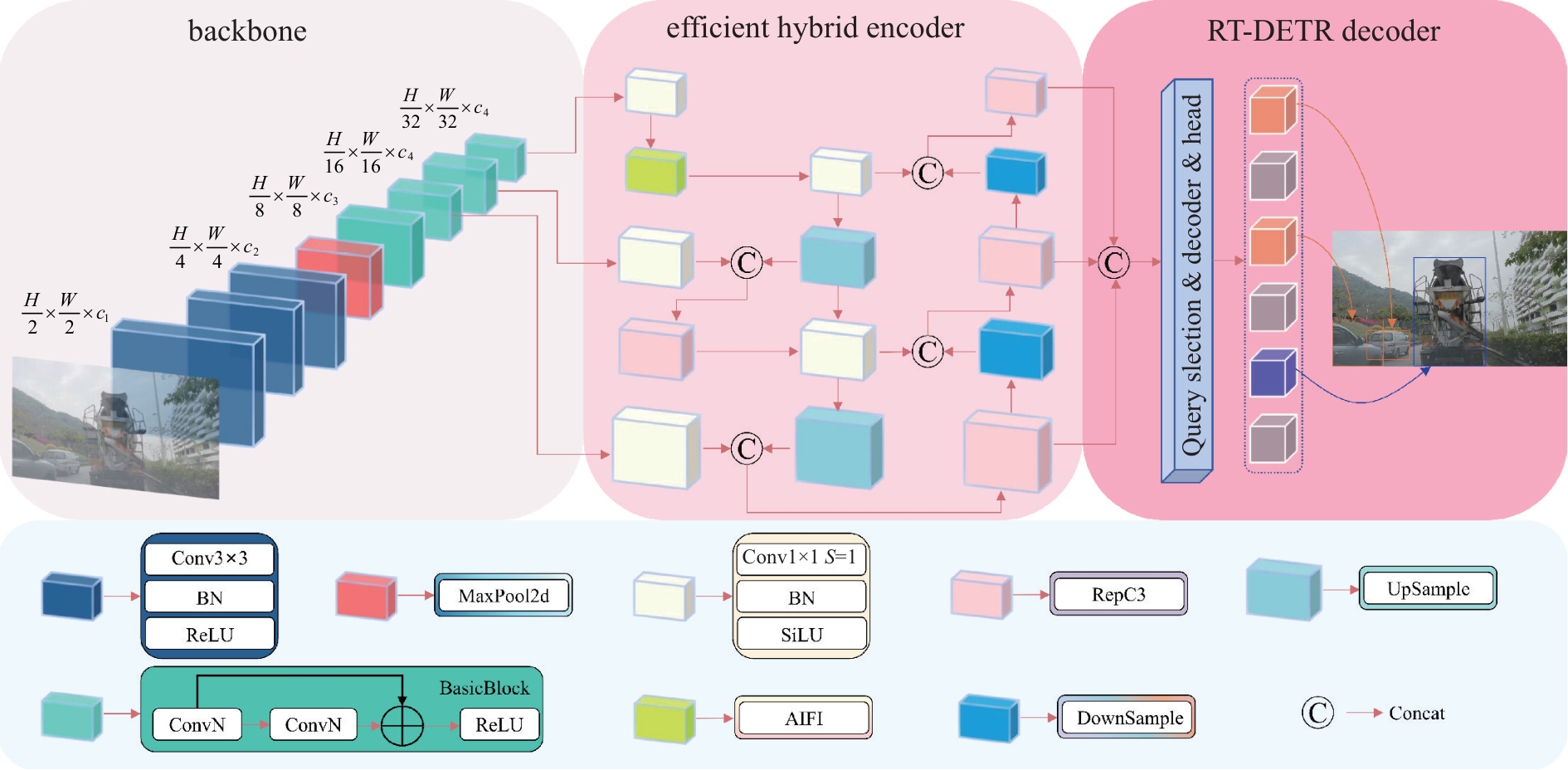
Fig. 2
TF-DETR model architecture
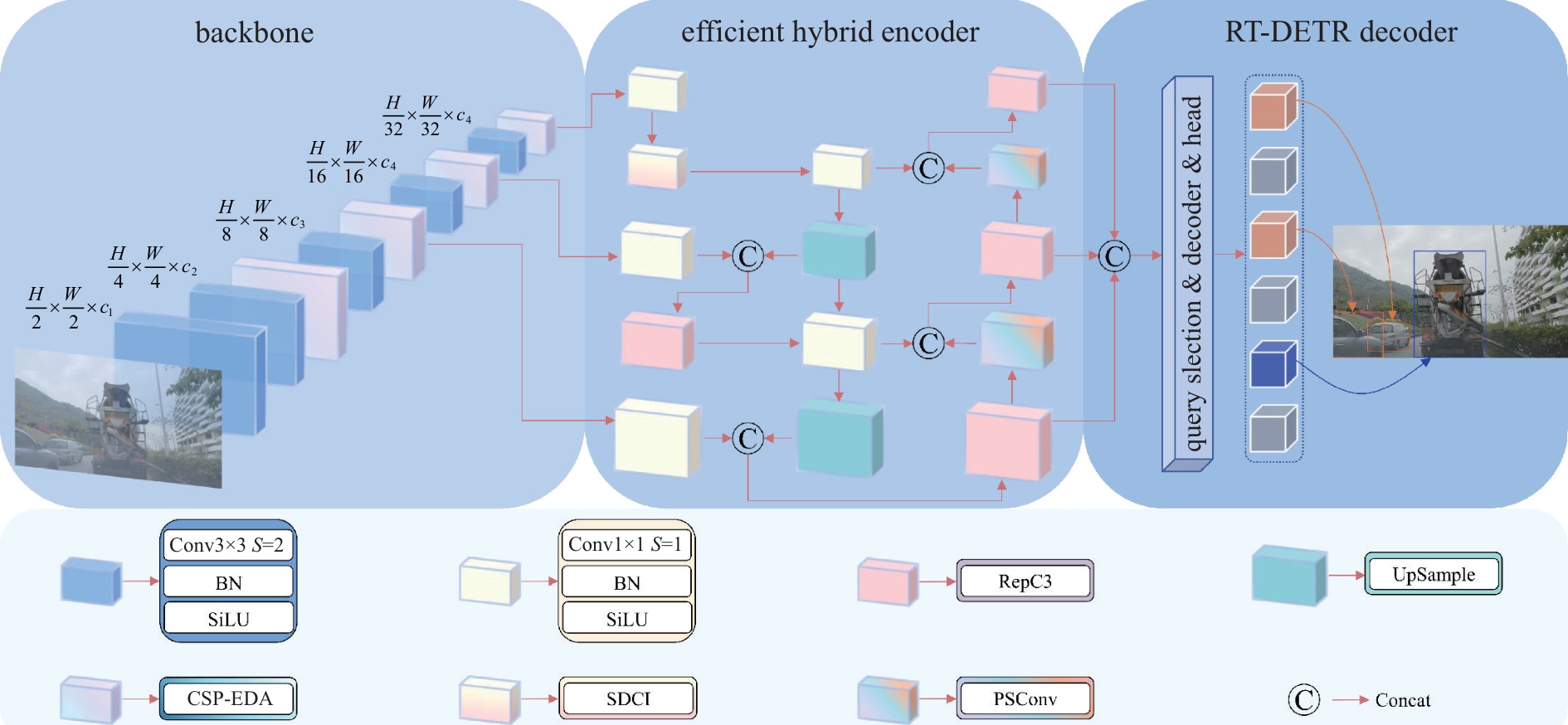
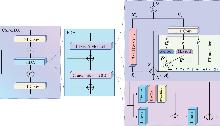
Fig. 3
CSP-EDA architecture
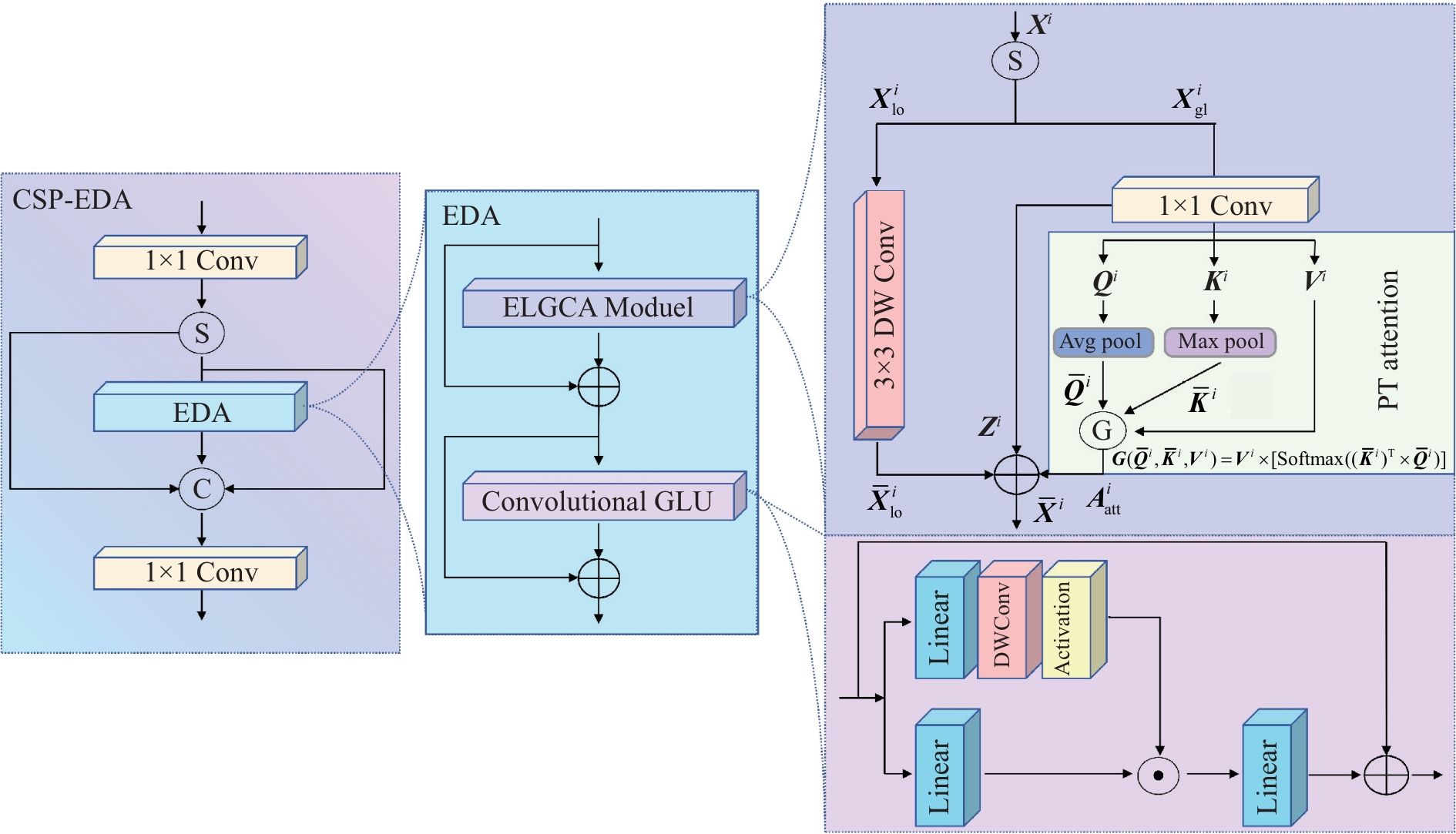
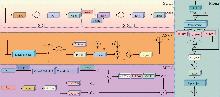
Fig. 4
SDCI model architecture
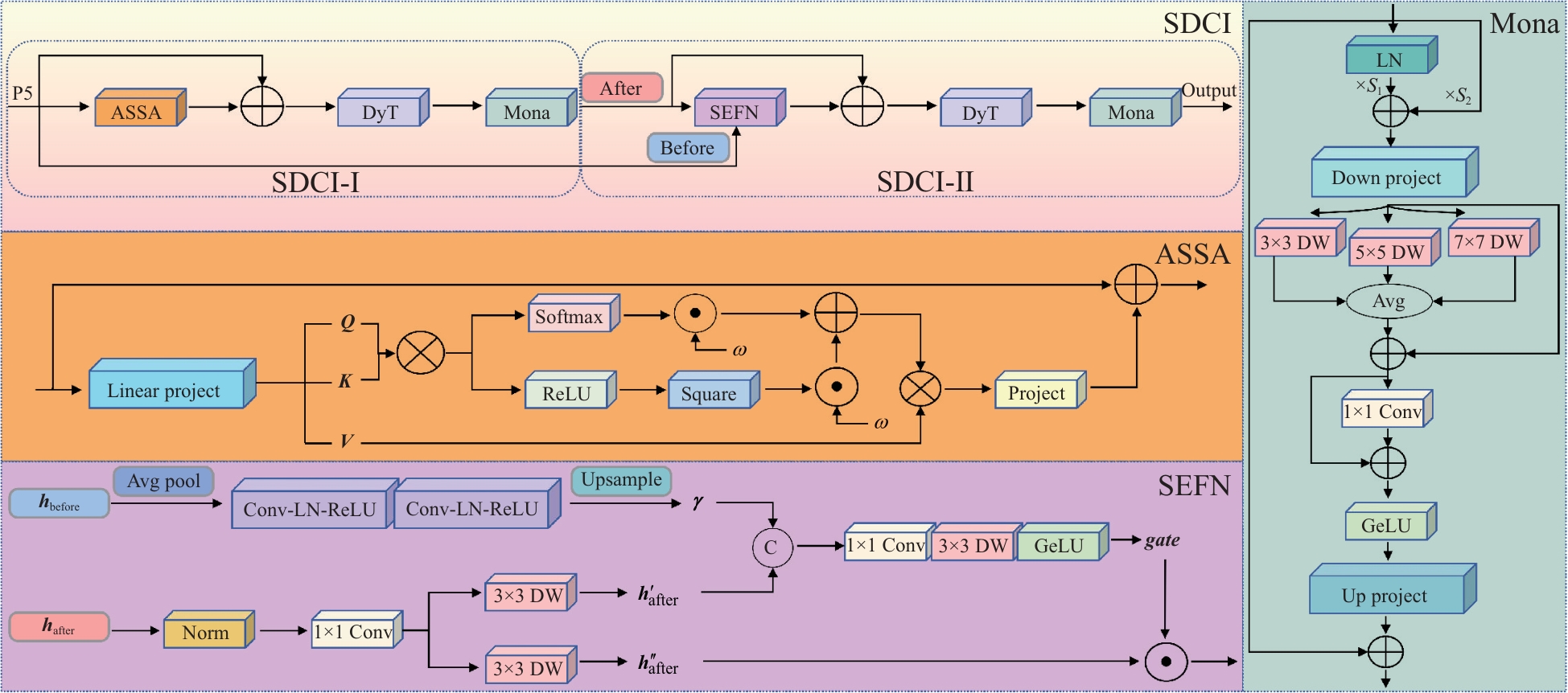
Fig. 5
PSConv model architecture
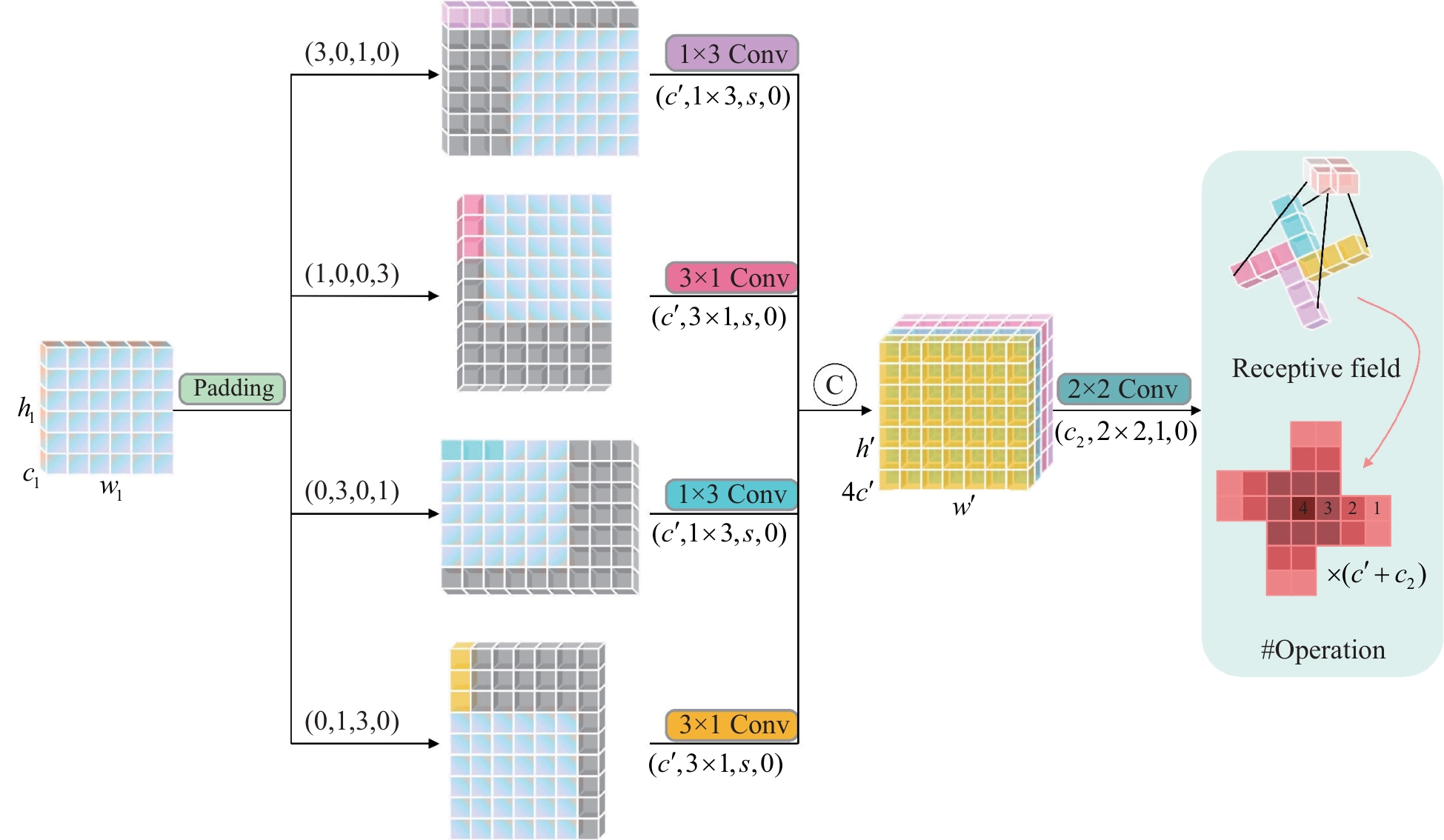
Fig. 6
Class distribution of CODA2022
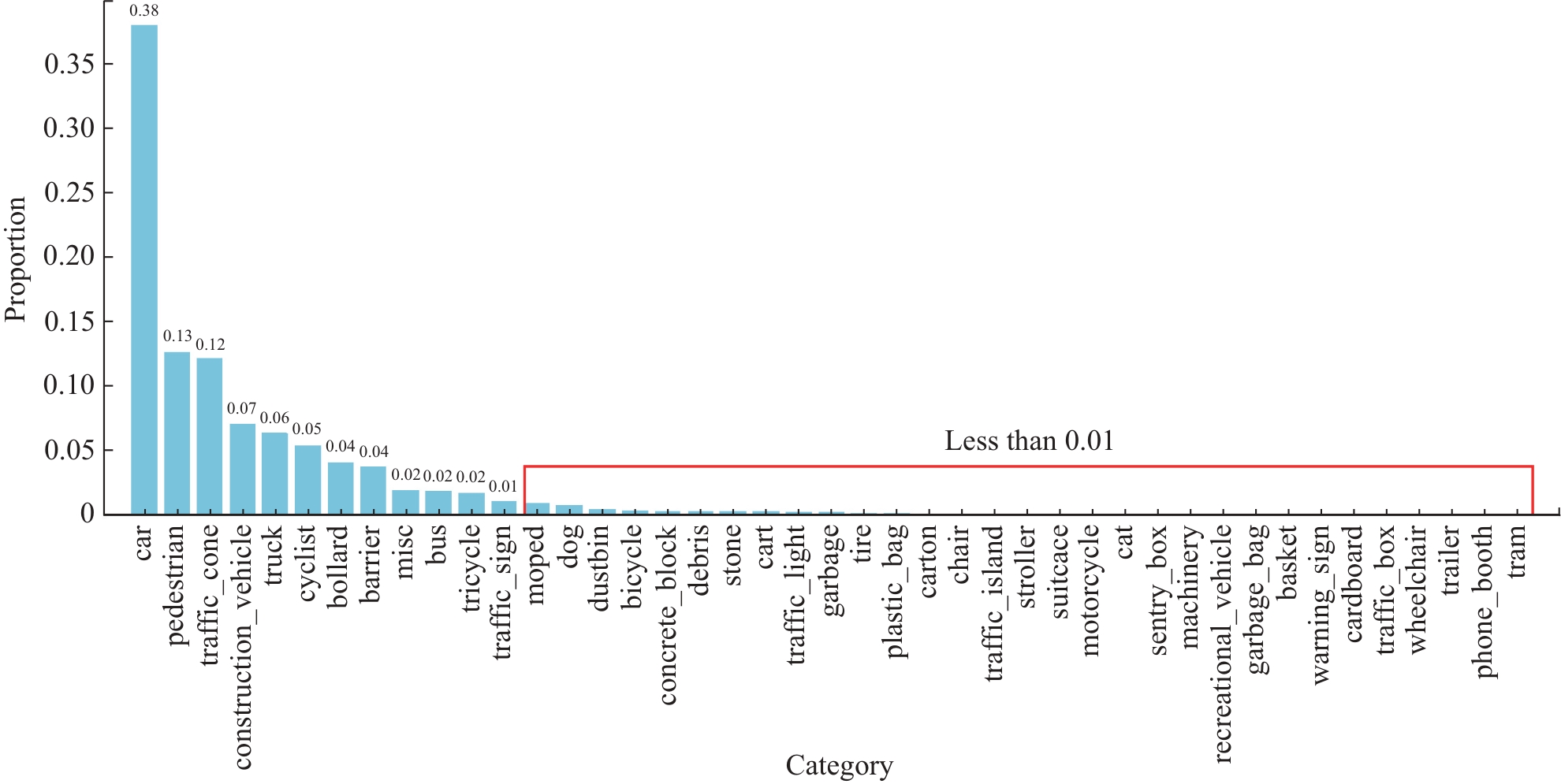

Table 1
Comparison of ablation test results for
| 实验 | CSP-EDA | SDCI | PSConv | AP50/% | AP75/% | AR50/% | AR75/% | FLOPs | Parameters |
|---|---|---|---|---|---|---|---|---|---|
| 1 | 44.0 | 34.8 | 53.2 | 42.5 | 57.1×10⁹ | 19.92×10⁶ | |||
| 2 | √ | 45.6 | 35.2 | 57.1 | 42.9 | 43.1×10⁹ | 12.87×10⁶ | ||
| 3 | √ | 44.3 | 35.7 | 54.6 | 43.6 | 58.5×10⁹ | 22.30×10⁶ | ||
| 4 | √ | 44.4 | 34.9 | 54.6 | 43.8 | 56.6×10⁹ | 19.46×10⁶ | ||
| 5 | √ | √ | 46.9 | 36.1 | 58.4 | 45.5 | 44.5×10⁹ | 15.25×10⁶ | |
| 6 | √ | √ | 46.3 | 36.2 | 57.3 | 44.3 | 42.6×10⁹ | 12.41×10⁶ | |
| 7 | √ | √ | 45.4 | 35.6 | 56.7 | 43.7 | 58.0×10⁹ | 21.84×10⁶ | |
| 8 | √ | √ | √ | 48.9 | 38.6 | 58.6 | 46.6 | 44.0×10⁹ | 14.79×10⁶ |
Table 2
Comparison of experimental findings for various backbone networks
| Model | AP50/% | AP75/% | AR50/% | AR75/% | FLOPs | Parameters |
|---|---|---|---|---|---|---|
| RT-DETR | 44.0 | 34.8 | 53.2 | 42.5 | 57.1×10⁹ | 19.92×10⁶ |
| +Mambaout | 41.8 | 32.5 | 51.9 | 40.3 | 42.2×10⁹ | 16.00×10⁶ |
| +Starnet | 37.8 | 28.4 | 50.1 | 36.5 | 40.3×10⁹ | 15.84×10⁶ |
| +Lsknet | 42.1 | 33.1 | 53.9 | 41.7 | 59.6×10⁹ | 20.47×10⁶ |
| +Mobilenetv4 | 40.5 | 31.4 | 51.0 | 38.4 | 39.7×10⁹ | 11.36×10⁶ |
| +Repvit | 42.5 | 32.6 | 54.5 | 41.5 | 60.5×10⁹ | 22.26×10⁶ |
| +Convnextv2 | 38.5 | 29.3 | 48.9 | 36.0 | 63.5×10⁹ | 24.41×10⁶ |
| +Efficientvit | 42.2 | 32.6 | 53.0 | 40.1 | 52.8×10⁹ | 20.81×10⁶ |
| +CSP-EDA (ours) | 45.6 | 35.2 | 57.1 | 42.9 | 43.1×10⁹ | 12.87×10⁶ |
Table 3
Comparison of experimental findings for various feature interaction modules
| Model | AP50/% | AP75/% | AR50/% | AR75/% | FLOPs | Parameters |
|---|---|---|---|---|---|---|
| RT-DETR+CSP-EDA | 45.6 | 35.2 | 57.1 | 42.9 | 43.1×10⁹ | 12.87×10⁶ |
| +EDFFN | 42.2 | 33.1 | 53.5 | 41.4 | 43.0×10⁹ | 12.76×10⁶ |
| +SEFFN | 44.0 | 35.3 | 52.6 | 42.0 | 43.0×10⁹ | 12.75×10⁶ |
| +SEFN | 45.4 | 34.8 | 55.0 | 42.4 | 43.6×10⁹ | 14.33×10⁶ |
| +DyT | 43.9 | 34.2 | 54.6 | 42.3 | 43.1×10⁹ | 12.87×10⁶ |
| +ASSA | 45.1 | 35.1 | 55.0 | 43.9 | 44.0×10⁹ | 13.71×10⁶ |
| +Mona | 46.3 | 36.5 | 57.7 | 45.0 | 43.2×10⁹ | 12.96×10⁶ |
| +SDCI (ours) | 46.9 | 36.1 | 58.5 | 45.6 | 44.5×10⁹ | 15.25×10⁶ |
Table 4
Comparison of experimental findings for various downsample modules
| Model | AP50/% | AP75/% | AR50/% | AR75/% | FLOPs | Parameters |
|---|---|---|---|---|---|---|
| RT-DETR+CSP-EDA+SDCI | 46.9 | 36.1 | 58.5 | 45.6 | 44.5×10⁹ | 15.25×10⁶ |
| +Wconv | 44.6 | 35.7 | 55.6 | 43.5 | 42.1×10⁹ | 15.25×10⁶ |
| +FourierConv | 43.6 | 32.8 | 56.2 | 41.0 | 44.5×10⁹ | 17.36×10⁶ |
| +GSConvE | 44.8 | 34.0 | 56.1 | 43.1 | 43.9×10⁹ | 14.96×10⁶ |
| +SRFD | 44.9 | 35.3 | 55.1 | 43.5 | 44.0×10⁹ | 15.00×10⁶ |
| +HWD | 42.7 | 33.1 | 53.3 | 40.2 | 43.2×10⁹ | 14.60×10⁶ |
| +PSConv (ours) | 48.9 | 38.6 | 58.6 | 46.6 | 44.0×10⁹ | 14.79×10⁶ |
Table 5
Experimental results of comparison with other object detection algorithms
| Model | AP50/% | AP75/% | AR50/% | AR75/% | FLOPs | Parameters |
|---|---|---|---|---|---|---|
| RT-DETR | 44.0 | 34.8 | 53.2 | 42.5 | 57.1×10⁹ | 19.92×10⁶ |
| RTMDet[ | 29.0 | 21.4 | 53.7 | 34.5 | 39.1×10⁹ | 24.68×10⁶ |
| SSD[ | 27.5 | 16.3 | 38.5 | 20.3 | 32.5×10⁹ | 29.36×10⁶ |
| ATSS[ | 31.0 | 23.0 | 58.0 | 38.9 | 110.0×10⁹ | 38.91×10⁶ |
| Gold-YOLO[ | 35.5 | 25.4 | 58.3 | 42.7 | 87.3×10⁹ | 41.30×10⁶ |
| YOLOv8m | 40.9 | 30.6 | 62.6 | 44.5 | 78.8×10⁹ | 25.86×10⁶ |
| YOLOv9m[ | 41.9 | 30.9 | 63.4 | 41.3 | 76.7×10⁹ | 20.04×10⁶ |
| YOLOv10m[ | 38.4 | 29.0 | 59.9 | 44.2 | 59.0×10⁹ | 15.33×10⁶ |
| YOLO11m | 40.9 | 30.9 | 61.0 | 45.3 | 67.8×10⁹ | 20.06×10⁶ |
| YOLO12m[ | 41.1 | 31.4 | 58.5 | 40.9 | 67.3×10⁹ | 20.10×10⁶ |
| TF-DETR (ours) | 48.9 | 38.6 | 58.6 | 46.6 | 44.0×10⁹ | 14.79×10⁶ |
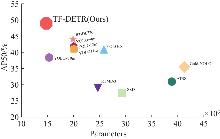
Fig. 7
Comparison of Parameters and AP50
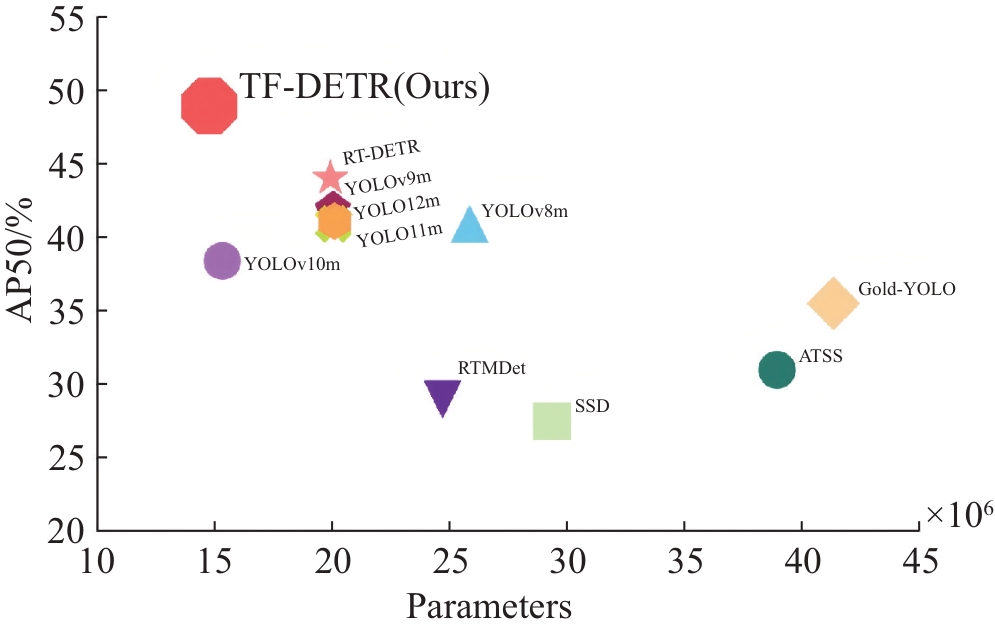
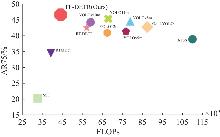
Fig. 8
Comparison of FLOPs and AR75
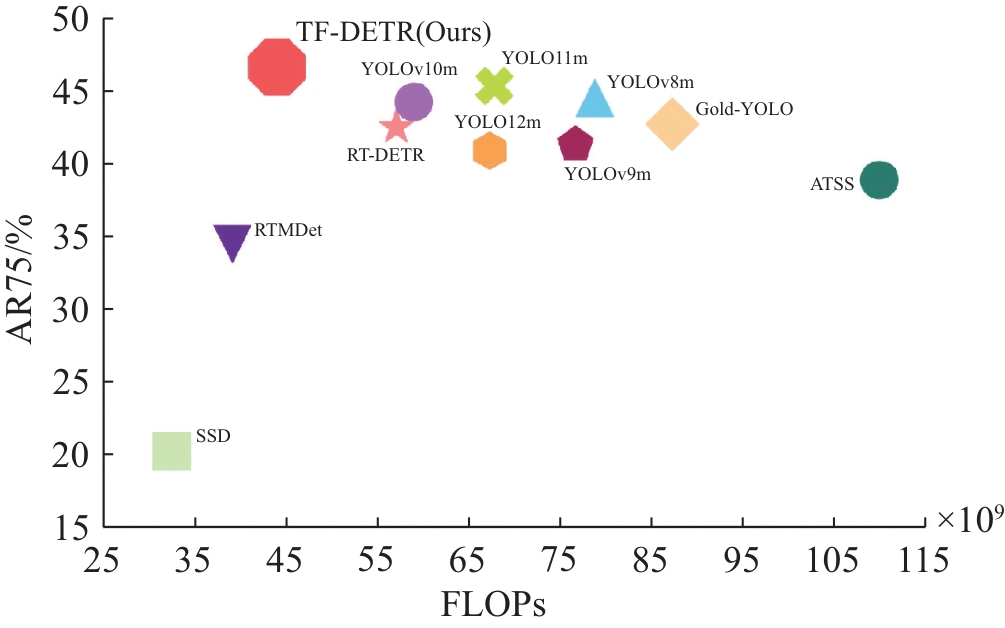
Fig. 9
Performance analysis of comparative experiments with normalization
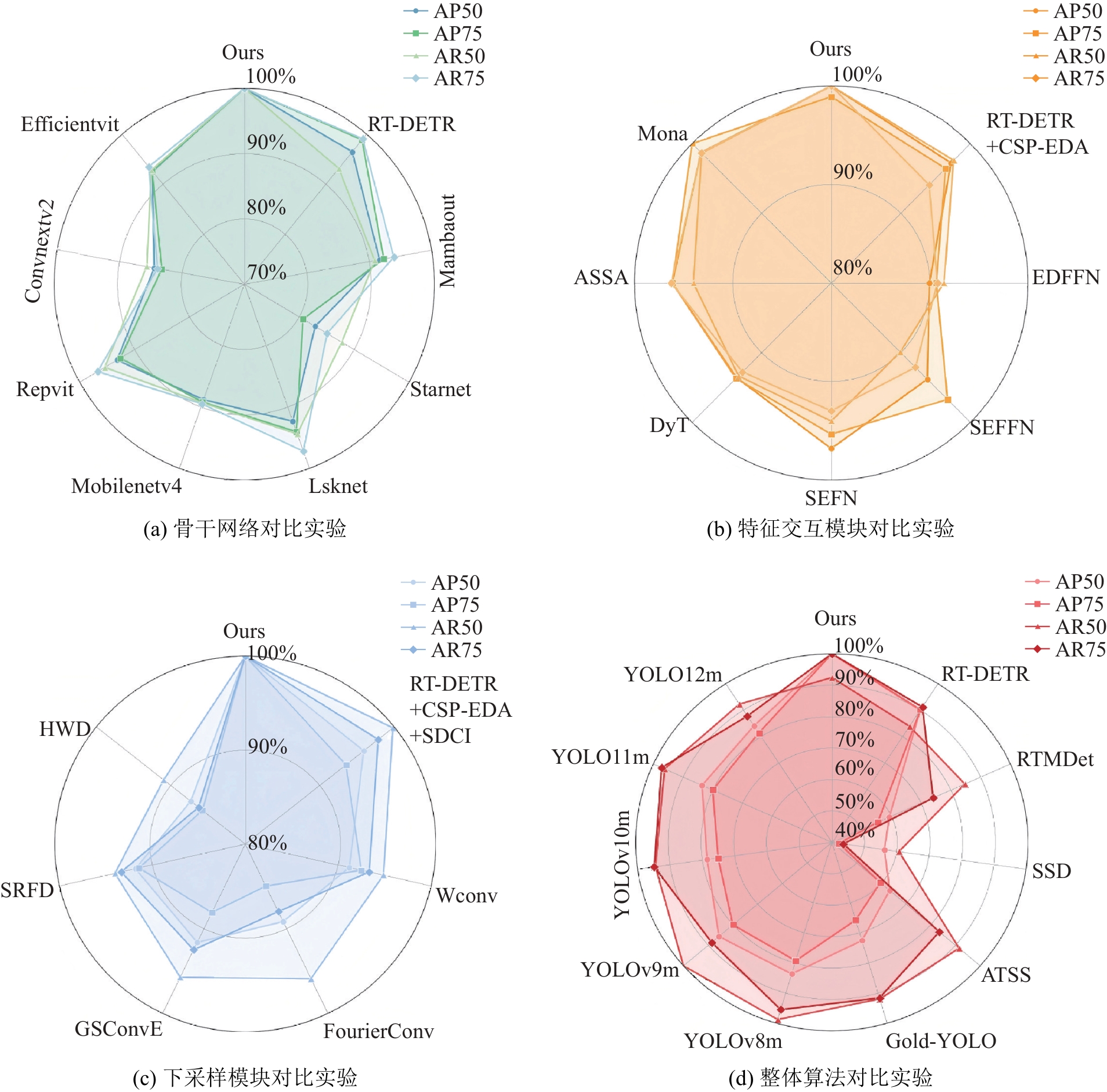
Fig. 10
Detection results in different scenarios
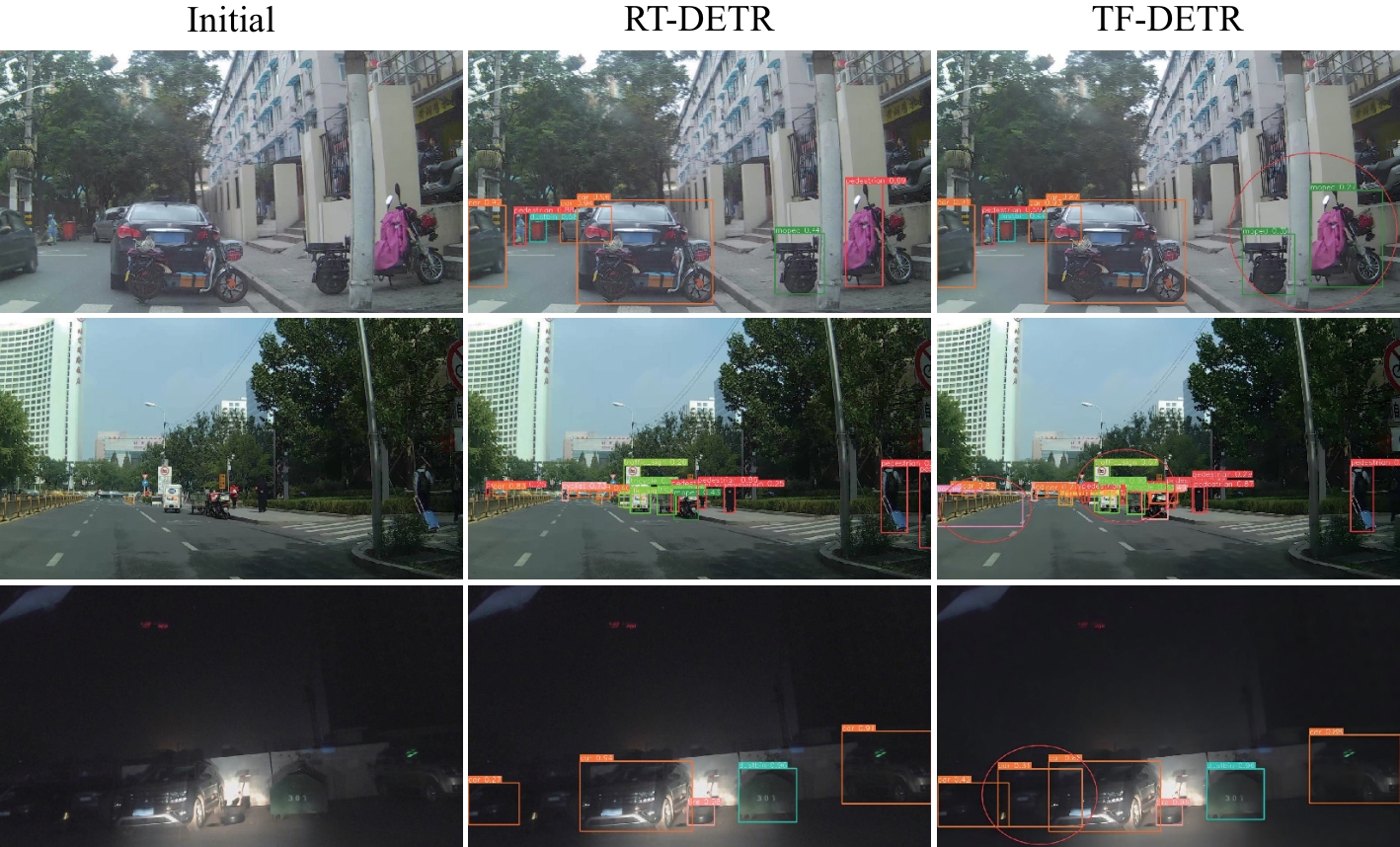
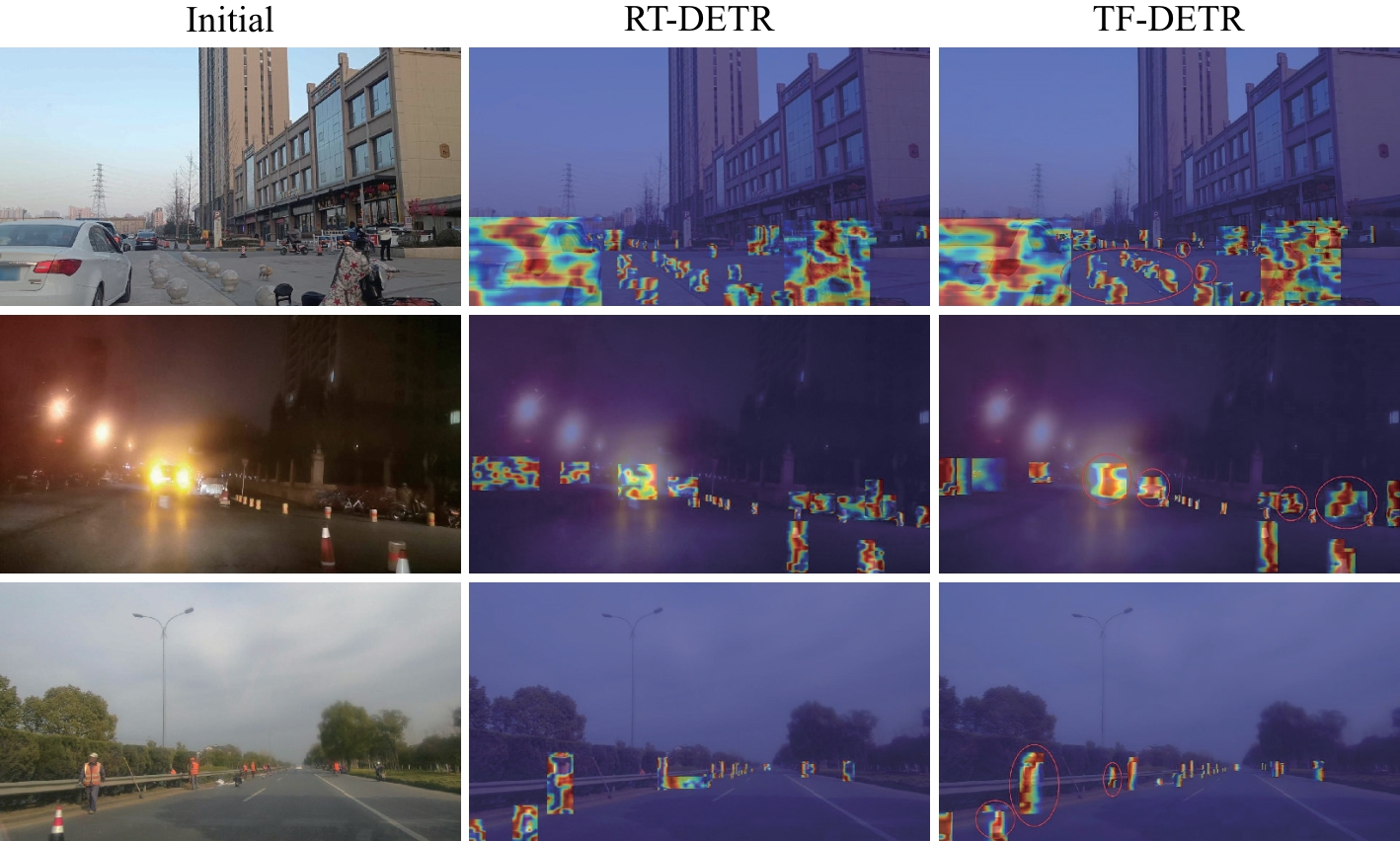
Fig. 11
Heatmap comparison in different models
| [1] | Breitenstein Jasmin, Termöhlen Jan-Aike, Lipinski Daniel, et al. Systematization of Corner Cases for Visual Perception in Automated Driving[C]//2020 IEEE Intelligent Vehicles Symposium (IV). Piscataway: IEEE, 2020: 1257-1264. |
| [2] | Girshick R, Donahue J, Darrell T, et al. Rich Feature Hierarchies for Accurate Object Detection and Semantic Segmentation[C]//2014 IEEE Conference on Computer Vision and Pattern Recognition. Piscataway: IEEE, 2014: 580-587. |
| [3] | Liu Wei, Anguelov D, Erhan D, et al. SSD: Single Shot MultiBox Detector[C]//Computer Vision — ECCV 2016. Cham: Springer International Publishing, 2016: 21-37. |
| [4] | Redmon J, Divvala S, Girshick R, et al. You Only Look Once: Unified, Real-time Object Detection[C]//2016 IEEE Conference on Computer Vision and Pattern Recognition (CVPR). Piscataway: IEEE, 2016: 779-788. |
| [5] | Carion N, Massa F, Synnaeve G, et al. End-to-end Object Detection with Transformers[C]//Computer Vision — ECCV 2020. Cham: Springer International Publishing, 2020: 213-229. |
| [6] | Zhao Yian, Wenyu Lü, Xu Shangliang, et al. DETRs Beat YOLOs on Real-time Object Detection[C]//2024 IEEE/CVF Conference on Computer Vision and Pattern Recognition (CVPR). Piscataway: IEEE, 2024: 16965-16974. |
| [7] | Gao Erfeng, Huang Weiguo, Shi Juanjuan, et al. Long-tailed Traffic Sign Detection Using Attentive Fusion and Hierarchical Group Softmax[J]. IEEE Transactions on Intelligent Transportation Systems, 2022, 23(12): 24105-24115. |
| [8] | 邓召学, 刘灿, 郝丙森, 等. 面向长尾分布和特征缺失的交通标志目标检测算法[J]. 吉林大学学报(工学版), 2026, 56(6): 1642-1654. |
| Deng Zhaoxue, Liu Can, Hao Bingsen, et al. Object Detection Algorithm for Traffic Signs in Long-tail Distribution and Feature Incompleteness[J]. Journal of Jilin University(Engineering and Technology Edition), 2026, 56(6): 1642-1654. | |
| [9] | 伍云鹏, 付应雄, 沈丽君, 等. 基于YOLOX-tiny的长尾分布交通标志识别模型[J]. 系统仿真学报, 2024, 36(11): 2503-2516. |
| Wu Yunpeng, Fu Yingxiong, Shen Lijun, et al. Traffic Sign Recognition Model with Long-tail Distribution Based on YOLOX-tiny[J]. Journal of System Simulation, 2024, 36(11): 2503-2516. | |
| [10] | Xiong Zhongxia, Song Tao, He Shan, et al. A Unified and Costless Approach for Improving Small and Long-tail Object Detection in Aerial Images of Traffic Scenarios[J]. Applied Intelligence, 2023, 53(11): 14426-14447. |
| [11] | Zhang Hancheng, Hu Yuanyuan, Qian Zhendong, et al. Enhancing Rare Object Detection on Roadways Through Conditional Diffusion Models for Data Augmentation[J]. IEEE Transactions on Intelligent Transportation Systems, 2024, 25(11): 19018-19029. |
| [12] | Zhang Houwang, Leanne Lai Hang Chan. Overcoming the Challenges of Long-tail Distribution in Nighttime Vehicle Detection[J]. IEEE Intelligent Systems, 2024, 39(2): 51-60. |
| [13] | Wang Chien-Yao, Liao Hongyuan, Wu Yueh-Hua, et al. CSPNet: A New Backbone that Can Enhance Learning Capability of CNN[C]//2020 IEEE/CVF Conference on Computer Vision and Pattern Recognition Workshops (CVPRW). Piscataway: IEEE, 2020: 1571-1580. |
| [14] | Noman Mubashir, Fiaz Mustansar, Cholakkal Hisham, et al. ELGC-net: Efficient Local-global Context Aggregation for Remote Sensing Change Detection[J]. IEEE Transactions on Geoscience and Remote Sensing, 2024, 62: 1-11. |
| [15] | Shi Dai. TransNeXt: Robust Foveal Visual Perception for Vision Transformers[C]//2024 IEEE/CVF Conference on Computer Vision and Pattern Recognition (CVPR). Piscataway: IEEE, 2024: 17773-17783. |
| [16] | Zhou Shihao, Chen Duosheng, Pan Jinshan, et al. Adapt or Perish: Adaptive Sparse Transformer with Attentive Feature Refinement for Image Restoration[C]//2024 IEEE/CVF Conference on Computer Vision and Pattern Recognition (CVPR). Piscataway: IEEE, 2024: 2952-2963. |
| [17] | Zhu Jiachen, Chen Xinlei, He Kaiming, et al. Transformers Without Normalization[C]//2025 IEEE/CVF Conference on Computer Vision and Pattern Recognition (CVPR). Piscataway: IEEE, 2025: 14901-14911. |
| [18] | Yin Dongshuo, Hu Leiyi, Li Bin, et al. 5%>100%: Breaking Performance Shackles of Full Fine-tuning on Visual Recognition Tasks[C]//2025 IEEE/CVF Conference on Computer Vision and Pattern Recognition (CVPR). Piscataway: IEEE, 2025: 20071-20081. |
| [19] | Chen Shuang, Zhang Haozheng, Atapour-Abarghouei A, et al. SEM-net: Efficient Pixel Modelling for Image Inpainting with Spatially Enhanced SSM[C]//2025 IEEE/CVF Winter Conference on Applications of Computer Vision (WACV). Piscataway: IEEE, 2025: 461-471. |
| [20] | Yang Jiangnan, Liu Shuangli, Wu Jingjun, et al. Pinwheel-shaped Convolution and Scale-based Dynamic Loss for Infrared Small Target Detection[C]//Proceedings of the Thirty-Ninth AAAI Conference on Artificial Intelligence and Thirty-Seventh Conference on Innovative Applications of Artificial Intelligence and Fifteenth Symposium on Educational Advances in Artificial Intelligence. Palo Alto: AAAI Press, 2025: 9202-9210. |
| [21] | Li Kaican, Chen Kai, Wang Haoyu, et al. CODA: A Real-world Road Corner Case Dataset for Object Detection in Autonomous Driving[C]//Computer Vision — ECCV 2022. Cham: Springer Nature Switzerland, 2022: 406-423. |
| [22] | Chengqi Lü, Zhang Wenwei, Huang Haian, et al. RTMDet: An Empirical Study of Designing Real-time Object Detectors[EB/OL]. (2022-12-16) [2026-02-25]. . |
| [23] | Zhang Shifeng, Chi Cheng, Yao Yongqiang, et al. Bridging the Gap Between Anchor-based and Anchor-free Detection via Adaptive Training Sample Selection[C]//2020 IEEE/CVF Conference on Computer Vision and Pattern Recognition (CVPR). Piscataway: IEEE, 2020: 9756-9765. |
| [24] | Wang Chengcheng, He Wei, Nie Ying, et al. Gold-YOLO: Efficient Object Detector via Gather-and-distribute Mechanism[C]//Proceedings of the 37th International Conference on Neural Information Processing Systems. Red Hook: Curran Associates Inc., 2023: 51094-51112. |
| [25] | Wang Chien-Yao, Yeh I-Hau, Liao Hongyuan. YOLOv9: Learning What You Want to Learn Using Programmable Gradient Information[C]//Computer Vision — ECCV 2024. Cham: Springer Nature Switzerland, 2025: 1-21. |
| [26] | Wang Ao, Chen Hui, Liu Lihao, et al. YOLOv10: Real-time End-to-end Object Detection[C]//Proceedings of the 38th International Conference on Neural Information Processing Systems. Red Hook: Curran Associates Inc., 2024: 107984-108011. |
| [27] | Tian Yunjie, Ye Qixiang, Doermann D. YOLOv12: Attention-centric Real-time Object Detectors[EB/OL]. (2025-02-18) [2026-02-25]. . |
| [1] | Wang Huaijun, Yu Zonghua, Xu Chenxin, Li Junhuai, Li Chenzhi, Yin Junjie. Hybrid Attention for Low-overlap Point Cloud Registration [J]. Journal of System Simulation, 2026, 38(9): 2502-2517. |
| [2] | Jiang Yanji, Cui Jiayu, Dong Hao, Liu Daqian, Fei Bowen, Yu Miao, Huang Jinshan. Object Detection Networks and Their Interpretability in Rain, Fog, and Snow Scenarios [J]. Journal of System Simulation, 2026, 38(6): 1628-1646. |
| [3] | Wang Jun, Liu Min, Zhang Xiaochuan, Ding Yishan, Feng Juhui, Zhuang Ye. Modelling Method of Unmanned Vehicle Dynamics Based on Neural Network [J]. Journal of System Simulation, 2026, 38(4): 932-947. |
| [4] | Feng Xuejian, Ding Han, Tong Yiqi, Huo Chaoying, Zhang Yanjin. Simulation and Multi-perspective Recognition Algorithm for Typical Trajectory Shapes [J]. Journal of System Simulation, 2026, 38(3): 725-735. |
| [5] | Liu Peijin, Zhang Minxin, He Lin, Sun Yige, Su Tingqi. Research on Visual Place Recognition Algorithms for Complex Urban Environments [J]. Journal of System Simulation, 2026, 38(3): 818-828. |
| [6] | Zou Jing, Tan Xu, Mao Junji, Gao Haidong, Tan Jianrong. Defect Detection Method Based on Hierarchical Microscopic Feature Modeling and Simulation [J]. Journal of System Simulation, 2026, 38(1): 1-13. |
| [7] | Zou Changjun, Ge Zhiyu, Zhong Chenxi. Spatio-temporal Swin Transformer-based Flow-solid Coupling Interaction Sequence Image Prediction Network [J]. Journal of System Simulation, 2026, 38(1): 112-124. |
| [8] | Zhu He, Zhou Feng, Zhang Qi, Zhu Mengxiao, Dai Ju. PL-Mamba: A 3D Point Cloud Semantic Segmentation Network Based on Bimodal Fusion [J]. Journal of System Simulation, 2026, 38(1): 73-83. |
| [9] | Li Mingyu, Lin Jiaquan. Lightweight Driver Face Object Detection Algorithm Based on YOLOv8-DF [J]. Journal of System Simulation, 2025, 37(8): 2103-2114. |
| [10] | Wang Bingheng, Liu Tingrui, Yang Fan, Zhang Huan, Li Wei, Ma Ping, Yang Ming. Research on Requirements and Methods for Intelligent Assessment of Simulation Credibility [J]. Journal of System Simulation, 2025, 37(7): 1710-1722. |
| [11] | Chen Kun, Chen Liang, Xie Jiming, Liu Fengbo, Chen Taixiong, Wei Lukuan. Simulation Study on Adaptive Signal Control of Deformed Intersection Based on LSTM-GNN [J]. Journal of System Simulation, 2025, 37(6): 1343-1351. |
| [12] | Yang Lu, Pei Junying. Aerial Target Detection Algorithm Fused with Multi-scale Features [J]. Journal of System Simulation, 2025, 37(6): 1486-1498. |
| [13] | Li Jie, Liu Yang, Li Liang, Su Bengan, Wei Jialong, Zhou Guangda, Shi Yanmin, Zhao Zhen. Remote Sensing Small Object Detection Based on Cross-stage Two-branch Feature Aggregation [J]. Journal of System Simulation, 2025, 37(4): 1025-1040. |
| [14] | Jiang Limei, Chen Xinwei. Visual SLAM Algorithm Based on Feature Point Selection in Dynamic Scenes [J]. Journal of System Simulation, 2025, 37(3): 753-762. |
| [15] | Jiang Dawei, Dong Yangyang, Zhang Lidong, Lu Xiao, Dong Chunxi. Research on Air Target Threat Assessment Technology Based on Deep Learning [J]. Journal of System Simulation, 2025, 37(3): 791-802. |
| Viewed | ||||||
|
Full text |
|
|||||
|
Abstract |
|
|||||
 http://www.china-simulation.com

