

Journal of System Simulation ›› 2026, Vol. 38 ›› Issue (1): 136-157.doi: 10.16182/j.issn1004731x.joss.25-0832
• Papers • Previous Articles Next Articles
Jiang Binze1, Song Wenfeng1, Hou Xia1, Li Shuai2,3
Received:2025-09-02
Revised:2025-10-11
Online:2026-01-18
Published:2026-01-28
Contact:
Song Wenfeng
CLC Number:
Jiang Binze, Song Wenfeng, Hou Xia, Li Shuai. Diffusion Model for Human Motion Generation with Fine-grained Text and Spatial Control Signals[J]. Journal of System Simulation, 2026, 38(1): 136-157.
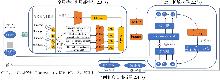
Fig. 1
Diffusion model based on fine-grained text and spatial control signals
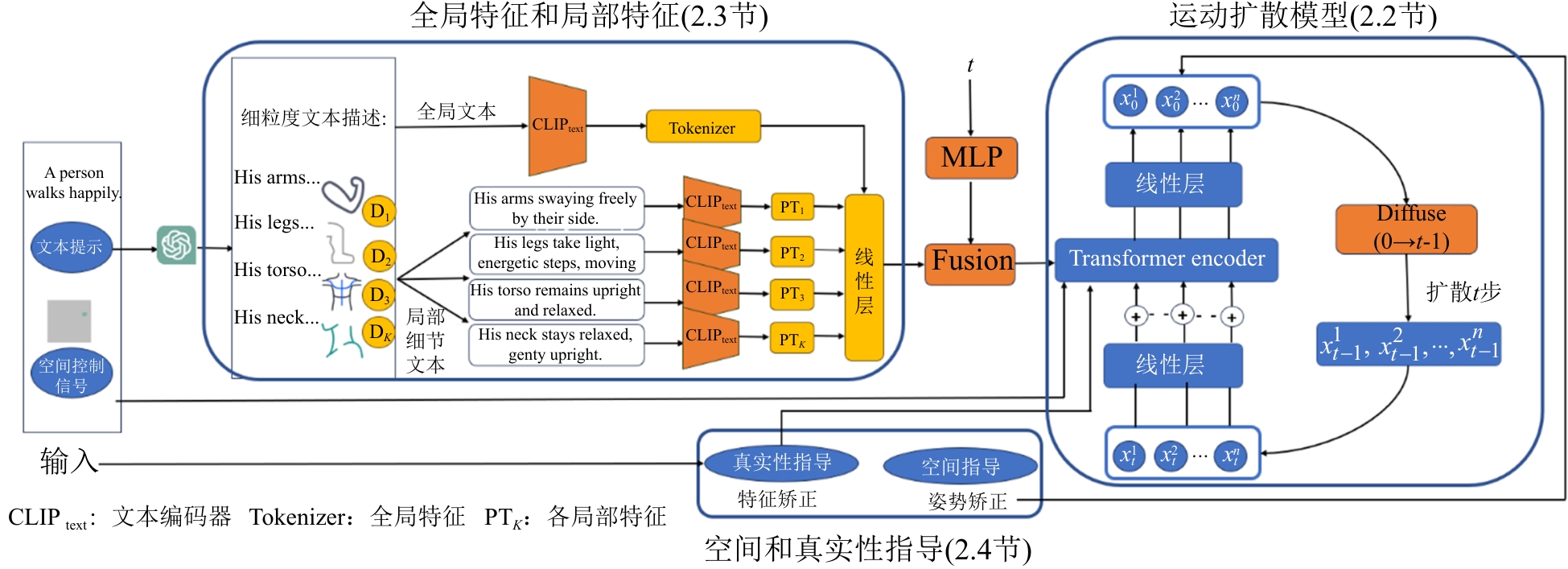
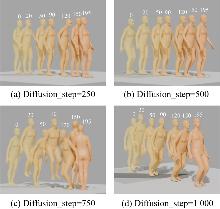
Fig. 2
Keyframe visualization of the influence of diffusion steps on action quality
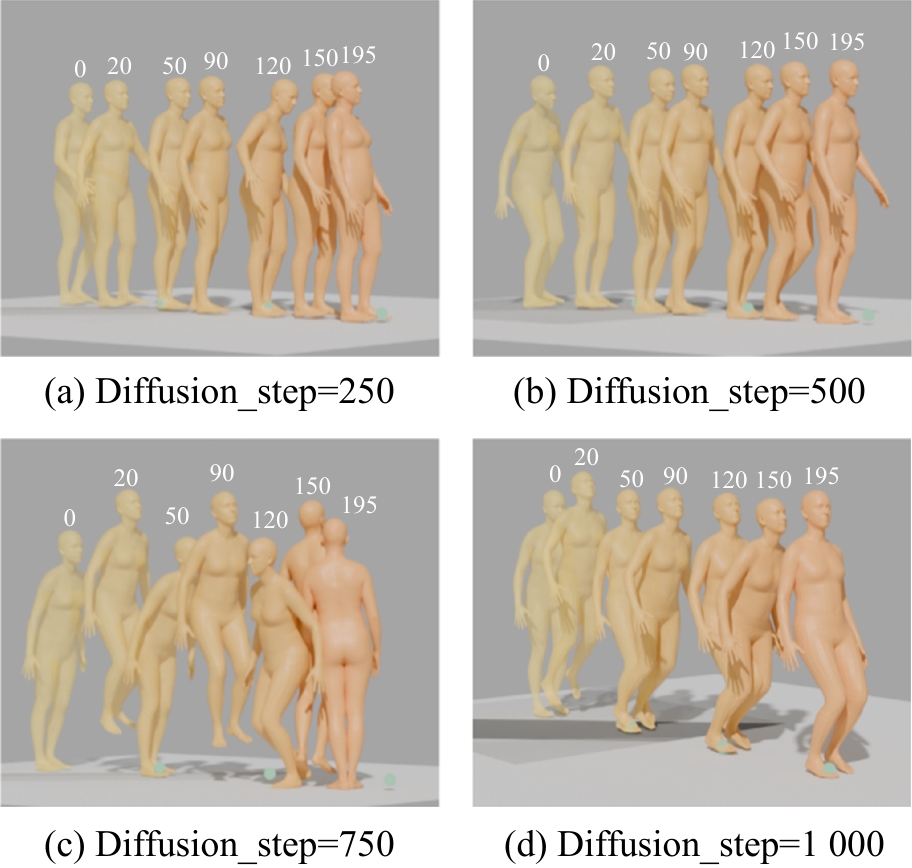
Fig. 3
Spatial guidance structure diagram
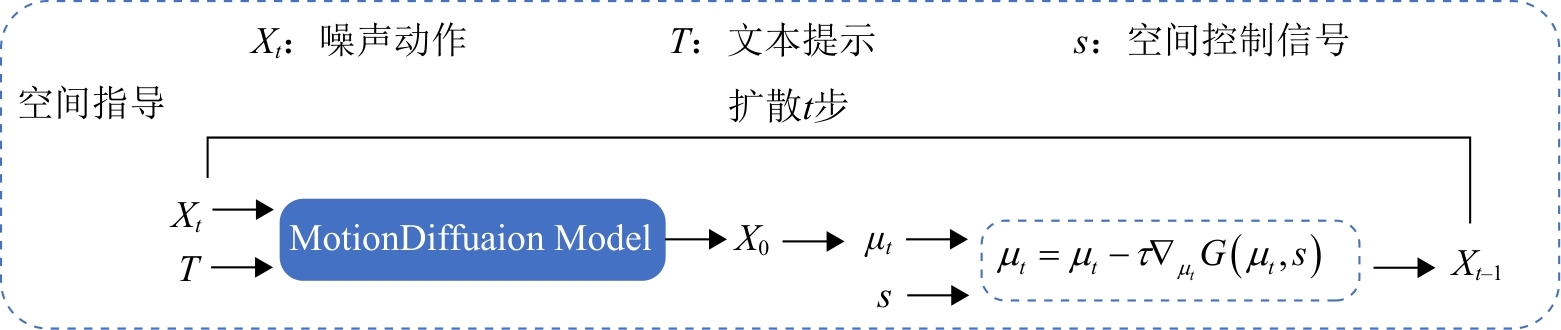
Fig. 4
realism guidance structure diagram
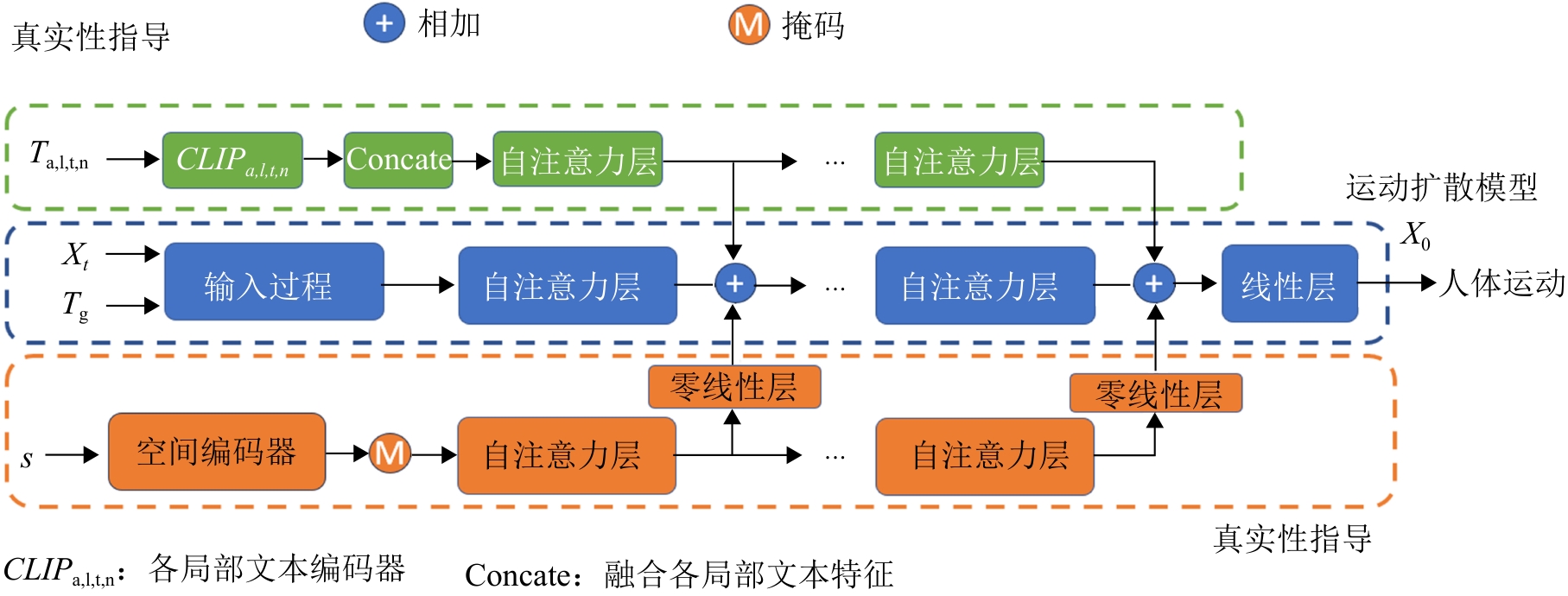
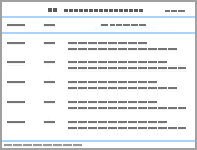
Table 1
Experimental environment
| 环境 | 参数 |
|---|---|
| 操作系统 | Ubuntu20.04 |
| 深度学习框架 | Pytorch 1.18 |
| CUDA版本 | CUDA 11.7 |
| 开发软件 | VS Code |
| 显卡 | 单张3090 |
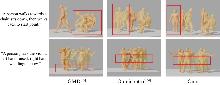
Fig. 5
Visual Experiment comparison (control pelvis)
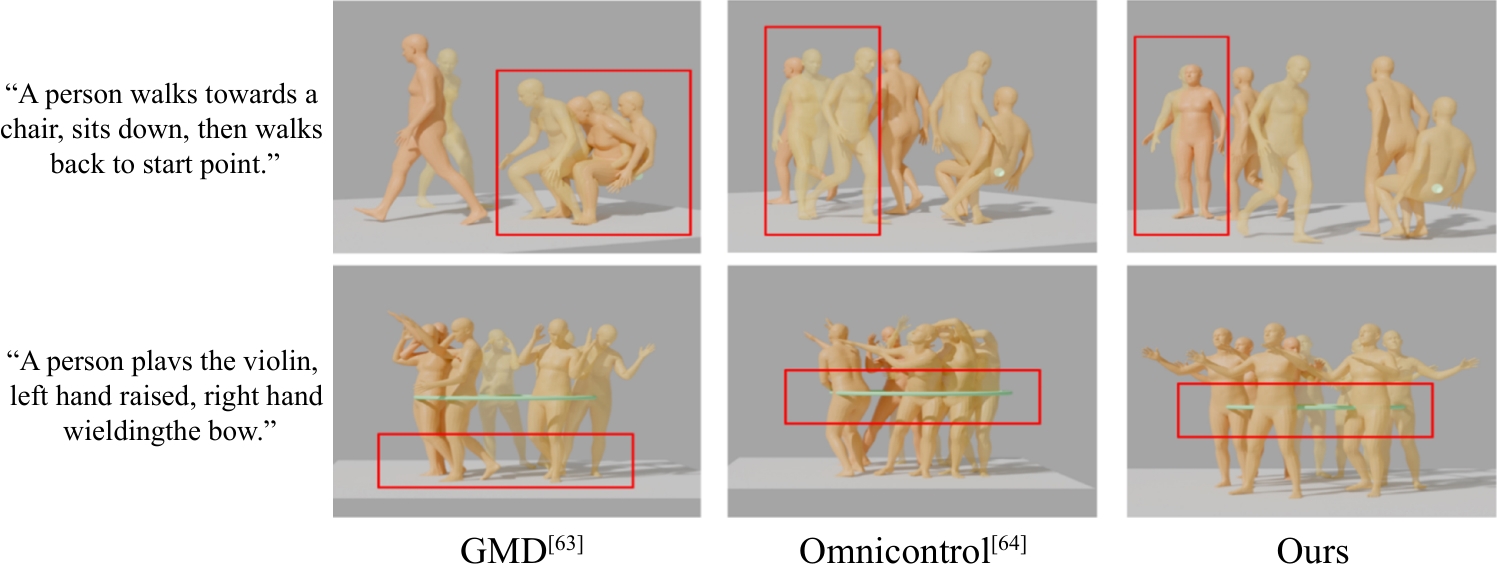
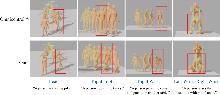
Fig. 6
Visual experiment comparison (control other body parts)
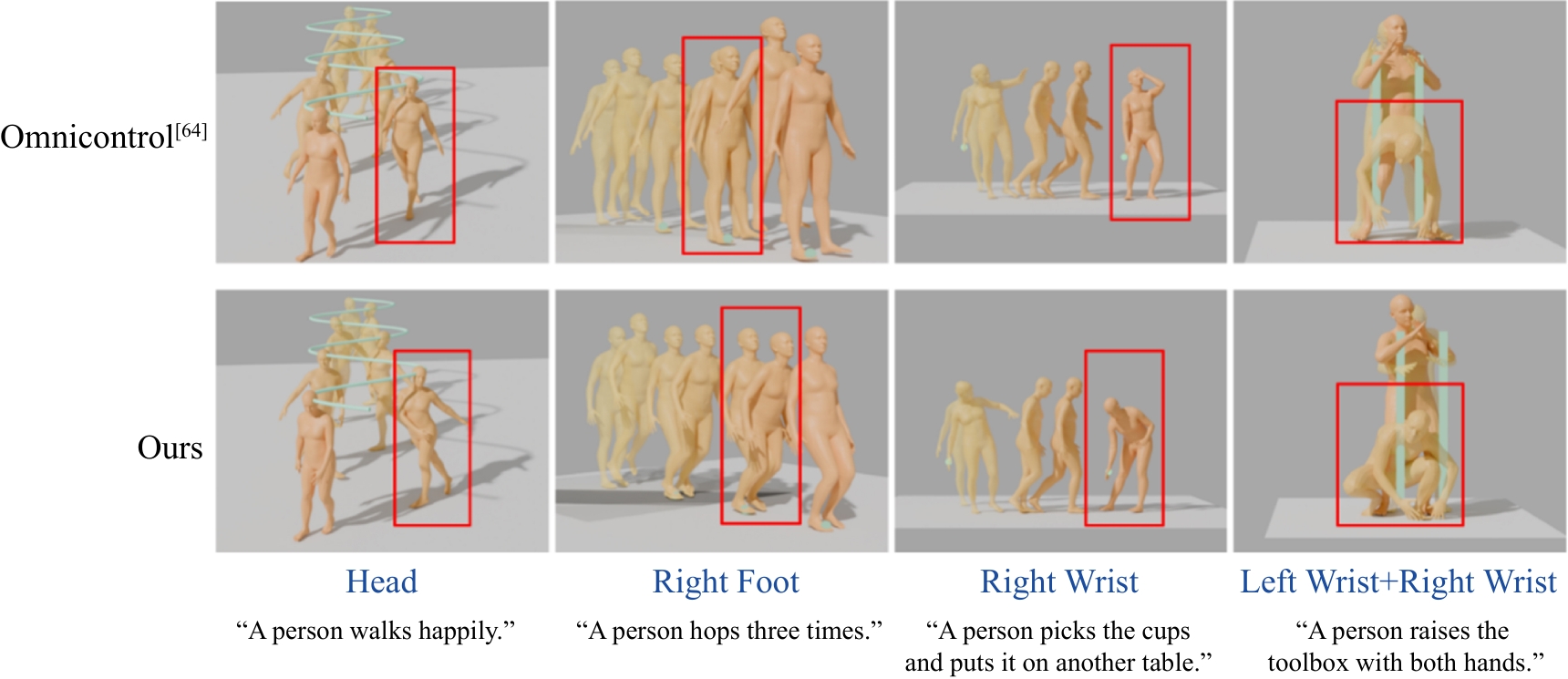
Table 2
Comparison of quantitative experimental results (control pelvis)
| Method | R-precision↑ | FID↓ | Diversity(9.503)→ | Foot skating ratio↓ | Traj. err. (50 cm)↓ | Loc. err. (50 cm)↓ | Avg. err. ↓ |
|---|---|---|---|---|---|---|---|
| real | 0.797 | 0.002 | 9.503 | — | 0 | 0 | 0 |
| MDM | 0.602 | 0.698 | 9.197 | 0.101 9 | 0.402 2 | 0.307 6 | 0.595 9 |
| PriorMDM | 0.583 | 0.475 | 9.156 | 0.089 7 | 0.345 7 | 0.213 2 | 0.441 7 |
| GMD | 0.665 | 0.576 | 9.206 | 0.100 9 | 0.093 1 | 0.032 1 | 0.143 9 |
| OmniControl | 0.687 | 0.218 | 9.422 | 0.054 7 | 0.038 7 | 0.009 6 | 0.033 8 |
| Ours | 0.708 | 0.173 | 9.806 | 0.047 1 | 0.030 6 | 0.007 9 | 0.028 4 |
Table 3
Comparison results of quantitative experiments (control other body parts)
| Method | Joint | R-precision↑ | FID↓ | Diversity(9.503)→ | Foot skating ratio↓ | Traj. err.(50 cm)↓ | Loc. err. (50 cm)↓ | Avg. err. ↓ |
|---|---|---|---|---|---|---|---|---|
| OmniControl | Pelvis | 0.691 | 0.322 | 9.545 | 0.057 1 | 0.040 4 | 0.008 5 | 0.036 7 |
| Ours | 0.708 | 0.197 | 9.803 | 0.042 3 | 0.035 5 | 0.007 3 | 0.032 7 | |
| OmniControl | Left Foot | 0.696 | 0.280 | 9.553 | 0.069 2 | 0.059 4 | 0.009 4 | 0.031 4 |
| Ours | 0.702 | 0.189 | 9.758 | 0.041 2 | 0.060 8 | 0.007 5 | 0.030 8 | |
| OmniControl | Right Foot | 0.701 | 0.319 | 9.481 | 0.066 8 | 0.066 6 | 0.012 0 | 0.033 4 |
| Ours | 0.704 | 0.217 | 9.747 | 0.042 5 | 0.065 3 | 0.014 1 | 0.033 4 | |
| OmniControl | Head | 0.696 | 0.335 | 9.480 | 0.055 6 | 0.042 2 | 0.007 9 | 0.034 9 |
| Ours | 0.711 | 0.232 | 9.738 | 0.042 1 | 0.038 3 | 0.006 9 | 0.031 8 | |
| OmniControl | Left Wrist | 0.680 | 0.304 | 9.436 | 0.056 2 | 0.080 1 | 0.013 4 | 0.052 9 |
| Ours | 0.707 | 0.199 | 9.569 | 0.039 4 | 0.061 3 | 0.008 5 | 0.040 6 | |
| OmniControl | Right Wrist | 0.692 | 0.299 | 9.519 | 0.060 1 | 0.081 3 | 0.012 7 | 0.051 9 |
| Ours | 0.706 | 0.220 | 9.705 | 0.043 4 | 0.065 2 | 0.012 3 | 0.042 1 | |
| OmniControl | Average | 0.693 | 0.310 | 9.502 | 0.060 8 | 0.061 7 | 0.010 7 | 0.040 4 |
| Ours | 0.706 | 0.209 | 9.720 | 0.041 7 | 0.041 0 | 0.009 4 | 0.035 2 |
Fig. 7
Ablation experiment
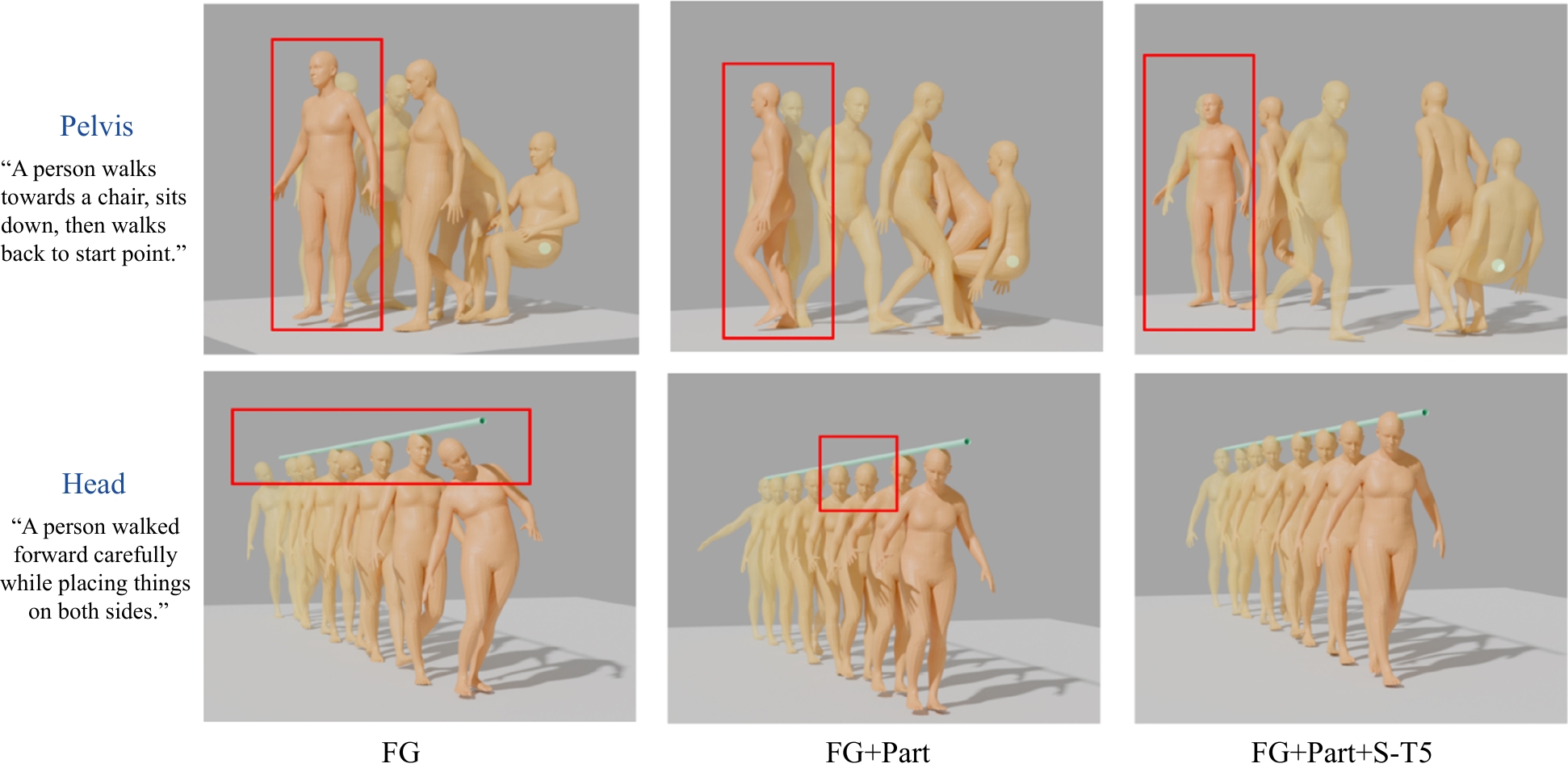
Table 4
Ablation experiment
| FG | Part | S-T5 | R-precision↑ | FID↓ | Diversity(9.503)→ | Foot skating ratio↓ | Traj. err. (50 cm)↓ | Loc. err. (50 cm)↓ | Avg. err. ↓ |
|---|---|---|---|---|---|---|---|---|---|
| 0.693 | 0.310 | 9.502 | 0.060 8 | 0.061 7 | 0.010 7 | 0.040 4 | |||
| √ | 0.691 | 0.279 | 9.504 | 0.059 2 | 0.058 9 | 0.010 9 | 0.040 2 | ||
| √ | √ | 0.698 | 0.240 | 9.681 | 0.045 1 | 0.042 1 | 0.010 2 | 0.035 8 | |
| √ | √ | √ | 0.706 | 0.209 | 9.720 | 0.041 7 | 0.041 0 | 0.009 4 | 0.035 2 |
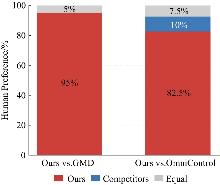
Fig. 8
User experiment results
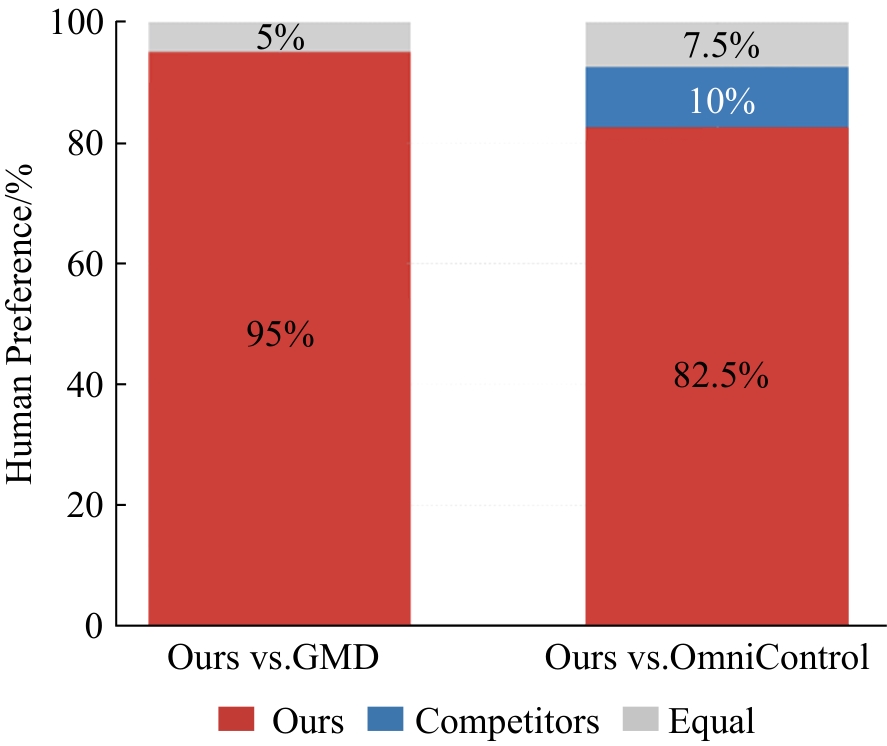
Fig. 9
Generalization assessment
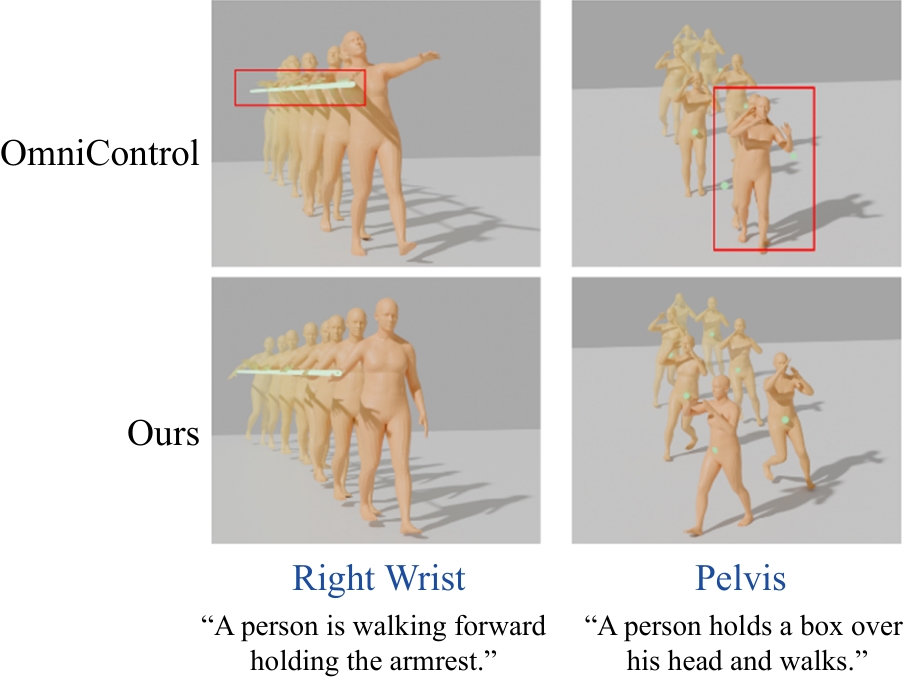
Table 5
Comparison of running times of different methods on RTX 3090
| 方法 | 平均运行时间/(s/帧) ↓ |
|---|---|
| MDM | 0.192 |
| GMD | 0.567 |
| OmniControl | 0.606 |
| Ours | 0.548 |
| [1] | Xu Liang, Song Ziyang, Wang Dongliang, et al. ActFormer: A GAN-based Transformer Towards General Action-conditioned 3D Human Motion Generation[C]//2023 IEEE/CVF International Conference on Computer Vision (ICCV). Piscataway: IEEE, 2023: 2228-2238. |
| [2] | Guo Chuan, Zou Shihao, Zuo Xinxin, et al. Generating Diverse and Natural 3D Human Motions from Text[C]//2022 IEEE/CVF Conference on Computer Vision and Pattern Recognition (CVPR). Piscataway: IEEE, 2022: 5142-5151. |
| [3] | Tevet G, Raab S, Gordon B, et al. Human Motion Diffusion Model[EB/OL]. (2022-10-03) [2025-08-12]. . |
| [4] | 赵宝全, 付一愉, 苏卓, 等. 多模态信息引导的三维数字人运动生成综述[J]. 中国图象图形学报, 2024, 29(9): 2541-2565. |
| Zhao Baoquan, Fu Yiyu, Su Zhuo, et al. A Survey on Multimodal Information-guided 3D Human Motion Generation[J]. Journal of Image and Graphics, 2024, 29(9): 2541-2565. | |
| [5] | Guo Chuan, Zuo Xinxin, Wang Sen, et al. Action2Motion: Conditioned Generation of 3D Human Motions[C]//Proceedings of the 28th ACM International Conference on Multimedia. New York: Association for Computing Machinery, 2020: 2021-2029. |
| [6] | Hoang N M, Gong Kehong, Guo Chuan, et al. MotionMix: Weakly-Supervised Diffusion for Controllable Motion Generation[C]//Proceedings of the Thirty-eighth AAAI Conference on Artificial Intelligence and Thirty-sixth Conference on Innovative Applications of Artificial Intelligence and Fourteenth Symposium on Educational Advances in Artificial Intelligence. Palo Alto: AAAI Press, 2024: 2157-2165. |
| [7] | Petrovich M, Black M J, Varol G. Action-conditioned 3D Human Motion Synthesis with Transformer VAE[C]//2021 IEEE/CVF International Conference on Computer Vision (ICCV). Piscataway: IEEE, 2021: 10965-10975. |
| [8] | Guo Chuan, Mu Yuxuan, Javed M G, et al. MoMask: Generative Masked Modeling of 3D Human Motions[C]//2024 IEEE/CVF Conference on Computer Vision and Pattern Recognition (CVPR). Piscataway: IEEE, 2024: 1900-1910. |
| [9] | Chen Xin, Jiang Biao, Liu Wen, et al. Executing Your Commands via Motion Diffusion in Latent Space[C]//2023 IEEE/CVF Conference on Computer Vision and Pattern Recognition (CVPR). Piscataway: IEEE, 2023: 18000-18010. |
| [10] | Bae J, Hwang I, Lee Y Y, et al. Less is More: Improving Motion Diffusion Models with Sparse Keyframes[EB/OL]. (2025-05-12) [2025-08-12]. . |
| [11] | Guo Chuan, Zuo Xinxin, Wang Sen, et al. TM2T: Stochastic and Tokenized Modeling for the Reciprocal Generation of 3D Human Motions and Texts[C]//Computer Vision – ECCV 2022. Cham: Springer Nature Switzerland, 2022: 580-597. |
| [12] | Guo Chuan, Hwang I, Wang Jian, et al. SnapMoGen: Human Motion Generation from Expressive Texts[EB/OL]. (2025-10-23) [2025-08-12]. . |
| [13] | Lin Junfan, Chang Jianlong, Liu Lingbo, et al. Being Comes from Not-Being: Open-vocabulary Text-to-motion Generation with Wordless Training[C]//2023 IEEE/CVF Conference on Computer Vision and Pattern Recognition (CVPR). Piscataway: IEEE, 2023: 23222-23231. |
| [14] | Petrovich M, Black M J, Varol G. TEMOS: Generating Diverse Human Motions from Textual Descriptions[C]//Computer Vision – ECCV 2022. Cham: Springer Nature Switzerland, 2022: 480-497. |
| [15] | Petrovich M, Litany O, Iqbal U, et al. Multi-Track Timeline Control for Text-driven 3D Human Motion Generation[EB/OL]. (2024-05-24) [2025-08-12]. . |
| [16] | Yuan Ye, Song Jiaming, Iqbal U, et al. PhysDiff: Physics-Guided Human Motion Diffusion Model[C]//2023 IEEE/CVF International Conference on Computer Vision (ICCV). Piscataway: IEEE, 2023: 15964-15975. |
| [17] | Zhang Jianrong, Zhang Yangsong, Xiaodong Cun, et al. Generating Human Motion from Textual Descriptions with Discrete Representations[C]//2023 IEEE/CVF Conference on Computer Vision and Pattern Recognition (CVPR). Piscataway: IEEE, 2023: 14730-14740. |
| [18] | Zhang Mingyuan, Cai Zhongang, Pan Liang, et al. MotionDiffuse: Text-driven Human Motion Generation with Diffusion Model[J]. IEEE Transactions on Pattern Analysis and Machine Intelligence, 2024, 46(6): 4115-4128. |
| [19] | Alexanderson S, Nagy R, Beskow J, et al. Listen, Denoise, Action! Audio-driven Motion Synthesis with Diffusion Models[J]. ACM Transactions on Graphics, 2023, 42(4): 44. |
| [20] | Gong Kehong, Lian Dongze, Chang Heng, et al. TM2D: Bimodality Driven 3D Dance Generation via Music-text Integration[C]//2023 IEEE/CVF International Conference on Computer Vision (ICCV). Piscataway: IEEE, 2023: 9908-9918. |
| [21] | Lee H Y, Yang Xiaodong, Liu Mingyu, et al. Dancing to Music[C]//Proceedings of the 33rd International Conference on Neural Information Processing Systems. Red Hook: Curran Associates Inc., 2019: 3586-3596. |
| [22] | Li Ruilong, Yang Shan, Ross D A, et al. AI Choreographer: Music Conditioned 3D Dance Generation with AIST++[C]//2021 IEEE/CVF International Conference on Computer Vision (ICCV). Piscataway: IEEE, 2021: 13381-13392. |
| [23] | Qi Qiaosong, Zhuo Le, Zhang Aixi, et al. DiffDance: Cascaded Human Motion Diffusion Model for Dance Generation[C]//Proceedings of the 31st ACM International Conference on Multimedia. New York: Association for Computing Machinery, 2023: 1374-1382. |
| [24] | Li Siyao, Yu Weijiang, Gu Tianpei, et al. Bailando: 3D Dance Generation by Actor-critic GPT with Choreographic Memory[C]//2022 IEEE/CVF Conference on Computer Vision and Pattern Recognition (CVPR). Piscataway: IEEE, 2022: 11040-11049. |
| [25] | Tseng J, Castellon R, Liu C K. EDGE: Editable Dance Generation from Music[C]//2023 IEEE/CVF Conference on Computer Vision and Pattern Recognition (CVPR). Piscataway: IEEE, 2023: 448-458. |
| [26] | 王家松,周雷,张博.基于扩散模型加速和感知优化的高效姿态驱动人体动作生成技术[J/OL].计算机应用研究,1-8[2025-10-10].. |
| [27] | 刘颖,李济廷,柴瑞坤,等.语音驱动说话数字人视频生成方法综述[J].电子科技大学学报,2024,53(06):911-921. |
| [28] | Bae J, Won J, Lim D, et al. PMP: Learning to Physically Interact with Environments using Part-wise Motion Priors[C]//ACM SIGGRAPH 2023 Conference Proceedings. New York: Association for Computing Machinery, 2023: 64. |
| [29] | Bhatnagar B L, Xie Xianghui, Petrov I A, et al. BEHAVE: Dataset and Method for Tracking Human Object Interactions[C]//2022 IEEE/CVF Conference on Computer Vision and Pattern Recognition (CVPR). Piscataway: IEEE, 2022: 15914-15925. |
| [30] | Ghosh A, Dabral R, Golyanik V, et al. IMoS: Intent-Driven Full-body Motion Synthesis for Human-object Interactions[J]. Computer Graphics Forum, 2023, 42(2): 1-12. |
| [31] | Kulkarni N, Rempe D, Genova K, et al. NIFTY: Neural Object Interaction Fields for Guided Human Motion Synthesis[C]//2024 IEEE/CVF Conference on Computer Vision and Pattern Recognition (CVPR). Piscataway: IEEE, 2024: 947-957. |
| [32] | Li Jiaman, Clegg A, Mottaghi R, et al. Controllable Human - object Interaction Synthesis[C]//Computer Vision-ECCV 2024. Cham: Springer Nature Switzerland, 2025: 54-72. |
| [33] | Li Jiaman, Wu Jiajun, Liu C K. Object Motion Guided Human Motion Synthesis[J]. ACM Transactions on Graphics, 2023, 42(6): 197. |
| [34] | Taheri O, Ghorbani N, Black M J, et al. GRAB: A Dataset of Whole-body Human Grasping of Objects[C]//Computer Vision - ECCV 2020. Cham: Springer International Publishing, 2020: 581-600. |
| [35] | Xu Sirui, Li Zhengyuan, Wang Yuxiong, et al. InterDiff: Generating 3D Human-object Interactions with Physics-informed Diffusion[C]//2023 IEEE/CVF International Conference on Computer Vision (ICCV). Piscataway: IEEE, 2023: 14882-14894. |
| [36] | Zhao Kaifeng, Wang Shaofei, Zhang Yan, et al. Compositional Human-scene Interaction Synthesis with Semantic Control[C]//Computer Vision – ECCV 2022. Cham: Springer Nature Switzerland, 2022: 311-327. |
| [37] | Cen Zhi, Pi Huaijin, Peng Sida, et al. Generating Human Motion in 3D Scenes from Text Descriptions[C]//2024 IEEE/CVF Conference on Computer Vision and Pattern Recognition (CVPR). Piscataway: IEEE, 2024: 1855-1866. |
| [38] | Huang Siyuan, Zan Wang, Li Puhao, et al. Diffusion-based Generation, Optimization, and Planning in 3D Scenes[C]//2023 IEEE/CVF Conference on Computer Vision and Pattern Recognition (CVPR). Piscataway: IEEE, 2023: 16750-16761. |
| [39] | Hwang I, Bae J, Lim D, et al. Goal-driven Human Motion Synthesis in Diverse Tasks[C]//2025 IEEE/CVF Conference on Computer Vision and Pattern Recognition Workshops (CVPRW). Piscataway: IEEE, 2025: 2911-2921. |
| [40] | Jiang Nan, He Zimo, Wang Zi, et al. Autonomous Character-scene Interaction Synthesis from Text Instruction[C]//SIGGRAPH Asia 2024 Conference Papers. New York: Association for Computing Machinery, 2024: 33. |
| [41] | Jiang Nan, Zhang Zhiyuan, Li Hongjie, et al. Scaling Up Dynamic Human-scene Interaction Modeling[C]//2024 IEEE/CVF Conference on Computer Vision and Pattern Recognition (CVPR). Piscataway: IEEE, 2024: 1737-1747. |
| [42] | Lee J, Joo H. Locomotion-Action-Manipulation: Synthesizing Human-scene Interactions in Complex 3D Environments[C]//2023 IEEE/CVF International Conference on Computer Vision (ICCV). Piscataway: IEEE, 2023: 9629-9640. |
| [43] | Lim D, Jeong C, Kim Y M. MAMMOS: MApping Multiple Human Motion with Scene Understanding and Natural Interactions[C]//2023 IEEE/CVF International Conference on Computer Vision Workshops (ICCVW). Piscataway: IEEE, 2023: 4280-4289. |
| [44] | Sui Kewei, Ghosh A, Hwang I, et al. A Survey on Human Interaction Motion Generation[EB/OL]. (2025-04-07) [2025-08-12]. . |
| [45] | Wang Zan, Chen Yixin, Liu Tengyu, et al. Humanise: Language-Conditioned Human Motion Generation in 3D Scenes[C]//Proceedings of the 36th International Conference on Neural Information Processing Systems. Red Hook: Curran Associates Inc., 2022: 14959-14971. |
| [46] | Wang Zan, Chen Yixin, Jia Baoxiong, et al. Move as You Say, Interact as You Can: Language-guided Human Motion Generation with Scene Affordance[C]//2024 IEEE/CVF Conference on Computer Vision and Pattern Recognition (CVPR). Piscataway: IEEE, 2024: 433-444. |
| [47] | Yi Hongwei, Thies J, Black M J, et al. Generating Human Interaction Motions in Scenes with Text Control[C]//Computer Vision – ECCV 2024. Cham: Springer Nature Switzerland, 2024: 246-263. |
| [48] | Zhao Kaifeng, Zhang Yan, Wang Shaofei, et al. Synthesizing Diverse Human Motions in 3D Indoor Scenes[C]//2023 IEEE/CVF International Conference on Computer Vision (ICCV). Piscataway: IEEE, 2023: 14692-14703. |
| [49] | Ahuja C, Morency L P. Language2Pose: Natural Language Grounded Pose Forecasting[C]//2019 International Conference on 3D Vision (3DV). Piscataway: IEEE, 2019: 719-728. |
| [50] | Ghosh A, Cheema N, Oguz C, et al. Synthesis of Compositional Animations from Textual Descriptions[C]//2021 IEEE/CVF International Conference on Computer Vision (ICCV). Piscataway: IEEE, 2021: 1376-1386. |
| [51] | Tevet G, Gordon B, Hertz A, et al. MotionCLIP: Exposing Human Motion Generation to CLIP Space[C]//Computer Vision – ECCV 2022: 17th European Conference. Berlin: Springer-Verlag, 2022: 358-374. |
| [52] | Radford A, Kim J K, Hallacy C, et al.Learning Transferable Visual Models from Natural Language Supervision [C]//Proceedings of the 38th International Conference on Machine Learning. Chia Laguna Resort: PMLR, 2021: 8748-8763. |
| [53] | Zhong Chongyang, Hu Lei, Zhang Zihao, et al. AttT2M: Text-Driven Human Motion Generation with Multi-perspective Attention Mechanism[C]//2023 IEEE/CVF International Conference on Computer Vision (ICCV). Piscataway: IEEE, 2023: 509-519. |
| [54] | 李健, 杨钧, 王丽燕, 等. 融入变分自编码网络的文本生成三维运动人体[J]. 中国图象图形学报, 2024, 29(5): 1434-1446. |
| LI Jian, YANG Jun, WANG Liyan, et al. Incorporating Variational Auto-encoder Networks for Text-driven Generation of 3D Motion Human Body[J]. Journal of Image and Graphics, 2024, 29(5): 1434-1446. | |
| [55] | Zhang Mingyuan, Cai Zhongang, Pan Liang, et al. MotionDiffuse: Text-driven Human Motion Generation with Diffusion Model[J]. IEEE Transactions on Pattern Analysis and Machine Intelligence, 2024, 46(6): 4115-4128. |
| [56] | Kim J, Kim J, Choi S. FLAME: Free-Form Language-Based Motion synthesis & Editing[C]//Proceedings of the Thirty-seventh AAAI Conference on Artificial Intelligence and Thirty-fifth Conference on Innovative Applications of Artificial Intelligence and Thirteenth Symposium on Educational Advances in Artificial Intelligence. Palo Alto: AAAI Press, 2023: 8255-8263. |
| [57] | Zhang Mingyuan, Guo Xinying, Pan Liang, et al. ReMoDiffuse: Retrieval-augmented Motion Diffusion Model[C]//2023 IEEE/CVF International Conference on Computer Vision (ICCV). Piscataway: IEEE, 2023: 364-373. |
| [58] | 石旭, 孙运莲, 骆岩林, 等. 基于时序感知潜在扩散模型的人体交互动作生成[J]. 计算机学报, 2025, 48(9): 2226-2240. |
| Shi Xu, Sun Yunlian, Luo Yanlin, et al. Human Interaction Generation Based on Temporal-aware Latent Diffusion Model[J]. Chinese Journal of Computers, 2025, 48(9): 2226-2240. | |
| [59] | Devlin J, Chang Mingwei, Lee K, et al. BERT: Pre-training of Deep Bidirectional Transformers for Language Understanding[C]//Proceedings of the 2019 Conference of the North American Chapter of the Association for Computational Linguistics: Human Language Technologies. Stroudsburg: ACL, 2019: 4171-4186. |
| [60] | Achiam J, Adler S, Agarwal S, et al. GPT-4 Technical Report[EB/OL]. (2024-03-04) [2025-08-12]. . |
| [61] | Raffel C, Shazeer N, Roberts A, et al. Exploring the Limits of Transfer Learning with a Unified Text-to-text Transformer[J]. The Journal of Machine Learning Research, 2020, 21(1): 140. |
| [62] | Gilardi F, Alizadeh M, Kubli M. ChatGPT Outperforms Crowd Workers for Text-annotation Tasks[J]. Proceedings of the National Academy of Sciences of the United States of America, 2023, 120(30): e2305016120. |
| [63] | Kalakonda S S, Maheshwari S, Sarvadevabhatla R K. Action-GPT: Leveraging Large-scale Language Models for Improved and Generalized Action Generation[C]//2023 IEEE International Conference on Multimedia and Expo (ICME). Piscataway: IEEE, 2023: 31-36. |
| [64] | Athanasiou N, Petrovich M, Black M J, et al. SINC: Spatial Composition of 3D Human Motions for Simultaneous Action Generation[C]//2023 IEEE/CVF International Conference on Computer Vision (ICCV). Piscataway: IEEE, 2023: 9950-9961. |
| [65] | Zhang Mingyuan, Li Huirong, Cai Zhongang, et al. FineMoGen: Fine-grained Spatio-temporal Motion Generation and Editing[C]//Proceedings of the 37th International Conference on Neural Information Processing Systems. Red Hook: Curran Associates Inc., 2023: 13981-13992. |
| [66] | Jiang Biao, Chen Xin, Liu Wen, et al. MotionGPT: Human Motion as a Foreign Language[C]//Proceedings of the 37th International Conference on Neural Information Processing Systems. Red Hook: Curran Associates Inc., 2023: 20067-20079. |
| [67] | Shafir Y, Tevet G, Kapon R, et al. Human Motion Diffusion as a Generative Prior[EB/OL]. (2023-08-30) [2025-08-12]. . |
| [68] | Karunratanakul K, Preechakul K, Suwajanakorn S, et al. Guided Motion Diffusion for Controllable Human Motion Synthesis[C]//2023 IEEE/CVF International Conference on Computer Vision (ICCV). Piscataway: IEEE, 2023: 2151-2162. |
| [69] | Xie Yiming, Jampani V, Zhong Lei, et al. OmniControl: Control Any Joint at Any Time for Human Motion Generation[EB/OL]. (2024-04-14) [2025-08-12]. . |
| [70] | Zhang Lümin, Rao Anyi, Agrawala M. Adding Conditional Control to Text-to-image Diffusion Models[C]//2023 IEEE/CVF International Conference on Computer Vision (ICCV). Piscataway: IEEE, 2023: 3813-3824. |
| [71] | Dai Wenxun, Chen Linghao, Wang Jingbo, et al. MotionLCM: Real-time Controllable Motion Generation via Latent Consistency Model[C]//Computer Vision – ECCV 2024. Cham: Springer Nature Switzerland, 2025: 390-408. |
| [72] | Wan Weilin, Dou Zhiyang, Komura T, et al. TLControl: Trajectory and Language Control for Human Motion Synthesis[C]//Computer Vision – ECCV 2024. Cham: Springer Nature Switzerland, 2025: 37-54. |
| [73] | Pinyoanuntapong E, Saleem M U, Karunratanakul K, et al. MaskControl: Spatio-temporal Control for Masked Motion Synthesis[EB/OL]. (2025-10-18) [2025-10-22]. . |
| [74] | Karunratanakul K, Preechakul K, Aksan E, et al. Optimizing Diffusion Noise Can Serve as Universal Motion Priors[C]//2024 IEEE/CVF Conference on Computer Vision and Pattern Recognition (CVPR). Piscataway: IEEE, 2024: 1334-1345. |
| [75] | Studer J, Agrawal D, Borer D, et al. Factorized Motion Diffusion for Precise and Character-agnostic Motion Inbetweening[C]//Proceedings of the 17th ACM SIGGRAPH Conference on Motion, Interaction, and Games. New York: Association for Computing Machinery, 2024: 11. |
| [76] | Sohl-Dickstein J, Weiss E A, Maheswaranathan N, et al. Deep Unsupervised Learning Using Nonequilibrium Thermodynamics[C]//Proceedings of the 32nd International Conference on International Conference on Machine Learning. Chia Laguna Resort: PMLR, 2015: 2256-2265. |
| [77] | Ho J, Jain A, Abbeel P. Denoising Diffusion Probabilistic Models[C]//Proceedings of the 34th International Conference on Neural Information Processing Systems. Red Hook: Curran Associates Inc., 2020: 6840-6851. |
| [78] | Ramesh A, Dhariwal P, Nichol A, et al. Hierarchical Text-Conditional Image Generation with CLIP Latents[EB/OL]. (2022-04-13) [2025-08-12]. . |
| [79] | Dhariwal P, Nichol A. Diffusion Models Beat GANs on Image Synthesis[C]//Proceedings of the 35th International Conference on Neural Information Processing Systems. Red Hook: Curran Associates Inc., 2021: 8780-8794. |
| [80] | Mahmood N, Ghorbani N, Troje N F, et al. AMASS: Archive of Motion Capture as Surface Shapes[C]//2019 IEEE/CVF International Conference on Computer Vision (ICCV). Piscataway: IEEE, 2019: 5441-5450. |
| [1] | Jing Shuxu, Zhang Di, Zhang Tinglei, Yuan Shaoxin. Method for Real-time Controllable Step-length Human Leg Continuous Walking Motion Generation [J]. Journal of System Simulation, 2015, 27(6): 1190-1198. |
| Viewed | ||||||
|
Full text |
|
|||||
|
Abstract |
|
|||||
 http://www.china-simulation.com

