

Journal of System Simulation ›› 2026, Vol. 38 ›› Issue (2): 261-277.doi: 10.16182/j.issn1004731x.joss.25-0612
• LLM-based Social Simulation • Previous Articles Next Articles
Zhang Mingxin1, Wu Jinxuan2, Zhu Rui2, Wang Yunlong1, Meng Wenjuan2, Liu Zhe2, Li Xu2, Chen Xiaolei2, Liang Yuxuan2, Zheng Yi2, Xue Xiangyang2
Received:2025-06-27
Revised:2025-10-27
Online:2026-02-18
Published:2026-02-11
Contact:
Wu Jinxuan
CLC Number:
Zhang Mingxin, Wu Jinxuan, Zhu Rui, Wang Yunlong, Meng Wenjuan, Liu Zhe, Li Xu, Chen Xiaolei, Liang Yuxuan, Zheng Yi, Xue Xiangyang. Social Cognition Simulation with Large Language Model-driven Agents[J]. Journal of System Simulation, 2026, 38(2): 261-277.
Table 1
Mapping of LLM capabilities to agent simulation requirements
| 项目 | 智能体核心能力 | LLM智能体对应能力 |
|---|---|---|
| 观察 | 快速感知环境、多源信息采集 | 工具调用;短期记忆 |
| 判断 | 动态分析信息;构建态势认知 | 角色扮演能力;长期记忆;知识库 |
| 决策 | 敏捷生成可行方案;权衡风险与收益 | 推理能力;规划能力;反思与优化 |
| 行动 | 精准执行指令;实时反馈闭环 | 工具执行能力;动态响应 |
Fig. 1
Social cognition framework of agents
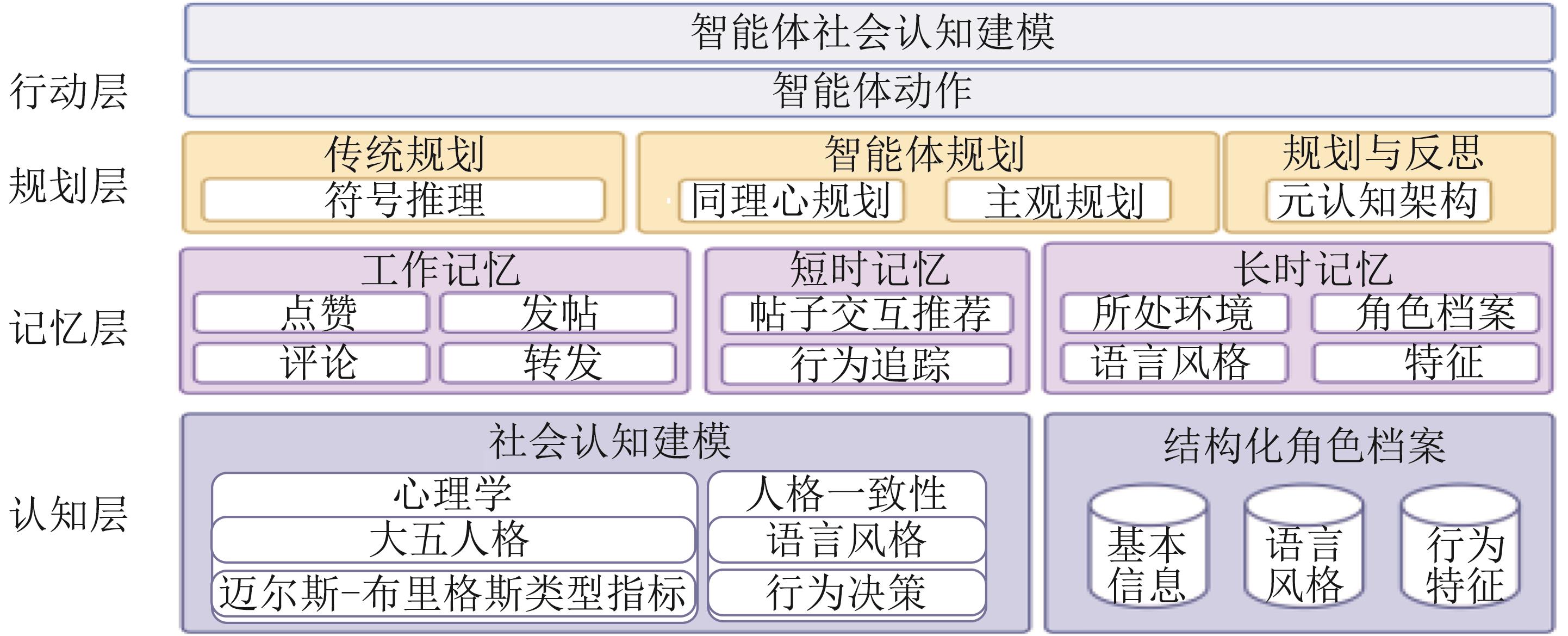
Table 2
Summary of commonly used datasets for individual-based simulation
| 领域 | 数据集 | 类型 | 来源 |
|---|---|---|---|
| 个体 | Final Dialogue Dataset | 对话 | 维基百科 |
| P-weibo Dataset | 对话、描述 | 微博 | |
| P-Ubuntu dialogue corpus | 对话、描述 | corpus | |
| LISCU Dataset | 描述 | 失业率 | |
| FoCus Dataset | 描述 | 选举 | |
| LaMP Benchmark | 描述 | 党派偏见 | |
| Multimodal Persona Chat | 图像、对话 | ||
| RoleBench | 对话 | 电影、剧本 | |
| Character-LLM Dataset | 描述 | — | |
| PersonaChat Dataset | 描述 | — | |
| Synthetic Persona Chat | 对话、描述 | LLM生成 | |
| RoleEval Dataset | 描述 | 维基百科、百度 | |
| Life Choice Dataset | 图像、对话、描述 | 维基百科、百度 | |
| RP Dataset | 对话 | 小说、剧本 | |
| MPI dataset | 描述 | — | |
| 人口统计特征 | Who is GPT3 Dataset | — | — |
| Dataset Movielens 1M | — | — | |
| EmotionBench | — | 调查 | |
| CultureLLM Dataset | 对话 | 调查 | |
| PersonaHub Dataset | 描述 | LLM生成 |
Table 3
Summary of commonly used datasets for scenario simulation
| 场景 | 数据集 | 类型 | 模拟目标 |
|---|---|---|---|
| 经济相关 | 2018.U.S.population | profile | 宏观经济活动 |
| 政府公开数据 | 租赁信息 | 资源分配 | |
| names-dataset 3.1.0 | profile | 传染病建模 | |
| Bureau of Labor Statistics | 劳工数据 | 失业率 | |
| 社会学与政治学 | ANES | profile, answers | 选举 |
| Pigeonholing Partisans | profile, opinion | 党派偏见 | |
| 用户言论 | 选举投票 | ||
| Milgram Shock Experiment | 行为记录 | 服从行为 | |
| collective decision-making | 用户决策意见 | 集体决策行为 | |
| Becker-2019 | profile, answers | 群体智慧 | |
| 网络社交平台 | Gender Discrimination | profile, opinion | 观点动力学 |
| Metoo | 用户言论 | 观点动力学 | |
| 新闻评论 | 谣言传播 | ||
| 社交评论 | 羊群效应 | ||
| Amazon Beauty | 用户-项目交互 | 用户-项目交互 |
Table 4
Process, mechanisms, and evaluation framework for generative agent-based social simulation
| 阶段 | 核心要素 | 分类 | 描述/内涵 |
|---|---|---|---|
| 模拟前(数据与建模) | 建模维度 | 个体 | 聚焦智能体自身的静态属性与动态言行数据 |
| 情景 | 聚焦智能体交互所处的环境、场景与人物数据 | ||
| 模拟中(协作机制) | 协作模式 | 辩论模式 | 通过观点交流与知识共享,激发集体智慧,达成共识 |
| 反思模式 | 个体通过审视过往决策进行自我批判与学习,优化行为 | ||
| 合作模式 | 多智能体通过任务分解与协调机制,协同完成集体目标 | ||
| 竞争模式 | 在资源或利益冲突下,基于博弈论与强化学习进行策略博弈 | ||
| 社交模式 | 模拟基于信任、模仿与角色扮演的日常社会互动 | ||
| 模拟后(评估验证) | 评估维度 | 社交智能 | 评估智能体理解他人意图、形成社会关系的能力 |
| 模拟准确度 | 评估行为与理论/数据的契合度及对多场景的适应性 | ||
| 记忆提取能力 | 评估记忆提取是否受时效性、相关性、重要性影响 | ||
| 可信性与可解释性 | 可信性:行为是否自然拟真;可解释性:决策逻辑是否透明可追溯 | ||
| 鲁棒性 | 评估在不确定、冲突环境下的系统稳定性与自我修复能力 | ||
| 社会效用 | 评估仿真在社会科学研究与现实应用中的价值与预测能力 |
Table 5
Quantitative performance comparison of LLM agents in typical social cognition simulation scenarios
| 应用场景 | 任务/设置 | 指标 / 评估维度 | 基线/对照 | LLM智能体结果 |
|---|---|---|---|---|
| 社会行为—谈判协作[ | 买方-卖方多轮议价,引入“第三方批评者/裁判”提供反馈 | 成交价趋势、达成率、破局率 | 初始回合/无反馈 | 强模型在多轮博弈中能“利用经历与AI反馈持续改进”,但“破局风险升高”;不同模型/角色学习能力差异显著 |
| 社会网络—假新闻传播[ | 带个体画像、短/长时记忆与反思的LLM代理网络;比较干预策略 | 感染人群流行度曲线拟合、干预频率效果 | 无/低频干预 | 早期且适度频次的官方辟谣最有效;“每日vs每3日”发布在控制传播上差异不显著 |
| 推荐系统—用户模拟/对齐[ | 用1 000代理在MovieLens等场景做“页级互动” | 偏好识别准确率/召回率 | 随机/干扰项 | 准确率≈65%,召回率≈75%,在引入干扰项数量变化下仍保持稳定 |
| 经济行为—竞争与市场动态[ | GPT-4餐馆-顾客博弈小镇 | 价格收敛、马太效应、服务质量/策略演化 | 初始阶段/无竞争压力 | 观察到价格收敛趋势与马太效应;竞争促使经营策略差异化与服务改进 |
| 经济行为—合谋/串通[ | “Guinea Pig Trials”智能体模拟企业竞价 | 均衡价格相对关系(与伯特兰/垄断/卡特尔比较) | 理论均衡 | 无沟通下价格收敛于“高于伯特兰、低于垄断”;允许沟通时逼近卡特尔价 |
| 军事推演—历史战例复现[ | WWI/WWII/战国多国体制仿真 | 仿真有效性(与史实进程对齐)、触发因素分析 | — | 提供多表多图对仿真有效性与开战触发因素的系统评估框架 |
| [1] | Wang Lei, Ma Chen, Feng Xueyang, et al. A Survey on Large Language Model Based Autonomous Agents[J]. Frontiers of Computer Science, 2024, 18(6): 186345. |
| [2] | Gao Chen, Lan Xiaochong, Li Nian, et al. Large Language Models Empowered Agent-based Modeling and Simulation: A Survey and Perspectives[J]. Humanities and Social Sciences Communications, 2024, 11(1): 1259. |
| [3] | Yehudai A, Eden L, Li A, et al. Survey on Evaluation of LLM-based Agents[EB/OL]. [2025-03-20]. . |
| [4] | Masterman T, Besen S, Sawtell M, et al. The Landscape of Emerging AI Agent Architectures for Reasoning, Planning, and tool Calling: A Survey[EB/OL]. (2024-04-17) [2024-06-04]. . |
| [5] | Jinghua Piao, Yan Yuwei, Zhang Jun, et al. AgentSociety: Large-scale Simulation of LLM-driven Generative Agents Advances Understanding of Human Behaviors and Society[EB/OL]. [2025-02-12] . |
| [6] | Wang Xintao, Wang Heng, Zhang Yifei, et al. CoSER: Coordinating LLM-based Persona Simulation of Established Roles[EB/OL]. [2025-05-28]. . |
| [7] | Hu Tiancheng, Collier N. Quantifying the Persona Effect in LLM Simulations[C]//Proceedings of the 62nd Annual Meeting of the Association for Computational Linguistics. Stroudsburg: ACL, 2024: 10289-10307. |
| [8] | Lewis P, Perez E, Piktus A, et al. Retrieval-augmented Generation for Knowledge-intensive NLP Tasks[C]//Proceedings of the 34th International Conference on Neural Information Processing Systems. Red Hook: Curran Associates Inc., 2020: 9459-9474. |
| [9] | Gamage Gihan, Mills Nishan, Daswin De Silva, et al. Multi-agent RAG Chatbot Architecture for Decision Support in Net-zero Emission Energy Systems[C]//2024 IEEE International Conference on Industrial Technology (ICIT). Piscataway: IEEE, 2024: 1-6. |
| [10] | Wei J, Wang Xuezhi, Schuurmans D, et al. Chain-of-thought Prompting Elicits Reasoning in Large Language Models[C]//Proceedings of the 36th International Conference on Neural Information Processing Systems. Red Hook: Curran Associates Inc., 2022: 24824-24837. |
| [11] | Yao Shunyu, Yu Dian, Zhao J, et al. Tree of Thoughts: Deliberate Problem Solving with Large Language Models[C]//Proceedings of the 37th International Conference on Neural Information Processing Systems. Red Hook: Curran Associates Inc., 2023: 11809-11822. |
| [12] | Guo Daya, Yang Dejian, Zhang Haowei, et al. DeepSeek-R1: Incentivizing Reasoning Capability in LLMs via Reinforcement Learning[EB/OL]. [2025-01-22]. . |
| [13] | Pan Jianfeng, Deng Senyou, Huang Shaomang. CoAT: Chain-of-associated-thoughts Framework for Enhancing Large Language Models Reasoning[EB/OL]. [2025-11-13]. . |
| [14] | Shen Yongliang, Song Kaitao, Tan Xu, et al. HuggingGPT: Solving AI Tasks with ChatGPT and its Friends in Hugging Face[C]//NeurIPS 2023 Conference. Red Hook: Curran Associates, Inc, 2023: 38154-38180. |
| [15] | Yao Shunyu, Zhao J, Yu Dian, et al. ReAct: Synergizing Reasoning and Acting in Language Models[C]//ICLR 2023 Conference. New York: ICLR, 2023: 1-33. |
| [16] | Wang Zekun, Peng Zhongyuan, Que Haoran, et al. RoleLLM: Benchmarking, Eliciting, and Enhancing Role-playing Abilities of Large Language Models[C]//Findings of the Association for Computational Linguistics: ACL 2024. Stroudsburg: ACL, 2024: 14743–14777. |
| [17] | Xu Rui, Wang Xintao, Chen Jiangjie, et al. Character is Destiny: Can Role-playing Language Agents Make Persona-driven Decisions?[EB/OL]. [2024-11-18]. . |
| [18] | Tu Quan, Chen Chuanqi, Li Jinpeng, et al. CharacterChat: Learning Towards Conversational AI with Personalized Social Support[EB/OL]. (2023-08-20) [2024-06-04]. . |
| [19] | Chen Nuo, Wang Yan, Jiang Haiyun, et al. Large Language Models Meet Harry Potter: A Dataset for Aligning Dialogue Agents with Characters[C]//Findings of the Association for Computational Linguistics: EMNLP 2023. Stroudsburg: ACL, 2023: 8506-8520. |
| [20] | Li Cheng, Leng Ziang, Yan Chenxi, et al. ChatHaruhi: Reviving Anime Character in Reality via Large Language Model[EB/OL]. (2023-08-18) [2024-06-04]. . |
| [21] | Li Yifan, Fan Shixuan, Wei Wei, et al. Improving Personality Consistency in Conversation with Commonsense Knowledge[J]. IEEE Transactions on Audio Speech and Language Processing, 2025, 33: 262-271. |
| [22] | Lee S, Peng Taiquan, Goldberg M H, et al. Can Large Language Models Estimate Public Opinion About Global Warming? An Empirical Assessment of Algorithmic Fidelity and Bias[J]. PLoS Climate, 2024, 3(8): e0000429. |
| [23] | Bisbee J, Clinton J D, Dorff C, et al. Synthetic Replacements for Human Survey Data? The Perils of Large Language Models[J]. Political Analysis, 2024, 32(4): 401-416. |
| [24] | Qu Yao, Wang Jue. Performance and Biases of Large Language Models in Public Opinion Simulation[J]. Humanities and Social Sciences Communications, 2024, 11(1): 1095. |
| [25] | Atkinson R C, Shiffrin R M. Human Memory: A Proposed System and its Control Processes[J]. Psychology of Learning and Motivation, 1968, 2: 89-195. |
| [26] | Ritter S, Wang J, Kurth-Nelson Z, et al. Been There, Done That: Meta-learning with Episodic Recall[C]//Proceedings of the 35th International Conference on Machine Learning. Chia Laguna Resort: PMLR, 2018: 4354-4363. |
| [27] | Ji Shaoxiong, Pan Shirui, Cambria E, et al. A Survey on Knowledge Graphs: Representation, Acquisition, and Applications[J]. IEEE Transactions on Neural Networks and Learning Systems, 2022, 33(2): 494-514. |
| [28] | 周棪忠, 罗俊仁, 谷学强, 等. 大语言模型视角下的智能规划方法综述[J]. 系统仿真学报, 2025, 37(4): 823-844. |
| Zhou Yanzhong, Luo Junren, Gu Xueqiang, et al. Survey on Intelligent Planning Methods from Large Language Models Perspective[J]. Journal of System Simulation, 2025, 37(4): 823-844. | |
| [29] | Wang Lei, Xu Wanyu, Lan Yihuai, et al. Plan-and-solve Prompting: Improving Zero-shot Chain-of-thought Reasoning by Large Language Models[C]//Proceedings of the 61st Annual Meeting of the Association for Computational Linguistics. Stroudsburg: ACL, 2023: 2609-2634. |
| [30] | Sun Linzhuang, Dong Yao, Xu Nan, et al. Rational Sensibility: LLM Enhanced Empathetic Response Generation Guided by Self-presentation Theory[EB/OL]. [2024-08-23]. . |
| [31] | Cox M T. Metacognition in Computation: A Selected Research Review[J]. Artificial Intelligence, 2005, 169(2): 104-141. |
| [32] | Light J, Cai Min, Shen Sheng, et al. AvalonBench: Evaluating LLMs Playing the Game of Avalon[C]//NeurIPS 2023 Workshop FMDM. Red Hook: Curran Associates Inc., 2023: 1-28. |
| [33] | Lin Jiaju, Zhao Haoran, Zhang Aochi, et al. AgentSims: An Open-source Sandbox for Large Language Model Evaluation[EB/OL]. (2023-08-08) [2024-06-04]. . |
| [34] | Wang Guanzhi, Xie Yuqi, Jiang Yunfan, et al. Voyager: An Open-ended Embodied Agent with Large Language Models[C]//NeurIPS 2023 Workshop IMOL. Red Hook: Curran Associates Inc., 2023: 1-43. |
| [35] | Minsky M. The Society of Mind[M]. New York: Simon & Schuster, 1986. |
| [36] | Chen Weize, Su Yusheng, Zuo Jingwei, et al. AgentVerse: Facilitating Multi-agent Collaboration and Exploring Emergent Behaviors[EB/OL]. [2023-10-23]. . |
| [37] | Elliott E, Kiel L D. Exploring Cooperation and Competition Using Agent-based Modeling[J]. Proceedings of the National Academy of Sciences of the United States of America, 2002, 99(S3): 7193-7194. |
| [38] | Dai G, Zhang Weijia, Li Jinhan, et al. Artificial Leviathan: Exploring Social Evolution of LLM Agents Through the Lens of Hobbesian Social Contract Theory[EB/OL]. [2024-07-01]. . |
| [39] | Wang Junqi, Zhang Chunhui, Li Jiapeng, et al. Evaluating and Modeling Social Intelligence: A Comparative Study of Human and AI Capabilities[EB/OL]. (2024-05-20) [2024-06-04]. . |
| [40] | Liu Xuan, Zhang Jie, Shang Haoyang, et al. Exploring Prosocial Irrationality for LLM Agents: A Social Cognition View[C]//ICLR 2025 Conference. New York: ICLR, 2025: 1-30. |
| [41] | Ren Siyue, Cui Zhiyao, Song Ruiqi, et al. Emergence of Social Norms in Generative Agent Societies: Principles and Architecture[C]//Proceedings of the Thirty-Third International Joint Conference on Artificial Intelligence. California: IJCAI, 2024: 7895-7903. |
| [42] | Park J S, O'Brien J, Cai Jun, et al. Generative Agents: Interactive Simulacra of Human Behavior[C]//Proceedings of the 36th Annual ACM Symposium on User Interface Software and Technology. New York: ACM, 2023: 2. |
| [43] | Zhao Kaiya, Naim M, Kondic J, et al. Lyfe Agents: Generative Agents for Low-cost Real-time Social Interactions[C]//ICLR 2024 Conference. New York: ICLR, 2024: 1-31. |
| [44] | Gyevnár Bálint, Lucas C G, Albrecht S V, et al. Integrating Counterfactual Simulations with Language Models for Explaining Multi-agent Behaviour[EB/OL]. [2025-10-28]. . |
| [45] | Yang Hailong, Gu Mingxian, Zhao Renhuo, et al. XAgents: A Framework for Interpretable Rule-based Multi-agents Cooperation[EB/OL]. [2025-09-22]. . |
| [46] | Ju Tianjie, Wang Bowen, Fei Hao, et al. When Disagreements Elicit Robustness: Investigating Self-repair Capabilities Under LLM Multi-Agent Disagreements[EB/OL]. [2025-10-02]. . |
| [47] | Joon Sung Park, Q Zou Carolyn, Shaw Aaron, et al. Simulating Human Behavior with AI Agents[EB/OL]. [2025-05-20]. . |
| [48] | Ashery A F, Aiello L M, Baronchelli A. Emergent Social Conventions and Collective Bias in LLM Populations[J]. Science Advances, 2025, 11(20): eadu9368. |
| [49] | Macy M W, Willer R. From Factors to Actors: Computational Sociology and Agent-based Modeling[J]. Annual Review of Sociology, 2002, 28: 143-166. |
| [50] | Cui Jiaxi, Ning Munan, Li Zongjia, et al. Chatlaw: A Multi-agent Collaborative Legal Assistant with Knowledge Graph Enhanced Mixture-of-experts Large Language Model[EB/OL]. (2024-05-30) [2024-06-04]. . |
| [51] | Fu Yao, Peng Haochun, Khot T, et al. Improving Language Model Negotiation with Self-play and In-context Learning from AI Feedback[C]//NeurIPS 2023 Conference. Red Hook: Curran Associates Inc., 2023: 1-11. |
| [52] | Akata E, Schulz L, Coda-Forno J, et al. Playing Repeated Games with Large Language Models[C]//ICLR 2024 Conference. New York: ICLR, 2024: 1-18. |
| [53] | Guo Jiaxian, Yang Bo, Yoo P, et al. Suspicion-agent: Playing Imperfect Information Games with Theory of Mind Aware GPT-4[C]//ICLR 2024 Conference. New York: ICLR, 2024: 1-27. |
| [54] | Wu Zengqing, Peng Run, Zheng Shuyuan, et al. Shall We Team Up: Exploring Spontaneous Cooperation of Competing LLM Agents[C]//Findings of the Association for Computational Linguistics: EMNLP 2024. Stroudsburg: ACL, 2024: 5163-5186. |
| [55] | El-Sayed A M, Scarborough P, Seemann L, et al. Social Network Analysis and Agent-based Modeling in Social Epidemiology[J]. Epidemiologic Perspectives & Innovations, 2012, 9(1): 1. |
| [56] | Gao Chen, Lan Xiaochong, Lu Zhihong, et al. S3: Social-network Simulation System with Large Language Model-empowered Agents[EB/OL]. [2025-06-3]. . |
| [57] | Gur I, Furuta H, Huang A V, et al. A Real-world WebAgent with Planning, Long Context Understanding, and Program Synthesis[C]//ICLR 2024 Conference. New York: ICLR, 2024: 1-28. |
| [58] | Nasrinpour H R, Friesen M R, McLeod R D. An Agent-based Model of Message Propagation in the Facebook Electronic Social Network[EB/OL]. (2016-11-22) [2024-06-04]. . |
| [59] | Liu Yuhan, Chen Xiuying, Zhang Xiaoqing, et al. from Skepticism to Acceptance: Simulating the Attitude Dynamics Toward Fake News[C]//Proceedings of the Thirty-Third International Joint Conference on Artificial Intelligence. California: IJCAI, 2024: 7886-7894. |
| [60] | Hou Yupeng, Zhang Junjie, Lin Zihan, et al. Large Language Models are Zero-shot Rankers for Recommender Systems[C]//Advances in Information Retrieval. Cham: Springer Nature Switzerland, 2024: 364-381. |
| [61] | Qian Chen, Liu Wei, Liu Hongzhang, et al. ChatDev: Communicative Agents for Software Development[C]//Proceedings of the 62nd Annual Meeting of the Association for Computational Linguistics. Stroudsburg: ACL, 2024: 15174-15186. |
| [62] | Zhang An, Chen Yuxin, Sheng Leheng, et al. On Generative Agents in Recommendation[C]//Proceedings of the 47th International ACM SIGIR Conference on Research and Development in Information Retrieval. New York: ACM, 2024: 1807-1817. |
| [63] | Huang Xu, Lian Jianxun, Lei Yuxuan, et al. Recommender AI Agent: Integrating Large Language Models for Interactive Recommendations[EB/OL]. (2024-01-30) [2024-06-04]. . |
| [64] | Domenico Delli Gatti, Desiderio Saul, Gaffeo Edoardo, et al. Macroeconomics from the Bottom-up[M]. Milano: Springer Milan, 2011. |
| [65] | Zhao Qinlin, Wang Jindong, Zhang Yixuan, et al. CompeteAI: Understanding the Competition Dynamics of Large Language Model-based Agents[C]//Proceedings of the 41st International Conference on Machine Learning. Chia Laguna Resort: PMLR, 2024: 61092-61107. |
| [66] | Nascimento Nathalia, Alencar Paulo, Cowan Donald. GPT-in-the-loop: Supporting Adaptation in Multiagent Systems[C]//2023 IEEE International Conference on Big Data (BigData). Piscataway: IEEE, 2023: 4674-4683. |
| [67] | Xia Tian, He Zhiwei, Ren Tong, et al. Measuring Bargaining Abilities of LLMs: A Benchmark and A Buyer-enhancement Method[C]//Findings of the Association for Computational Linguistics: ACL 2024. Stroudsburg: ACL, 2024: 3579-3602. |
| [68] | Filippas A, Horton J J, Manning B S. Large Language Models as Simulated Economic Agents: What Can We Learn from Homo Silicus?[C]//Proceedings of the 25th ACM Conference on Economics and Computation. New York: ACM, 2024: 614-615. |
| [69] | Han Xu, Wu Zengqing, Xiao Chuan. "Guinea Pig Trials" Utilizing GPT: A Novel Smart Agent-based Modeling Approach for Studying Firm Competition and Collusion[EB/OL]. (2024-01-31) [2024-06-04]. . |
| [70] | Hua Wenyue, Fan Lizhou, Li Lingyao, et al. War and Peace (WarAgent): LLM-based Multi-agent Simulation of World Wars[C]//ICLR 2025 Conference. New York: ICLR, 2025: 1-41. |
| [71] | Mukobi G, Erlebach H, Lauffer N, et al. Welfare Diplomacy: Benchmarking Language Model Cooperation[C]//ICLR 2024 Conference. New York: ICLR, 2024: 1-61. |
| [1] | Liu Dayong, Dong Zhiming, Guo Qisheng, Gao Ang, Qiu Xuehuan. Construction Approach of LLM-empowered Tactical Wargame Decision-making Agents [J]. Journal of System Simulation, 2026, 38(3): 758-775. |
| [2] | Xu Risheng, Yang Linyao, Qin Yuanqi, Wang Xiao, Sun Changyin. Knowledge-enhanced LLM-based Method for Regional Traffic Signal Control [J]. Journal of System Simulation, 2026, 38(2): 518-531. |
| [3] | Wang Yifan, Yang Bin, Wang Congjun. Simulation Method for Multi-crew Construction Processes Based on Large Language Model-powered Agent [J]. Journal of System Simulation, 2026, 38(2): 488-500. |
| [4] | Liu Yiqing, Zhang Qiuyang, Liu Chunyu, Xue Yao, Wei Zhiwei, Feng Yan. A Semantic Knowledge-enhanced Assessment Method for Spectrum Effectiveness of Low Earth Orbit Constellations [J]. Journal of System Simulation, 2026, 38(2): 460-475. |
| [5] | Wang Xiang, Tan Guozhen. Research on Decision-making of Autonomous Driving in Highway Environment Based on Knowledge and Large Language Model [J]. Journal of System Simulation, 2025, 37(5): 1246-1255. |
| [6] | Teng Li, Peipei Ding, Jinfang Liu. Multi-Stage Multi-AGV Path Planning with Walk under Shelves for Robotic Mobile Fulfillment Systems [J]. Journal of System Simulation, 2022, 34(7): 1512-1523. |
| [7] | Li Wenxiang, Li Ye, Dong Jieshuang, Li Yiming. Development Paths of New Energy Vehicles Incorporating CO2 Emissions Trading Scheme [J]. Journal of System Simulation, 2021, 33(6): 1451-1465. |
| [8] | Niu Zhiqiang, Li Chaoyang, Dong Hongyu, Zhang Feng, Meng Lingyun, Tong Lu, Wu Shengnan. Analyzing dispatching wave policies for e-commerce logistics based on the multi-agent-based simulation [J]. Journal of System Simulation, 2020, 32(12): 2415-2425. |
| [9] | Zhang Yongsheng, Xiong Zhengxiang. Exploration of Soldier Morale Using Multi-mode Simulation Approach [J]. Journal of System Simulation, 2019, 31(12): 2740-2749. |
| [10] | Zhao Yitong, Mei Shan, Ma Liang, Zhang Wei. Simulation Analysis of Beijing H1N1 Influenza Based on Spatial Clustering [J]. Journal of System Simulation, 2017, 29(9): 2115-2121. |
| Viewed | ||||||
|
Full text |
|
|||||
|
Abstract |
|
|||||
 http://www.china-simulation.com

