

系统仿真学报 ›› 2026, Vol. 38 ›› Issue (5): 1453-1465.doi: 10.16182/j.issn1004731x.joss.25-0506
蒋圣超1, 裴云庆1, 翟宏营1, 吴国键2, 高放2
收稿日期:2025-06-04
修回日期:2025-09-23
出版日期:2026-05-21
发布日期:2026-05-29
通讯作者:
高放
第一作者简介:蒋圣超(1988-),男,高级工程师,硕士,研究方向为量子技术、电气工程。
基金资助:Jiang Shengchao1, Pei Yunqing1, Zhai Hongying1, Wu Guojian2, Gao Fang2
Received:2025-06-04
Revised:2025-09-23
Online:2026-05-21
Published:2026-05-29
Contact:
Gao Fang
摘要:
为突破传统牛顿‒拉夫逊(Newton-Raphson, NR)法在新型电力系统高维潮流计算中的效率瓶颈,以及变分量子算法框架的制约,提出融合块编码技术和绝热量子计算原理的潮流计算框架。基于块编码技术、绝热量子理论和NR法构建块编码绝热量子潮流计算框架(BQ-NR)。将NR法修正方程映射至量子系统,通过构造厄密扩展矩阵与投影算符实现修正方程的量子态编码;设计离散绝热演化方案,并利用Trotter-Suzuki分解和块编码技术将连续哈密顿量转化为量子线路可执行的酉算子序列,实现量子求解器与经典算法的动态耦合。实验结果表明:当离散演化步数M≥5×10⁶时,BQ-NR法可在3次迭代内实现收敛,其误差精度达1×10‒5量级,与传统NR法相当,验证了块编码绝热量子线性求解器在修正方程求解中的有效性;潮流计算实验进一步验证了所提算法的可推广性,为量子计算在电力系统分析中的工程应用提供了理论支撑。
中图分类号:
蒋圣超,裴云庆,翟宏营等 . 基于块编码绝热量子牛顿‒拉夫逊法的潮流计算[J]. 系统仿真学报, 2026, 38(5): 1453-1465.
Jiang Shengchao,Pei Yunqing,Zhai Hongying,et al . Power Flow Calculation Based on Block-encoded Adiabatic Quantum Newton-Raphson Method[J]. Journal of System Simulation, 2026, 38(5): 1453-1465.
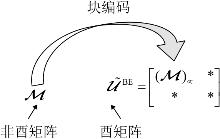
图1
块编码技术示意图
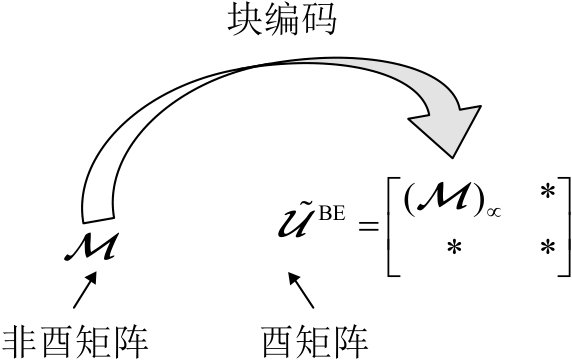
图2
通用精确块编码量子线路
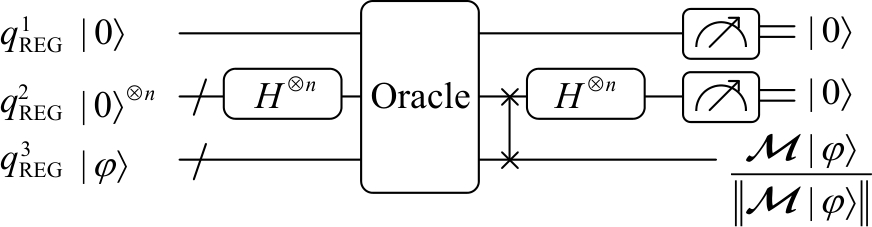
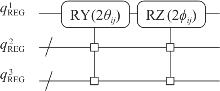
图3
块编码量子线路中的Oracle
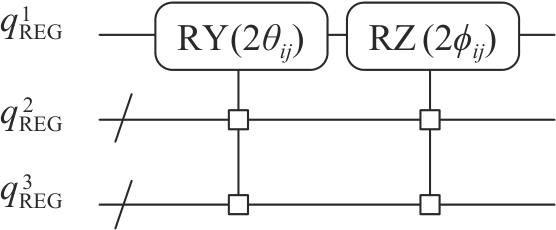
图4
块编码绝热量子潮流计算流程图
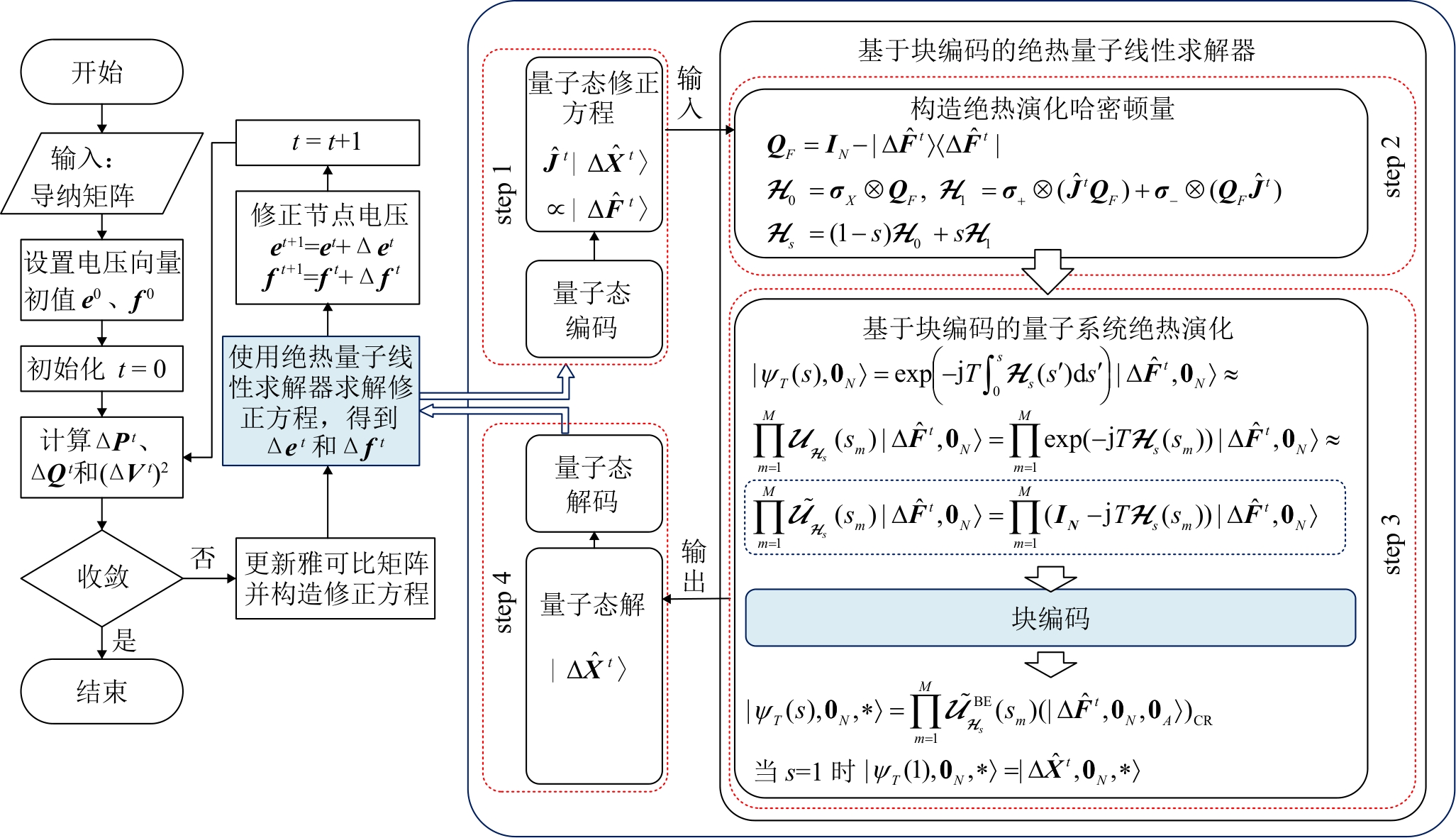
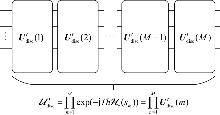
图5
离散演化算符𝒰 disc'的量子线路实现
图6
离散演化算符𝒰 ''disc的量子线路实现
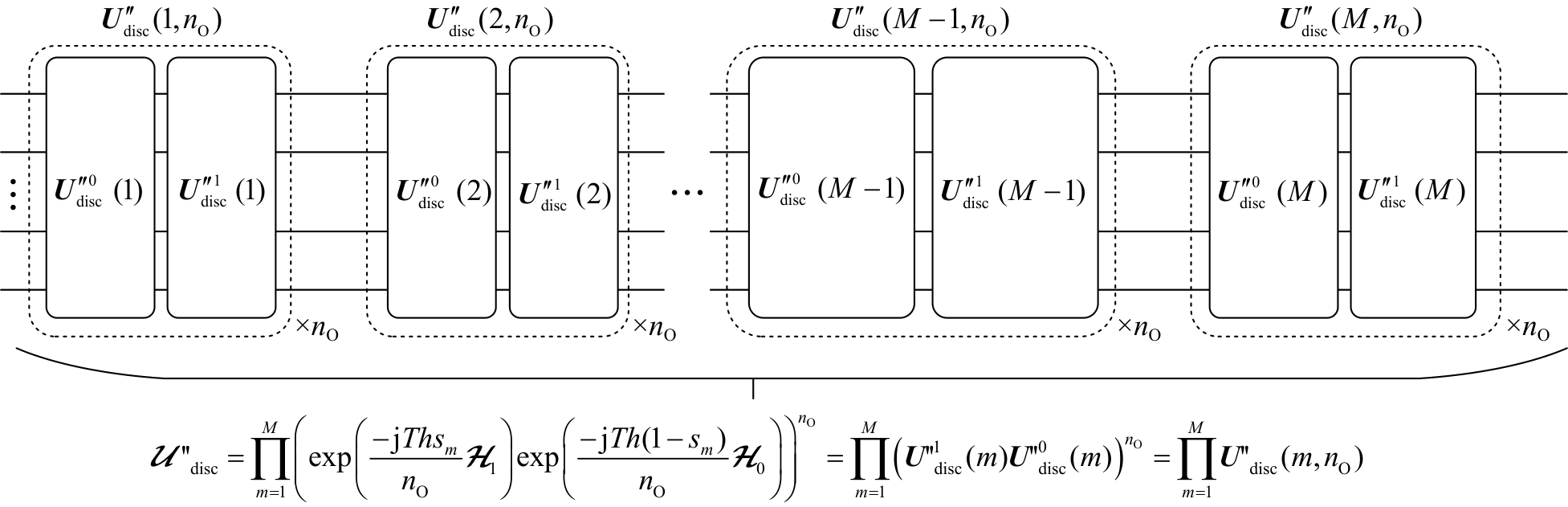
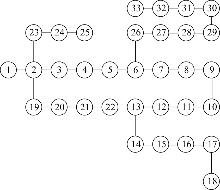
图7
IEEE-33节点系统
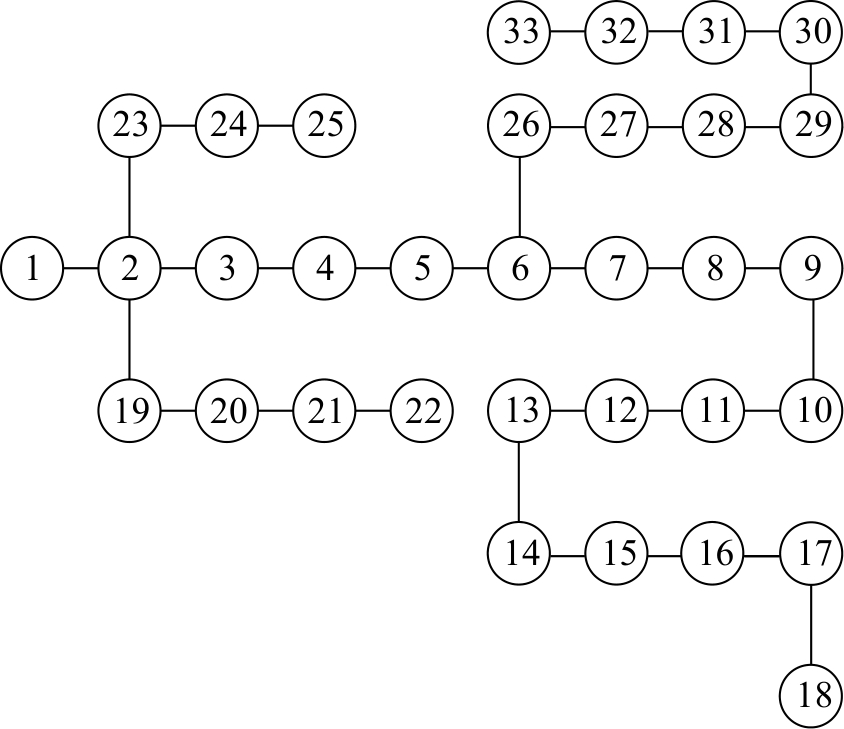
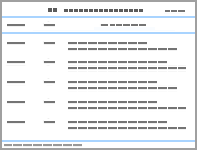
表1
各节点有功和无功功率
节点 编号 | 有功 功率 | 无功 功率 | 节点 编号 | 有功 功率 | 无功 功率 |
|---|---|---|---|---|---|
| 1 | 0 | 0 | 18 | 0.090 | 0.039 |
| 2 | 0.099 | 0.060 | 19 | 0.090 | 0.039 |
| 3 | 0.090 | 0.039 | 20 | 0.090 | 0.039 |
| 4 | 0.120 | 0.081 | 21 | 0.090 | 0.039 |
| 5 | 0.060 | 0.030 | 22 | 0.090 | 0.039 |
| 6 | 0.060 | 0.021 | 23 | 0.090 | 0.051 |
| 7 | 0.201 | 0.099 | 24 | 0.420 | 0.210 |
| 8 | 0.201 | 0.099 | 25 | 0.420 | 0.210 |
| 9 | 0.060 | 0.021 | 26 | 0.060 | 0.024 |
| 10 | 0.060 | 0.010 | 27 | 0.060 | 0.024 |
| 11 | 0.045 | 0.030 | 28 | 0.060 | 0.021 |
| 12 | 0.060 | 0.036 | 29 | 0.120 | 0.069 |
| 13 | 0.060 | 0.036 | 30 | 0.201 | 0.60 |
| 14 | 0.120 | 0.081 | 31 | 0.150 | 0.069 |
| 15 | 0.060 | 0.009 | 32 | 0.210 | 0.099 |
| 16 | 0.060 | 0.021 | 33 | 0.060 | 0.039 |
| 17 | 0.060 | 0.021 |
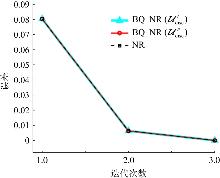
图8
不同方法的误差折线图
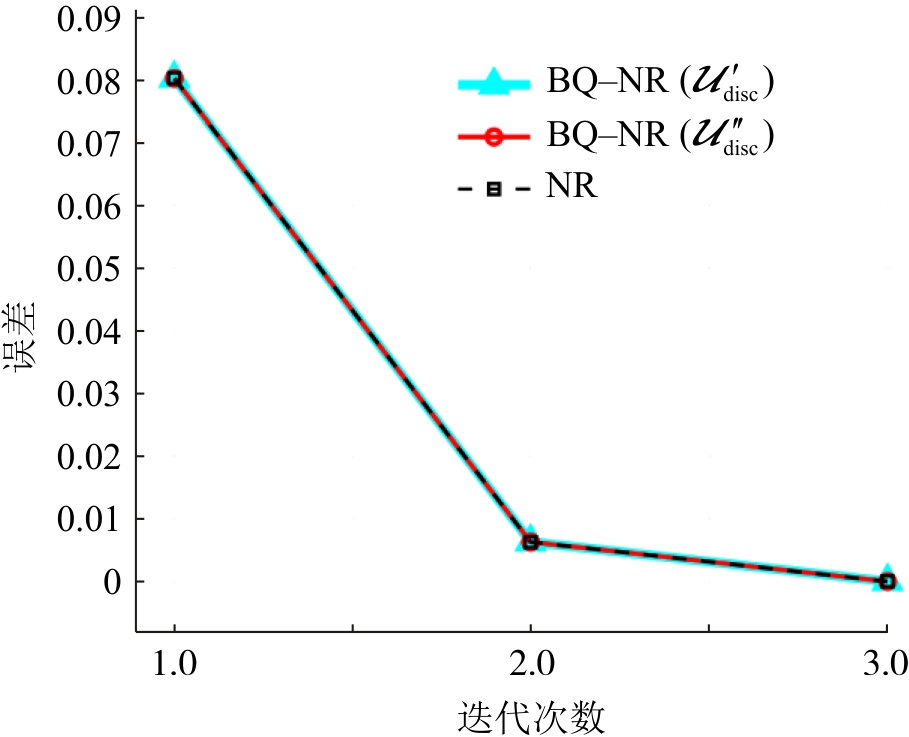
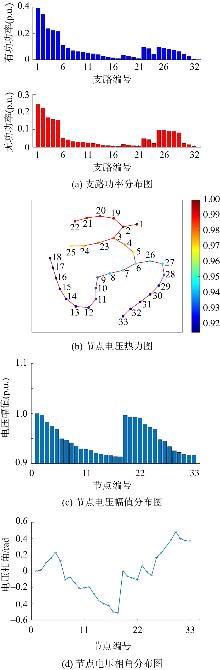
图9
绝热量子潮流计算结果
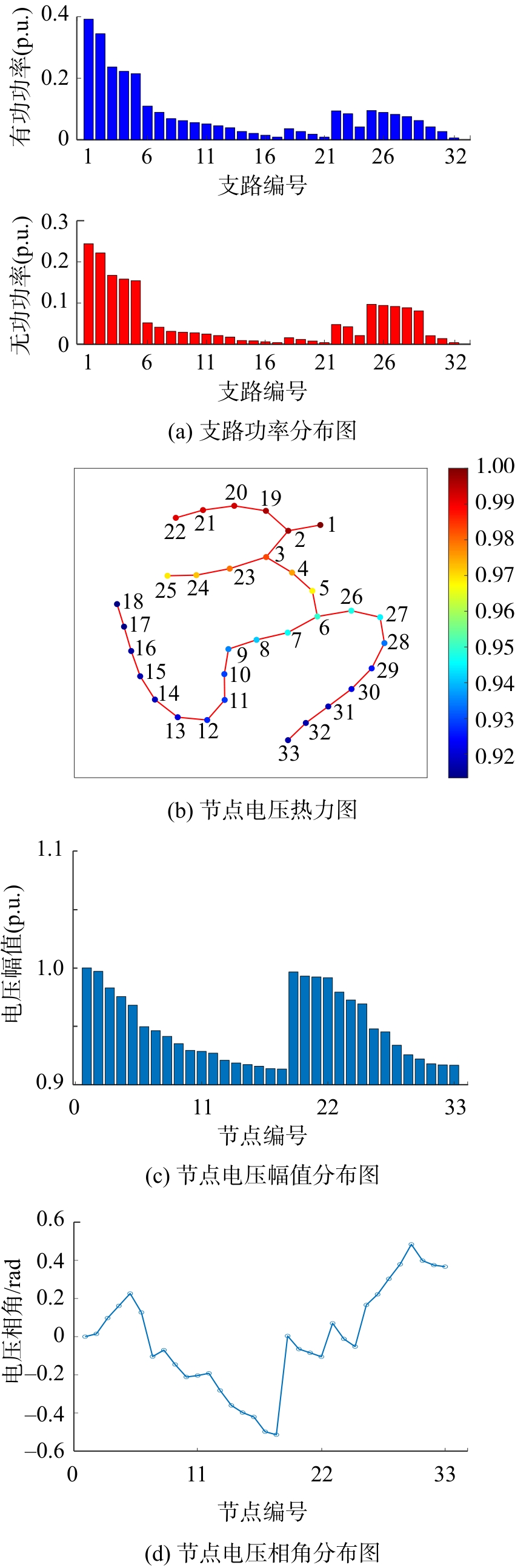
表2
不同绝热演化步长下BQ-NR算法求解结果
| 方法 | 是否 收敛 | 迭代 周期 | 收敛时误差值 |
|---|---|---|---|
| NR | 是 | 3 | 4.108 9×10⁵ |
| BQ-NR(M=1×10⁴) | 否 | ||
| BQ-NR(M=5×10⁴) | 否 | ||
| BQ-NR(M=1×10⁵) | 是 | 13 | 1.302 9×10⁵ |
| BQ-NR(M=5×10⁵) | 是 | 5 | 7.611 6×10⁶ |
| BQ-NR(M=1×10⁶) | 是 | 5 | 3.417 6×10⁵ |
| BQ-NR(M=5×10⁶) | 是 | 3 | 6.487 0×106 |
| BQ-NR(M=1×10⁷) | 是 | 3 | 7.611 9×10⁵ |
| BQ-NR(M=5×10⁷) | 是 | 3 | 4.725 2×10⁶ |
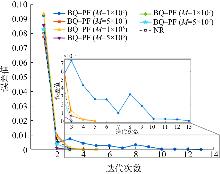
图10
不同绝热演化步长下BQ-NR算法收敛过程
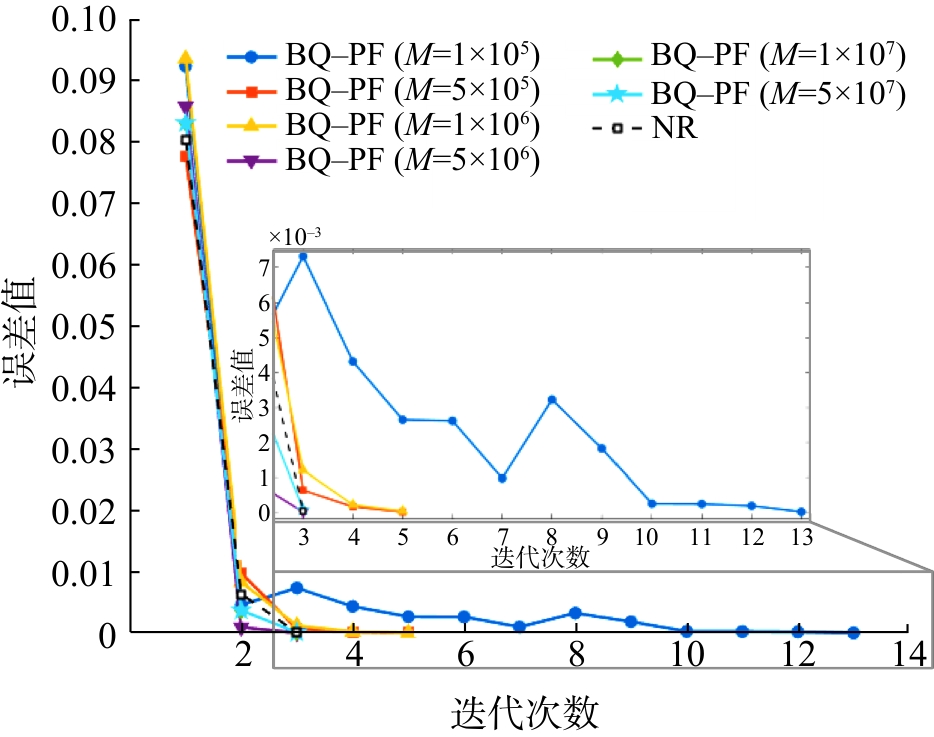
表3
不同节点系统中BQ-NR算法求解结果
| 测试系统 | 迭代周期 | 收敛时误差值 | |
|---|---|---|---|
| 传统NR | BQ-NR | ||
| IEEE-5 | 2 | 2 | 8.300 3×10⁵ |
| IEEE-9 | 3 | 3 | 3.764 7×10⁷ |
| IEEE-14 | 1 | 1 | 5.660 8×10⁵ |
| IEEE-18 | 3 | 3 | 5.499 9×10⁶ |
| IEEE-22 | 2 | 2 | 2.122 0×107 |
| IEEE-30 | 2 | 2 | 6.653 0×105 |
| IEEE-39 | 2 | 2 | 2.122 0×107 |
| IEEE-57 | 2 | 2 | 5.235 2×10⁶ |
| IEEE-69 | 3 | 3 | 2.204 1×10⁷ |
| IEEE-85 | 3 | 3 | 2.454 1×10⁷ |
| IEEE-118 | 2 | 2 | 9.843 3×10⁶ |
| [1] | Cain M B, O'Neill R P, Castillo A. History of Optimal Power Flow and Formulations[J]. Federal Energy Regulatory Commission, 2012, 1: 1-36. |
| [2] | Radman G, Raje R S. Power Flow Model/Calculation for Power Systems with Multiple FACTS Controllers[J]. Electric Power Systems Research, 2007, 77(12): 1521-1531. |
| [3] | 赵真, 袁旭峰, 徐玉韬, 等. 一种改进三点估计法的概率潮流计算方法[J]. 南方电网技术, 2020, 14(11): 43-48. |
| Zhao Zhen, Yuan Xufeng, Xu Yutao, et al. An Improved Three-point Estimate Method for Probability Load Flow Calculation[J]. Southern Power System Technology, 2020, 14(11): 43-48. | |
| [4] | 朱怡莹, 周荣生, 林文硕. 考虑通信时延与中断的省地协同异步式潮流计算[J]. 南方电网技术, 2021, 15(6): 91-97. |
| Zhu Yiying, Zhou Rongsheng, Lin Wenshuo. Provincial-local Coordinated Asynchronous Power Flow Calculation Considering Communication Delays and Interruptions[J]. Southern Power System Technology, 2021, 15(6): 91-97. | |
| [5] | 董清, 屈桐. 一种牛顿潮流算法收敛性定理的应用研究[J]. 电力科学与工程, 2021, 37(3): 16-22. |
| Dong Qing, Qu Tong. A Study on the Application of Convergence Theorem of Newton Power Flow Algorithm[J]. Electric Power Science and Engineering, 2021, 37(3): 16-22. | |
| [6] | 徐震, 张大波, 杨贺钧, 等. 基于HHL算法的量子牛顿-拉夫逊法潮流计算[J]. 中国电机工程学报, 2025, 45(14): 5564-5576. |
| Xu Zhen, Zhang Dabo, Yang Hejun, et al. Quantum Newton-raphson Power Flow Computation Based on HHL Algorithm[J]. Proceedings of the CSEE, 2025, 45(14): 5564-55760. | |
| [7] | Feng Fei, Zhou Yifan, Zhang Peng. Quantum Power Flow[J]. IEEE Transactions on Power Systems, 2021, 36(4): 3810-3812. |
| [8] | 韩平平, 吴家毓, 仇茹嘉, 等. 电力系统离散绝热变分量子潮流计算方法[J]. 电网技术, 2025, 49(7): 2852-2862. |
| Han Pingping, Wu Jiayu, Qiu Rujia, et al. Discrete Adiabatic Variation Quantum Power Flow Calculation Method for Power Systems[J]. Power System Technology, 2025, 49(7): 2852-2862. | |
| [9] | 凌佳杰, 耿光超, 江全元. 基于变分量子算法的电力系统潮流计算[J]. 中国电机工程学报, 2023, 43(1): 28-36. |
| Ling Jiajie, Geng Guangchao, Jiang Quanyuan. Power Flow Calculation of Power System Based on Variable Quantum Algorithm[J]. Proceedings of the CSEE, 2023, 43(1): 28-36. | |
| [10] | 刘成骏, 娄骐, 徐一骏, 等. 基于光量子计算机的电网停电后分区模型及量子比特扩容方法[J]. 电力系统自动化, 2025, 49(11): 80-90. |
| Liu Chengjun, Lou Qi, Xu Yijun, et al. Partitioning Model and Qubit Expansion Method for Power Grid Blackout Based on Optical Quantum Computers[J]. Automation of Electric Power Systems, 2025, 49(11): 80-90. | |
| [11] | 李知艺, 许悦, 韩旭涛. 量子计算技术在新型电力系统决策优化中的应用[J]. 电力系统自动化, 2024, 48(6): 62-73. |
| Li Zhiyi, Xu Yue, Han Xutao. Application of Quantum Computing Technology in Decision-making Optimization of New Power System[J]. Automation of Electric Power Systems, 2024, 48(6): 62-73. | |
| [12] | Gao Fang, Wu Guojian, Guo Suhang, et al. Solving DC Power Flow Problems Using Quantum and Hybrid Algorithms[J]. Applied Soft Computing, 2023, 137: 110147. |
| [13] | Harrow A W, Hassidim A, Lloyd S. Quantum Algorithm for Linear Systems of Equations[J]. Physical Review Letters, 2009, 103(15): 150502. |
| [14] | Albash T, Lidar D A. Adiabatic Quantum Computation[J]. Reviews of Modern Physics, 2018, 90(1): 015002. |
| [15] | C S Costa Pedro, An Dong, Sanders Yuval R, et al. Optimal Scaling Quantum Linear-systems Solver via Discrete Adiabatic Theorem[J]. PRX Quantum, 2022, 3(4): 040303. |
| [16] | Alan Costa Dos Santos. Adiabatic Dynamics and Shortcuts to Adiabaticity: Fundamentals and Applications[EB/OL]. (2021-07-25) [2025-05-18]. . |
| [17] | Childs Andrew M, Kothari Robin, Somma Rolando D. Quantum Algorithm for Systems of Linear Equations with Exponentially Improved Dependence on Precision[J]. SIAM Journal on Computing, 2017, 46(6): 1920-1950. |
| [18] | Gilyén András, Su Yuan, Low G H, et al. Quantum Singular Value Transformation and Beyond: Exponential Improvements for Quantum Matrix Arithmetics[C]//Proceedings of the 51st Annual ACM SIGACT Symposium on Theory of Computing. New York: ACM, 2019: 193-204. |
| [19] | Suzuki Masuo. Generalized Trotter's Formula and Systematic Approximants of Exponential Operators and Inner Derivations with Applications to Many-body Problems[J]. Communications in Mathematical Physics, 1976, 51(2): 183-190. |
| [20] | Lloyd S. Universal Quantum Simulators[J]. Science, 1996, 273(5278): 1073-1078. |
| [21] | Kashem M A, Ganapathy V, Jasmon G B, et al. A Novel Method for Loss Minimization in Distribution Networks[C]//DRPT2000. International Conference on Electric Utility Deregulation and Restructuring and Power Technologies. Proceedings. Piscataway: IEEE, 2000: 251-256. |
| [1] | 董志明, 胡忠奇, 戴浩然, 高建成. 基于大语言模型的作战仿真想定自动化生成方法[J]. 系统仿真学报, 2026, 38(5): 1129-1145. |
| [2] | 李校男, 晁涛, 马萍, 杨明, 王玉轩. 基于期望最大化方法的非线性SSM黑箱鲁棒辨识[J]. 系统仿真学报, 2026, 38(5): 1146-1158. |
| [3] | 刘银钢, 马明, 张荣华. 基于大语言模型的兵棋推演动态任务规划[J]. 系统仿真学报, 2026, 38(5): 1187-1204. |
| [4] | 苏泓嘉, 张成, 刘飞. 基于模糊功能依赖网分析的体系效能评估方法[J]. 系统仿真学报, 2026, 38(5): 1224-1238. |
| [5] | 梅华威, 杨鹏慧, 余洋. 计及数据漂移改进PatchTST的超短期光伏功率预测[J]. 系统仿真学报, 2026, 38(5): 1239-1254. |
| [6] | 李权, 苏鹏, 万海英, 张承玺, 何志坚, 倪艺洋, 赵忠盖, 刘飞. 基于多阶段LHS-EPRCC方法的青霉素发酵过程建模[J]. 系统仿真学报, 2026, 38(5): 1255-1276. |
| [7] | 周子聪, 曾俊杰, 胡越, 朱正秋, 尹全军. 基于次优示例引导的兵棋推演多智能体强化学习方法[J]. 系统仿真学报, 2026, 38(5): 1277-1289. |
| [8] | 石敏, 郭诗盛, 王素琴, 李兆歆, 朱登明. 融合物理与几何先验的无抓取标注6-DoF抓取检测方法[J]. 系统仿真学报, 2026, 38(5): 1290-1302. |
| [9] | 姜彦吉, 肖星佚, 董浩, 于淼, 黄金山, 刘大千, 费博雯. 融合点线特征的图关系优化3D车道线检测方法[J]. 系统仿真学报, 2026, 38(5): 1303-1319. |
| [10] | 张鑫, 张平, 张琛, 刘威, 韩博阳. 非均质土壤条件下挖掘阻力计算模型研究[J]. 系统仿真学报, 2026, 38(5): 1320-1332. |
| [11] | 王伟, 刘东, 崔新豪, 李博, 肖依永, 任羿. 复杂项目多级动态挣值管理数字化模型及应用[J]. 系统仿真学报, 2026, 38(5): 1350-1364. |
| [12] | 彭莉峻, 苏庭琪, 刘沛津, 何林, 周协武, 张闽心. 融合人体关键点的实验室PPE规范穿戴检测方法[J]. 系统仿真学报, 2026, 38(5): 1365-1382. |
| [13] | 滕靖, 童文聪, 张中杰, 姚幸, 李君羡. 有轨电车交叉口速度自动引导方法及仿真评价[J]. 系统仿真学报, 2026, 38(5): 1426-1439. |
| [14] | 秦浪, 谢嘉成, 乔晓军, 王学文, 肖智杰. 执行器位姿异常的机器人轨迹规划调整方法[J]. 系统仿真学报, 2026, 38(5): 1466-1483. |
| [15] | 南焱栋, 朱金达, 路鑫彬, 秦志英, 齐丹丹, 丁智恒. 数字孪生驱动的核电连接套质检设备状态监测[J]. 系统仿真学报, 2026, 38(4): 1004-1017. |
| 阅读次数 | ||||||
|
全文 |
|
|||||
|
摘要 |
|
|||||
 http://www.china-simulation.com

