

系统仿真学报 ›› 2026, Vol. 38 ›› Issue (3): 545-562.doi: 10.16182/j.issn1004731x.joss.25-1056
• 专栏 • 下一篇
张莉莎1, 霍宇驰2, 叶琦2, 陈安军1, 郭诗辉1, 陈积明2
收稿日期:2025-10-30
修回日期:2026-01-05
出版日期:2026-03-18
发布日期:2026-03-27
通讯作者:
陈安军
第一作者简介:张莉莎(2003-),女,硕士生,研究方向为具身智能、三维重建。
基金资助:Zhang Lisha1, Huo Yuchi2, Ye Qi2, Chen Anjun1, Guo Shihui1, Chen Jiming2
Received:2025-10-30
Revised:2026-01-05
Online:2026-03-18
Published:2026-03-27
Contact:
Chen Anjun
摘要:
三维人体重建技术是VR/AR落地的核心支撑。早期研究依赖多视角相机与深度传感器,精度高但成本高、难以适配动态场景。中期以参数化人体模型为代表,将重建转为低维姿态与形状参数估计,实现单图高效重建。隐式神经表示提升了细节保真度与环境适应性,但相关方法渲染效率偏低。当前三维高斯溅射技术通过优化离散高斯元参数,兼顾建模精度与实时渲染效率,为动态人体重建提供新范式。目前该技术仍面临细节失真、泛化性不足、效率与终端算力不匹配等挑战,未来将进一步适配VR/AR场景,提升实用价值并推动二者深度融合。
中图分类号:
张莉莎,霍宇驰,叶琦等 . 赋能VR/AR的三维人体重建方法综述[J]. 系统仿真学报, 2026, 38(3): 545-562.
Zhang Lisha,Huo Yuchi,Ye Qi,et al . Review of 3D Human Reconstruction Methods Empowering VR/AR[J]. Journal of System Simulation, 2026, 38(3): 545-562.
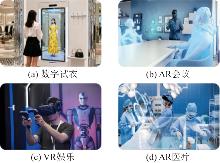
图1
三维人体重建应用场景
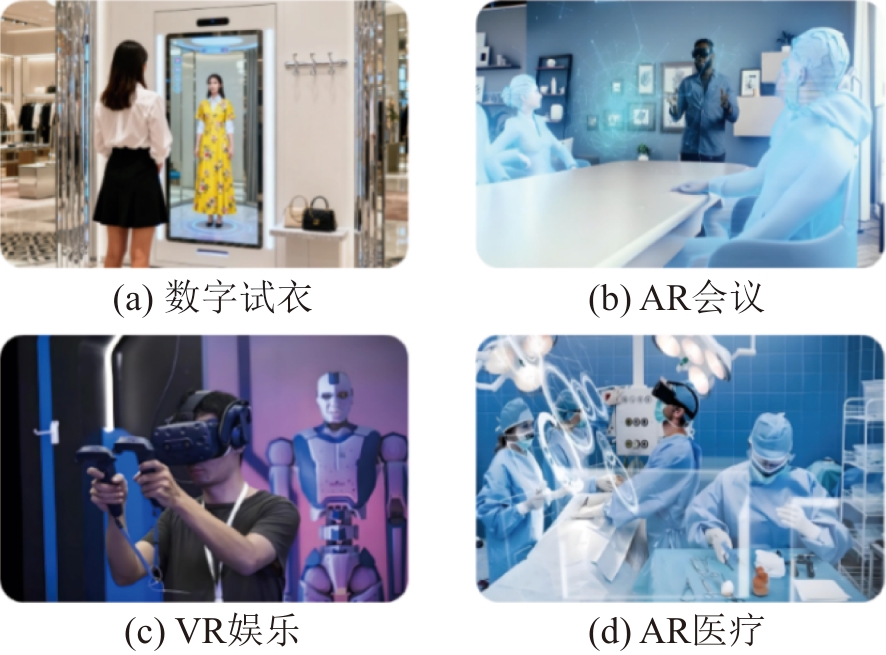
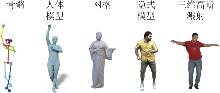
图2
常用的人体三维表示
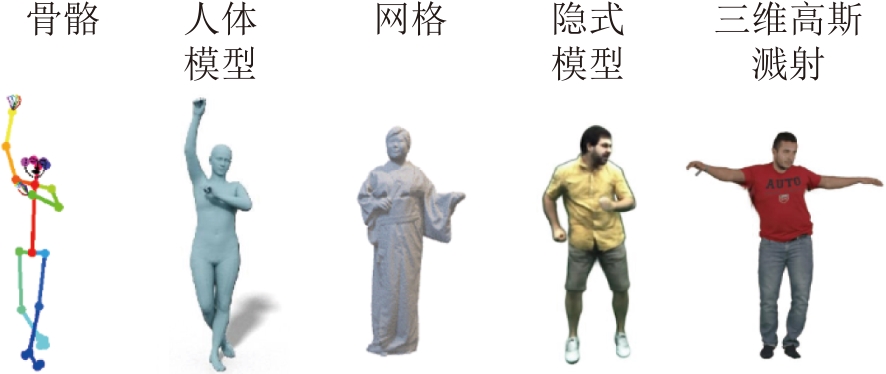

表1
三维人体重建核心技术体系分类及典型方法对比
| 类别 | 典型方法 | 具体案例 | 核心技术特点 | 性能指标 (基于H36M/3DPW数据集) | |
|---|---|---|---|---|---|
| PA-MPJPE | MPJPE | ||||
基于 优化 的建模 | 轮廓对齐方法 | 基于SCAPE模型的轮廓对齐 | 通过三维模型投影与图像剪影的几何一致性优化 | ||
| 人体参数优化 | SMPLify[ | 迭代优化SMPL模型的姿态与形状参数 | 82.3 (H36M) | ||
| 多视觉线索融合 | HoloPose[ | 融合DensePose稠密姿态估计、关键点与分割掩码 | 50.56 (H36M) | 64.28 (H36M) | |
| 深度学习辅助优化 | ExemplarFine-Tuning (EFT)[ | 利用预训练回归器生成隐式先验,在参数邻域内开展无正则项的少量样本微调 | 44.0 (H36M) 51.6 (3DPW) | ||
| 逆运动学方法 | HybrIK | 将关节旋转解耦为摆动与扭转分量 | 33.6 (H36M) 45.0 (3DPW) | 55.4 (H36M) 74.1 (3DPW) | |
基于 学习 的建模 | 参数化学习 | Neural Body Fitting | 端到端回归参数化模型参数(如SMPL的姿态θ与形状β参数) | 59.9 (H36M) | |
| 非参数化学习 | I2L-MeshNet | 基于线像素一维热图的高效顶点定位 | 41.7 (H36M) 58.6 (3DPW) | 55.7 (H36M) 93.2 (3DPW) | |
| 回归概率分布 | ProHMR | 采用条件归一化流,对姿态参数的条件概率分布进行建模 | 41.2 (H36M) 59.8 (3DPW) | ||
| 回归中间表示 | DecoMR[ | 通过IUV图像建立图像与3D网格的密集对应,迁移局部特征并回归位置图 | 39.3 (H36M) 68.5 (3DPW) | 60.6 (H36M) | |
混合 与新兴 方法 | 隐式表示方法 | PIFu[ | 像素对齐隐式函数,从单张图像推断三维表面及纹理 | ||
| 显隐混合表示 | D3-Human | SMPL显式模板+隐式hmSDF分割服装与身体 | |||
| 3DGS | SplattingAvatar | 优化离散高斯元的几何与外观参数,实时渲染 | |||
| 全身重建 | ExPose | 预测SMPL-X参数,高分辨率区域裁剪细化,融合专项数据集知识 | 60.7 (3DPW) | 93.4 (3DPW) | |
网络 结构 设计 | 单阶段框架 | HMR | 基于ResNet全局特征提取 + 迭代误差反馈(IEF)机制优化 | 56.8 (H36M) 81.3 (3DPW) | 88.0 (H36M) 130.0 (3DPW) |
| 多阶段框架 | Zanfir et al. | 多阶段框架结合语义信息中间表示,以归一化流实现弱监督三维人体姿态与形状重建 | 57.1 (3DPW) | 90.0 (3DPW) | |
| 多分支框架 | DaNet | 全局或局部流任务拆分,IUV全局参数预测 + 关键点RoI池化局部优化 | 42.9 (H36M) 54.8 (3DPW) | 54.6 (H36M) 85.5 (3DPW) | |
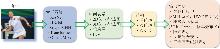
图3
三维人体重建全流程技术架构
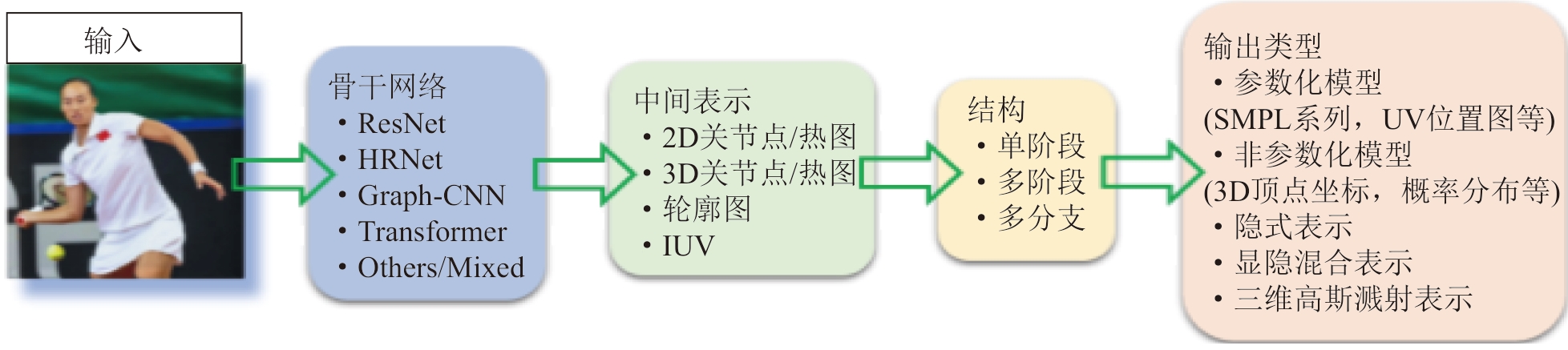
表2
常用人体重建数据集比较
| 类型 | 数据集 | 帧数 | 场景数 | 人数 | 人数/帧 | 真实场景 | 标注类型 |
|---|---|---|---|---|---|---|---|
| 渲染数据集 | SURREAL[ | 6.5×10⁶ | 2 607 | 145 | 1 | SMPL | |
| GTA-Human[ | 1.4×10⁶ | >600 | 1 | SMPL | |||
| AGORA[ | 1.7×10⁴ | >350 | 4 240 | 5~15 | SMPL-X | ||
| THUman2.0[ | 200 | 1 | SMPL-X | ||||
| MultiHuman[ | 50 | 1~3 | SMPL-X | ||||
| 标记/传感器 | HumanEva[ | 8.0×10⁴ | 1 | 4 | 1 | ||
| Human3.6M[ | 3.6×10⁶ | 1 | 11 | 1 | SMPL | ||
| Total Capture[ | 1.9×10⁶ | 1 | 5 | 1 | |||
| 3DPW[ | >5.1×10⁴ | 60 | 7 | 1~2 | | SMPL | |
| 无标记多视角 | CMUPanoptic[ | 1.5×10⁶ | 1 | 40 | 3~8 | ||
| MPI-INF-3DHP[ | >1.3×10⁶ | 1 | 8 | 1 | SMPL | ||
| 3DOH50K[ | 5.16×10⁴ | 1 | - | 1 | SMPL | ||
| Mirrored-Human[ | 1.8×10⁶ | >200 | >200 | ≥1 | SMPL | ||
| MTC[ | 8.34×10⁶ | 1 | 40 | 1 | |||
| EHF[ | 1.0×10² | 1 | 1 | 1 | SMPL-X | ||
| HUMBI[ | 1.73×10⁷ | 1 | 772 | 1 | SMPL | ||
| ZJU-MoCap[ | 1 | 9 | 1 | SMPL-X | |||
| 伪3D标签 | LSP[ | 2.0×10³ | 1 | | SMPL | ||
| LSP-Extended[ | 1.0×10⁴ | 1 | | SMPL | |||
| MSCOCO[ | 3.8×10⁴ | ≥1 | | SMPL | |||
| MPII[ | 2.492×10⁴ | 3 913 | >40 000 | ≥1 | | SMPL | |
| PoseTrack[ | 6.637 4×10⁴ | 550 | 550 | >1 | | SMPL | |
| OCHuman[ | 4.731×10³ | 8 110 | >1 | | SMPL | ||
| Ubody[ | >1.050×10⁶ | ≥1 | | SMPL-X |
表3
人体重建领域常用传感器比较
| 传感器比较 | 主动传感器 | 被动传感器 | |||||
|---|---|---|---|---|---|---|---|
| 运动捕捉系统 | 深度相机 | 激光雷达 | 毫米波雷达 | 触觉传感器 | IMU | RGB相机 | |
| 探测距离 | 近 | 较近 | 较远 | 远 | 很近 | 很近 | 一般 |
| 室外工作能力 | 弱 | 弱 | 强 | 强 | 强 | 强 | 强 |
| 夜间工作能力 | 强 | 强 | 强 | 强 | 强 | 强 | 弱 |
| 烟雾环境工作能力 | 弱 | 弱 | 弱 | 强 | 强 | 强 | 一般 |
| 雨雪环境工作能力 | 弱 | 弱 | 一般 | 强 | 强 | 强 | 一般 |
| 温度稳定性 | 一般 | 强 | 强 | 强 | 弱 | 弱 | 强 |
| 速度测量能力 | 弱 | 弱 | 弱 | 强 | 弱 | 强 | 弱 |
| 测量精度 | 很高 | 高 | 高 | 低 | 低 | 低 | 高 |
| [1] | Yang Shuo, Gu Xiaoling, Kuang Zhenzhong, et al. Innovative AI Techniques for Photorealistic 3D Clothed Human Reconstruction from Monocular Images or Videos: A Survey[J]. The Visual Computer, 2025, 41(6): 3973-4000. |
| [2] | Sun Mingyang, Yang Dingkang, Kou Dongliang, et al. Human 3D Avatar Modeling with Implicit Neural Representation: A Brief Survey[EB/OL]. (2023-06-06) [2025-08-12]. . |
| [3] | Correia Helena A, José Henrique Brito. 3D Reconstruction of Human Bodies from Single-view and Multi-view Images: A Systematic Review[J]. Computer Methods and Programs in Biomedicine, 2023, 239: 107620. |
| [4] | Kolotouros N, Alldieck T, Corona E, et al. Instant 3D Human Avatar Generation Using Image Diffusion Models[EB/OL]. (2024-07-12) [2025-08-14]. . |
| [5] | Loper Matthew, Mahmood Naureen, Romero Javier, et al. SMPL: A Skinned Multi-person Linear Model[J]. ACM Transactions on Graphics, 2015, 34(6): 248. |
| [6] | Pavlakos Georgios, Choutas Vasileios, Ghorbani Nima, et al. Expressive Body Capture: 3D Hands, Face, and Body from a Single Image[C]//2019 IEEE/CVF Conference on Computer Vision and Pattern Recognition (CVPR). Piscataway: IEEE, 2019: 10967-10977. |
| [7] | Saito S, Huang Zeng, Natsume Ryota, et al. PIFu: Pixel-aligned Implicit Function for High-resolution Clothed Human Digitization[C]//2019 IEEE/CVF International Conference on Computer Vision (ICCV). Piscataway: IEEE, 2019: 2304-2314. |
| [8] | Mildenhall B, Srinivasan P P, Tancik M, et al. NeRF: Representing Scenes as Neural Radiance Fields for View Synthesis[J]. Communications of the ACM, 2022, 65(1): 99-106. |
| [9] | Newcombe R A, Izadi S, Hilliges O, et al. KinectFusion: Real-time Dense Surface Mapping and Tracking[C]//2011 10th IEEE International Symposium on Mixed and Augmented Reality. Piscataway: IEEE, 2011: 127-136. |
| [10] | Yu Tao, Zhao Jianhui, Zheng Zerong, et al. DoubleFusion: Real-time Capture of Human Performances with Inner Body Shapes from a Single Depth Sensor[J]. IEEE Transactions on Pattern Analysis and Machine Intelligence, 2020, 42(10): 2523-2539. |
| [11] | Kerbl Bernhard, Kopanas Georgios, Leimkuehler Thomas, et al. 3D Gaussian Splatting for Real-time Radiance Field Rendering[J]. ACM Transactions on Graphics, 2023, 42(4): 139. |
| [12] | Pan Panwang, Su Zhuo, Lin Chenguo, et al. HumanSplat: Generalizable Single-image Human Gaussian Splatting with Structure Priors[C]//Proceedings of the 38th International Conference on Neural Information Processing Systems. Red Hook: Curran Associates Inc., 2024: 74383-74410. |
| [13] | Hu Shoukang, Liu Ziwei. GauHuman: Articulated Gaussian Splatting from Monocular Human Videos[EB/OL]. (2023-12-05) [2025-08-06]. . |
| [14] | Romero J, Tzionas D, Black M J. Embodied Hands: Modeling and Capturing Hands and Bodies Together[EB/OL]. (2022-01-07) [2025-08-12]. . |
| [15] | Li Tianye, Bolkart T, Black M J, et al. Learning a Model of Facial Shape and Expression from 4D Scans[J]. ACM Transactions on Graphics, 2017, 36(6): 194. |
| [16] | Jiang Boyan, Zhang Yinda, Wei Xingkui, et al. H4D: Human 4D Modeling by Learning Neural Compositional Representation[C]//2022 IEEE/CVF Conference on Computer Vision and Pattern Recognition (CVPR). Piscataway: IEEE, 2022: 19333-19343. |
| [17] | Patel Chaitanya, Liao Zhouyingcheng, Pons-Moll Gerard. TailorNet: Predicting Clothing in 3D as a Function of Human Pose, Shape and Garment Style[C]//2020 IEEE/CVF Conference on Computer Vision and Pattern Recognition (CVPR). Piscataway: IEEE, 2020: 7363-7373. |
| [18] | Xiu Yuliang, Yang Jinlong, Cao Xu, et al. ECON: Explicit Clothed Humans Optimized via Normal Integration[C]//2023 IEEE/CVF Conference on Computer Vision and Pattern Recognition (CVPR). Piscataway: IEEE, 2023: 512-523. |
| [19] | Pons-Moll Gerard, Pujades Sergi, Hu Sonny, et al. ClothCap: Seamless 4D Clothing Capture and Retargeting[J]. ACM Transactions on Graphics, 2017, 36(4): 73. |
| [20] | Zeng Wang, Ouyang Wanli, Luo Ping, et al. 3D Human Mesh Regression with Dense Correspondence[C]//2020 IEEE/CVF Conference on Computer Vision and Pattern Recognition (CVPR). Piscataway: IEEE, 2020: 7052-7061. |
| [21] | Zhang Tianshu, Huang Buzhen, Wang Yangang. Object-occluded Human Shape and Pose Estimation from a Single Color Image[C]//2020 IEEE/CVF Conference on Computer Vision and Pattern Recognition (CVPR). Piscataway: IEEE, 2020: 7374-7383. |
| [22] | Mescheder Lars, Oechsle Michael, Niemeyer Michael, et al. Occupancy Networks: Learning 3D Reconstruction in Function Space[C]//2019 IEEE/CVF Conference on Computer Vision and Pattern Recognition (CVPR). Piscataway: IEEE, 2019: 4455-4465. |
| [23] | Park J J, Florence P, Straub J, et al. DeepSDF: Learning Continuous Signed Distance Functions for Shape Representation[C]//2019 IEEE/CVF Conference on Computer Vision and Pattern Recognition (CVPR). Piscataway: IEEE, 2019: 165-174. |
| [24] | Anguelov D, Srinivasan P, Koller D, et al. SCAPE: Shape Completion and Animation of People[C]. ACM Transactions on Graphics, 2005, 24(3): 408-416. |
| [25] | Bogo F, Kanazawa A, Lassner Christoph, et al. Keep It SMPL: Automatic Estimation of 3D Human Pose and Shape from a Single Image[C]//Computer Vision – ECCV 2016. Cham: Springer International Publishing, 2016: 561-578. |
| [26] | Zanfir Andrei, Marinoiu Elisabeta, Sminchisescu Cristian. Monocular 3D Pose and Shape Estimation of Multiple People in Natural Scenes: The Importance of Multiple Scene Constraints[C]//2018 IEEE/CVF Conference on Computer Vision and Pattern Recognition. Piscataway: IEEE, 2018: 2148-2157. |
| [27] | Riza Alp Güler, Kokkinos I. HoloPose: Holistic 3D Human Reconstruction In-the-wild[C]//2019 IEEE/CVF Conference on Computer Vision and Pattern Recognition (CVPR). Piscataway: IEEE, 2019: 10876-10886. |
| [28] | Riza Alp Güler, Neverova N, Kokkinos I. DensePose: Dense Human Pose Estimation in the Wild[C]//2018 IEEE/CVF Conference on Computer Vision and Pattern Recognition. Piscataway: IEEE, 2018: 7297-7306. |
| [29] | Joo H, Neverova N, Vedaldi A. Exemplar Fine-tuning for 3D Human Model Fitting Towards In-the-wild 3D Human Pose Estimation[C]//2021 International Conference on 3D Vision (3DV). Piscataway: IEEE, 2021: 42-52. |
| [30] | Song Jie, Chen Xu, Hilliges Otmar. Human Body Model Fitting by Learned Gradient Descent[C]//Computer Vision – ECCV 2020. Cham: Springer International Publishing, 2020: 744-760. |
| [31] | Iqbal U, Xie K, Guo Yunrong, et al. KAMA: 3D Keypoint Aware Body Mesh Articulation[C]//2021 International Conference on 3D Vision (3DV). Piscataway: IEEE, 2021: 689-699. |
| [32] | Yu Zhenbo, Wang Junjie, Xu Jingwei, et al. Skeleton2Mesh: Kinematics Prior Injected Unsupervised Human Mesh Recovery[C]//2021 IEEE/CVF International Conference on Computer Vision (ICCV). Piscataway: IEEE, 2021: 8599-8609. |
| [33] | Li Jiefeng, Xu Chao, Chen Zhicun, et al. HybrIK: A Hybrid Analytical-neural Inverse Kinematics Solution for 3D Human Pose and Shape Estimation[C]//2021 IEEE/CVF Conference on Computer Vision and Pattern Recognition (CVPR). Piscataway: IEEE, 2021: 3382-3392. |
| [34] | Li Jiefeng, Bian Siyuan, Liu Qi, et al. NIKI: Neural Inverse Kinematics with Invertible Neural Networks for 3D Human Pose and Shape Estimation[C]//2023 IEEE/CVF Conference on Computer Vision and Pattern Recognition (CVPR). Piscataway: IEEE, 2023: 12933-12942. |
| [35] | Shetty Karthik, Birkhold Annette, Jaganathan Srikrishna, et al. PLIKS: A Pseudo-linear Inverse Kinematic Solver for 3D Human Body Estimation[C]//2023 IEEE/CVF Conference on Computer Vision and Pattern Recognition (CVPR). Piscataway : IEEE, 2023: 574-584. |
| [36] | Zhou Yi, Barnes C, Lu Jingwan, et al. On the Continuity of Rotation Representations in Neural Networks[C]//2019 IEEE/CVF Conference on Computer Vision and Pattern Recognition (CVPR). Piscataway: IEEE, 2019: 5738-5746. |
| [37] | Varol Gül, Ceylan D, Russell B, et al. BodyNet: Volumetric Inference of 3D Human Body Shapes[C]//Computer Vision – ECCV 2018. Cham: Springer International Publishing, 2018: 20-38. |
| [38] | Kolotouros N, Pavlakos G, Daniilidis K. Convolutional Mesh Regression for Single-image Human Shape Reconstruction[C]//2019 IEEE/CVF Conference on Computer Vision and Pattern Recognition (CVPR). Piscataway: IEEE, 2019: 4496-4505. |
| [39] | Moon Gyeongsik, Mu Lee Kyoung. I2L-MeshNet: Image-to-lixel Prediction Network for Accurate 3D Human Pose and Mesh Estimation from a Single RGB Image[C]//Computer Vision – ECCV 2020. Cham: Springer International Publishing, 2020: 752-768. |
| [40] | Biggs B, Ehrhardt Sébastien, Joo H, et al. 3D Multi-bodies: Fitting Sets of Plausible 3D Human Models to Ambiguous Image Data[C]//Proceedings of the 34th International Conference on Neural Information Processing Systems. Red Hook: Curran Associates Inc., 2020: 20496-20507. |
| [41] | Kolotouros N, Pavlakos G, Jayaraman D, et al. Probabilistic Modeling for Human Mesh Recovery[C]//2021 IEEE/CVF International Conference on Computer Vision (ICCV). Piscataway: IEEE, 2021: 11585-11594. |
| [42] | Fang Qi, Chen Kang, Fan Yinghui, et al. Learning Analytical Posterior Probability for Human Mesh Recovery[C]//2023 IEEE/CVF Conference on Computer Vision and Pattern Recognition (CVPR). Piscataway: IEEE, 2023: 8781-8791. |
| [43] | Sengupta A, Budvytis I, Cipolla R. HuManiFlow: Ancestor-conditioned Normalising Flows on SO(3) Manifolds for Human Pose and Shape Distribution Estimation[C]//2023 IEEE/CVF Conference on Computer Vision and Pattern Recognition (CVPR). Piscataway: IEEE, 2023: 4779-4789. |
| [44] | Gabeur Valentin, Franco Jean-Sebastien, Martin Xavier, et al. Moulding Humans: Non-parametric 3D Human Shape Estimation from Single Images[C]//2019 IEEE/CVF International Conference on Computer Vision (ICCV). Piscataway: IEEE, 2019: 2232-2241. |
| [45] | Zhang Siwei, Zhang Yan, Bogo F, et al. Learning Motion Priors for 4D Human Body Capture in 3D Scenes[C]//2021 IEEE/CVF International Conference on Computer Vision (ICCV). Piscataway: IEEE, 2021: 11323-11333. |
| [46] | Sun Yu, Ye Yun, Liu Wu, et al. Human Mesh Recovery from Monocular Images via a Skeleton-disentangled Representation[C]//2019 IEEE/CVF International Conference on Computer Vision (ICCV). Piscataway: IEEE, 2019: 5348-5357. |
| [47] | Kocabas Muhammed, Huang Chunhao, Hilliges Otmar, et al. PARE: Part Attention Regressor for 3D Human Body Estimation[C]//2021 IEEE/CVF International Conference on Computer Vision (ICCV). Piscataway: IEEE, 2021: 11107-11117. |
| [48] | Choutas Vasileios, Pavlakos G, Bolkart Timo, et al. Monocular Expressive Body Regression Through Body-driven Attention[C]//Computer Vision – ECCV 2020. Cham: Springer International Publishing, 2020: 20-40. |
| [49] | Sun Yu, Huang Tianyu, Bao Qian, et al. Learning Monocular Mesh Recovery of Multiple Body Parts Via Synthesis[C]//ICASSP 2022 - 2022 IEEE International Conference on Acoustics, Speech and Signal Processing (ICASSP). Piscataway: IEEE, 2022: 2669-2673. |
| [50] | Lin Jing, Zeng Ailing, Wang Haoqian, et al. One-stage 3D Whole-body Mesh Recovery with Component Aware Transformer[C]//2023 IEEE/CVF Conference on Computer Vision and Pattern Recognition (CVPR). Piscataway: IEEE, 2023: 21159-21168. |
| [51] | Forte Maria-Paola, Kulits Peter, Huang Chunhao, et al. Reconstructing Signing Avatars from Video Using Linguistic Priors[C]//2023 IEEE/CVF Conference on Computer Vision and Pattern Recognition (CVPR). Piscataway: IEEE, 2023: 12791-12801. |
| [52] | Alldieck Thiemo, Magnor Marcus, Bharat Lal Bhatnagar, et al. Learning to Reconstruct People in Clothing from a Single RGB Camera[C]//2019 IEEE/CVF Conference on Computer Vision and Pattern Recognition (CVPR). Piscataway: IEEE, 2019: 1175-1186. |
| [53] | Bhatnagar Bharat, Tiwari Garvita, Theobalt Christian, et al. Multi-garment Net: Learning to Dress 3D People from Images[C]//2019 IEEE/CVF International Conference on Computer Vision (ICCV). Piscataway: IEEE, 2019: 5419-5429. |
| [54] | Alldieck Thiemo, Pons-Moll Gerard, Theobalt Christian, et al. Tex2Shape: Detailed Full Human Body Geometry from a Single Image[C]//2019 IEEE/CVF International Conference on Computer Vision (ICCV). Piscataway: IEEE, 2019: 2293-2303. |
| [55] | Saito S, Simon T, Saragih J, et al. PIFuHD: Multi-level Pixel-aligned Implicit Function for High-resolution 3D Human Digitization[C]//2020 IEEE/CVF Conference on Computer Vision and Pattern Recognition (CVPR). Piscataway: IEEE, 2020: 81-90. |
| [56] | Huang Zeng, Xu Yuanlu, Lassner C, et al. ARCH: Animatable Reconstruction of Clothed Humans[C]//2020 IEEE/CVF Conference on Computer Vision and Pattern Recognition (CVPR). Piscataway: IEEE, 2020: 3090-3099. |
| [57] | He Tong, Xu Yuanlu, Saito S, et al. ARCH++: Animation-ready Clothed Human Reconstruction Revisited[C]//2021 IEEE/CVF International Conference on Computer Vision (ICCV). Piscataway: IEEE, 2021: 11026-11036. |
| [58] | He Tong, Collomosse J, Jin Hailin, et al. Geo-PIFu: Geometry and Pixel Aligned Implicit Functions for Single-view Human Reconstruction[C]//Proceedings of the 34th International Conference on Neural Information Processing Systems. Red Hook: Curran Associates Inc., 2020: 9276-9287. |
| [59] | Peng Sida, Zhang Yuanqing, Xu Yinghao, et al. Neural Body: Implicit Neural Representations with Structured Latent Codes for Novel View Synthesis of Dynamic Humans[C]//2021 IEEE/CVF Conference on Computer Vision and Pattern Recognition (CVPR). Piscataway: IEEE, 2021: 9050-9059. |
| [60] | Liao Tingting, Zhang Xiaomei, Xiu Yuliang, et al. High-fidelity Clothed Avatar Reconstruction from a Single Image[C]//2023 IEEE/CVF Conference on Computer Vision and Pattern Recognition (CVPR). Piscataway: IEEE, 2023: 8662-8672. |
| [61] | Zhang Yi, Ji Pengliang, Wang Angtian, et al. 3D-aware Neural Body Fitting for Occlusion Robust 3D Human Pose Estimation[C]//2023 IEEE/CVF International Conference on Computer Vision (ICCV). Piscataway: IEEE, 2023: 9365-9376. |
| [62] | Gao Xiangjun, Yang Jiaolong, Kim Jongyoo, et al. MPS-NeRF: Generalizable 3D Human Rendering from Multiview Images[J]. IEEE Transactions on Pattern Analysis and Machine Intelligence, 2025, 47(8): 6110-6121. |
| [63] | Mu Jiteng, Sang Shen, Vasconcelos N, et al. ActorsNeRF: Animatable Few-shot Human Rendering with Generalizable NeRFs[C]//2023 IEEE/CVF International Conference on Computer Vision (ICCV). Piscataway: IEEE, 2023: 18345-18355. |
| [64] | Zhu Hao, Zuo Xinxin, Wang Sen, et al. Detailed Human Shape Estimation from a Single Image by Hierarchical Mesh Deformation[C]//2019 IEEE/CVF Conference on Computer Vision and Pattern Recognition (CVPR). Piscataway: IEEE, 2019: 4486-4495. |
| [65] | Bharat Lal Bhatnagar, Sminchisescu C, Theobalt Christian, et al. Combining Implicit Function Learning and Parametric Models for 3D Human Reconstruction[C]//Computer Vision – ECCV 2020. Cham: Springer International Publishing, 2020: 311-329. |
| [66] | Zhu Hao, Zuo Xinxin, Yang Haotian, et al. Detailed Avatar Recovery from Single Image[J]. IEEE Transactions on Pattern Analysis and Machine Intelligence, 2022, 44(11): 7363-7379. |
| [67] | Xiu Yuliang, Yang Jinlong, Tzionas Dimitrios, et al. ICON: Implicit Clothed Humans Obtained from Normals[C]//2022 IEEE/CVF Conference on Computer Vision and Pattern Recognition (CVPR). Piscataway: IEEE, 2022: 13286-13296. |
| [68] | Feng Yao, Liu Weiyang, Bolkart T, et al. Learning Disentangled Avatars with Hybrid 3D Representations[EB/OL]. (2023-09-12) [2025-08-12]. . |
| [69] | Zhang Xuanmeng, Zhang Jianfeng, Chacko R, et al. GETAvatar: Generative Textured Meshes for Animatable Human Avatars[C]//2023 IEEE/CVF International Conference on Computer Vision (ICCV). Piscataway: IEEE, 2023: 2273-2282. |
| [70] | Wang A, Xu Yuanlu, Sarafianos N, et al. HISR: Hybrid Implicit Surface Representation for Photorealistic 3D Human Reconstruction[C]//Proceedings of the Thirty-Eighth AAAI Conference on Artificial Intelligence and Thirty-Sixth Conference on Innovative Applications of Artificial Intelligence and Fourteenth Symposium on Educational Advances in Artificial Intelligence. Palo Alto: AAAI Press, 2024: 5298-5308. |
| [71] | Chen Honghu, Peng Bo, Tao Yunfan, et al. D3-human: Dynamic Disentangled Digital Human from Monocular Video[C]//2025 IEEE/CVF Conference on Computer Vision and Pattern Recognition (CVPR). Piscataway: IEEE, 2025: 10836-10846. |
| [72] | Qiu Lingteng, Gu Xiaodong, Li Peihao, et al. LHM: Large Animatable Human Reconstruction Model for Single Image to 3D in Seconds[C]//Proceedings of the IEEE/CVF International Conference on Computer Vision (ICCV). Piscataway: IEEE, 2025: 14184-14194. |
| [73] | Yan Chi, Qu Delin, Xu Dan, et al. GS-SLAM: Dense Visual SLAM with 3D Gaussian Splatting[C]//2024 IEEE/CVF Conference on Computer Vision and Pattern Recognition (CVPR). Piscataway: IEEE, 2024: 19595-19604. |
| [74] | Liu Yang, Huang Xiang, Qin Minghan, et al. Animatable 3D Gaussian: Fast and High-quality Reconstruction of Multiple Human Avatars[C]//Proceedings of the 32nd ACM International Conference on Multimedia. New York: ACM, 2024: 1120-1129. |
| [75] | Moon Gyeongsik, Shiratori T, Saito S. Expressive Whole-body 3D Gaussian Avatar[C]//Computer Vision – ECCV 2024. Cham: Springer Nature Switzerland, 2025: 19-35. |
| [76] | Jiang Yujiao, Liao Qingmin, Li Xiaoyu, et al. UV Gaussians: Joint Learning of Mesh Deformation and Gaussian Textures for Human Avatar Modeling[J]. Knowledge-based Systems, 2025, 320: 113470. |
| [77] | Hu Liangxiao, Zhang Hongwen, Zhang Yuxiang, et al. GaussianAvatar: Towards Realistic Human Avatar Modeling from a Single Video via Animatable 3D Gaussians[C]//2024 IEEE/CVF Conference on Computer Vision and Pattern Recognition (CVPR). Piscataway: IEEE, 2024: 634-644. |
| [78] | Shao Zhijing, Wang Zhaolong, Li Zhuang, et al. SplattingAvatar: Realistic Real-time Human Avatars with Mesh-embedded Gaussian Splatting[C]//2024 IEEE/CVF Conference on Computer Vision and Pattern Recognition (CVPR). Piscataway: IEEE, 2024: 1606-1616. |
| [79] | Lei Jiahui, Wang Yufu, Pavlakos G, et al. GART: Gaussian Articulated Template Models[C]//2024 IEEE/CVF Conference on Computer Vision and Pattern Recognition (CVPR). Piscataway: IEEE, 2024: 19876-19887. |
| [80] | Li Zhe, Sun Yipengjing, Zheng Zerong, et al. Animatable and Relightable Gaussians for High-fidelity Human Avatar Modeling[EB/OL]. (2024-05-25) [2025-08-13]. . |
| [81] | Li Zhe, Zheng Zerong, Wang Lizhen, et al. Animatable Gaussians: Learning Pose-dependent Gaussian Maps for High-fidelity Human Avatar Modeling[C]//2024 IEEE/CVF Conference on Computer Vision and Pattern Recognition (CVPR). Piscataway: IEEE, 2024: 19711-19722. |
| [82] | He Yisheng, Gu Xiaodong, Ye Xiaodan, et al. LAM: Large Avatar Model for One-shot Animatable Gaussian Head[EB/OL]. (2025-04-04) [2025-09-24]. . |
| [83] | Zhang D, Liu Y, Lin L, et al. GUAVA: Generalizable Upper Body 3D Gaussian Avatar[C]//Proceedings of the IEEE/CVF International Conference on Computer Vision. Piscataway: IEEE, 2025: 14205-14217. |
| [84] | Liao Kaimin, Wang Hua, Chen Zhi, et al. LiteGS: A High-performance Framework to Train 3DGS in Subminutes via System and Algorithm Codesign[EB/OL]. (2025-09-26) [2025-09-29]. . |
| [85] | Kanazawa A, Black Michael J, Jacobs D W, et al. End-to-End Recovery of Human Shape and Pose[C]//2018 IEEE/CVF Conference on Computer Vision and Pattern Recognition. Piscataway: IEEE, 2018: 7122-7131. |
| [86] | Zanfir Andrei, Eduard Gabriel Bazavan, Xu Hongyi, et al. Weakly Supervised 3D Human Pose and Shape Reconstruction with Normalizing Flows[C]//Computer Vision – ECCV 2020. Cham: Springer International Publishing, 2020: 465-481. |
| [87] | Pavlakos G, Zhu Luyang, Zhou Xiaowei, et al. Learning to Estimate 3D Human Pose and Shape from a Single Color Image[C]//2018 IEEE/CVF Conference on Computer Vision and Pattern Recognition. Piscataway: IEEE, 2018: 459-468. |
| [88] | Zhang Hongwen, Cao Jie, Lu Guo, et al. Learning 3D Human Shape and Pose from Dense Body Parts[J]. IEEE Transactions on Pattern Analysis and Machine Intelligence, 2022, 44(5): 2610-2627. |
| [89] | Omran Mohamed, Lassner Christoph, Pons-Moll Gerard, et al. Neural Body Fitting: Unifying Deep Learning and Model Based Human Pose and Shape Estimation[C]//2018 International Conference on 3D Vision (3DV). Piscataway: IEEE, 2018: 484-494. |
| [90] | Loper Matthew, Mahmood Naureen, Black Michael J. MoSh: Motion and Shape Capture from Sparse Markers[J]. ACM Transactions on Graphics, 2014, 33(6): 220. |
| [91] | Varol Gül, Romero J, Martin Xavier, et al. Learning from Synthetic Humans[C]//2017 IEEE Conference on Computer Vision and Pattern Recognition (CVPR). Piscataway: IEEE, 2017: 4627-4635. |
| [92] | Cai Zhongang, Zhang Mingyuan, Ren Jiawei, et al. Playing for 3D Human Recovery[J]. IEEE Transactions on Pattern Analysis and Machine Intelligence, 2024, 46(12): 10533-10545. |
| [93] | Patel Priyanka, Huang Chunhao, Tesch Joachim, et al. AGORA: Avatars in Geography Optimized for Regression Analysis[C]//2021 IEEE/CVF Conference on Computer Vision and Pattern Recognition (CVPR). Piscataway: IEEE, 2021: 13463-13473. |
| [94] | Yu Tao, Zheng Zerong, Guo Kaiwen, et al. Function4D: Real-time Human Volumetric Capture from Very Sparse Consumer RGBD Sensors[C]//2021 IEEE/CVF Conference on Computer Vision and Pattern Recognition (CVPR). Piscataway: IEEE, 2021: 5742-5752. |
| [95] | Zheng Yang, Shao Ruizhi, Zhang Yuxiang, et al. DeepMultiCap: Performance Capture of Multiple Characters Using Sparse Multiview Cameras[C]//2021 IEEE/CVF International Conference on Computer Vision (ICCV). Piscataway: IEEE, 2021: 6219-6229. |
| [96] | Ionescu Catalin, Papava Dragos, Olaru Vlad, et al. Human3.6M: Large Scale Datasets and Predictive Methods for 3D Human Sensing in Natural Environments[J]. IEEE Transactions on Pattern Analysis and Machine Intelligence, 2014, 36(7): 1325-1339. |
| [97] | Timo von Marcard, Henschel Roberto, Black Michael J, et al. Recovering Accurate 3D Human Pose in the Wild Using IMUs and a Moving Camera[C]//Computer Vision – ECCV 2018. Cham: Springer International Publishing, 2018: 614-631. |
| [98] | Mahmood Naureen, Ghorbani Nima, Troje Nikolaus F, et al. AMASS: Archive of Motion Capture as Surface Shapes[C]//2019 IEEE/CVF International Conference on Computer Vision (ICCV). Piscataway: IEEE, 2019: 5441-5450. |
| [99] | Joo H, Liu Hao, Tan Lei, et al. Panoptic Studio: A Massively Multiview System for Social Motion Capture[C]//2015 IEEE International Conference on Computer Vision (ICCV). Piscataway: IEEE, 2015: 3334-3342. |
| [100] | Yu Zhixuan, Shin Yoon J, Lee I K, et al. HUMBI: A Large Multiview Dataset of Human Body Expressions[C]//2020 IEEE/CVF Conference on Computer Vision and Pattern Recognition (CVPR). Piscataway: IEEE, 2020: 2987-2997. |
| [101] | Kolotouros N, Pavlakos G, Black M, et al. Learning to Reconstruct 3D Human Pose and Shape via Model-fitting in the Loop[C]//2019 IEEE/CVF International Conference on Computer Vision (ICCV). Piscataway: IEEE, 2019: 2252-2261. |
| [102] | Sigal Leonid, Balan A O, Black M J. HumanEva: Synchronized Video and Motion Capture Dataset and Baseline Algorithm for Evaluation of Articulated Human Motion[J]. International Journal of Computer Vision, 2010, 87(1): 4-27. |
| [103] | Trumble M, Gilbert A, Malleson C, et al. Total Capture: 3D Human Pose Estimation Fusing Video and Inertial Sensors[C]//2017 British Machine Vision Conference (BMVC). Durham: BMVA Press, 2017: 1-13. |
| [104] | Mehta Dushyant, Rhodin Helge, Dan Casas, et al. Monocular 3D Human Pose Estimation in the Wild Using Improved CNN Supervision[C]//2017 International Conference on 3D Vision (3DV). Piscataway: IEEE, 2017: 506-516. |
| [105] | Fang Qi, Qing Shuai, Dong Junting, et al. Reconstructing 3D Human Pose by Watching Humans in the Mirror[C]//2021 IEEE/CVF Conference on Computer Vision and Pattern Recognition (CVPR). Piscataway: IEEE, 2021: 12809-12818. |
| [106] | Xiang Donglai, Joo H, Sheikh Y. Monocular Total Capture: Posing Face, Body, and Hands in the Wild[C]//2019 IEEE/CVF Conference on Computer Vision and Pattern Recognition (CVPR). Piscataway: IEEE, 2019: 10957-10966. |
| [107] | Johnson S, Everingham M. Clustered Pose and Nonlinear Appearance Models for Human Pose Estimation[C]//Proceedings of the British Machine Vision Conference. Durham: BMVA Press, 2010: 1-11. |
| [108] | Johnson S, Everingham M. Learning Effective Human Pose Estimation from Inaccurate Annotation[C]//CVPR 2011. Piscataway: IEEE, 2011: 1465-1472. |
| [109] | Lin T Y, Maire M, Belongie S, et al. Microsoft COCO: Common Objects in Context[C]//Computer Vision – ECCV 2014. Cham: Springer International Publishing, 2014: 740-755. |
| [110] | Andriluka Mykhaylo, Pishchulin Leonid, Gehler Peter, et al. 2D Human Pose Estimation: New Benchmark and State of the Art Analysis[C]//2014 IEEE Conference on Computer Vision and Pattern Recognition. Piscataway: IEEE, 2014: 3686-3693. |
| [111] | Andriluka M, Iqbal Umar, Insafutdinov Eldar, et al. PoseTrack: A Benchmark for Human Pose Estimation and Tracking[C]//2018 IEEE/CVF Conference on Computer Vision and Pattern Recognition. Piscataway: IEEE, 2018: 5167-5176. |
| [112] | Zhang Songhai, Li Ruilong, Dong Xin, et al. Pose2Seg: Detection Free Human Instance Segmentation[C]//2019 IEEE/CVF Conference on Computer Vision and Pattern Recognition (CVPR). Piscataway: IEEE, 2019: 889-898. |
| [113] | Hu Pengpeng, Ho E S L, Munteanu Adrian. 3DBodyNet: Fast Reconstruction of 3D Animatable Human Body Shape from a Single Commodity Depth Camera[J]. IEEE Transactions on Multimedia, 2022, 24: 2139-2149. |
| [114] | Yan Ming, Zhang Yan, Cai Shuqiang, et al. RELI11D: A Comprehensive Multimodal Human Motion Dataset and Method[C]//2024 IEEE/CVF Conference on Computer Vision and Pattern Recognition (CVPR). Piscataway: IEEE, 2024: 2250-2262. |
| [115] | Zhao Mingmin, Li Tianhong, Alsheikh M A, et al. Through-wall Human Pose Estimation Using Radio Signals[C]//2018 IEEE/CVF Conference on Computer Vision and Pattern Recognition. Piscataway: IEEE, 2018: 7356-7365. |
| [116] | Wang Fei, Zhou Sanping, Panev S, et al. Person-in-WiFi: Fine-grained Person Perception Using WiFi[C]//2019 IEEE/CVF International Conference on Computer Vision (ICCV). Piscataway: IEEE, 2019: 5451-5460. |
| [117] | Luo Yiyue, Li Yunzhu, Foshey M, et al. Intelligent Carpet: Inferring 3D Human Pose from Tactile Signals[C]//2021 IEEE/CVF Conference on Computer Vision and Pattern Recognition (CVPR). Piscataway: IEEE, 2021: 11250-11260. |
| [118] | Zuo Chengxu, Wang Yiming, Zhan Lishuang, et al. Loose Inertial Poser: Motion Capture with IMU-attached Loose-wear Jacket[C]//2024 IEEE/CVF Conference on Computer Vision and Pattern Recognition (CVPR). Piscataway: IEEE, 2024: 2209-2219. |
| [119] | Bujić Mila, Macey Anna-Leena, Järvelä Simo, et al. Playing with Embodied Social Interaction: A Thematic Review of Experiments on Social Aspects in Gameful Virtual Reality[J]. Interacting With Computers, 2022, 33(6): 583-595. |
| [120] | Pan Ye, Zhang Ruisi, Wang Jingying, et al. Real-time Facial Animation for 3D Stylized Character with Emotion Dynamics[C]//Proceedings of the 31st ACM International Conference on Multimedia. New York: ACM, 2023: 6851-6859. |
| [121] | Raj A, Tanke Julian, Hays J, et al. ANR: Articulated Neural Rendering for Virtual Avatars[C]//2021 IEEE/CVF Conference on Computer Vision and Pattern Recognition (CVPR). Piscataway: IEEE, 2021: 3721-3730. |
| [122] | Wu Jiajie, Li F W B, Tam G K L, et al. Talking Face Generation with Lip and Identity Priors[J]. Computer Animation & Virtual Worlds, 2025, 36(3): e70026. |
| [123] | Wang Xinyi, Liu Shiguang, Yang Xu. SSGesture: Multimodal Gesture Generation Framework for Human Animation Synthesis[J/OL]. IEEE Computer Graphics and Applications. (2025-06-06) [2025-08-14]. . |
| [124] | Zhang Zechuan, Sun Li, Yang Zongxin, et al. Global-correlated 3D-decoupling Transformer for Clothed Avatar Reconstruction[C]//Proceedings of the 37th International Conference on Neural Information Processing Systems. Red Hook: Curran Associates Inc., 2023: 7818-7830. |
| [125] | Martini Miriana, Valentini Valeria, Ciprian Alberto, et al. Semi-automated Digital Human Production for Enhanced Media Broadcasting[C]//2024 IEEE Gaming, Entertainment, and Media Conference (GEM). Piscataway: IEEE, 2024: 1-6. |
| [126] | Zheng Zerong, Yu Tao, Wei Yixuan, et al. DeepHuman: 3D Human Reconstruction from a Single Image[C]//2019 IEEE/CVF International Conference on Computer Vision (ICCV). Piscataway: IEEE, 2019: 7738-7748. |
| [127] | Peng Sida, Dong Junting, Wang Qianqian, et al. Animatable Neural Radiance Fields for Modeling Dynamic Human Bodies[C]//2021 IEEE/CVF International Conference on Computer Vision (ICCV). Piscataway: IEEE, 2021: 14294-14303. |
| [128] | Akbari H, Yuan Liangzhe, Qian Rui, et al. VATT: Transformers for Multimodal Self-supervised Learning from Raw Video, Audio and Text[C]//Advances in Neural Information Processing Systems. Red Hook: Curran Associates Inc., 2021: 24206-24221. |
| [129] | Mohr A, Gleicher M. Building Efficient, Accurate Character Skins from Examples[J]. ACM Transactions on Graphics, 2003, 22(3): 562-568. |
| [1] | 王沐晴, 张磊, 范秀敏, 骆晓萌, 朱文敏. VR外设驱动的虚拟人姿态优化仿真方法[J]. 系统仿真学报, 2022, 34(6): 1296-1303. |
| 阅读次数 | ||||||
|
全文 |
|
|||||
|
摘要 |
|
|||||
 http://www.china-simulation.com

