

系统仿真学报 ›› 2026, Vol. 38 ›› Issue (9): 2437-2449.doi: 10.16182/j.issn1004731x.joss.26-0414
• 专栏:自动驾驶与智能交通系统仿真 •
龙潜1, 迪力萨提·吐尔洪1, 郑淇1, 沈丽君2
收稿日期:2026-04-30
修回日期:2026-07-15
出版日期:2026-09-30
发布日期:2026-10-02
通讯作者:
沈丽君
第一作者简介:龙潜(1976-),男,教授,博士,研究方向为机器视觉、自动驾驶。
Long Qian1, Dilixiati·Tuerhong 1, Zheng Qi1, Shen Lijun2
Received:2026-04-30
Revised:2026-07-15
Online:2026-09-30
Published:2026-10-02
Contact:
Shen Lijun
摘要:
双目系统在长期运行中,温度、振动冲击等因素导致外参发生微小漂移,漂移累积使测距误差随距离放大,严重损害远距测距能力。由于在线补偿困难,这些微小漂移常被忽略。为此,提出一种基于位置-迭代双重感知的在线微调方法。建立乘法耦合权重仿真模型,融合空间可靠度与迭代阶段调制函数;设计三阶段渐进优化算法,平衡收敛速度与鲁棒性;构建面向离线标定与在线微调的仿真系统,建立面向高可信初值的快速收敛机制。在EuRoC MAV数据集上进行验证,所提方法的归一化残余误差为0.601,绝对旋转误差较离线标定初值显著降低,平均迭代18.9次,运行时间约23.5 ms,修正精度与收敛稳定性均优于对比方法。蒙特卡罗仿真验证了算法鲁棒性,系统集成仿真展示了可行性,KITTI Odometry跨场景验证进一步表明了算法在真实道路环境中的基础泛化能力。所提方法为双目相机外参在线微调提供了有效建模与优化方案。
中图分类号:
龙潜,迪力萨提·吐尔洪,郑淇等 . 基于位置-迭代双重感知的双目相机外参在线微调方法[J]. 系统仿真学报, 2026, 38(9): 2437-2449.
Long Qian,Dilixiati·Tuerhong,Zheng Qi,et al . Online Fine-tuning of Binocular Camera Extrinsic Parameters Based on Position-iteration Dual Perception[J]. Journal of System Simulation, 2026, 38(9): 2437-2449.
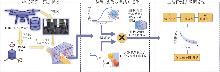
图1
双目外参微调系统的模型框架
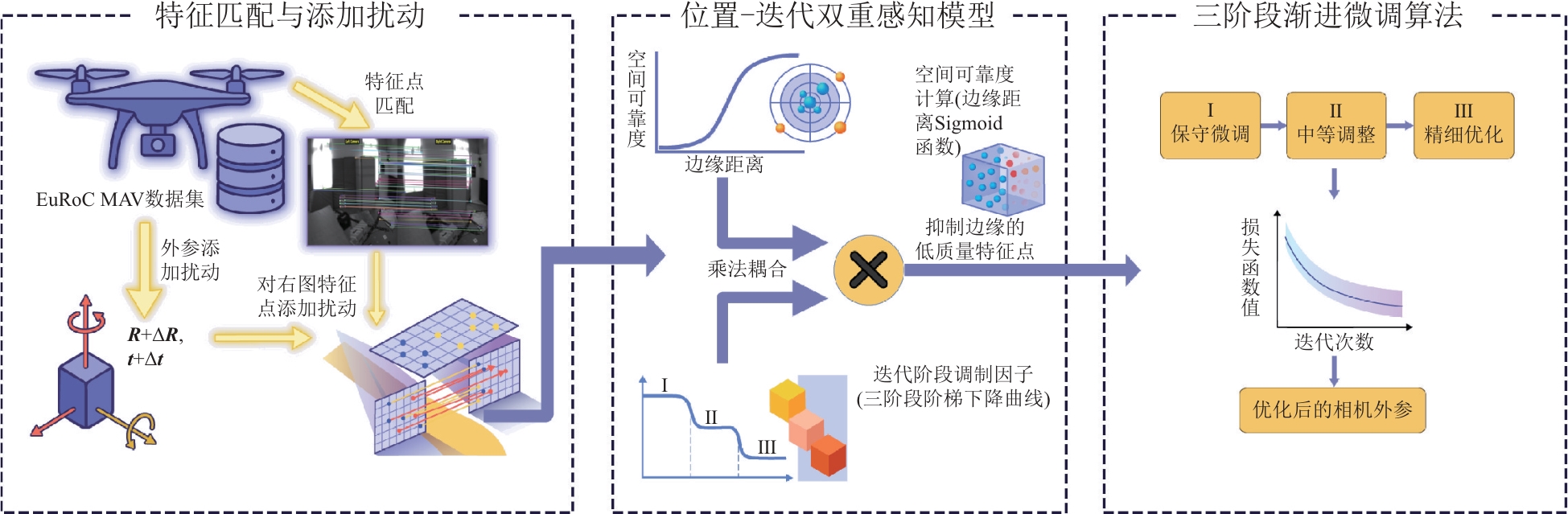
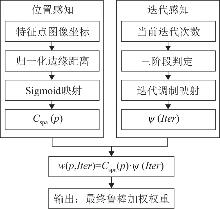
图2
权重模型结构图
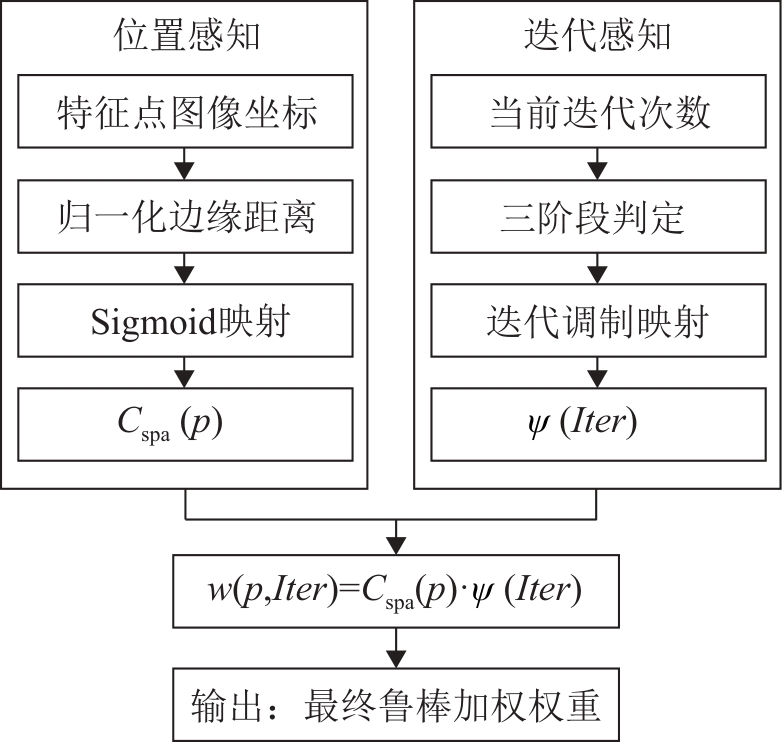
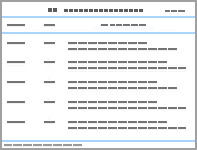
表1
三阶段渐进微调算法
| 阶段 | 迭代范围 | 收敛条件 | |
|---|---|---|---|
| I保守微调 | 0.6 | ||
| II中等调整 | 0.6→0.3 | ||
| III精细优化 | 0 |
图3
三阶段渐进微调算法流程图
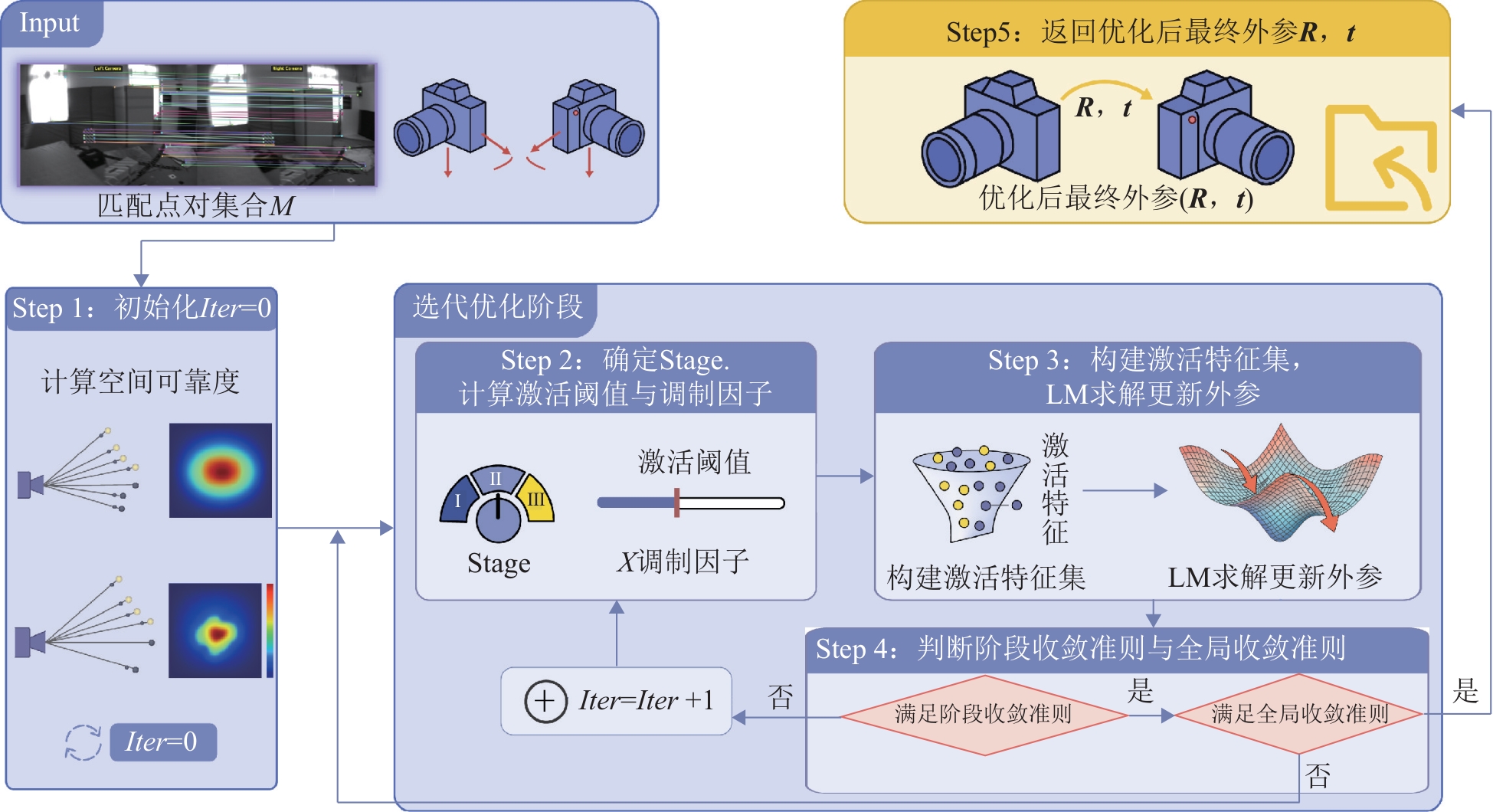
表2
实验中扰动、噪声与异常值的生成方式
| 类型 | 具体描述与参数 |
|---|---|
| 在线微调扰动 | 对双目相机的真实外参施加微小随机扰动,以验证算法的自恢复能力。旋转扰动:随机轴+随机旋转角 |
| 特征点高斯噪声 | 引入蒙特卡罗噪声,模拟图像传感器噪声的标准差 |
| 异常值比例 | 模拟错误匹配的特征点比例为 |
表3
对比方法概述与本文方法的核心区别
| 方法名称 | 核心特点 | 与本文方法的关键区别 |
|---|---|---|
| StandardLM | 标准LM优化,所有观测点单位权重 | 缺乏对异常值和空间异质性的感知 |
| SpatialOnly | 仅基于特征点空间位置分配权重 | 忽略了优化迭代过程中的残差动态变化和迭代阶段的鲁棒性需求 |
| IterativeOnly | 仅根据优化迭代进程动态调整权重 | 忽略了特征点固有的空间可靠性差异,可能导致低质量边缘特征被错误赋高权重 |
| Additive | 空间权重与迭代权重采用加法组合 | 无法实现对异常值和不可靠观测点的有效抑制 |
| 本文 | 基于位置-迭代双重感知,乘法耦合权重 | 通过乘法耦合融合空间可靠度与迭代调制,有效抑制异常。三阶段优化兼顾收敛鲁棒,实现在线微调快速收敛 |
表4
在线微调场景仿真结果
| 方法 | 迭代次数 | ||
|---|---|---|---|
| SpatialOnly | 0.229±0.121 | 1.027 | 28.5±7.8 |
| IterativeOnly | 0.195±0.108 | 0.874 | 25.7±6.9 |
| Additive | 0.162±0.095 | 0.726 | 22.4±5.7 |
| 本文 | 0.134±0.082 | 0.601 | 18.9±4.5 |
表5
场景泛化结果
| 场景 | ||
|---|---|---|
| easy | 0.134 | 0.601 |
| difficult | 0.262 | 1.175 |
表6
消融实验结果
| 变体 | 组件 | ||
|---|---|---|---|
| 完整算法 | 0.134±0.082 | 0.601 | |
| 变体1 | 移除空间加权 | 0.195±0.108 | 0.874 |
| 变体2 | 移除迭代调制 | 0.229±0.121 | 1.027 |
| 变体3 | 乘法→加法 | 0.162±0.095 | 0.726 |
| 变体4 | 仅中心特征 | 0.149±0.088 | 0.668 |
表7
蒙特卡罗结果
| 噪声/像素 | 异常值比例 | 成功率/% | ||
|---|---|---|---|---|
| 0.5 | 0 | 0.134±0.082 | 0.601 | 98 |
| 10 | 0.162±0.095 | 0.726 | 92 | |
| 1.0 | 0 | 0.229±0.121 | 1.027 | 88 |
| 10 | 0.305±0.158 | 1.368 | 82 | |
| 2.0 | 0 | 0.462±0.215 | 2.072 | 75 |
| 10 | 0.669±0.284 | 3.000 | 68 |
表8
各模块单帧耗时
| 模块 | 时间/ms | 占比/% |
|---|---|---|
| 特征匹配 | 12.5 | 53.2 |
| 空间可靠度计算 | 1.2 | 5.1 |
| 权重计算 | 0.8 | 3.4 |
| LM迭代(平均18.9次) | 9 | 38.3 |
表9
时序滤波消融实验
| 方法 | ||
|---|---|---|
| 单帧(无时序) | 0.134 | 0.601 |
| SMA (窗3) | 0.120 | 0.350 |
| SMA (窗5) | 0.197 | 0.370 |
| EMA ( | 0.110 | 0.305 |
| EMA ( | 0.114 | 0.315 |
| 卡尔曼滤波 | 0.181 | 0.342 |
表10
固定参数和自适应参数对比
| 方法 | ||
|---|---|---|
| 固定参数 | 0.134 | 0.601 |
| 自适应参数 | 0.127 | 0.432 |
| [1] | 王若萱, 吴建平, 徐辉. 自动驾驶汽车感知系统仿真的研究及应用综述[J]. 系统仿真学报, 2022, 34(12): 2507-2521. |
| Wang Ruoxuan, Wu Jianping, Xu Hui. Overview of Research and Application on Autonomous Vehicle Oriented Perception System Simulation[J]. Journal of System Simulation, 2022, 34(12): 2507-2521. | |
| [2] | Wang Kunfeng, Zhao Kaichun, Lu Wenshuai, et al. Temperature Drift and Compensation in Stereo Visual Odometry[J]. IEEE Sensors Journal, 2024, 24(23): 39744-39750. |
| [3] | He Zhicheng, Tan Juntao, Lin Zhigui, et al. Online Extrinsic Parameters Calibration of On-board Stereo Cameras Based on Certifiable Optimization[J]. Measurement, 2025, 242: 115911. |
| [4] | 全国汽车标准化技术委员会. 智能网联汽车 组合驾驶辅助系统技术要求及试验方法 第1部分:单车道行驶控制: [S]. 北京: 中国标准出版社, 2024. |
| National Automotive Standardization Technical Committee. Intelligent and Connected Vehicle—Technical Requirements and Testing Methods for Combined Driver Assistance System—Part 1: Single-lane Manoeuvre: [S]. Beijing: Standards Press of China, 2024. | |
| [5] | Ling Yonggen, Shen Shaojie. High-precision Online Markerless Stereo Extrinsic Calibration[C]//2016 IEEE/RSJ International Conference on Intelligent Robots and Systems (IROS). Piscataway: IEEE, 2021: 1771-1778. |
| [6] | Dexheimer E, Peluse P, Chen Jianhui, et al. Information-theoretic Online Multi-camera Extrinsic Calibration[J]. IEEE Robotics and Automation Letters, 2022, 7(2): 4757-4764. |
| [7] | Kanai T, Vasiljevic I, Guizilini V, et al. Robust Self-supervised Extrinsic Self-calibration[C]//2023 IEEE/RSJ International Conference on Intelligent Robots and Systems (IROS). Piscataway: IEEE, 2023: 1932-1939. |
| [8] | Chen Yanshun, Yan Weiqing, Yue Guanghui, et al. Multi-resolution Hybrid Explicit Representation for Novel View Synthesis of Dynamic Scenes[J]. IEEE Transactions on Intelligent Vehicles, 2025, 10(2): 1117-1127. |
| [9] | Zhang Z. A Flexible New Technique for Camera Calibration[J]. IEEE Transactions on Pattern Analysis and Machine Intelligence, 2000, 22(11): 1330-1334. |
| [10] | Heikkila J, Silven O. A Four-step Camera Calibration Procedure with Implicit Image Correction[C]//Proceedings of IEEE Computer Society Conference on Computer Vision and Pattern Recognition. Piscataway: IEEE, 1997: 1106-1112. |
| [11] | Abad Francisco, Camahort Emilio, Vivó Roberto. Camera Calibration Using Two Concentric Circles[C]//Image Analysis and Recognition. Berlin, Heidelberg: Springer Berlin Heidelberg, 2004: 688-696. |
| [12] | Sturm Peter F, Ramalingam S, Tardif J P, et al. Camera Models and Fundamental Concepts Used in Geometric Computer Vision[J]. Foundations and Trends in Computer Graphics and Vision, 2011, 6(1/2): 1-183. |
| [13] | Chen Siyu, Ma Chao, Liu Chao, et al. Feature Selection Based on the Self-calibration of Binocular Camera Extrinsic Parameters[J]. International Journal of Wavelets, Multiresolution and Information Processing, 2024, 22(1): 2350030. |
| [14] | Lepetit Vincent, Moreno-Noguer Francesc, Fua Pascal. EPnP: An Accurate O(n) Solution to the PnP Problem[J]. International Journal of Computer Vision, 2009, 81(2): 155-166. |
| [15] | Kneip Laurent, Li Hongdong, Seo Yongduek. UPnP: An Optimal O(n) Solution to the Absolute Pose Problem with Universal Applicability[C]//Computer Vision-ECCV 2014. Cham: Springer International Publishing, 2014: 127-142. |
| [16] | Li Shiqi, Xu Chi, Xie Ming. A Robust O(n) Solution to the Perspective-n-point Problem[J]. IEEE Transactions on Pattern Analysis and Machine Intelligence, 2012, 34(7): 1444-1450. |
| [17] | 姜丽梅, 陈信威. 动态场景下基于特征点筛选的视觉SLAM算法[J]. 系统仿真学报, 2025, 37(3): 753-762. |
| Jiang Limei, Chen Xinwei. Visual SLAM Algorithm Based on Feature Point Selection in Dynamic Scenes[J]. Journal of System Simulation, 2025, 37(3): 753-762. | |
| [18] | Yi Hao, Liu Bo, Zhao Bin, et al. Outliers Rejection for Robust Camera Pose Estimation Using Graduated Non‐convexity[J]. IET Computer Vision, 2025, 19(1): e12330. |
| [19] | Triggs Bill, McLauchlan P F, Hartley R I, et al. Bundle Adjustment—A Modern Synthesis[C]//Vision Algorithms: Theory and Practice. Berlin, Heidelberg: Springer Berlin Heidelberg, 2000: 298-372. |
| [20] | Yuhai Oleksandr, Cho Yubin, Choi Ahnryul, et al. Enhanced Three-axis Frame and Wand-based Multi-camera Calibration Method Using Adaptive Iteratively Reweighted Least Squares and Comprehensive Error Integration[J]. Photonics, 2024, 11(9): 867. |
| [21] | Xie Qiwei, Long Qian, Li Jianping, et al. Application of Intelligence Binocular Vision Sensor: Mobility Solutions for Automotive Perception System[J]. IEEE Sensors Journal, 2024, 24(5): 5578-5592. |
| [22] | Zhao Liangtian, Xu Xiangmin, Pei Shanshan, et al. Road Surface State Change Detection Based on Binocular Vision for Autonomous Driving System[J]. ACM Transactions on Autonomous and Adaptive Systems, 2025, 20(4): 29. |
| [23] | Xie Qiwei, Hu Xiyuan, Ren Lei, et al. A Binocular Vision Application in IoT: Realtime Trustworthy Road Condition Detection System in Passable Area[J]. IEEE Transactions on Industrial Informatics, 2023, 19(1): 973-983. |
| [1] | 陈有松, 程若发, 刘屹, 张谊, 左志豪. 考虑光热电站与氢能利用的虚拟电厂优化调度[J]. 系统仿真学报, 2026, 38(8): 2179-2196. |
| [2] | 刘兆鹏, 靳凯迪, 刘逊韵, 周东傲, 徐新海. 一种高时效交互仿真时间步长放松方法[J]. 系统仿真学报, 2026, 38(8): 2197-2205. |
| [3] | 靳凯迪, 刘逊韵, 周东傲, 王杨, 刘兆鹏. 大规模作战仿真空间索引技术综述[J]. 系统仿真学报, 2026, 38(8): 2206-2222. |
| [4] | 李芳, 周德雨, 王刚, 刘光军, 胡淇. 多循环嵌套云制造服务生态系统学习演化建模[J]. 系统仿真学报, 2026, 38(8): 2265-2282. |
| [5] | 王政凯, 于轶蓉, 胡青. 基于二维二阶矢量水听器的线谱增强技术[J]. 系统仿真学报, 2026, 38(8): 2312-2323. |
| [6] | 崔浩浩, 邸彦强, 刘青, 孟宪国. 多视图几何约束下的大场景三维高斯重建[J]. 系统仿真学报, 2026, 38(8): 2353-2363. |
| [7] | 李庚鹏, 蔡伟, 杨志勇, 张志利, 王晓伟. 偏振图像仿真技术的演进与展望[J]. 系统仿真学报, 2026, 38(7): 1783-1800. |
| [8] | 钱名军, 尹超, 黄志文, 王全能. 基于级联失效的“一带一路”复合运输网络脆弱性仿真研究[J]. 系统仿真学报, 2026, 38(7): 1801-1814. |
| [9] | 朱烨雷, 沈寿林, 朱江, 闻传花. 一种面向智能无人机集群作战的多尺度建模方法[J]. 系统仿真学报, 2026, 38(7): 1849-1869. |
| [10] | 刘亚, 张照允, 安成, 郑灿广. 薄煤层数字孪生综采工作面安全监测体系研究[J]. 系统仿真学报, 2026, 38(7): 1922-1934. |
| [11] | 杨永琪, 王聪, 张宏立, 马萍, 孟月, 周天浩. 基于自适应时空图神经网络的居民区净负荷预测[J]. 系统仿真学报, 2026, 38(7): 2007-2019. |
| [12] | 李金蔚, 刘晓阳, 鞠儒生. 面向跨模态理解的时序行为定位方法研究[J]. 系统仿真学报, 2026, 38(7): 2053-2067. |
| [13] | 张佳丽, 刘海平, 蒋勤升, 党思娜. 基于有限元热分析的主轴对流换热参数优化[J]. 系统仿真学报, 2026, 38(7): 2082-2090. |
| [14] | 郭肇禄, 刘千辉. 面向低并发设备的矿山边缘计算任务卸载仿真与优化[J]. 系统仿真学报, 2026, 38(7): 2091-2104. |
| [15] | 李明辉, 高道祥. 基于强化学习的桥式起重机输出反馈控制研究[J]. 系统仿真学报, 2026, 38(6): 1771-1781. |
| 阅读次数 | ||||||
|
全文 |
|
|||||
|
摘要 |
|
|||||
 http://www.china-simulation.com

